
 Courtesy Virginia Currents
In 1937, Rosa “Garnet” Williams wrote about “The Claiborne Home” for the Virginia Historical Survey. Her description located the dwelling 5.1 miles south of Arvonia, on Highway 15, “thence .2 mile on private road.”
In the 1840s, the house was owned by John T. “Jack” Claiborne and was the site of Claiborne’s school, Oak Grove Academy. In the 1860s, “Parson” Tom Hall owned the house, to be followed by Dr. Fredric Boatwright, President of Richmond College. In 1937, Mrs. Williams described the structure:
The house is beautifully located in a very large field about 100 yards from the highway. The building consists of six rooms, and a full size basement, two long halls, and a small two story front porch…. The corner posts were all hewn out of large trees and the floors are of the wide type, original timbers. There are very large brick chimneys on either end of the house, the bricks being thought to have been made on the place.
As with so many antebellum dwellings in Buckingham County, these bricks were likely made by enslaved African Americans.

Buckingham County, 1850 Census, Oak Grove Academy
Across two decades, John T. Claiborne operated Oak Grove Academy in the northeastern corner of Buckingham County. In 1850, the following advertisement ran in the Richmond Enquirer:
OAK GROVE ACADEMY
The exercises of this School (situated near the Female Collegiate Institute, on the road leading from New Canton to Buckingham Court House.) will resume on the 13th of January next, and terminate on the 13th of November following. The course of instruction embraces the common English branches, Latin, and first branches of Mathematics. The subscriber, grateful for the confidence heretofore reposed in him, respectfully solicits a continuation of the patronage of his former friends and the public generally, and pledges himself that no pains will be spared in the morals and mental culture of those entrusted to his charge.
Terms —For Board and Tuition per session of 10 months $100.
JOHN T. CLAIBORNE.
Address Gravel Hill Post Office, Buckingham county, Virginia.
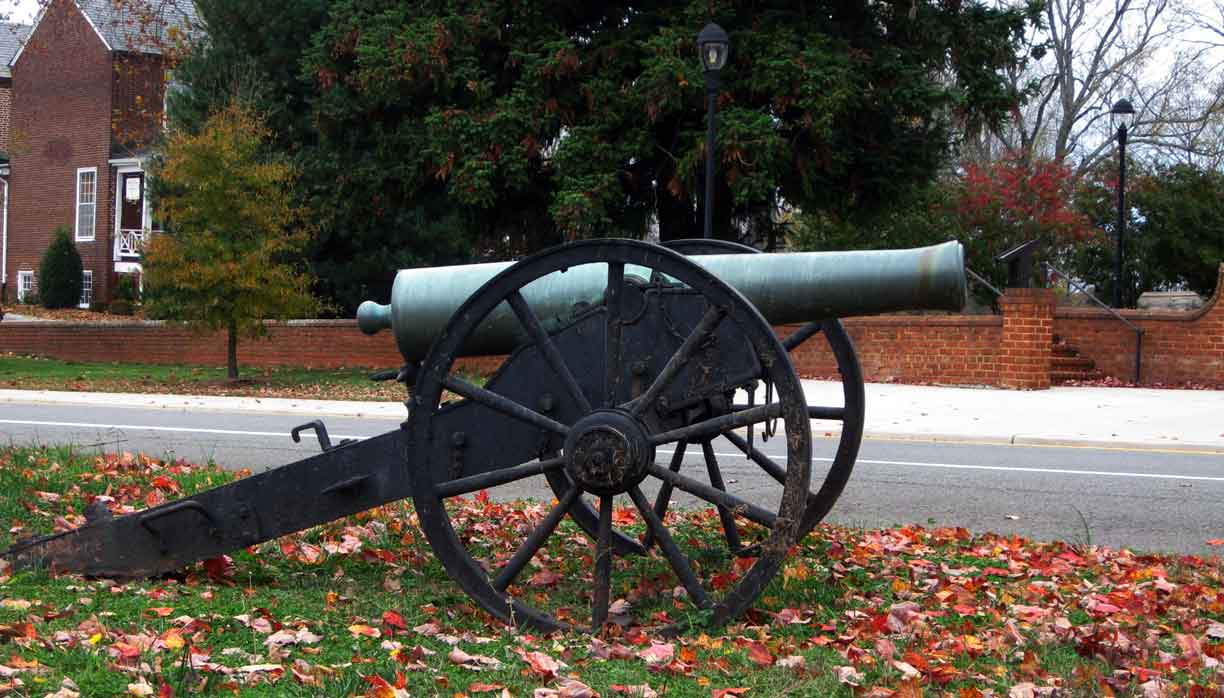
History is full of irony and Buckingham County is no exception. One Slate River Rambling reader has informed me that the cannons in front of Buckingham Courthouse originally belonged to the Yankees!
When myriad monuments were erected after the Civil War, the Federal Government apparently sold or donated countless stockpiled cannons to memorial sites across the country. Sitting in front of the courthouse, next to Buckingham County’s Confederate monument, are two artillery pieces. Both are 12-pounder Napoleons, commonly used during the war. Both were manufactured in Boston, Massachusetts by the Revere Copper Co. One was made in September of 1862 and the second one was made in May of 1863. The dates are based on the guns’ serial numbers.
Did those involved in the erection of Buckingham County’s Confederate monument realize they were placing Yankee artillery at the memorial

Tandy Holman. Courtesy Harry Stuart Holman.
From time to time, Slate River Ramblings will highlight Buckingham County Genealogy – the handmaiden to social history and biography.
Recently, Harry S. Holman completed and published the 3rd edition of his book, The Holmans of Virginia. In it, Mr. Holman goes far beyond a list of names and dates, including, in many cases, lengthy biographies. A significant number of Holmans resided in Buckingham (and immediate environs, such as Fluvanna and Cumberland counties) and intermarried with other well-established Buckingham County families, including: Allen, Ayres, Chambers, Ford, Hooper, Miller, Moseley, Shepard, Smith, Winfrey, Woodson, etc.

The volume is also richly illustrated. Copies are still available. Send inquires to Harry Holman at holmanhs321@gmail.com.

On June 20, 1945, the Richmond Times-Dispatch reported: “POW Escapees Surrender to War Vet.”
Three German prisoners of war who escaped Monday from the Green Hay work project on Route 480, near Farmville, surrendered yesterday morning to a wounded war veteran 24 miles west of Farmville on Route 60 near Sprouse’s Corner, after being trailed through underbrush by bloodhounds.
The prisoners, Johann Nowak, Friedrich Matousek, and Alfred Fruch, surrendered to Private First Class Stuart T. Adams of Red Oak who turned them over to Buckingham County Sheriff Y.G. Johnson.
These prisoners may have been from Camp Pickett near Blackstone or from the White Hall area of Albemarle. In both locales, camps originally built by the Civilian Conservation Corps (CCC) housed German POWs.
Know any more about the story? Please comment here or write to me at jlyeck@gmail.com.

When Bill Davidson saw his family’s “Davidson Orchard” included on the Caryswood Centennial Map, he commented that his family once owned over 5,000 acres there and added, “I recently learned that during World War II, some German prisoners of war were brought in to help with the work on the orchard.”
Coincidentally, I recently learned that in February of 1944 it was announced that approximately 250 German POWs would be held in western Albemarle County at White Hall. They would be housed in the camp built in 1933 by the Civilian Conservation Corps (CCC) and work in the vicinity as agricultural laborers, picking apples and peaches. Surely, Davidson Orchard was not the only farm in Buckingham to utilize the Germans POWs.
Does anyone know of other Buckingham farms where the German prisoners worked?
Coming Next: Three German Prisoners Escape

Currently, the 19th century house pictured above is for sale in Buckingham County. Located at 274 Fitzpatrick Road, one real estate listing describes it as “A Diamond in the rough!!”
The listing goes on to say:
This manor style home has been well loved and has great history behind her! Some believe the property to be on old burial grounds . . . . and the house has been known to be haunted . . . however [by] a kind spirit . . .
Does anyone recognize the house? Know its history? Any details about the ghost . . . ?

Plantation life in Buckingham County before emancipation was a complex structure historians are just beginning to understand as we address that complexity through individual stories. As we study the institution of slavery by looking at the interweaving of families and farms, myths and generalizations are transformed into biography and social history.
Historian and author Dianne Swann-Wright was extremely fortunate to discover surviving documents from Caryswood where her families lived and worked in the 19th century. Her book, A Way out of No Way, follows her Swanns, Woodsons, and other families from slavery to emancipation. It is a privileged look into one of Buckingham County’s myriad microcosms.
Read more about her book at University of Virginia Press.
 This charming map was enclosed in the invitation to the Caryswood Centennial. Bessie Page Trent (1871–1956), Kate Trent (1900–1987), and Page Trent Bird (1902–1994) hosted the birthday bash on Saturday, August 15, 1953.
According to the invitation, “Caryswood is a part of the original Cary tract, comprising thirty-eight thousand acres, of which eleven thousand were in Buckingham County, inherited by Colonel Archibald Cary (1721–1786) from his father, Henry Cary (1650–1749) and bequeathed to his daughter and son-in-law in 1787.”
For previous posts about the Cary family see:

Courtesy Virginia Department of Historic Resources
In 1953, the Trent family celebrated the centennial of this handsome dwelling house at Caryswood. In 1991, it was added to the Virginia Landmarks Register. In 2007, it was nominated to the National Register of Historic Places and the farm was described as follows:
In 1853 … Edward Trent Page inherited 836 acres including the plantation house, and renamed it Caryswood. He married Elizabeth Coupland Nicholas (1834-1897) of Seven Islands plantation. In 1904 Caryswood was divided among four children: Edward Trent Page, Jr., Mary Haynes, John Page, and Bessie Trent. The house and surrounding 168 acres going to Bessie and her husband John Gannaway Trent (1868-1934). In 1934 the farm was inherited by their daughters: Kate Gannaway Trent, and Elizabeth Coupland Page Trent who married Branch Bird of Idaho. By 1991 the acreage was mostly restored and stood at more than 700 acres. The owner at that time was Mrs. Branch Bird, Elizabeth Coupland Page Trent, a descendant of the original Cary family. Many of the furnishings at Caryswood are from homes with Page or Cary associations such as: Rosewell, Berkeley, Seven Islands, and Union Hill.
For more about Seven Islands click here.
Coming next: The Caryswood Centennial


 slate river ramblings . . . .