Twenty years ago, this month, the enthusiastic members of the Town of Dillwyn Historic Committee produced “A Pictorial History of the Town of Dillwyn, Virginia.”
Located just north of Highway 60, the Town of Dillwyn has roots in a spot originally called Rosney, a “small industrial center” which contained a post office, a general store, the Rosney Mining Company, and Rosney Iron and Lumber Co. Highway 15 runs through the town, north to New Canton and the James River, south to Farmville. See the detail map: Central Buckingham County.
For many years, Dillwyn was also known as White Hall or Whitehall. By 1881, and perhaps before, Dillwyn was the official post office for the town we know today. Robert B. Allen was postmaster, followed by Dillwyn Smith in February of 1882. Joshua Davis succeeded him and, in August of 1893, Hamden M. White became postmaster.
Is he H.M. White, one of the two men behind the name White Hall?
During 2012, Dillwyn celebrated its 100th anniversary and tidbits of its history appeared in the Buckingham Beacon. You can find them online at Fluvanna Review.
Martha Louis’ introductory article appeared in the February-March 2012 issue.
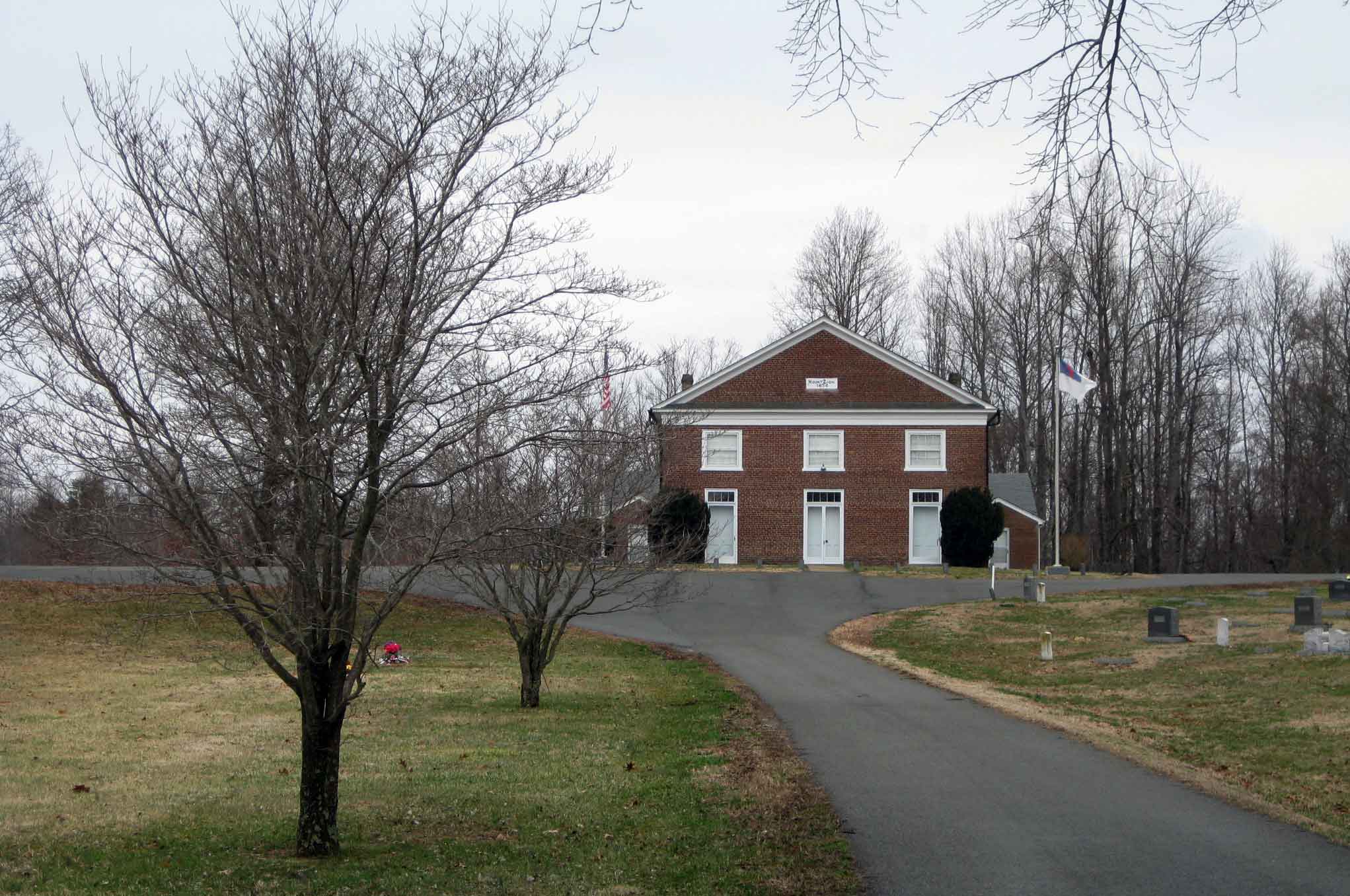
Photo by Joanne L. Yeck
This coming Sunday, May 19th, memorial services will be held at Buckingham County’s Mt. Zion Baptist Church cemetery honoring two Confederate soldiers.
One is Private John Randolph Phillips, of Co. C, 44th Va. Infantry (Buckingham County’s Travis Rifles) and later, Co. K, 4th Virginia Cavalry. Born in 1842, Phillips was mortally wounded on September 28, 1864. His father, Richard Phillips, and his oldest sister, America, traveled to Waynesboro to bring him back to Buckingham County to die at home. His obituary began…
Died on the 9th October 1864 Mr. John R. Phillips oldest son of Richard Phillips, Esq. of Fluvanna County, Virginia, and member of Company K, 4th Virginia Cavalry, of a wound from a ball through the right lung received in the gallant charge at Waynesboro on the 28th September.
He was the grandson of Private Randolph Phillips who served during the War of 1812 with the 4th Regiment of Virginia Militia.
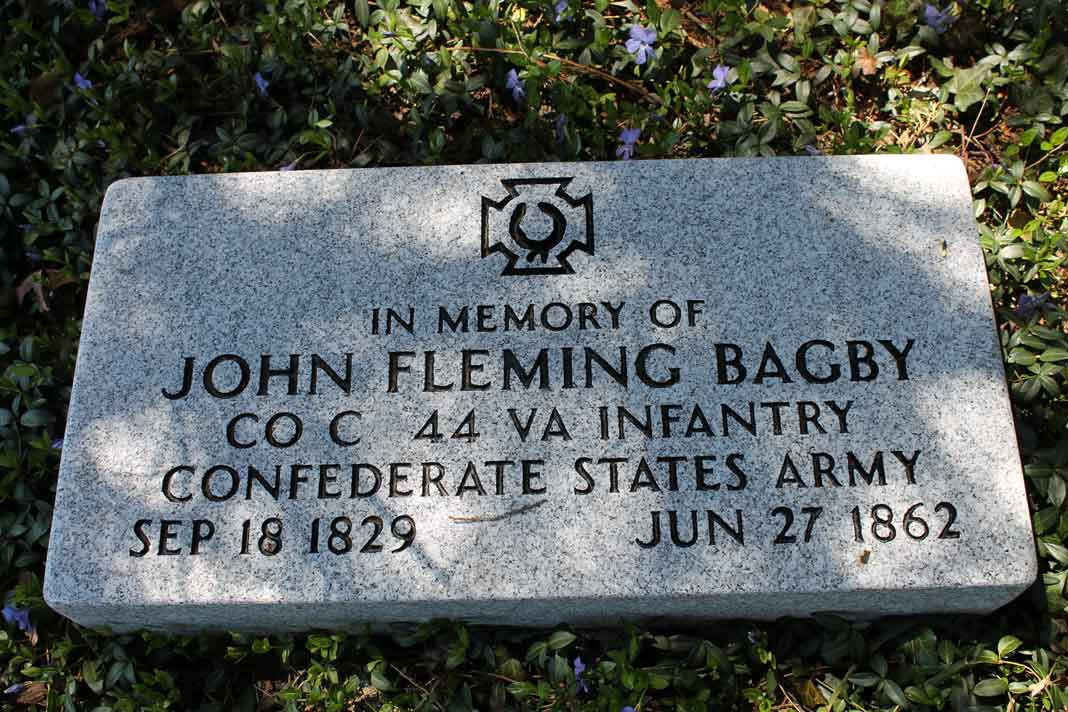
Photo by Linda Doerger
The other soldier to be honored, also of Co. C., 44th Va. Infantry (Buckingham County’s Travis Rifles), is Sergeant John Fleming Bagby. Born in 1829, he was killed at the battle of Gaines Mill on June 27, 1862. Originally, Bagby was buried near Gaines Mill. It is unknown if he was re-interned at Mt. Zion; however, a stone has been placed there, in his honor, in the Bagby plot.
For those wishing to attend, the service will be held Sunday, May 19, 2013 at 4:00 p.m.
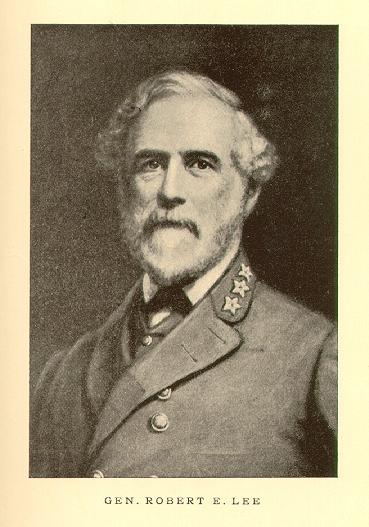
Among the stories connecting Robert E. Lee with Buckingham County is the one preserved by Rosa “Garnet” Williams. In her 1937 survey for the Virginia Historical Inventory, Mrs. Williams described Dorcus Allen’s memory of feeding General Lee after the surrender at Appomattox. (See May 8th post for more details.)
One Slate River Ramblings reader pointed out some flaws in this Buckingham Tale. Despite the story’s charm, General Lee did not go to Richmond by way of New Canton in order to “catch the boat.” He rode his horse all the way to Richmond from Appomattox/Buckingham, spending the night in the yard of his brother in Powhatan County. Furthermore, the canal at New Canton had been severely damaged the previous March during General Sheridan’s raid, making catching a boat difficult if not impossible.
Oral histories are often laced with exaggeration or wishful thinking or blended tales. It is still possible that Dorcus Allen fed the General on his way through Buckingham to Powhatan County. Can anyone provide the specifics of the General’s route? Could he have ridden by the old Atkinson place, about two miles southeast of Gold Hill?
Coming soon: General Lee stops at William P. Sheppard’s home.

The Road to Snowden, Photo by Joanne L. Yeck
By now, most of you are aware that Thomas Jefferson had a much younger brother, Randolph, and that he lived his entire adult life in Buckingham County at his plantation, Snowden. His 2,000 acre patrimony sat at the tip of the Horseshoe Bend, directly across from what is today Scottsville.
Many of you have heard me speak about Randolph Jefferson and have read The Jefferson Brothers (Slate River Press, 2012). If you are hungry for more about the President’s brother, consider reading my profile in the 2011 issue of the Magazine of Albemarle County History. The article, “A Most Valuable Citizen,” expands on Randolph Jefferson’s personality and character, including a discussion of the paternity of Eston Hemings, Sally Hemings’ last child. At the time of Eston’s birth, there were two dozen Jeffersons who might have been Eston’s father, including Thomas, Randolph, and Randolph’s oldest sons.

The magazine is available online from the Albemarle Charlottesville Historical Society: Society Store

This month, the image on the 2013 Historic Buckingham Calendar reveals that Hollywood movies were projected at the Arvonia High School. Was this a regular occurrence?
During the Golden Age of Hollywood, if you lived in northern Buckingham, you could patronize Victory Hall in Scottsville. For more visit Scottsville Museum’s tribute to the theater at Victory Hall.
If you lived in southeastern Buckingham, you could drive to the State Theatre in Farmville. Learn more about it at Cinema Treasures.

Mid-20th century, the Dillwyn Movie Theater was operated by the iron-fisted Mrs. Ponton. You can read more about it in Martha Louis’ article, “The Dillwyn Movie Theater,” in the July 6–August 2, 2012 issue of the Buckingham Beacon.
If you have stories about going to the movies in Buckingham County, please comment here or write to me at jlyeck@gmail.com.
Remember, if you don’t live in or near Buckingham, you can always purchase your Historic Buckingham calendar by mail. For details see Historic Buckingham’s website: Items For Sale.
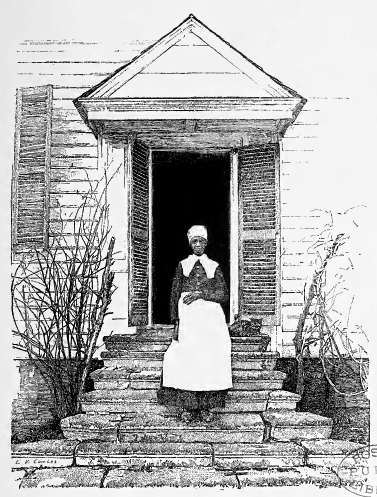
“A Typical Mammy,” by Genevieve Cowles and Maude Cowels
In 1937, Garnet Williams surveyed the old Atkinson home site. The house, located two miles southeast of Gold Hill, burned in 1925 and was also known as “the Cole place.” In her survey, Mrs. Williams related the following story:
General Robert E. Lee, after the surrender, left Appomattox and marched through Buckingham. A part of his staff and many of his men were with him, his men stopping off as they would reach their homes. About night fall they reached the farm of William P. Sheppard. It was here he pitched his camp, the last night he ever spent with any of his men in camp. The next morning he marched on to New Canton to catch the boat for Richmond, stopping to rest near the home of Robert Atkinson, who went out and invited him to have lunch with his family, and he very readily accepted. Dorcas Allen, a servant in the home prepared the lunch, which consisted of ham, eggs, pear preserves and hot biscuits. “Old Aunt Dorcas” talked of this as long as she lived, and considered it one of the happiest hours of her life.
In 1870, a Dorcas Allen was living in Prince Edward County with her husband, Henry. She was thirty-eight years old. Is she the woman who feed General Lee? If anyone knows more about her life or her family, please comment or write to me at jlyeck@gmail.com.

On February 3, 1937, Elizabeth McCraw surveyed the Frank McCraw graveyard. She described it at being located “.5 mile north of Andersonville on Route #638; thence .5 mile west in body of pine woods.”
The McCraw burying ground at “Elysian Grove”, a pre-Revolutionary estate, now owned by the heirs of Richard Morgan, is back of the house in a dense body of pines. There are eight or ten graves here, sunken and neglected. Tho the grave is not marked, the one of Frank McCraw, pioneer settler of that name in Buckingham and teacher of Peter Francisco, is here. A tree as large as a man’s body is growing in the center of this grave. Only one marker could be found; that of a Confederate soldier who died of fever while with Jackson on his “March to Romney”.
In Memory of
R.M. McCraw
Born in Buckingham Co., Va.
Nov. 14, 1841
Died Jan. 15, 1862

Sorting out the Elizabeth McCraws has been a challenge, especially untangling concurrent individuals with the same name!
Thanks to several cousins, we have isolated the Elizabeth McCraw who worked for the WPA and contributed to the Virginia Historical Inventory.
Our chronicler of Buckingham County history was born Elizabeth B. Watts. She first married Richard Miller McCraw, son of William “Emmett” McCraw and Elizabeth “Bettie” Gilliam. Later, Elizabeth married Van Gilliam and her third husband was James P. McCraw. In 1930, just prior to her years as a WPA fieldworker, Elizabeth (age 38) lived in Farmville, Prince Edward County with her husband, Richard Miller McCraw (age 61), and their son, Richard Miller McCraw, Jr. (age 2).
She has been confused with Elizabeth “Bessie” Edmonia McCraw (7 February 1888–20 January 1941), the daughter of Emmett and Bettie McCraw. Bessie was the sister-in-law of Elizabeth B. (Watts) McCraw. In 1920, Bessie (age 31) remained unmarried, living with her parents and her bachelor brother, Richard Miller McCraw. She was a trained nurse, Richard was a traveling salesman, and their sister, Louise Harrison McCraw, taught in the grammar school. Later, Louise moved to Richmond, where she helped establish the Braille Circulating Library; she also wrote and published thirteen religious novels.
The McCraw family had deep Buckingham roots, offering many connections for Elizabeth B. (Watts) McCraw to help with her fieldwork. The McCraw homeplace, The Pines, was at Andersonville, the address Mrs. McCraw gave on her surveys. Richard Miller McCraw died in 1931, leaving Elizabeth a widow in a deepening Depression. Perhaps, by 1936–37 when she was hired by the WPA, she had left Farmville and was living at The Pines with her in-laws. Her job with the WPA surely gave her family some much appreciated income. Her contribution to Buckingham County history continues to be appreciated today.
Coming Next: Elizabeth McCraw’s poignant tribute to her husband’s family

James Nimmo Ellis
James Nimmo Ellis (1863-1931) was born in Buckingham County on March 6, 1863. His parents were Richard Skelton Ellis of Richmond and Anne Fearn Perkins of “Solitude,” Buckingham County. His great-grandfather was Dr. William Perkins.
Ellis grew up at “Afton” and attended Slate River Academy, eventually leaving Buckingham to attend the University of Nashville and receive his M.D. from the Medical College of Virginia in 1889. From 1889-1896, he practiced medicine in Richmond, Virginia, at the Medical College of Virginia and the University College of Medicine. He studied in Vienna, Berlin, London, and Paris. In 1889, Ellis was elected a fellow of the Medical Society of Virginia and, eventually, married Miss Leila Venable of Atlanta, Georgia.
From Slate River Academy to studying in European capitals is quite a narrative arc! Today, his personal papers are collected at Emory University in Atlanta.
Ellis’ presence at Slate River Academy c. 1875 indicates it survived the Civil War and was still operating well into the 1870s. Currently, it is unknown when Slate River Academy closed; however, the rise of public education in Virginia during the 1870s decreased the need for so many regional, private schools.
If you know of other graduates of Slate River Academy and/or have knowledge about the final days of the school, please write to me here or at jlyeck@gmail.com.
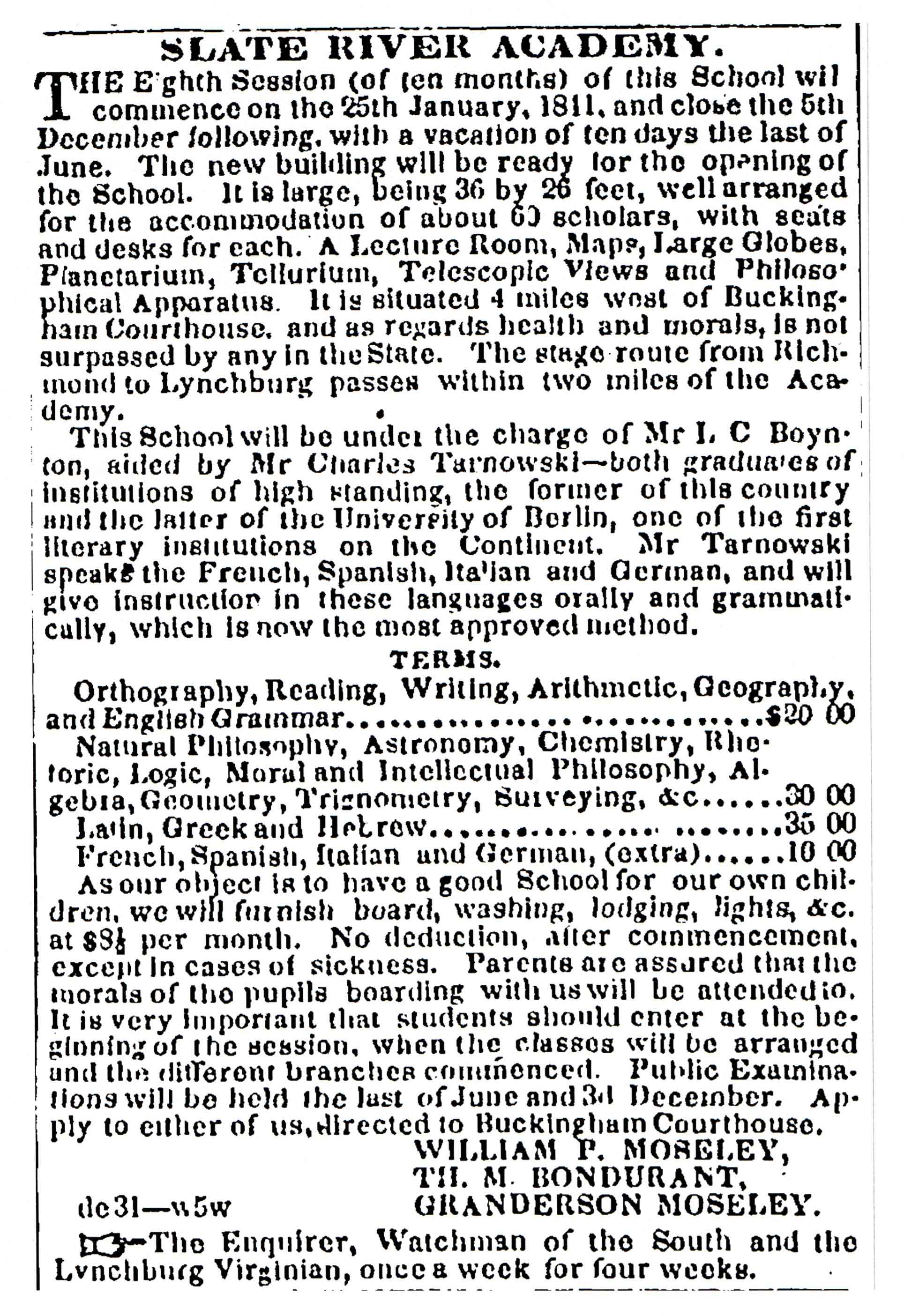
In 1841, several of Buckingham County’s schools and academies advertised in the Richmond Whig. Among them was Slate River Academy. The advertisement also ran in Richmond’s Enquirer, the Watchman of the South (a Presbyterian newspaper) and the Lynchburg Virginian. The trustees of Slate River Academy were William Perkins Moseley, Thomas Moseley Bondurant, and Grandison Moseley, a prominent member of Maysville Presbyterian Church.
Though Slate River Academy was not incorporated until 1839, 1841 marked the school’s eighth session. Mr. L.C. Boynton was the principle teacher, with Mr. Charles Tarnowski assisting. By 1850, William B. Shepard had taken over as the principle teacher and was living with Grandison Moseley and his large family.
An 1850 advertisement for the Academy stated, “The location is most healthy and in every way desirable, and very accessible, being four miles west of Buckingham Court House, immediately on the road leading from that place to Hardwicksville (later Winginia) on the James River Canal.”
Interested in learning more about other schools and academies in Buckingham County? Use the search box in the right hand column. You’ll discover previous posts about Seven Islands School, Humanity Hall Academy, etc.


 slate river ramblings . . . .