
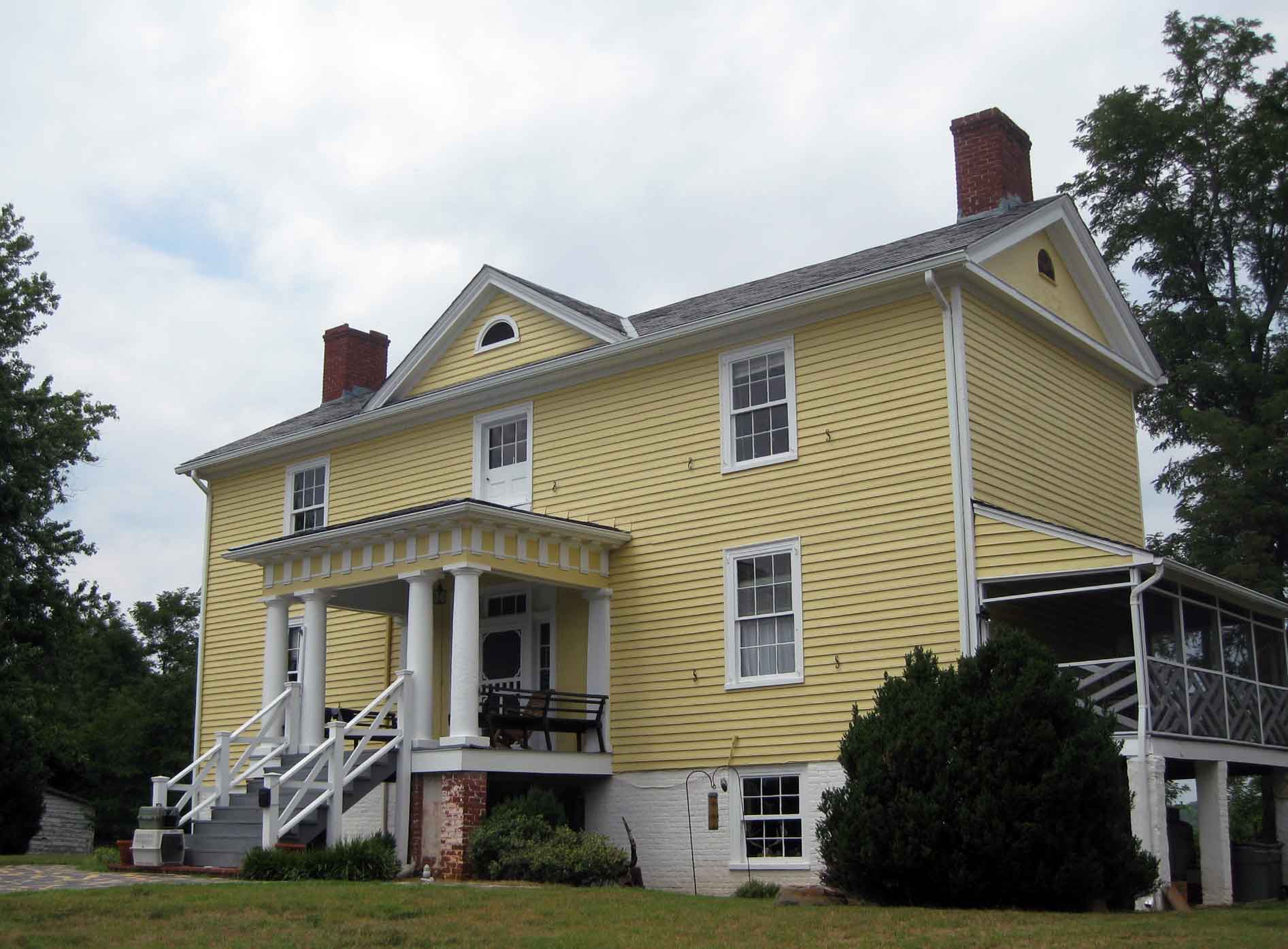
Seven Islands (2010), Photo by Joanne Yeck

Not all of Buckingham County’s private academies closed as a result of the Civil War.
Seven Islands School survived as indicated by this advertisement placed in the Richmond Whig on August 7, 1866.
One Buckingham cousin attended school there as young boy from roughly 1898 to 1900. At that time, Seven Islands a very crowded place. About a dozen members of the extended Nicholas family lived there.
The school was confined to the English basement of the Nicholas home. In 1900, Philip Ambler, born 1834, was still teaching classes.

New Store Presbyterian Church (Courtesy Historic Buckingham)
In 1854, the nineteen Buckingham churches mentioned in Thomas Baldwin’s Gazetteer of the United States included New Store Presbyterian founded in 1844 and located in, of course, New Store.
In 1937, Elizabeth McCraw surveyed the church for the Virginia Historical Inventory:
This is a conventional type country church built in a grove of large oak trees, surrounded by a large level yard, far enough from the highway for quiet, and close enough for convenience. ..
New Store Presbyterian Church was organized in 1844, but it had functioned as a free church some years before this. Some changes have been made in the church since the War Between the State. Closing the back entrance where the slaves entered the galleries is one change.
There is in the church a very handsome illustrated Bible, given to the church some years ago by Christian McKinney, oldest son of former Governor P.W. McKinney in memory of his mother, Nannie Christian McKinney. . . The Bible contains a good many family records.
There is a comparatively new cemetery in the side yard.
For the detail map featuring New Store see 31 January 2013.
This marks the halfway point in identifying the nineteen churches mentioned in Thomas Baldwin’s Gazetteer of the United States (1854). To catch up on previous posts, search “churches” using the search box at Slate River Ramblings.

Many of us are interested or involved in DNA projects involving Buckingham surnames. Projects I follow include Chambers, Harris, Holman, and Bondurant. If you haven’t considered DNA research, take a look at this Bondurant sample site. http://www.worldfamilies.net/surnames/bondurant
Last month, Bill Davidson commented on the on-going success of the Davidson DNA project:
The six or seven members of my overall Davidson family who have taken the Y chromosome DNA test have been “combined” into DNA “Family 10″ at http://www.davidsongenes.org (which uses Family Tree DNA to do the actual testing). My family included the Edward (who was once a constable in Buckingham Co., VA), David, William (William, Senior, but perhaps not William, Junior….see more below) and Charles Davidson (who was a son of Edward) who all appeared on the 1764 Buckingham tithe list. There was also yet a third William Davidson on that tithe list, and he was shown in the home of David Davidson….and I suspect that he was an adult son of David Davidson.
DNA testing shows, however, that some members of the unrelated DNA “Family 7″ Davidson/Davison family also eventually lived in Buckingham (apparently by around 1793). The John Davidson who appeared on the 1810 Buckingham census was an apparent member of DNA “Family 7,” as was the Stephen Davidson who married Lucy Neighbours, and the Josiah Davidson who married “Sukey” Hughes. DNA “Family 7″ had come to Bedford Co., VA from PA by the 1770s, and they “spread-out” from there…
So….the above are just some of the dozen or so unrelated Davidson/Davison/Davisson families that were in all of Virginia in the 1700s and 1800s. Without DNA testing, much of the above would not be known with any certainty (if known at all). I cannot imagine anyone who is truly interested in genealogy not taking advantage of DNA testing, where possible. Such testing will certainly not provide “all of the answers”….and it is essentially useless if not combined with excellent “conventional research”….but it has already done a tremendous job at disclosing many errors and “wrong guesses.” ….
For Bill Davidson’s complete comment, see the post on February 20, 2013: “Buckingham Notables: William Diuguid, Jr.”

Buckingham Female Collegiate Institute
Among the Buckingham County-related manuscripts held at the Library of Virginia is a speech given in 1937 entitled “The Contribution of Buckingham [County] to the Confederacy.” Delivered before the United Daughters of the Confederacy, the manuscript is unsigned and attributed to William Shepard.
In it, Shepard is candid about the state of public education in Buckingham as it entered the Civil War. “The outlay of public funds for education, or free schools as they were contemptuously called, was the magnificent sum of $480 per year.” Yet private education was supported by the landed gentry. In addition to Buckingham Female Collegiate Institute, Shepard mentions Physic Springs Academy for Boys and Maysville High School for Girls. The High School offered a ten month session. The Classical curriculum was provided for $30.00, Music for $25.00, English curriculum for $20.00, and board at the school was an additional $120.00.
The county also maintained the Buckingham Literary Academy, a sort of Literary Society. According to Shepard, it was organized by William Evans who lived at Merioneth at the south-eastern end of Willis’ Mountain. The Literary Academy assembled regularly “in various parts of the county for the purpose of discussing books, current topics and poetry.”
He closed this part of his speech saying, “At the conclusion of the formal affairs of these organizations, brandy of local manufacture was usually served to assist the assembled guest[s] to digest some of the indigestible prose and poetry of local authors.” This would not have included the very popular prose of William Evans’ grandson, Dr. George W. Bagby!
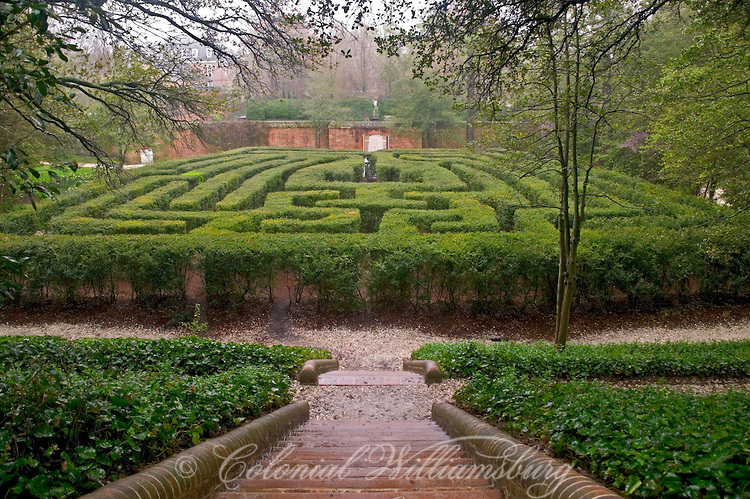
Governor’s Palace Garden and boxwood maze during a Spring rain.
Colonial Williamsburg, Williamsburg, Virginia. Photo by David M. Doody.
In response to the March 5th post, I was reminded that one of the largest collections of boxwood to go to Colonial Williamsburg came from Avon Hill in Nelson County, about a mile upriver from Howardsville, in sight of Buckingham County across the James River.
Avon Hill had been in the Lewis family for many generations and, in 1936, Annie Lee Harrower wrote this for the Virginia Historical Inventory: “The large yard [at Avon Hill] was famed for its boxwood. The Lewis’ shipped over $5,000.00 worth to Williamsburg several years ago.” In 2003, William Giannini (a local resident) and John Moore, a Lewis descendant, both attested to the fact that the Williamsburg Foundation purchased several railroad flat car loads of boxwood from Avon Hill to be planted at the restored Williamsburg in the late 1920’s.
That’s a lot of boxwood!
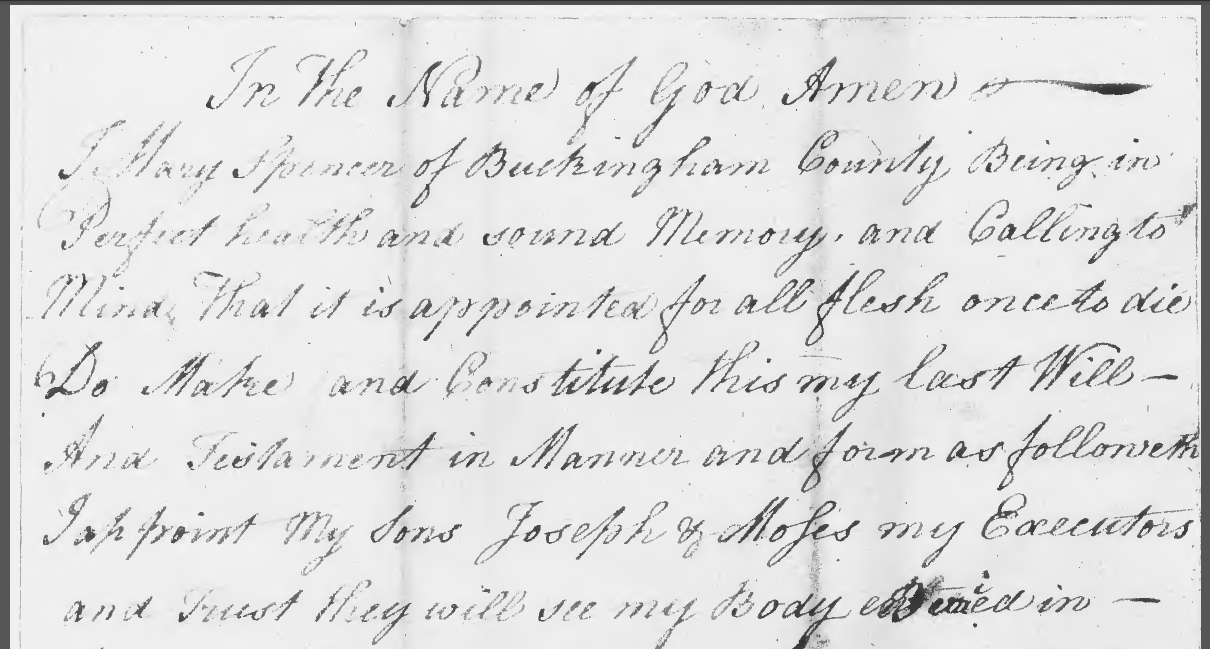
Coz. Harry reports that he hit Buckingham gold yesterday when he followed the Library of Virginia’s link to the digital collection of “Lost Records.” The result was a new Buckingham ancestor, Mary Spencer (d. 1783), mother of Moses Spencer (d. 1829). Congratulations! Above is the opening of her last will.
Once more, here’s the link. It’s worth a look. Just ask Coz. Harry!

Despite the loss of virtually all of the Buckingham Courthouse records prior to 1869, many wills and deeds were rerecorded in the months following the devastating fire. My ancestor George Chambers’ 1846 will is a good example. Given up for lost, it is one of the first wills rerecorded post-fire, as is the November 18, 1856 deed between my ancestor John M. Harris and his wife, Harriet (Tate), and Henry St. George Harris. This deed transferred a large part of Harris’ Sharps Creek plantation to his nephew who would become a leading figure in Buckingham County in the coming years. In fact, on March 11, 1869, Henry St. George Harris and John C. Turner were named as two of the commissioners who would develop plans for a new courthouse. Interestingly, Turner would eventually win the bid to construct the new building.
Moral of the story: Be sure to check the deed and will indexes for Buckingham County. You just might find a very valuable pre-1869 document.
Also take a moment to look at the Library of Virginia’s digital collection of “Lost Records.” I got lucky and found two wills I’d given up for lost. Click on the link below and click again on Buckingham.
Lost Records Localities Digital Collection
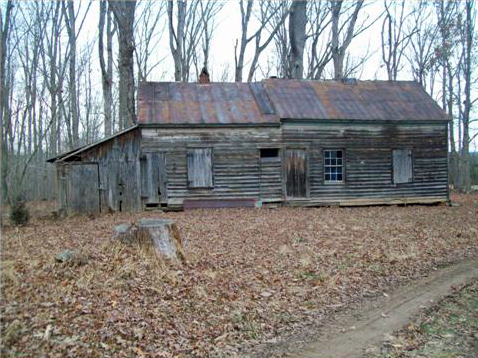
Malone School (2013), Photo by Bessie Clements
Alberta Anderson Caldwell and Martha Anderson Rollings recorded their memories of the Malone School. Dr. Powell Anderson shared them with Bessie Clements who shared them with me.
The ladies recalled that, in 1862, their ancestor, Richard Malone, bought Rose Hill; then, he built a store to “supply that area” and opened a post office. Later, “he gave the land and built a one-room log school for the children in that community.” On Sunday afternoons, at 2:00 p.m., Grandpa Malone held a Sunday School (Christadelphian) in the humble structure.
In 1867 or 1868, their father, Charles Hutson Anderson (b.1861), attended Malone School. “After Daddy finished at the log school, he walked to Cousin Emmet McCraw’s above Andersonville and was tutored for two additional years. I remember his talking about walking through snow and rain four miles each way unless the snow was too deep. He rode the horse sometimes.” In 1888, C.H. Anderson married Ella Spencer and they lived at Rose Hill with his mother, Margaret Anderson, and her mother, Mary Ann Peterson Malone.
The log school closed about 1917, replaced by “the one-room school that stands there now.” Eventually, a second room was added. All twelve Anderson children attended that school. It served many families in the area including: Harvey, Seay, Robertson, Spencer, Jones, Guill, Day, Gowin, Ripley, Warsing, and Shumaker. In the summer of 1927, Malone School closed and was consolidated with the Buckingham County Schools.
A big thank you to the Virginia Genealogical Society for highlighting Slate River Ramblings in the February 2013 Newsletter.
Explore their online home and its many resources: Virginia Genealogical Society
If you aren’t a member, please consider joining.

What does Buckingham County have to do with Colonial Williamsburg?
I’ve been told by at least one Buckingham cousin that during the 1930s, representatives from Colonial Williamsburg came to the county offering “good money” for mature boxwood. It was the Great Depression and times were tough. At least one cousin sold his giant boxwood to help establish the gardens at the Governor’s Palace.
Does your family have similar stories?
“A Williamsburg Perspective on Colonial Gardens” (The Gardens of Colonial Williamsburg) M. Kent Brinkley and Gordon W. Chappell begin with the following:
The story of the beginning of Williamsburg’s restoration is well documented in the annals of the American preservation movement. In 1926, Dr. W. A. R. Goodwin, then the rector of Bruton Parish Church, was able to fire the imagination and enthusiasm of John D. Rockefeller, Jr. Rockefeller agreed to finance Dr. Goodwin’s vision of returning the city of Williamsburg to its eighteenth-century appearance. From the very beginning, Williamsburg’s restorers appreciated the importance of reconstructing the gardens and greens, as well as the houses and shops.

After World War I, a renewed interest by the American public in our colonial past began to give rise to the preservation of old homes and the veneration of all things “colonial.” American history teaching became focused on the “Founding Fathers” with decidedly nationalistic and patriotic enthusiasm. Historic sites and house museums followed this trend, combining a unique blend of historical evidence and nostalgia to make the colonial past more appealing and attractive. This period has become known as “colonial revival” in the preservation movement as well as in decorative arts and design. Thus, these period gardens are considered to be colonial revival since they present a 1930s and 1940s view of our past created in spite of mounting evidence that most colonial gardens were simple, functional, and even somewhat bare.
For the rest of the story visit: http://www.history.org/almanack/life/garden/garintro.cfm


 slate river ramblings . . . .