

The embedded video did not appear in the emails of today’s post.
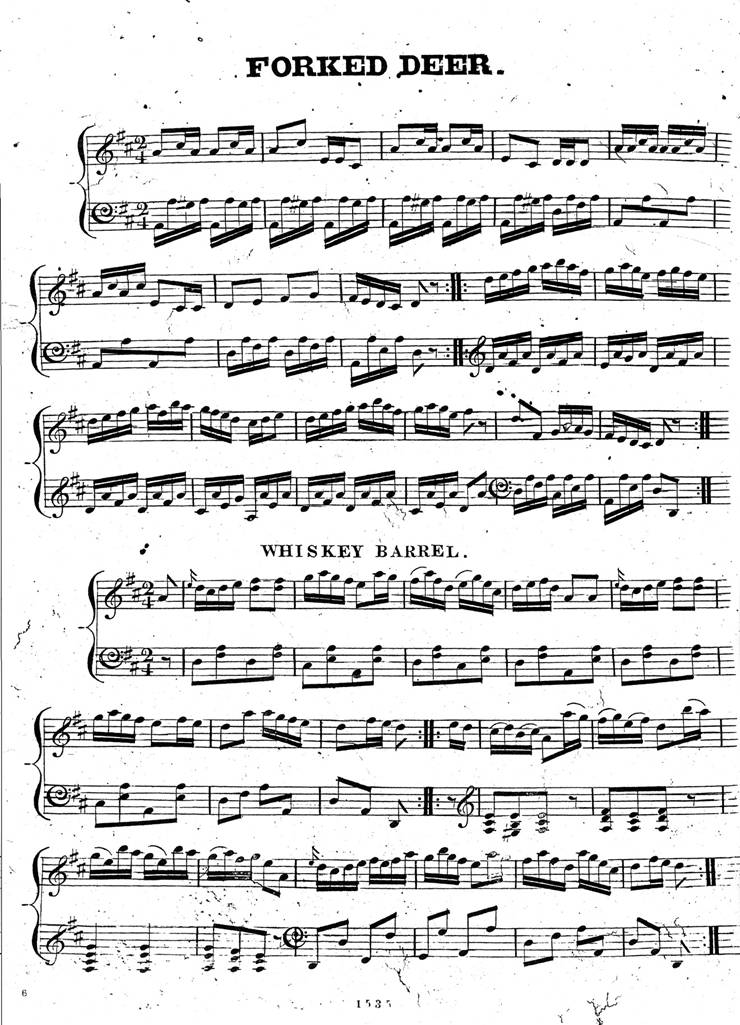
Please visit Slate River Ramblings to hear “Forked Deer” by George P. Knauff.
Over the years, the Buckingham Female Collegiate Institute had many financial worries. A letter from Samuel Shepard (Buckingham County, Virginia) to D.B. Malloy (Holly Springs, Mississippi) offers an example of the school’s disastrous spending habits.
I do know that they display little business in their management. – You will be interested in an example. Some year or so ago, Mr. Arnaud Préot suggested that, as one of the piano fortes obtained from Rosenkranz had a mechanical imperfection difficult to remedy, that they buy in its place a new one manufactured in Farmville by Mr. George P. Knauff. Mr Knauff sensibly offered to repair the old one at his factory, but they must have a new one. The old instrument is in the attic, and Mr. Knauff has so far received the sum of $15.00 on the purchase price of that of his own make. This is a small but common instance of the execution of the business of the Institute.
George P. Knauff was known as a composer far beyond Farmville. His composition “Forked Deer” is still performed today. This version of the song was recorded at Colonial Williamsburg. Mark Campbell is the fiddler, his daughter, Mauren, is on guitar, and Gregg Kimball is playing the banjo.

Photo by Joanne Yeck
Among the Buckingham County-related manuscripts held at the Library of Virginia is a speech given in 1937 entitled “The Contribution of Buckingham [County] to the Confederacy.” Delivered before the United Daughters of the Confederacy, the manuscript is unsigned and attributed to William Shepard. Looking back on the war years, he remembers many aspects of life in Buckingham including social life and customs, education, religion, and slavery. The speech also mentions Buckingham’s support of secession and various companies from Buckingham County that served in the Confederate Army, discussing particularly Buckingham’s role in the battles of Fort Donelson, Cold Harbor, Gettysburg, and the siege of Petersburg.
Opening his talk, Shepard reminded his audience of some basic Buckingham statistics as of 1860:
Population: 6,041 (white), 360 (free blacks), and 8,811 (slaves)
Size of the county: more than 300,000 acres
Cash Value of farm lands: just under $4,000,000
In upcoming posts, various sections of William Shepard’s speech will be highlighted.
 Dr. George W. Bagby
Little known today, Dr. George W. Bagby (1828-1883) was once a celebrated man of letters as well as a very popular humorist and public speaker. He was born in Buckingham County on August 13, 1828 at his mother’s plantation, near the Cumberland County line. Virginia Young (Evans) Bagby was the“daughter of “fine, intellectual Buckingham stock” and young George would spend much of his youth in this vicinity. Rural life in Buckingham and Cumberland counties shaped his view of the world and informed his humor.
In addition to writing and speaking, Dr. Bagby served as Corresponding Secretary and Librarian of the Virginia Historical Society from 1859 to 1868 and as member of its Executive Committee from 1859 to 1870. Richmond novelist Ellen Glasgow commented on a volume of his collected work, “The vital warmth and humanity of the writing will give this book a permanent place in the life and literature of Virginia. Some books do not grow old with the years, and these essays seem as fresh to me nowadays as they did when I first read them.”
For more about Dr. Bagby’s life see the February 2012 issue of the Buckingham Beacon or follow this link to a PDF of my article:
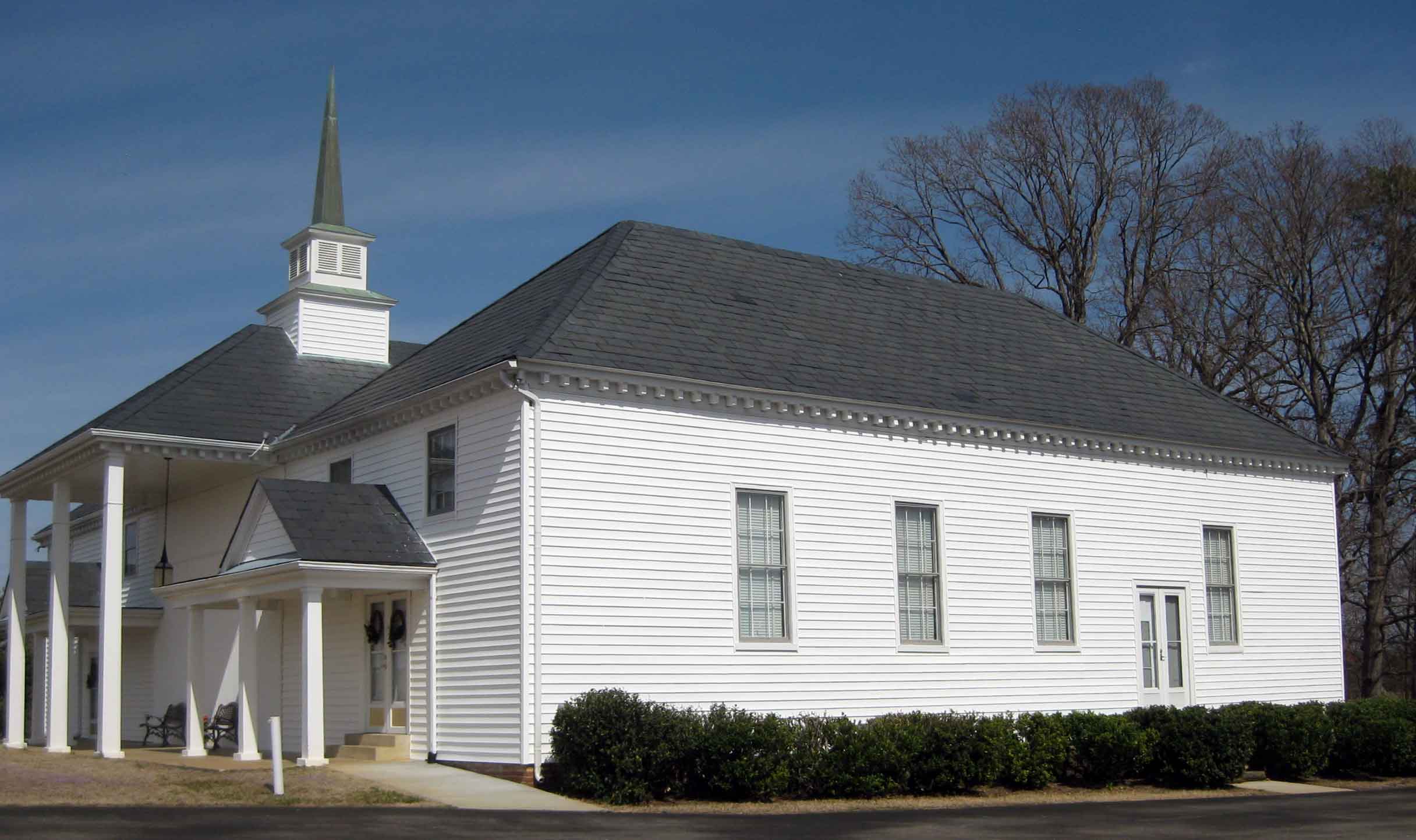
Buckingham Baptist Church (foreground section, Old Buckingham Church)
Photo by Joanne Yeck
While a record of Anglican ministers in Virginia exists for 1758, no parson is included for Tillotson Parish, indicating that there may have been a lag between the establishment of the parish and the arrival of a minister. Buckingham’s first known rector was Rev. William Peaseley, who served the county uninterruptedly for almost two decades. Born in 1714 in Dublin, he was the son of a carpenter. Educated at Trinity College in Dublin, he began serving the Church of England at age nineteen, continuing until his death in about 1786.
During Peaseley’s first decade in Buckingham, all four churches were holding services and he was attending to orphans and the poor. Between 1772 and 1776, William Binion served as a lay reader at Buckingham Church; John Flood was the sexton, while William Hensley acted as lay reader and sexton at Buck and Doe Church. John Patteson was reader and sexton of Maynards Church. Charles May and Charles Maxey were lay readers at Goodwin’s Church; Margaret McDaniel was sexton there.
In 1774, among the Gentleman Vestrymen were: Samuel Jordan (Magistrate and County Lieutenant), William Cannon (Sheriff), John Nicholas (County Clerk of Albemarle, who resided in Buckingham), Dolphin Drew, John Fearn (Captain, Revolutionary War), Rolfe Eldridge (County Clerk of Buckingham), John Bernard (Sheriff), and Hardin Perkins (Captain, Buckingham Militia). They were all leading planters and/or civic leaders.
The surprise in the list is Margaret McDaniel. Does any recognize her or the McDaniel family?

In 1966, Marguerite DuPont Lee told a third Cabell ghost story in her book, Virginia Ghosts:
The hall doors at Green Hill were not only locked but barred with heavy wooden timbers held in place by iron hooks. One evening while the family and a visitor were in the sitting-room laughing and talking, from no visible cause, the heavy bar across the front door was flung aside and the door burst open! An immediate search revealed no normal explanation. Someone remarked: “Something must have displeased Colonel John!” constant rappings were heard in different parts of the house. Everyone felt the Colonel continued to hold sway over his family and earthly possessions long after he had gone to the Spirit world.
After the Civil War, Green Hill was sold out of the Cabell family. Lee wrote, “The purchaser evidently had reason to know that the ghost of Colonel Cabell continued his interest in his old home, for it is said he became so terrified he refused to sleep alone in a room, declaring Colonel Cabell came and pulled the clothes off the bed!”
Despite his hauntings, Col. John Cabell is one of the Buckingham men of note included in the Dictionary of Virginia Biography. Published by the Library of Virginia, the Dictionary is a scholarly, comprehensive biographical reference work on Virginia. Many of the entries offer the first reliable biography ever printed about their subjects. For more information about the project visit: http://www.lva.virginia.gov/public/dvb/.
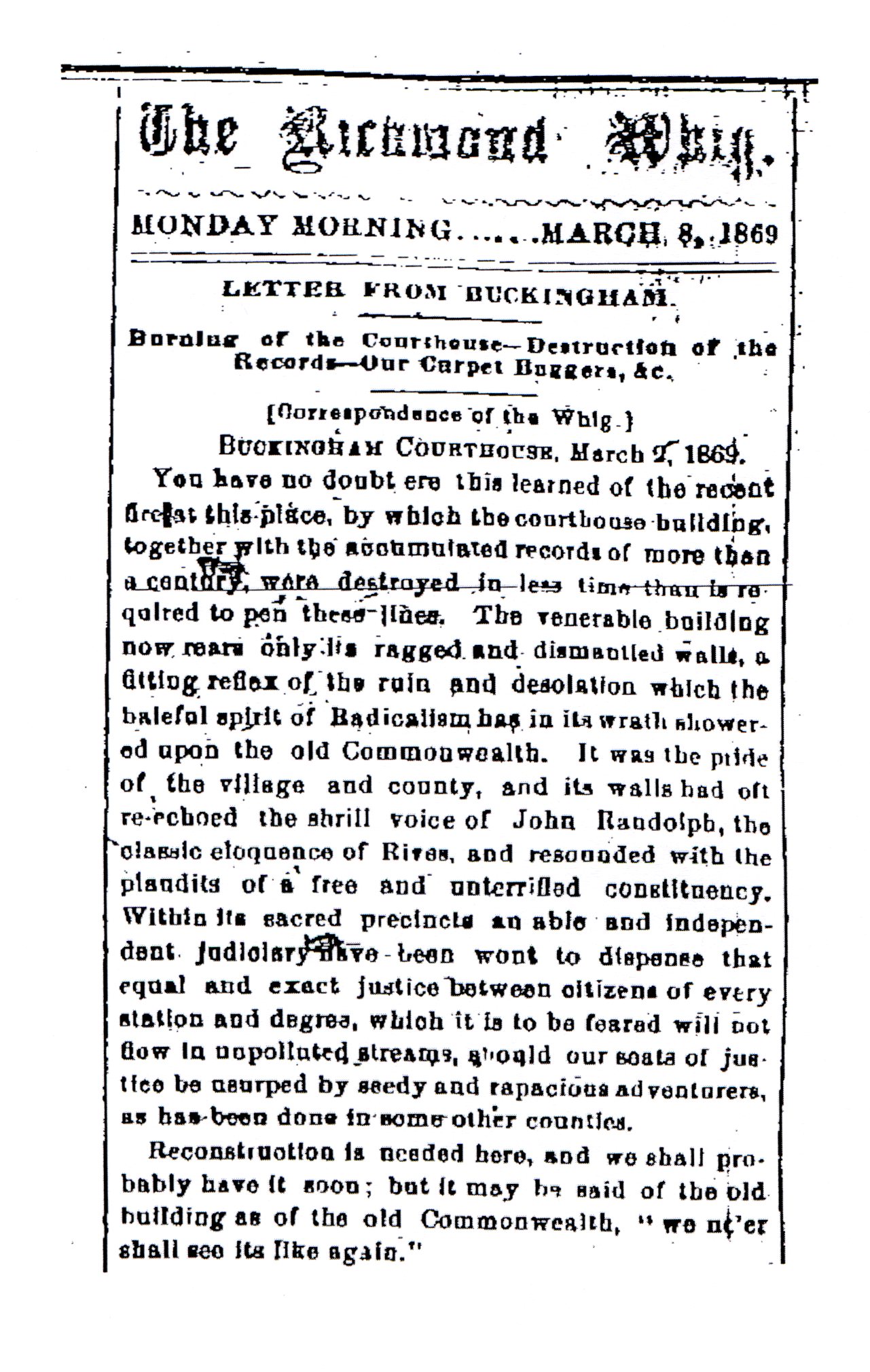
The person or persons behind the burning of Buckingham Courthouse on the night of February 24, 1869 were never found. Over the years, diverse scenarios have been speculated: Carpetbaggers set the blaze; they would be contracted to build a new courthouse. Lawyers were responsible; they would profit from redrafting documents. A slightly more plausible tale is that deed histories were the target; their destruction would obscure land ownership and confound the dreaded tax man. Years later, William Shepard, who knew witnesses of the burning, wrote, “A rather weird tale is told to account for the burning of the court house. The oil-saturate hand-railings which escaped complete consumption showed a carefully planned procedure.”
If anyone knows of other theories behind the burning of Buckingham Courthouse, please comment!
 Photo by Joanne Yeck
The Buckingham Courthouse survived the Civil War only to be burned by an arsonist in early 1869. Court continued at the nearby Brick Tavern House, “occupied” by John M. Hooper, and, quickly, conversations were held about constructing a new courthouse. Responsible men of Buckingham, lawyers and planters, gathered in Maysville, the county seat, on March 11, 1869.
Thanks to Patrick Murray who submitted the following court document which was reprinted in Carl Rosen’s book, The Papers of Col. Richard H. Gilliam of Buckingham County, Virginia:
Wheras the courthouse and clerks office of this county were consumed by fire on the night of the 24th of February last and now it being the duty of this court to provide a courthouse and clerks office for the county – with a view to use speedy performance of this duty the court doeth appoint N.F. Bocock and William Hocker in district No 1, William R. Wright and Chapman Glover in district No 2, Geo. D. Saunders and Rich H. Gilliam in district No 3, Edmund W. Hubard and William E. Gannaway in district No 4, James B. Ficklin and D.J. Woodfin in district No 5, and Henry St. Geo Harris and Jno C. Turner in district No 6, commissioners whose duty it shall be to obtain prepare and report to the court as soon as practicalbe such plans for a courthouse and clerks office as they may deem suitable of the court, and the court doth further empower said comrs or any two of them to take such steps as may seem necessary to them to preserve and secure from work and material of the old courthouse building and enclosure now remaining. And the court doth further direct that a copy of this order be forthwith served by the Sheriff of this county on each one of the commissioners approved.
A copy teste
R.K. Irving (Buckingham County Clerk)
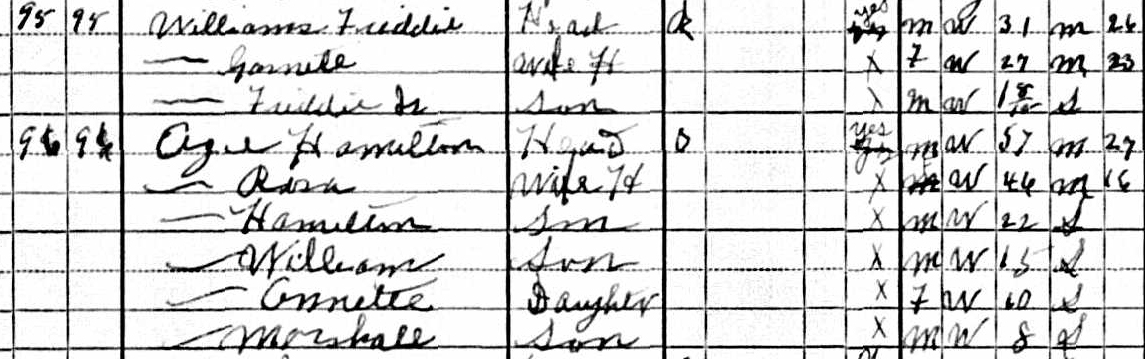
1930 U.S. Population Census, Buckingham County
Unlike WPA fieldworker Elizabeth McCraw, Rosa Garnett (Agee) Williams of Dillwyn inconsistently signed her reports. She is listed as Rosa G. Williams, Mrs. Garnett Williams, and Garnett Agee Williams.
“Garnett” was the daughter of Cornelius “Hamilton” Agee and Rosa Kate Claiborne. The Hamilton Agee family lived at Gravel Hill, not far from the Buckingham Collegiate Female Institute, and close to the old Claiborne home at Cold Comfort.
In 1930, approximately six years before Garnett took the job as a fieldworker for the Virginia Historical Inventory, she was living adjacent her parents with her husband, Freddie Williams, and her young son, Freddie, Jr.
Garnett Williams lived into her 80s and one Agee cousin noted that she was “quite elegant and lovely – good bones!” I can remember women of my mother’s generation making similar comments about great cheek bones.
If anyone knows more about Garnett Williams or is willing to share a photo of her, please let me know.
Note: To explore the Virginia History Inventory online, visit the Library of Virginia.

The January 18th post about “The Ladies of the WPA” resulted in a comment about Elizabeth McCraw.
Coz. Harry wrote: “Making a search in the Buckingham County portion of the U. S. Census records, we find one Elizabeth McCraw of Andersonville who fits this time period: Miss Elizabeth E. McCraw, who was born about 1889. This would have put her in her forties during The Depression. The Census further reveals she was earlier listed as Elizabeth E. McCraw, Jr., child of William E. and Elizabeth E. McCraw of Andersonville. Her father appears in the Census as William E. McCraw born in 1849, son of C. H. McCraw of Andersonville, who was born about 1801.”
To my knowledge, on her survey reports, she always signed her name Elizabeth McCraw of Andersonville. She never used a middle initial. Interestingly, her co-worker, Rosa Williams, signed her reports with a variety of variations of her name.
Is the Elizabeth E. McCraw of Andersonville the Elizabeth McCraw who was a fieldworker for the Virginia Historical Inventory? If so, then she was Miss McCraw. Did she ever marry?
Note: To explore the Virginia History Inventory online, visit the Library of Virginia at www.lva.virginia.gov.


 slate river ramblings . . . .