
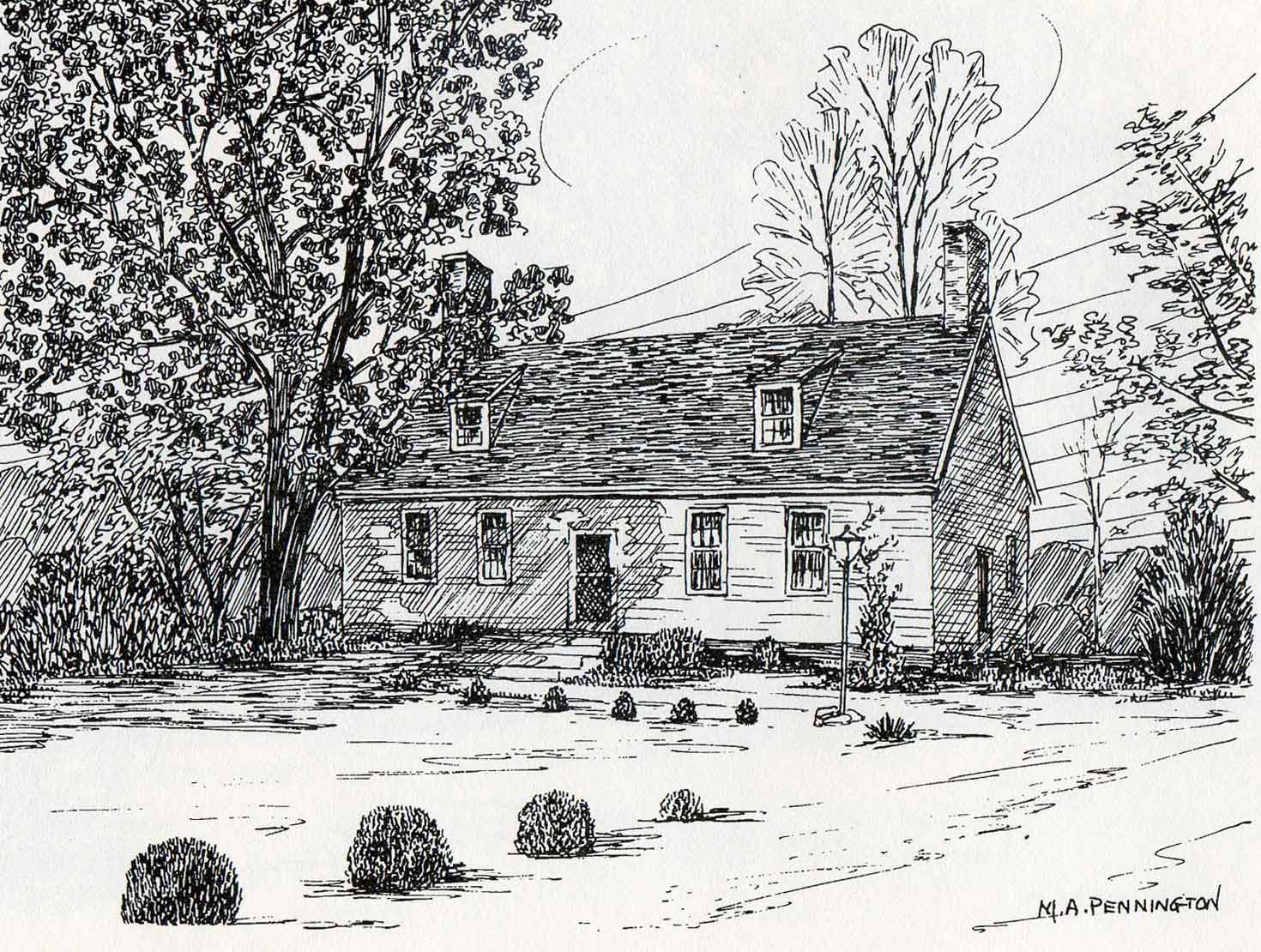
Bellmont (Courtesy Historic Buckingham)
In 1761, it was probably David Bell, Sr. who became the first Clerk of Court in Buckingham County. His wife, Judith Cary, had inherited their land from her father, Henry Cary. Judith, born in Henrico, on August 12, 1726, was about twenty years old when she wed David Bell. They began married life at the river port town of Warwick, south of the James River near Richmond where Henry Cary had established the thriving plantation, Ampthill.
When the Bells moved west, they established Bellmont and, in 1937, when the dwelling house was surveyed for the Virginia Historical Inventory it was believed to be the oldest, existing frame house, not only in Buckingham County, but west of Richmond. Located roughly eight miles northeast of Dillwyn, off Route 667, near the Cumberland County line, the Bell home was a very early and elegant entry in what was to become Buckingham County.
David Bell, Sr. died intestate on March 28, 1770, leaving Judith to face the American Revolution as a mature widow. Following the Revolution, in October of 1783, Judith applied for a claim and received £11.6.8 for 1,420 lbs. of beef provided for the cause.
Their son, David Bell, Jr. (d. 15 December 1799), along with Charles Patteson, represented Buckingham County at the Virginia Ratifying Convention in June 1788. Bell is one of the notable men of Buckingham County included in the Dictionary of Virginia Biography. Published by the Library of Virginia, the Dictionary is a scholarly, comprehensive biographical reference work on Virginia. Many of the entries offer the first reliable biography ever printed about their subjects. For more information about the project visit: http://www.lva.virginia.gov/public/dvb/

Col. Archibald Cary
( “Genealogy of the Page Family in Virginia,” by Richard Channing Moore Page)
In September 1742, when Albemarle County was still a twinkle in Goochland County’s eye and Buckingham County was nowhere on the horizon, Henry Cary transferred 4,132 acres, lying on both sides of Willis’s Creek, to his son, Archibald “Old Iron” Cary. The deed included ten slaves and was witnessed by David Bell, who married Henry’s daughter, Judith Cary, and became the first Clerk of Court of Buckingham County.
In 1744, these Cary holdings were cut from Goochland, becoming the far eastern edge of the newly established Albemarle County. The family called the place, Buckingham. The name persisted, and in 1746, Albemarle road orders mention the “Buckingham Path,” in the vicinity of Slate River. It is entirely possible that the continuation of what became the “Buckingham Road” was the single biggest factor in the dissemination of the name throughout the region.
Archibald Cary held his “Buckingham tract” for thirty years when he considered selling. An advertisement in the Virginia Gazette, which ran in April 1772, offered the property coupled with an additional 3,000 adjacent acres. In the end, Col. Cary did not part with the Buckingham land prior to his death. Instead, he passed it to various family members in his last will, dated February 12, 1787. To his son-in-law, Archibald Bolling and his second wife, Jane Randolph (daughter of Richard Randolph), he gave the 1000-acre plantation known as Red Oak, on Mountain Creek of “Willis River,” in Buckingham County. Another 1,000 acres, adjoining Red Oak, went to his grandson Archibald Cary Bolling, the son of his daughter Sarah Bolling, deceased. To his daughter, Betty Cary, he left the remaining 2,000 acres at fork of Willis in Buckingham.
In addition to Red Oak, other Cary plantations lying in Buckingham County included “Half Way Branch,” “Taylor’s Branch,” and “Caryswood.” None, it appears, was called “Buckingham.” Each developed its own identity, and the original reference to Buckingham as a specific plantation drifted out of memory.
Coming up next: More about David Bell and his home, Bellmont.
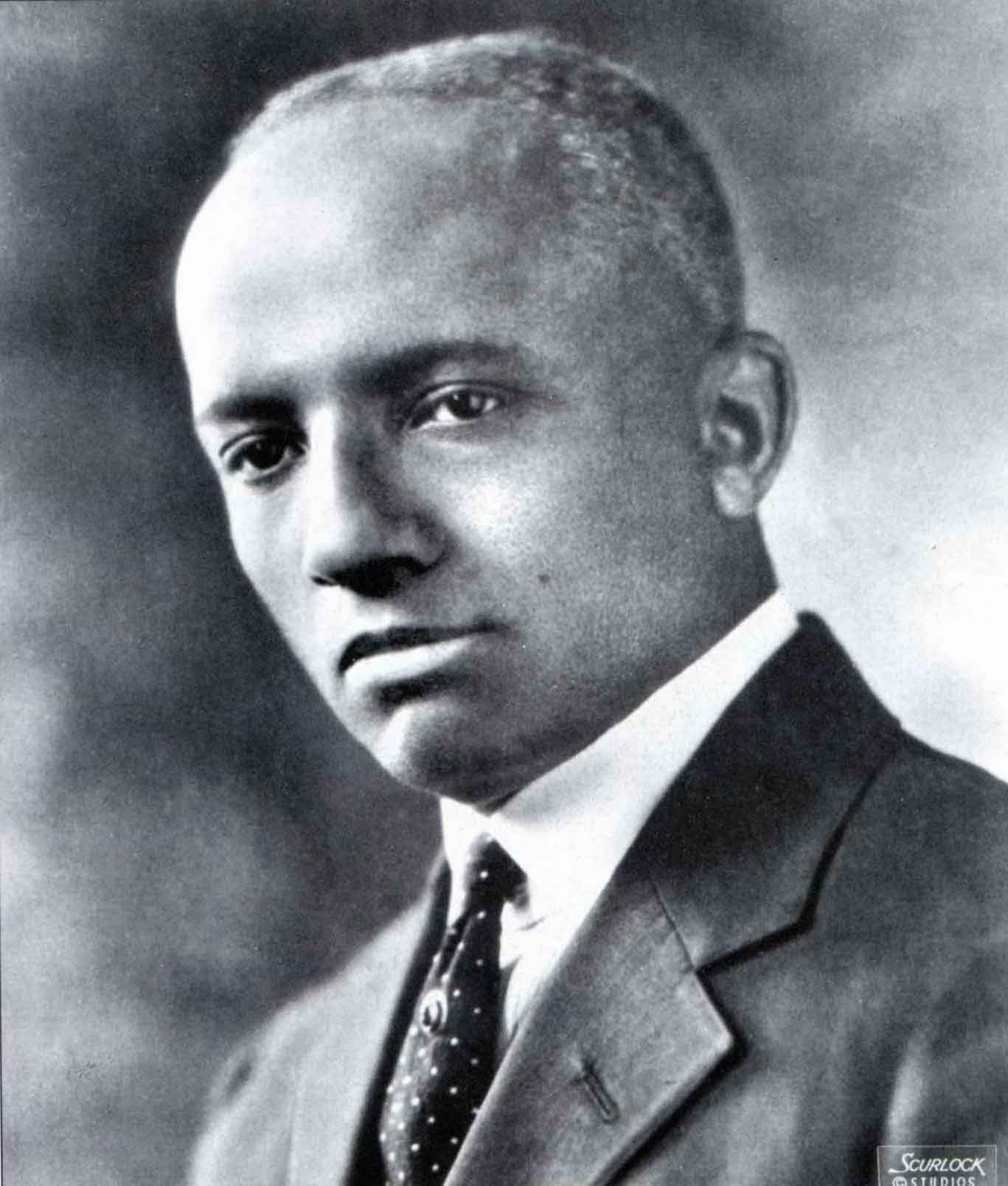
Yesterday, I mentioned Carter Woodson, Sr., the grandfather of one of Buckingham’s most famous sons, Dr. Carter G. Woodson (1875-1950), pictured above.
His grandfather, Carter Woodson, was a talented carpenter and lived as a slave in Fluvanna County and as a free man in Buckingham County.
By the 1830s, Carter Woodson, his wife, and his first family were the property of a man named John W. “Jack” Toney, who lived across the James River from Buckingham in Fluvanna County. The origin of Carter’s surname is unknown; however, an 18th-century marriage connected Toney’s family to William Woodson, who owned land in Buckingham on Randolph’s Creek, near the Cumberland County border and Dr. Carter G. Woodson’s birthplace.
Sometime before emancipation or soon after, Carter Woodson came to live in Buckingham where he married a woman named Sidney, who was the property of James Harris, and lived on one of his plantations in the northeast corner of Buckingham. While still enslaved, Carter and Sidney were members of Buckingham’s Sharon Baptist Church and church records indicate they were both Harris’ property. They were members in good standing, and in January of 1870, Sharon’s Clerk recorded that letters of dismissal were granted to the couple, allowing them to transfer their membership to an African-American church.
I’m very interested in learning more about the descendants of Carter Woodson, Sr., especially the children he had with Sidney.
 Crossing Sharps Creek, photo by Joanne Yeck
Writing history or doing genealogical work in Buckingham County is, of course, perennially plagued by the loss of the courthouse in 1869. Still more challenges are presented by the burning of private homes (and the proprietor’s contents with them – letters, farm books, ledgers, diaries, etc.). Still more come with the loss of public buildings through fire or demolition.
In the mid-late 19th century there was a Methodist Chapel in Buckingham called Dunn’s Chapel. I believe it was in the general vicinity of Sharps Creek, or Hunt’s Creek, or even Diana Mills. It might have been near Arvonia and the slate quarries.
My cousin, Sarah “Sallie” J. (Harris) Allen (1825-1902) attended services there before switching to Sharon Baptist Church sometime before 1873. The Allens lived near Slate River and Hunt’s Creek.
In 1871, Carter Woodson, Sr. recorded that his daughter, Leticia, was born at Dunn’s Chapel. This indicates to me that there might have been a post office there as well. In 1870, the Woodsons lived near the quarries.
Does anyone know more about Dunn’s Chapel?
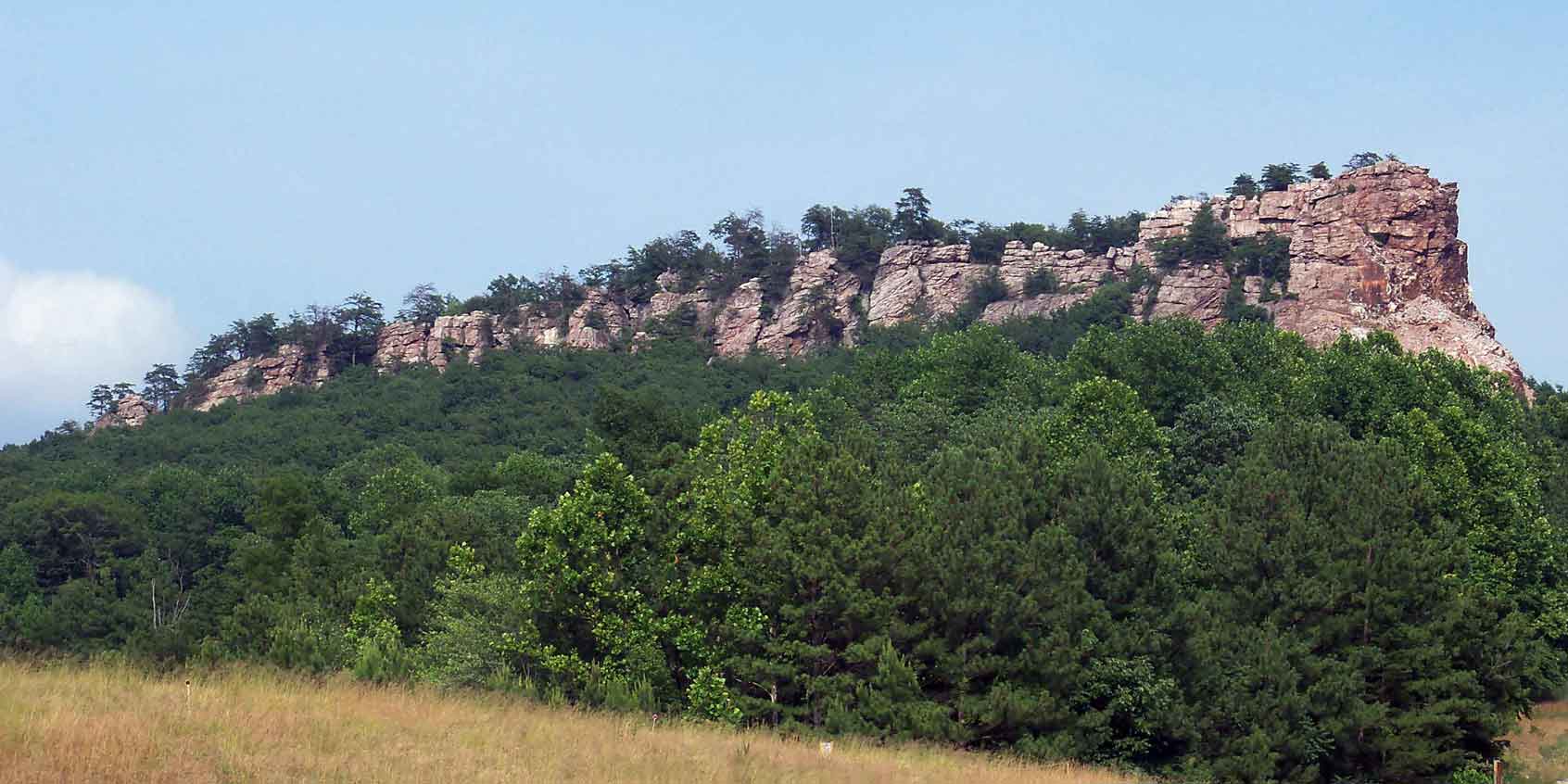 photo by Amy Brailey
In the 19th century, Willis Mountain was a popular destination, an inviting natural setting drawing young Virginians for a day in the great outdoors.
In the 1930s, Elizabeth McCraw wrote for the Virginia Historical Inventory, “The huge moss grown rocks were piled one upon another and in places deep crevices can be seen. There was at one time some splendid timber at the base and extending some distance up the sides. Along the trail to the top of the largest of the two main peaks, are several splendid springs of sparkling mountain water.”
Last month, following my initial post about Willis Mountain, Nancy Jamerson Weiland wrote, “My father retired from the Kyanite mine. He worked on Willis Mountain and Baker Mountian in Cullen. As a little girl, we would go for picnics at the foot of the mountain at a place called Peaceful Valley.”
Does anyone else recall Peaceful Valley or pleasure outings to Willis Mountain?
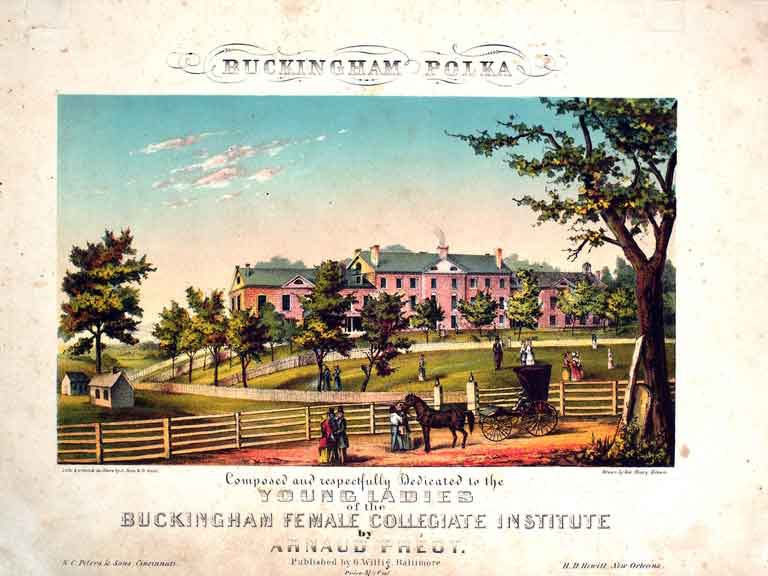
Buckingham Female Collegiate Institute was truly innovative. The county’s planter elite began planning “The Institute” in 1831. The goal was to promote the higher education of women and perpetuate an educational plan. Though there would be beloved faculty members and Presidents, the Institute was designed to transcend personalities, even specific religious affiliation.
The curriculum far exceeded the typical female academy, and several textbooks used by the men at Randolph-Macon College were assigned. Mathematics, for example, eventually included Trigonometry. Ancient Languages included Greek and Latin, in preparation to read Caesar and Cicero. German and French languages, music lessons on the Forte Piano, Drawing and Painting were also taught; however, there was a supplemental fee for these classes. The Institute owned four pianos for the use of the young ladies, and its extraordinary library contained 3,000 volumes, donated by the citizens of Buckingham. The exceptional depth and breadth of these offerings makes it clear that the forward-thinking families of the county were convinced that their daughters were fully capable of achieving intellectual and artistic accomplishments equal to their brothers.
Pictured above: In 1852, Arnaud Preot, the Institute’s music master, composed “The Buckingham Polka,” which he dedicated to the girls.
 photo by Joanne Yeck
Linda Hope Doerger, great-granddaughter of Thomas Marshall Phillips, remembers Mary Virginia Adams as a great story-teller and keeper of the family history. The daughter of Callie Phillips Bagby, Mary Virginia relished recounting family legends, sayings, and traditions. They include treasured ghost stories like this one about Buckingham resident Thomas Marshall Phillips (1849-1932).
One night Thomas Marshall Phillips was riding his horse, Olos, in complete darkness when the horse suddenly stopped as if a hand had reached out and grabbed the reins. When he spoke up and told the horse to go on, it started again as if the hand released the reins. Did a ghost stop the horse in its tracks? Or, could it have been a bandit who released the reins once he heard the voice of Thomas Marshall Phillips, a well-respected man in the area?
1900 Census, Marshall District, Buckingham County


Yesterday’s post about “The Ladies of the WPA” created some lively conversation and some of you would like to know how to access the Virginia Historical Inventory online.
First, I highly recommend this wonderful article written by Edward D. C. Campbell, Jr. and Stacy Gibbons Moore, “Foundations of the Past: The WPA Historical Inventory Project in Virginia.” It is available online at: http://www.lva.virginia.gov/public/guides/opac/vhiarticle.htm.
Second, this link will take you to the Library’s catalogue, specifically to the index for the Virginia Historical Inventory Project, and you can search the entire collection:
http://lva1.hosted.exlibrisgroup.com/F/?func=file&file_name=find-b-clas15&local_base=CLAS15
If you find a photograph you’d like to own, it can be purchased from the Library.
Happy Hunting!

From time to time I will quote documents written in the 1930s by two women of Buckingham County: Rosa Garnett (Agee) Williams of Dillwyn and Elizabeth McCraw of Andersonville. Together, during the mid-to-late 1930s, they wrote approximately 450 reports about a variety of people, places, and things in Buckingham County. Eighty years after their dedicated work, these surveys stand as one of the largest single collections of information about Buckingham’s elusive past.
They worked for the Virginia Historical Inventory (VHI) which was designed to document the state’s quickly vanishing past, particularly everyday buildings built before 1860. Funded by the Works Progress Administration (WPA) and created under the umbrella of the Virginia Writers’ Project, VHI field workers across Virginia conducted interviews, photographed a wide variety of structures, and wrote statistical reports. Today, the resultant collection is housed at the Library of Virginia and consists of more than 19,300 survey reports (approximately 70,000 pages), more than 6,200 photographs, and 103 annotated county and city maps. This remarkable effort, made by historically-minded Virginians, remains one of the many significant legacies of Franklin D. Roosevelt’s New Deal.
In addition to the documentation of dozens of old homesteads, the women gathered pension declarations and family lineages from Bibles. They transcribed wills, grants, deeds, and old letters. They interviewed life-long residents of the county about mills and schools no longer standing. Today, in many cases, their accompanying photographs are the only known visual record of structures long destroyed.
I am very interested in collecting biographical information about these two women and photos of them and/or their families. If you can contribute anything about Mrs. Williams or Miss McCraw feel free to comment here or write to me at jlyeck@gmail.com.
 Gwen Arvon (2011), photo by Joanne Yeck
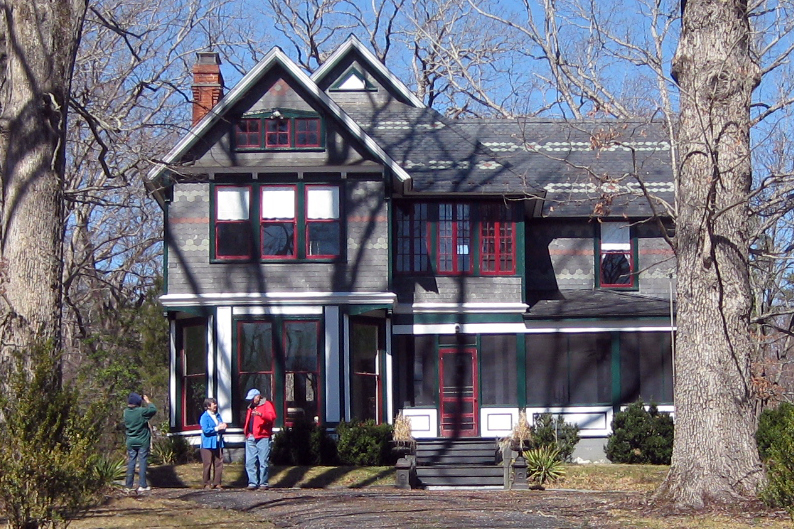
During the 1870s, the Williams brothers of Caernarvonshire, Wales, brought their considerable expertise and strong work ethic to the Buckingham slate quarries. John Williams lived in Richmond, handling marketing and sales; Evan Williams ran operations on Hunt’s Creek. The Williams brothers’ success was concurrent with the coming of the railroad, taking Buckingham slate to destinations far beyond the county limits. The family displayed their affluence with a private rail car, which they referred to as “the accommodation.”
Other Welshman followed, bringing names like Davis, Davies, Lloyd, Jeffery, Jones, Pierce, and Thomas to Buckingham and the quarries. The growing settlement was eventually called Arvon (later Arvonia), its name rooted in Caernarvon. The Arvon Presbyterian Church was established, where Welsh hymns were sung and where the Arvonia Memorial Cemetery contains many graves with epitaphs written in Welsh.
As slate products diversified from roofing material to other uses, the Williams brothers built “sample houses” designed to demonstrate the material’s versatility. Bryn Arvon (Evan Williams) and Gwen Arvon (John Williams) were Queen Anne-style marvels. They sported slate mantels, staircases, baseboards, and even the kitchen sinks were made of slate!
Today, Gwen Arvon, still owned by a Williams descendant, has been beautifully restored.


 slate river ramblings . . . .