

As most of you know, many Buckingham farms contain family graveyards with some burials going back to the early 19th century. There are many church-connected graveyards as well. Grave hunting has become one of my favorite pastimes. It is a great way to combine a walk in the woods and a picnic with cousins, tics and snakes aside.
If you aren’t already aware of the marvelous resource, Buckingham Burials, Vols 1 – 3, I highly recommend these volumes for anyone conducting research about Buckingham families. Volume 4 will be published in the near future. The books are available directly from Historic Buckingham. Just follow this link to learn more: http://www.historicbuckingham.org/
 photo by Joanne Yeck
There are many so-called “burned counties” in Virginia and Buckingham is one of them.
The courthouse that burned in February of 1869 was doubly precious, not only did it contain virtually all of the county’s records since its inception in 1761; the building was designed by Thomas Jefferson. Ironically, both the structure and the records had survived the Civil War only to be burned by an arsonist. On February 24th, The Richmond Dispatch reported:
A sad calamity has befallen our county. The court-house was set fire yesterday morning about 1 o’clock, and by daylight was a mass of ruins. The clerks’ offices of the county were kept in the court-house, and there is not a single record left—-everything lost. This county was organized in 1761, and the records relating back to its foundation have also been destroyed. No suspicion attaches to anyone, but the building was evidently fired with a view of destroying the clerks’ offices.
 Photo by Joanne Yeck
According to Thomas Baldwin’s Gazetteer of the United States (1854), in the mid-19th century, Buckingham County contained nineteen churches. My ancestors attended several, including Sharon Baptist Church. Located on Route 622 (now Sharon Church Road), it was founded on March 29, 1835, when the members of Pine Grove and the members of Gooseberry Meeting Houses combined forces to form Sharon. In February of 1854, it was proposed that a new church be built to replace Pine Grove Meeting House, which had served the congregation for over twenty years. The result, pictured here, is still serving Sharon’s congregation in 2012.
Not only did two generations of my Harris and Saunders families attend Sharon, but also my extended family, including Agee, Chambers, Maxey, and Winfrey cousins. In 2008, Gordon G. Ragland, Jr. authored, The Tie That Binds: The Stories of Sharon Baptist Church, Buckingham County, Virginia, documenting the lives of many members of Sharon as well as capturing an important part of the county’s history.
To catch up on other posts featuring Buckingham County churches included in the 1854 Gazetteer, just type Gazetteer in the search box at Slate River Ramblings. Enjoy the results!

More to come about the courthouse and the “classic 19th-century rural courthouse village. . . .
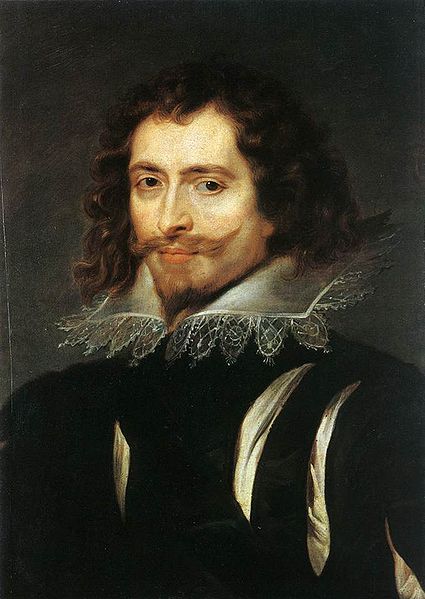
George Villiers, 1st Duke of Buckingham
(Peter Paul Rubens, c. 1625)
Thomas Baldwin’s Gazetteer of the United States (1854) goes on to state that the county was “Organized in 1761, and named from Buckingham, a county of England.”
Indeed, Buckinghamshire in England might have been the inspiration for the county’s name; however, there are other possibilities. There might have been a connection to the Buck River or nearby Buck Mountain. It might have honored George Villiers, the Duke of Buckingham. Whatever the origin, for more than thirty years prior to the county’s establishment, the area had been referred to as Buckingham. The earliest known reference appears on a land patent dated September 27, 1729, in which Henry Cary, Gentleman, was granted “3942 acres at a place called Buckingham.” Signed by Governor William Gooch, the patent describes the tract as “the west side and on the branches of Buck River, alias Willis’s Creek,” located in the western part of what was then an enormous Goochland County.
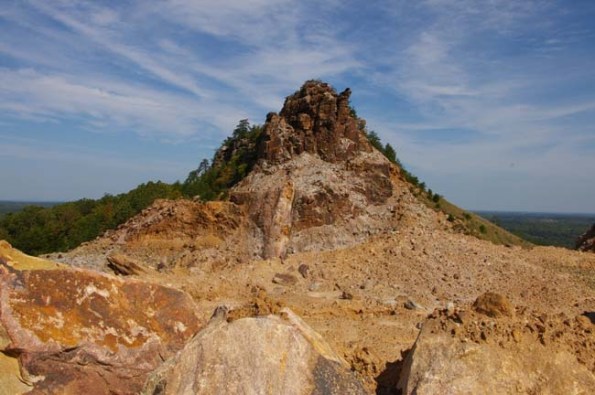
Willis Mountain (2008) Photo by Callan Bentley
In Thomas Baldwin’s Gazetteer of the United States (1854), Buckingham’s topography was described like this: “The surface varies from level to hilly: Willis mountain, in the S. E. part, is the principal elevation.”
Many things change slowly in Buckingham, including Willis mountain which, while giving up its precious Kyanite, has also given up it elevation. Two hundred years ago, Willis Mountain was visible from Thomas Jefferson’s mountain-top home at Monticello. Intrigued, he wrote of its shapeshifting, almost magical qualities in his Notes on the State of Virginia:
“There is a solitary mountain about forty miles off in the South, whose natural shape, as presented to view there, is a regular cone; but by the effect of looming, it sometimes subsides almost totally into the horizon; sometimes it rises more acute and more elevated; sometimes it is hemispherical; and sometimes its sides are perpendicular, its top flat, and as broad as its base. In short it assumes at times the most whimsical shapes, and all these perhaps successively in the same morning.”
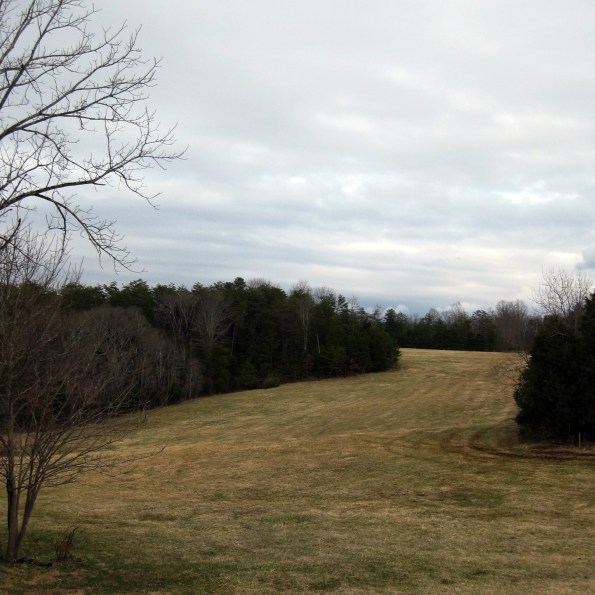 photo by Joanne Yeck
More about Buckingham County from Thomas Baldwin’s Gazetteer of the United States (1854):
“The soil is not naturally rich, excepting in the vicinity of the rivers. Tobacco, Indian corn wheat, oats, and livestock are the staples. In 1850 this county produced 304,711 bushels of corn; 133,819 of wheat; 117,091 of oats; 2,342,987 pounds of tobacco, and 83,480 of butter.”
Those were the facts. From the pen of Buckingham’s native son, Dr. George W. Bagby, a different image emerged, revealing the bucolic “paradise” hiding behind the statistics:
“Wide, very wide fields of waving grain, billowy seas of green or gold, as the season chance to be, over which the scudding shadows chased and played, gladdened the heart with wealth far spread. Upon lowlands level as the floor, the plumed and tasseled corn stood tall and dense, rank behind rank in military alignment – a serried army, lush and strong. The rich, dark soil of the gently swelling knolls could scarcely be seen under the broad, lapping leaves of the mottled tobacco. The hills were carpeted with clover. In the midst of this plenty, half hidden in foliage over which the graceful shafts of the Lombard poplar towered, with its bounteous garden and its orchards heavy with fruit near at hand, peered the old mansion, white, or dusky red or mellow gray by the storm and shine of years.”
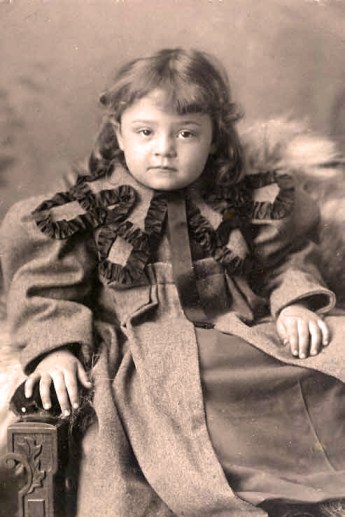
My maternal grandmother, Minnie Garland (Harris) Sanger, was born near Well Water in the spring of 1891. At the age two, Minnie was taken to southern Iowa where she was raised within a community of Buckingham County expatriates, an environment both home-like and foreign. Most of these Virginians felt some degree of exile. Many went home to Buckingham to die. They would not be buried in Iowa.
Decades later, I was born and grew up in southern Ohio. Iowa was far away; visits were few and far between. As a result, I knew nothing of my grandmother’s deep Virginia heritage.
In 1995, in part inspired by the family tradition that my grandmother was descended from Pocahontas and in part inspired to uncover a family culture I knew nothing of, I made my way to Buckingham. Gradually, what began as a somewhat idle curiosity deepened into a fascination with the community and family Minnie had left behind. My grandmother had been uprooted . . . but her family left tracks. Faint tracks, but tracks none the less. It has turned out to be a very big puzzle with a whole lot of missing pieces.
 sketch by Dr. Margaret A. Pennington
 photo by Jeremy Winfrey
These ruins of the Well Water School are all that remains of the community of Well Water, located in northern Buckingham County, Virginia. Once a bustling place, it was founded by Frank N. Maxey after the Civil War. In the late 19th century, my maternal grandmother’s maternal grandfather, John T.L. Woodson, taught at Well Water’s one-room school house; it was replaced by this spacious, two-story structure.
Frank N. Maxey’s obituary in the Appomattox and Buckingham Times read in part, “Mr. Maxey had been engaged in many business enterprises during his life. He conducted a large general merchandise store, built and put in operation a splendid wheat, corn and saw mill, foundry and etc., besides farming on an extensive scale. For many years he bought nearly all the tobacco that was raised in this part of the county. He took the deepest interest in the welfare and development of the community in which he lived. It was his home, and he was its son, and when his death was announced it came as a personal loss to every citizen.”

Buckingham County Postal Routes, 1896
Virginia in Maps – Four Centuries of Settlement, Growth, and Development,
by Richard W. Stephenson and Marianne M. McKee, eds. (The Library of Virginia, 2000).
In response to yesterday’s post, I received this map showing Buckingham County’s postal routes.
Here you can clearly see the borders of the county as well as the late 19th century “service centers” which included post offices. Many thanks to my Buckingham cousin MCM!


 slate river ramblings . . . .