

Need to catch up? Click here: Buckingham Notables: “The Western Sampson,” Part I
One of the most famous stories about Peter Francisco is retold in the Alexandria Gazette and Virginia Advertiser, peppered with colorful “Kaintuck” dialect. Our unknown author continued:
“Ah!” returned the other, “you’re just the man I want to find”—at the same time, riding inside the fence, he dismounted and tied the animal—a rough, ungainly Indian pony to one of the posts.
“My name is Big Bill Stokes all the way from Old Kentuck. I am the Kentucky game chicken, I am. I can out run, out-hop, outjump, knock down, drag out, and whip any man in all them diggings. So, as I heard tell of a fellow down hereabouts could whip all creation, I thought I’d saddle Old Blossum, and just ride over and see what stuff he’s made of, and here I am. And now, stranger, I’m most starved for a fight, and I am bound to see who’s the best man before I go home. It’s all in a good feeling you know; but if you lick me, why, I’m satisfied. But—“
“Stop a minute, stranger,” said Francisco; “you’ve mistaken the man entirely: I’m no fighting man at all; and if I was, I’ve nothing against you to fight about.”
“Well I don’t know, is there any other Peter Francisco in these parts?”
“No—not that I know of.”
“Well then, you’re the man, and you must fight. I’ve come all the way from Old Kentuck, and I ain’t a-going back without knowing which is the best man.”
“But I won’t fight. I’ve got nothing to fight about, and I tell you I won’t fight.”
“Darned if you shan’t fight, stranger—I’m bound to lick you if I can; if I don’t you must lick me.”
By this time Francisco had become angry at the importunity of his visitor, and determined to put an end to the scene. Seizing his antagonist, therefore, by the seat of his buckskin breeches and the collar of his hunting shirt, he threw him over the fence into the road; then walking leisurely to where his pony was tied, he unfastened him, and taking him up by main strength, threw him after his discomfited rider.
The Kentuckian raised himself from the ground, perfectly dumbfounded by such an exhibition of strength, and, after rubbing his eyes as though he thought he might not have seen clearly, he mounted the poney—remarking, “Well, stranger, I reckon you’ll do. I reckon it’s about time for me to make tracks. If any body asks you about that great fight, you can tell ‘em you licked Bill Stokes most confoundedly.
Coming next: Buckingham Notables: “The Western Sampson,” Part V
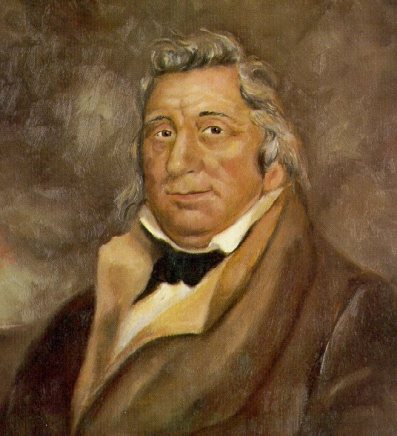
Courtesy Peter Francisco Society.
Need to catch up? Click here: Buckingham Notables: “The Western Sampson,” Part I
It is a pity that this article about Peter Francisco in the Alexandria Gazette is unsigned. Apparently, the author knew Francisco personally and heard the following story while the man himself still lived in Buckingham County. It has been often repeated over the years, the colorful details very. This telling, complete with “Kaintuck” dialect, is particularly charming.
~
Many other anecdotes are told of Francisco, illustrative of his immense strength and personal prowess. At Camden, where Gates was defeated, he retreated, and after running along the road some distance he sat down to rest himself. He was accosted by a British dragoon, who presented a pistol and demanded his immediate surrender. His gun being empty, he feigned submission and said he would surrender—at the same time remarking that his gun was of no further use to him, he presented it sideways to the trooper, who, on reaching for it, threw himself off his guard, when Francisco, quick as thought, ran him through with the bayonet, and as he fell from his horse he mounted him and continued his retreat. Overtaking his commanding officer, Col. Mayo, of Powhatan, he gave up the animal, for which act of generosity the colonel afterwards presented him with a thousand acres of land in Kentucky.
The following anecdote exemplifying his peaceful nature and his strength, is also told of Francisco. How true it is we cannot say, but we tell it as it was told to us many years ago, while he was still living in Buckingham County.
One day while working in his garden he was accosted by a stranger who rode up to the fence and inquired if he knew where a man by the name of Francisco lived?
Raising himself up from his work, and eyeing his interrogator, who appeared to be one of the “half-horse, half-alligator” breed of Kentuckians, he replied — “Well stranger, I don’t know of any other person by that name in these parts but myself.”
“Well, I reckon you ain’t the man I want. I want to find a great fighting man I’ve heard tell so much about. The feller they say can whip all creation and Kaintuck to boot.”
“I can’t tell you, stranger, where you’ll find that man. I don’t know such a man,” said Francisco—resuming his work as a hint to the other that the conference had ended, but the Kentuckian was not to be bluffed off, as he would term it. “Look ‘ere, stranger,” said he—returning to the charge, “what might your name be?”
“My name is Peter Francisco, at your service.” . . .
Coming next: Buckingham Notables: “The Western Sampson,” Part IV
Need to catch up? Click here: Buckingham Notables: “The Western Sampson,” Part I
In 1855, an entertaining biography of Peter Francisco was printed in the Alexandria Gazette and Virginia Advertiser. Twenty years after his death, tales of Francisco’s feats of strength and cunning had taken on a life of their own. The article continued:
One day while reconnoitering he stopped at the house of the man by the name of W— to refresh himself. While at the table he was surprised by nine British troops who rode up to the house and told him he was their prisoner. Seeing that he was so greatly outnumbered, he pretended to surrender; and the dragoons seeing he was apparently peacefully inclined, after disarming him allowed him considerable freedom, while they sat down to partake of the food which he had left when disturbed. Wandering out in the door yard he was accosted by the paymaster, who demanded of him everything of value about him at the risk of his life, in the case of refusal.
“I have nothing to give,” said Francisco, “so use your pleasure.”
“Give up those massive silver buckles on your shoes,” said the dragoon.
“They with the gift of a friend,” replied Francisco; “and give them to you—I never shall, take them if you will; you have the power, but I will never give them to any one.”
Putting a saber under his arm, the soldier stooped down to take them. Francisco seeing the opportunity which was too good to be lost, seized the sword, and, drawing it with force from under the arm of the soldier, dealt him a severe blow across the skull. Although severely wounded, yet being a brave man, the dragoon drew a pistol and aimed it at his antagonist, who was too quick for him, however; and as he pulled the trigger, a blow from the sword nearly severed his wrist, and placed him hors de combat. The report of the pistol drew the other dragoons into the yard, as well as W—, who very ungenerously brought out a musket which he handed one of the soldiers and told him to make use of it. Mounting the only horse they could get, he presented the muzzle at the breast of Francisco, and pulled the trigger. Fortunately it missed fire, and Francisco closed in upon him. A short struggle ensued, which ended in his disarming and wounding the soldier. Tarleton’s troop of four hundred men were right now in sight, and the other dragoons were about to attack him. Seeing his case was desperate, he turned toward an adjoining thicket, and, as if cheering on a party of men, cried out, “Come on, my brave boys!” now’s your time; we will soon dispatch these few, and then attack the main body!” at the same time rushing at the dragoons with the fury of an enraged tiger.
They did not wait to engage him, but fled precipitately to the troop, panic struck and dismayed. Seizing upon the traitorous villain, W—, Francisco was about to dispatch him; but he begged and plead so hard for his life, that he forgave him and told him to secrete for him the eight horses which the soldiers had left behind them. Perceiving that Tarleton had dispatched to other dragoons in search of him, he made off into the adjoining wood, and, while they stopped at the house, he like an old fox, doubled upon the rear and successfully evaded their vigilance. The next day he went to W—, for his horses, who demanded two of them for his services and generous intensions. Finding his situation dangerous, and surrounded by enemies where he should have found friends, Francisco was compelled to make the best of it, and left with six horses intending to revenge himself upon W—, at a future time “but,” as he said, “Providence ordained that I should not be his executioner; for he broke his neck by a fall from one of the very horses.”
Coming next: Buckingham Notables: “The Western Sampson,” Part III

Peter Francisco is undoubtedly one of Buckingham County’s best known citizens. His life story has been told and retold, even mythologized. Recently, I discovered a version of his biography printed in the Alexandria Gazette and Virginia Advertiser in 1855. Printed twenty years after his death, Francisco’s story had already cured long enough to take on mythic proportions. As an early telling, it is particularly valuable, revealing some curious details in his beloved rags to riches story. The mid-nineteenth century language has its own charm. Unfortunately, the article is unsigned. It begins:
An American Sampson.
As late as the year 1836 there lived in western Virginia a man whose strength was so remarkable as to win him the title of “The Western Sampson.” He knew nothing of his birth or parentage, but supposed he was born in Portugal, whence he was stolen when a child and carried to Ireland. His earliest recollections were those of boyhood in the latter country. While yet a lad he apprenticed himself to a sea captain for seven years, in pay for passage to this country. On his arrival his time and services were sold to a Mr. Winston, of Virginia, in whose service he remained until the breaking out of the Revolution. Being of an adventurous turn of mind, he sought and obtained permission of his master to join the army, and was engaged in active service during the whole contest.
Such was his strength and bravery that no enemy could resist him. He wielded his sword, the blade of which was five feet in length, as though it had been a feather, and everyone who came in contact with him paid the forfeit of his life. At Stony Point he was one of the “forlorn hope,” which was advanced to cut away the abattis* and next to Major Gibson, was the first man to enter the works. At Brandywine and Monmouth he exhibited the most fearless bravery; and nothing but his inability to write prevented his promotion to a commission. Transferred to the South he took part in most of the engagements in that section, and toward the close of the war he was engaged in a contest which exhibited in a striking manner his self-confidence and courage.
* abattis – a line of defense consisting of a barrier of felled or live trees with branches (sharpened or with barbed wire entwined) pointed toward the enemy.
Coming next: Buckingham Notables: “The Western Sampson,” Part II
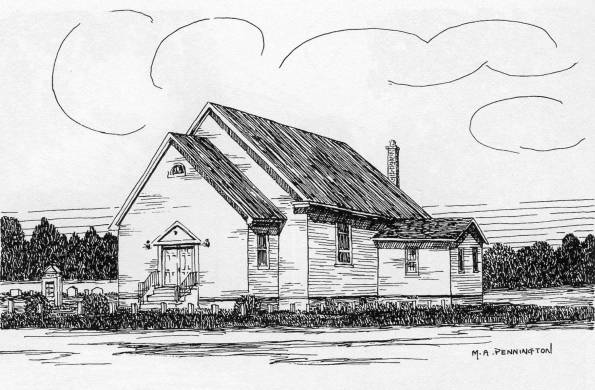
Chestnut Grove Baptist Church. Courtesy Historic Buckingham.
From time to time, all of us who save scraps of paper bearing important pieces of information fail to note the source and date. This is the case with the news clipping transcribed below. Instead of holding it forever unposted, I decided to post it for the readers of Slate River Ramblings as a puzzle. Can anyone identify what year the O’Bryant family experienced two weddings in the burial on the same day?
Note: Many thanks to Slate River Ramblings follower Fran Harris-Hill who identified the date as November 4, 1902.
~
TWO WEDDINGS AND A BURIAL THE SAME DAY.
Interesting Events in the O’Bryant Family at New Store, Buckingham County.
NEW STORE, VA., November 5. — (Special.) The remains of Mrs. Francis O’Bryant were interred yesterday afternoon. She was the widow of Francis O’Bryant, deceased, whose father, Glinn O’Bryant, lived with Peter Francisco as overseer on the farm adjoining his place upon Williams Creek. It was interesting to hear her tell of what happened upon the farm when he was a boy — about the rolling of tobacco to Manchester. Peter Francisco’s exploits, fights and almost super human strength.
Mr. Louis Napoleon O’Bryant, a young ship carpenter of Newport News, and Ms. Nannie Wooldridge were married by the Rev. Mr. Pat Warren. Miss Theodosia O’Bryant, a sister of the groom mentioned above, was married to Mr. Joseph Cook, a prosperous young farmer of Arcanum post office, in this county, by the same minister.
Mr. and Mrs. O’Bryant are grandchildren of Mrs. Francisco O’Bryant, who has just died. Assuredly it is an unusual thing to have two marriages and a burial in one family on the same day.
Other Buckingham County news reported on the same day, “Mr. Pat Warren, the well-known Baptist minister, and pastor of Chestnut Grove church, assisted by Mr. Warren, the evangelist, is carrying on a revival meeting at Chestnut Grove this week.”
Want to learn more about Peter Francisco and his “supper human strength?” Please consult “From Waif to Legend: Peter Francisco” in my book, “At A Place Called Buckingham”.

Indian Gap. Courtesy Charlie Henneman.
For decades, a large collection of Bolling-Hubard papers have been housed at the Buckingham County farm “Indian Gap.” Current owner, Charlie Henneman, described the property and some of its inhabitants as follows:
[The dwelling house at Indian Gap] was built by my great grandmother Marion Hubard Henneman, the daughter of Robert T. Hubard Jr. and Sallie Edmonds Hubard. Marion was raised at Chellowe and was a school teacher in Farmville when she met my great grandfather John Bell Henneman, when he was a professor at Hampden Sydney. They married and moved to Tennessee where he was a professor at Sewanee and an early editor of The Sewanee Review. Dr. Henneman died of cancer in 1908 at the age of 44, and Marion returned home to Buckingham with two small boys, John (my grandfather) and Richard.
She built Indian Gap in 1910 on her land which had been part of the Chellowe estate. Indian Gap was an operating farm for several decades, and I have very early memories of my grandfather in a tobacco field in a place that is now planted in pines. My grandfather retired there in 1966 after a 40 year career in New York, and I grew up visiting my grandparents there.
I was told as a child that the house is named for the gap in the rocky ridge that passes through the property, which was supposedly a well-used migration path for native peoples traveling from Tidewater to the Piedmont. (The house still contains a sizable collection of arrow heads accumulated by Hubard ancestors, and we continue to find them on the property to this day).
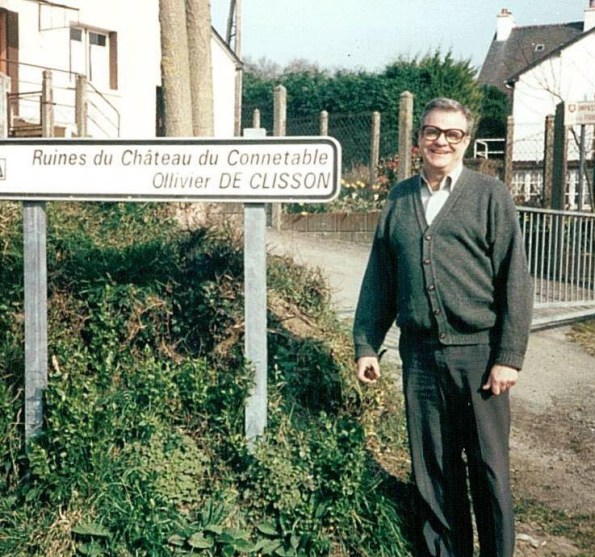
John Bell Henneman, Jr. Courtesy Charlie Henneman.
John Bell Henneman, Jr., pictured here, was a Medieval historian and, following the death of his father in 1992, continued the work of curating the Hubard papers his family inherited. Today, his son, Charlie Henneman is preparing the collection for donation to the University of Virginia.
~
Need to catch up, click here: Buckingham County Notables: The Bolling Brothers, Part I
~
Robert T. Hubard prefaced his essay, “Family Notices,” writing: “For the gratification of my children I now write such details as I have been able to obtain, concerning my ancestors and also those of my wife.”
Hubard was about fifty years old when he made his notes, an age when many of us begin to consider leaving a legacy of family history for future generations.
Hubard’s recollections are part of a large collection of Bolling-Hubard papers now being prepared by Bolling-Hubard descendant Charlie Henneman for donation to the University of Virginia’s archives. This “new” cache of Buckingham County gold includes farm ledgers from Chellowe, Rosney, and Whispering; a slave register from 1856; and more than 2,000 letters, dating from the 1890s to the 1950s.
This gift will complement the University of Virginia’s existing collection: “THE HUBARD FAMILY PAPERS 1749-1950.”
The current finding aid describes its contents, in part, as follows:
This ancestry is represented in the collection by ca. 50 pages of genealogical material. Of interest in the correspondence are letters to Hubard from his brothers William Bolling Hubard and Edmund Wilcox Hubard, a member of the U.S. House of Representatives from 1841-1847, touching on political issues of the period, and ca. 30 letters, 1851-1857, from Hubard’s son, James L., relating his experiences as a cadet at Virginia Military Institute. Also included are a letter from Philip St. George Cocke concerning James Linneaus Hubard’s appointment to VMI, an extensive 1840 letter from Buchner Thruston re: Hubard family history and numerous letters concerning plantation business. Other Robert Thruston Hubard I material of note are his plantation journals, 1847-1871, and his lecture notes for Professor Tucker’s economics class at the University of Virginia in 1828.

Thomas Jefferson
Need to catch up, click here: Buckingham County Notables: The Bolling Brothers, Part I
~
Robert T. Hubard’s sketch of Lenaeus Bolling was a glowing tribute to a moderate, thoughtful man, who like most planters of his era did not shy away from politics.
Lenaeus Bolling, continued
He belonged to the Republican Party and was warmly attached to Mr. Jefferson and his views, although he though Mr. Jefferson ultra in desiring to abolish the freehold suffrage in Virginia. While he concurred with Mr. Jefferson in opposing the politics of Alexander Hamilton in advocating a strict construction of the Federal Constitution, and therefore opposing a National Bank, a protective tariff and etc. as unauthorized by the Constitution of the United States, Lenaeus Bolling would never yield his opinions up to Jefferson or any other man unless convinced of error and believing that no man in Virginia ought to vote except the freeholders, he expressed his astonishment that Mr. Jefferson and other sensible men should avow so much faith in Dick, Tom, and Harry as to suppose that they lived without land, or other property, “mere hangers on and loafers upon society,” should be allowed to exercise political power.
Lenaeus Bolling was the half-brother of my mother, and of course he was my half uncle. I knew him from my infancy until his death. He was fond of my mother and her children. I married his daughter Susan, who was my half first cousin. This marriage had his entire approbation. Upon his deathbed, he spoke to me and of me, in terms of praise and high regard. He never made any profession of religion; but I never saw anyone meet death or speak of it with more composure philosophy, or resignation. My love and regard for him and his character may have insensibly biased my feelings or impaired my judgement in some parts of this sketch; but I know that I have only sought to do justice and to leave to my own sons a faithful notice of the character of their grandfather Lenaeus Bolling.
Coming Next: Buckingham County Notables: The Bolling Brothers, Part IV
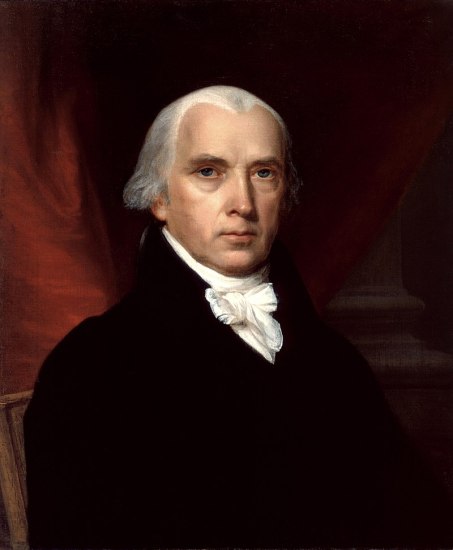
James Madison
Need to catch up, click here: Buckingham County Notables: The Bolling Brothers, Part I
~
In stark contrast to Powhatan Bolling, Robert T. Hubard described at length his maternal uncle and father-in-law, Lenaeus Bolling (1763–1849):
Lenaeus Bolling
Lenaeus had none of the eccentricities or excesses of his brother Powhatan. He possessed much more discretion, sounder judgement, and more respect for public opinion. He was educated at William and Mary College, married at the early age of 21 years, studied no profession, became a farmer and planter, was devoted to his wife and children, had a good library, was fond of reading works on politics, history, and science.
His constitution was not very robust and his health never good. On this account he was not a gentleman of great activity and energy of body. He lived at his ease because his fortune was ample for support of his family, his tastes were plain and he was entirely exempt from avarice. He loved and he practiced economy, not because he loved money, but because he loved independence and abhorred debt. He had no fondness for ostentation or show in dress, or equipage, fine houses, fine furniture, fine dinners, and etc. All these things he held in contempt.
He was a man of fine sense, fond of the company of intelligent people, dignified and graceful in his manners, tall and fine looking, candid, independent and honest in expressing his views, as patriotic as Washington himself and as thoroughly honest in all things as any man I ever heard of. I never knew any man more devoted to truth.
He indulged in no familiarity with others and allowed [none] to be familiar with him. He was an affectionate husband and father, and a kind master. He cared but little about acquiring more property for his children, thinking that he had enough to make them independent and that more probably might prove injurious to them. He served as a member of the House of Delegates from Buckingham (when quite young) during the memorable session of 1799–1800, when Madison’s report was discussed and adopted. He then retired from public life; but was elected again and served in the House of Delegates during the session of 1811–12 and afterwards, he served in the House of Delegates during the session of 1819–20. Becoming somewhat deaf and his health being delicate, he declined being a candidate afterwards, although he took great interest in all public concerns up to the period of his last illness.
Coming Next: Buckingham County Notables: The Bolling Brothers, Part III

Courtesy Library of Congress.
The Bolling and Hubard families are not strangers to the followers of Slate River Ramblings. Over the years, numerous posts have discussed their plantations, including Cellowe and Rosney, and their contributions to Buckingham County history. Recently, Charlie Henneman, who inherited a collection of Bolling-Hubard papers, shared a marvelous biographical sketch, an excerpt from “Family Notices,” written by Robert T. Hubard, dated June of 1858.
Robert Thruston Hubard (1808–1871) was educated at Hampden-Sydney and the University of Virginia. He lived at “Rosney” in Buckingham County and, after 1850, at “Chellowe,” which he purchased from his brother-in-law, Robert Bolling.
In an essay entitled “Family Notices,” Hubbard characterized his maternal uncles, the Bolling brothers: Powhatan and Lenaeus (a. k. a. Linneaus). Dramatically different in character, these Bolling brothers remind us never to stereotype a Virginia planter.
First, Robert T. Hubard takes on the eccentric Powhatan Bolling (1767–1803), who resided at Rosney.
Powhatan Bolling
The two brothers Powhatan and Lenaeus were quite different in many traits of character. Powhatan Bolling died when I was an infant or before my birth, but I have heard a great deal said of him—part of which was no doubt true and part error or falsehood.
He was generally considered rather eccentric and this may have originated mainly from the fact of his contempt for the then prevailing fashions as to dress and his determination to dress always according to his own taste. He always dressed very well, very clean, and often in such a showy manner as to excite the admiration and the wonder of weak mind[ed] people.
For instance, he wore a three cocked hat, a red coat made of the finest English broadcloth, blue vest or pants and etc. Being tall, well formed and a very commanding appearance, always confident and self-possessed, conscious of good descent, endowed with no ordinary intellect, well educated, acquainted with the world, fluent in conversation and possessing no little tact, he was quite a prominent man in his day.
Had his passions been more under his control, had he exhibited more stability and more discretion, he might had he lived longer been a distinguished man. He had some ambition and was a candidate for Congress in opposition to John Randolph the first time that Randolph offered. John Randolph was elected by a majority of five votes over Powhatan Bolling and it was generally thought that in mind and in powers of debate they were well matched.
Powhatan Bolling had, I think, served one session in the Virginia Legislature before offering for Congress, though I am not sure of the fact. After being defeated by John Randolph, Powhatan became more dissipated than before and so continued until his death. He was engaged in two, three or more duels, was very brave and by no means unwilling to engage in a duel or fight for a doubtful cause and certainly for any good and sufficient cause. The ignorant and the vulgar admired him, talked about him and loved him, or were over awed by him and dreaded him; while intelligent and independent men admired his manly appearance, his fine manners, his good sense and etc., although they deplored some of his excesses and his errors.
Click here to learn more: Buckingham Notables: Powhatan Bolling
Coming Next: Buckingham County Notables: The Bolling Brothers, Part II


 slate river ramblings . . . .