

Willis Chambers (1790–1850)
Need to catch up? Click here: Buckingham Notables: The Allens of Hunts Creek, Part I
~
William Allen, 1824 will, continued
When William Allen wrote his will in 1824, it was not unusual to add a provision covering the possibility that a widow remarried. The underlying assumption was that her new husband would provide for her and the estate could then be divided amongst the children of her previous marriage. William Allen did just that, instructing:
In case my wife should marry my wish is, that my land where I now live and two hundred acres in the state of Alabama; my house hold furniture &c. may be sold on a credit from one to three years, and the money arising from the sale and the negroes to be equally divided amongst my children. . . .
Interestingly, Allen stressed that this property was to be divided equally among his children, male and female. In the 19th century, sons most often inherited land. Sometimes daughters only inherited their personal belongings, such as bedding, and a personal servant.
If Nancy Allen remarried, she still got her choice of a horse, feather bed and furniture, and five hundred dollars. Additionally, at her death, slaves in her possession, as well as any increase from the females, would return to her deceased husband’s estate to be divided amongst their children or their heirs. This protected his estate from children that his widow might have with another husband.
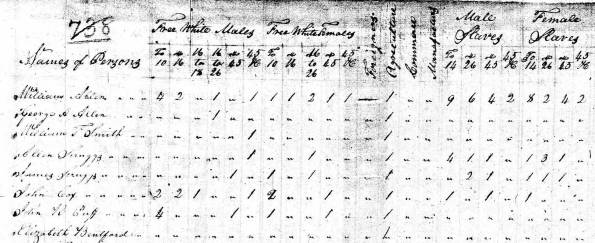
1820 Census, Buckingham County, Virginia.
The witnesses and executors of William Allen’s will reveal more trusted friends and relations. First he named his son-in-law, Willis Chambers, who was a neighbor and a cousin. Sometime before 1820, Chambers had married his first cousin and William Allen’s daughter, Mary Ballard Allen.
The second executor was to be his eldest son, George H. Allen (1799–1842).
The third executor was Walter C. Allen, no doubt Walter Clopton Allen (1801–1848), who was the Allens’ third child and who moved with his family to Tennessee.
Witnesses included Finch Scruggs, a neighbor. A man named Hector W. Scruggs would marry George Hunt Allen’s daughter, Mary Ann (b. 1817).
Another witness was John Cox, who lived close to William Allen in 1820. He owned eleven slaves and was a mature man over the age of forty-five.
Witness William Smith signed with his mark, possibly indicating that he was elderly. In 1820, a man named William T. Smith (over age forty-five) lived adjacent the Allens.
The will was recorded at Buckingham County courthouse on March 8, 1824. Rolfe Eldridge was Clerk.
~
These three surviving Allen wills are chock-full of historical and genealogical clues, waiting to be expanded with complementary sources such as printed genealogies, tax records, and census data. Any and every surviving will from the period prior to the burning of the courthouse in 1869 are nuggets of Buckingham County gold. The Allen wills are no exception.
Special thanks to Jean L. Cooper for transcribing these wills.
~
Science is changing history. For those of you who are members of the Allen family, there is an active Allen DNA project, “The Allen Patrilineage 1 Project,” headed by John B. Robb. Learn more at: http://www.johnbrobb.com/JBR-ALLEN.htm.
~
Available at Amazon: Central Virginia Heritage (Fall 2018)
Also featured in this issue is my article, “Out of the Frying Pan and into the Fire: Tracing My Harris Ancestor from One Burned County to Another.” Don’t be frustrated by the lack of county documents when the local courthouse burns. Complementary and duplicate records can help solve many mysteries!
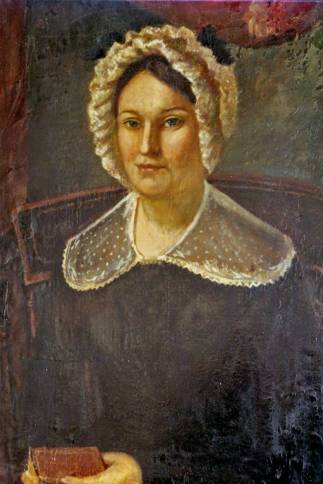
Mary Ballard (Allen) Chambers (1797–1849).
The Fall 2018 Issue of Central Virginia Heritage includes three Allen family wills transcribed by Jean L. Cooper. These wills inspired “The Allens of Hunts Creek.”
Need to catch up? Click here: Buckingham Notables: The Allens of Hunts Creek, Part I
~
The third and final will was written on February 14, 1824 by another William Allen. The nephew of William Hunt Allen, his parents were George Hunt and Mary (Ballard) Allen of Buckingham County. Born on April 5, 1771, this William Allen married his cousin Nancy Allen, the daughter of Samuel and Mary (Mimms) Allen. Dying in middle age, he left a widow with children yet to rear and educate.
Allen’s first desire was that his estate stay whole as long as his wife remained unmarried. She was given her choice of a horse, a feather bed and furniture, and allotted five hundred dollars. It would be a very long time before the estate was divided, for Nancy Allen did not die until June 18, 1855, at which point she was living with some of her children in Tennessee.
William Allen directed that the land he inherited from William Hunt Allen be sold and the proceeds divided among his sons, as William Hunt Allen had directed. Additionally, William Allen owned between 500 and 600 acres adjoining that tract, which he also wished to be sold.
~
As sometimes was the case in the healthier climates in Virginia, this William Allen owned more slaves than were necessary to cultivate his plantation. The excess labor, he wished to be hired out (a common practice at that time), hopefully producing additional income for his widow and his minor children.
According to Allen family genealogist Rev. Richard Fenton Wicker, Jr., William and Nancy (Allen) Allen had twelve children, their births ranging from 1797 through 1819. The youngest was born only five years before his father’s death. Allen’s will directed that his minor children be educated as though he were alive. When they came of age, if they needed assistance from his estate, he wished that they receive gifts equal to those he had already given to his adult children.
Coming next: Buckingham Notables: The Allens of Hunts Creek, Part XI
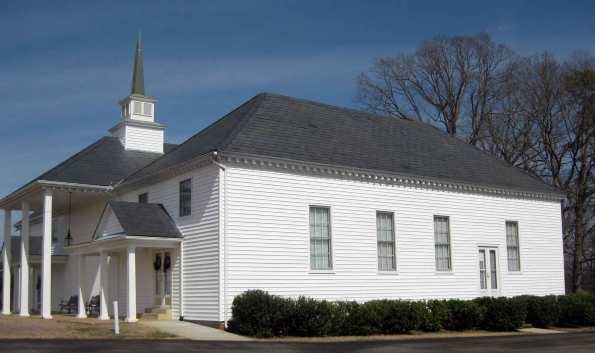
Photo by Joanne Yeck
Buckingham Baptist Church, site of Tillotson Parish’s mother church.
It may be the church referred to in William Hunt Allen’s will.
The Fall 2018 Issue of Central Virginia Heritage includes three Allen family wills transcribed by Jean L. Cooper. These wills inspired “The Allens of Hunts Creek.”
Need to catch up? Click here: Buckingham Notables: The Allens of Hunts Creek, Part I
~
William Hunt Allen, 1806 will, continued
By 1806, the repetition of names in this Allen family had become a genealogist’s nightmare, with multiple William Allens living in Buckingham during the late 1700s through the early 1800s. Without the work of someone like Rev. Wicker, this tangle quickly becomes unwieldy—a classic, infuriating genealogical mess. A perfect example is the decoding the bequest of about 200 acres to be sold after William Hunt Allen’s death.
In addition to his primary plantation, William Hunt Allen owned property in Buckingham County, which he wished to be sold. He described the property not by name but by its boundaries:
. . . my land lying above the road which leads to Buckingham church and adjoining the lands of William Allen deceased, supposed to be about two hundred acres, shall be sold by the person who may have the charge of Wm. Allen’s estate for the equal benefit of Philip Allen and John Allen sons of the said William Allen deceased and the money arising from the sale thereof to be laid out in lands on the western waters and then equally divided, between the said Philip and John Allen.
Was “William Allen deceased” William Hunt Allen’s father who died in 1751/1752? He had a son Phillip and a son John, both mentioned in his Albemarle County will. Son John, however, died in 1754 and Phillip died in 1771. On to the next generation to find these legatees!
William Hunt Allen’s brother, Phillip, had a son named William who was born in Buckingham County c. 1765 and died 1800/1, making him deceased when William Hunt Allen wrote his will in 1806. This William Allen had a son Phillip (1795–1869) and a son John William (1800–1855)—both alive in 1806 to receive gifts from their great uncle. It was these two great-nephews who inherited 200 acres on the road to Buckingham church.
Another tract in Buckingham County consisting of 500 acres was left to two sons of Samuel Allen of Amherst County—Samuel Hunt and John Allen. Samuel Hunt Allen also inherited a “negro girl” named Mary, while his brother George Allen received and oddly qualified gift, the proceeds from the sale of a “negro man” called Jim, should he live until “next fall.”
Two other tracts of land in Buckingham County, totaling 225 acres, were left to a younger William Hunt Allen, son of Jesse Allen. He also inherited a “negro girl” named Charlotte. According to land tax records, covering 1809–1823, this William Hunt Allen was a nonresident of Buckingham County.
William Hunt Allen concluded his last will by appointing Col. Samuel Allen, William Allen (son of George), and William M. Allen (son of Col. Samuel) as his executors. Witnesses to the Buckingham County were Boaz Ford, Milly Chastaine (her mark), and William Ayres. Buckingham County Clerk Rolfe Eldridge recorded the document.
Coming next: Buckingham Notables: The Allens of Hunts Creek, Part X

“A Typical Mammy,” 1897. Social Life in Old Virginia before the War, by Thomas Nelson Page.
Illustrated by Genevieve Cowles and Maude Cowles.
The Fall 2018 Issue of Central Virginia Heritage includes three Allen family wills transcribed by Jean L. Cooper. These wills inspired “The Allens of Hunts Creek.”
Need to catch up? Click here: Buckingham Notables: The Allens of Hunts Creek, Part I
~
William Hunt Allen, 1806 will, continued
William Hunt Allen widely dispersed his slaves, especially to younger family members, some of whom did not live or remain in Buckingham County. Some African-American families may have been divided, though Allen did make an effort to keep at least two mothers together with their children.
Following his widow’s death, William Hunt Allen desired that the “negro girl” Aggy, go to his great-niece Elizabeth Gates. Also, without qualification, Elizabeth received the direct gift of Maggey and her daughter, Fanny. Elizabeth Gates died in Bedford County, Virginia, which may have been the eventual home for these women.
Also following Elizabeth Allen’s death, a “negro boy” named Archer was to be given to William Hunt Allen’s great-nephew, George. His brother, Walter Clopton Allen, received “a negro boy” named George as an outright gift. This Allen line removed to Tennessee, possibly taking their slaves even further from Buckingham County.
Other slaves stood a better chance of staying in Buckingham.
Martha A. (Jones) Cottrell, the mother of George and Walter Clopton Allen, was remembered by William Hunt Allen. Her current husband, Richard Cottrell/Cottrill, inherited two slaves—Candice and Tomboy. William Hunt Allen also left a “negro boy” named Vincent to a man named William Cottrell, who married William Hunt Allen’s niece, yet another Elizabeth Allen, daughter of George Hunt and Mary (Ballard) Allen.
Three sons of Col. Samuel Allen of Buckingham County received the following individuals: William was given Charity and her two children Cissely & Betty; John received a boy named Solomon; and Sutton Farrar Allen became the owner of a boy named Ben.
William Hunt Allen’s great-nephew, Benjamin Clopton Glover, also of Buckingham County, inherited a “negro girl” named Rhoda.
Coming next: Buckingham Notables: The Allens of Hunts Creek, Part IX

Allen Territory. Note: Rocky and Hunts creeks.
Buckingham County, Virginia, northeast corner, c. 1991.
The Fall 2018 Issue of Central Virginia Heritage includes three Allen family wills transcribed by Jean L. Cooper. These wills inspired “The Allens of Hunts Creek.”
Need to catch up? Click here: Buckingham Notables: The Allens of Hunts Creek, Part I
~
William Hunt Allen, 1806 will, continued
William Hunt Allen also gave instructions as to the disbursement of his wife’s property after her death, distributing rather than concentrating his extensive holdings in Buckingham County. Since we don’t know Elizabeth Allen’s age at the time of her husband’s death or her death date, it is difficult to discern how and when her property was dispersed.
First, William Hunt Allen ordered his nephew, William Allen (son of George), to sell the home plantation after his widow’s death and, rather specifically, to purchase lands in “the western country with the profits arising therefrom for the benefit of himself during his life but then to be for the equal benefit of all his sons which he may leave at his death.”
Thankfully, William Hunt Allen identified this William Allen’s father as George. He was George Hunt Allen (1734–1778), who married Mary Ballard. This William Allen was born in Buckingham County on April 5, 1771 and married his cousin Nancy Allen. Members of this line indeed moved westerly, first to Tennessee and then to Texas.
Additionally, after Elizabeth Allen’s death, nephew William Allen (son of George) was to inherit six slaves originally left to Elizabeth. William also directly inherited slaves Hannah and “great Tom,” as well as 400 acres on Rockey Creek in Buckingham County, which he was free to sell and the profits of which were to purchase “lands in the western county.” It was a sizable inheritance.
This nephew was clearly a trusted favorite of William Hunt Allen, perhaps, a surrogate son. From the wording of the will, William Allen was already planning his family’s removal to Tennessee, escaping the increasingly crowded Central Virginia. A widely known gentleman, William Allen is the author of the third Buckingham County will and his obituary appeared in the Richmond Enquirer on March 16, 1824. He died in Virginia before making the move to Tennessee, though his widow and their children went west after his death—perhaps, primarily funded by William Hunt Allen.
Coming next: Buckingham Notables: The Allens of Hunts Creek, Part VIII

Archival Treasures in Virginia
The Winter 2018 issue of Central Virginia Heritage, published by the Central Virginia Genealogical Association, is now available and includes my article “Buckingham County Gold: The Allen Family Papers.” In it, I reveal my complex relationship to this family and offer suggestions about how to utilize the collection and others like it.
As a result of Buckingham County’s courthouse fire in 1869, genealogists and historians lack a solid vein of vital records containing this Virginia county’s rich past and are forced to dig hither and yon for nuggets of information. Today, many helpful records are preserved in private collections, including the impressive “Allen Family Papers” safeguarded in the Virginia Historical Society’s archive, housed at the Virginia Museum of History and Culture in Richmond.
Available at Amazon: Central Virginia Heritage (Winter 2018)

Courtesy Central Virginia Heritage (Fall 2018)
The Fall 2018 Issue of Central Virginia Heritage includes three Allen family wills transcribed by Jean L. Cooper. These wills inspired “The Allens of Hunts Creek.”
Need to catch up? Click here: Buckingham Notables: The Allens of Hunts Creek, Part I
~
William Hunt Allen, 1806 will, continued
First, William Hunt Allen considered the security and comfort of his widow, Elizabeth, who received the household and kitchen furniture, the family wagon, three horses of her choice, half of the Allen stock of cattle, all of the sheep and hogs, as well as any corn on hand and part of the wheat. She also inherited a sizable farm:
[In] lieu and bar of dower in my estate . . . I leave to her during her life the following tract of land, to wit, Beginning at a white oak corner in my fathers William Allens old line, below Hunt’s Creek, thence crossing the creek in the said old line to Guerrant’s line to a branch called and known by the name of the (WA) branch to a path called the Schoolhouse path which is a dividing line, between myself and Peter Guerrant, thence along the said path to my line where it crosses the said path, thence along my line to the land I bought of Adrian Anglin, thence, along the said Anglin’s old line so far as that a line may be drawn therefrom crossing the land which I purchased of the said Adrian Anglin and the land I had of my father to include my Barn and Orchard and four hundred acres of land. . . .
Elizabeth Allen also received slaves to serve her. The will continued:
I also leave to my wife during her life the following negroes to wit, Bettey, Fanny, Peter, Isham, Little Henry, Aggy, Archer and Molly, also a boy by the name of Jerry until he arrives to twenty one, after which time my desire is that the said Jerry may go free. I also leave to [my] wife during her life my negro woman Conday. . . .
Who was Jerry and why was he to be freed at the age of twenty-one? A search of the 1810 and 1820 census did not produce a free black man named Jerry living in Buckingham County. If a Slate River Ramblings reader recognizes him, please comment.
Also, does anyone know which schoolhouse was near Hunts Creek c. 1806? If so, please comment below.
Coming Next: Buckingham Notables: The Allens of Hunts Creek, Part VII
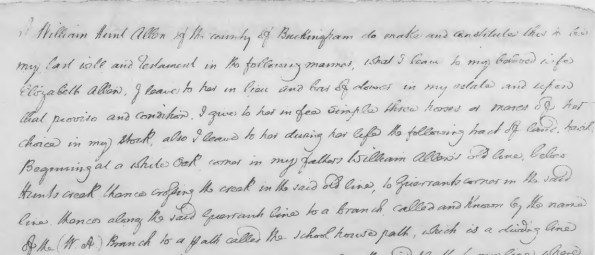
William Hunt Allen will. Courtesy Library of Virginia.
The Fall 2018 Issue of Central Virginia Heritage includes three Allen family wills transcribed by Jean L. Cooper. These wills inspired “The Allens of Hunts Creek.”
Need to catch up? Click here: Buckingham Notables: The Allens of Hunts Creek, Part I
~
The second Allen will transcribed by Jean L. Cooper and published in Central Virginia Heritage (Fall 2018) was written by William Hunt Allen on May 29, 1806, entered into Buckingham County’s Court on October 13, 1806, and now available at the Library of Virginia, it is an extraordinary document filled with clues to Allen family kinship webs, affiliated families, and neighbors in northeastern Buckingham County.
According to Allen-family genealogist Rev. Richard Fenton Wicker, Jr., William Hunt Allen, son of William and Mary (Hunt) Allen, was born in Henrico County, Virginia on May 7, 1724 and married a woman named Elizabeth. Rev. Wicker never discovered her maiden name.
William Hunt Allen, who lived to the age of eighty-two, purchased 680 acres from his father, his property stretching between Slate River and Hunts Creek in Buckingham County. In 1774, he patented an additional 100 acres on Greens Creek in Buckingham and, over the years, purchased numerous additional tracts. An affluent man, on the 1787 tax list, William Hunt Allen reported twenty-six slaves, nine horses, and twenty-nine head of cattle.
Rev. Wicker identifies William Hunt Allen as a leader in the community and the county. Believing Allen to be childless, his property was bequeathed to his widow, nephews, nieces, and other relations. Wicker was saddened by the fact that such an important Buckingham County figure had no lineal descendants, writing: “This editor feels sorrow that no children came from his marriage. They would have been a tremendous contribution to the Commonwealth of Virginia if they had had any of the intelligence, public service orientation, and generous spirit of their father.”
Coming next: Buckingham Notables: The Allens of Hunts Creek, Part VI
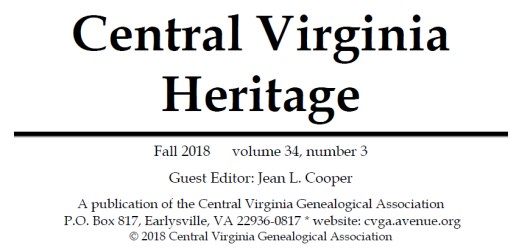
The Fall 2018 Issue of Central Virginia Heritage includes three Allen family wills transcribed by Jean L. Cooper. These wills inspired “The Allens of Hunts Creek.”
Need to catch up? Click here: Buckingham Notables: The Allens of Hunts Creek, Part I
~
Jesse Allen, 1780 will, continued
Jesse Allen of Buckingham, Amherst, and Nelson counties, was the author of the first transcribed will, written on July 27, 1780 and entered into court on June 3, 1782. Unmarried and childless, Jesse Allen left the majority of his property to the family of his brother and sister-in-law, Samuel and Hannah (Jopling) Allen.
Samuel’s son, Jesse Allen, received all of his uncle’s land in Amherst County.
Samuel’s son, George Allen, received all of his uncle’s land in Buckingham County, as well as two Negro slaves, Will and Job.
Samuel’s daughter, Lucy Allen, received a bequest of four Negro slaves: Kate, [illegible], Nan, and Linnas.
Jesse Allen also desired that his brother, Samuel, collect and pay his debts. Once the accounts were settled, Samuel would receive two horses and one mare named Holliday, Buck, and Polly.
According to Rev. Richard Fenton Wicker, Jr., author of The Allen Family of England, Virginia, North Carolina, Tennessee, Mississippi, Texas and Illinois, 1600–1995, Samuel Allen (a. k. a. Samuel Hunt Allen) was born in what would become Buckingham County on November 8, 1750. His will was proven in Amherst County, Virginia, on January 20, 1800, over seventeen years after the death of his brother, Jesse.
Coming next: Buckingham Notables: The Allens of Hunts Creek, Part V

Snowden For Sale. Jesse Jopling, Trustee for Zachariah Nevil.
The Fall 2018 Issue of Central Virginia Heritage includes three Allen family wills transcribed by Jean L. Cooper. These wills inspired “The Allens of Hunts Creek.”
Need to catch up? Click here: Buckingham Notables: The Allens of Hunts Creek, Part I
~
Jesse Allen, 1780 will, continued
To my surprise, I recognized Jesse Allen’s legatee Jesse Jopling, first encountering him through a Nevil-Jefferson connection. (Recall that Jesse Allen’s mother was Betheniah Thomas. Her father was James Nevil, making her kin to Zachariah Nevil of Nelson county who died in 1830.)
In 1803, Randolph Jefferson’s only daughter, Anna Scott Jefferson, married Zachariah Nevil. When Nevil died suddenly in 1830, he left no will and two of his four children were minors. Anna Scott (Jefferson) Nevil had predeceased her husband.
Their oldest son, James Lilburne Nevil, and Jesse Jopling were appointed administrators to Nevil’s estate. Lafayette Nevil chose Jesse Jopling as his guardian.
 Jesse Jopling grew to have a wide influence. In 1810, while living in Buckingham County, he owned thirty slaves, three of them may have been the individuals inherited from Jesse Allen. By 1830, he lived in Nelson County. He died in Albemarle County in March of 1837 and, in July of 1839, his plantation was advertised for sale in the Richmond Enquirer. Located in Albemarle County, “Peach Orchard” contained 700 acres. It was Jopling’s home at the time of his death, described as “valuable and very desirable. . . . Having on it a large and good dwelling house, an excellent young Apple Orchard of choice fruit, grape vines, peach trees, &c.” In addition to these Albemarle lands, there was property in Nelson, to be sold by Holman Jopling and James Pamplin.
~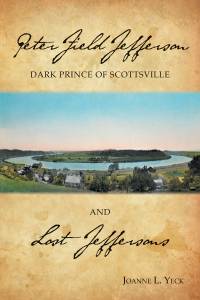
For more about Jesse Jopling, the Jeffersons, and the Nevil family, see “Anna Scott Jefferson: The Rise and Fall of the Nevils of Nelson County,” in my newest book: Peter Field Jefferson: Dark Prince of Scottsville & Lost Jeffersons.
Coming next: Buckingham Notables: The Allens of Hunts Creek, Part IV


 slate river ramblings . . . .