

Illustration by Genevieve and Maude Cowels.
Need to catch up? Click here: Snowden: A Plantation in Buckingham County, Part I
African American Life At Snowden
Over the decades in which the Jefferson family owned the plantation known as Snowden, dozens of enslaved African Americans made it their home.
While it was still Peter Jefferson’s distant plantation across the river from Albemarle County’s first courthouse with only an overseer in charge, Snowden was home to at least six adults and, eventually, a child. Named in Jefferson’s 1755 inventory were: Betty, Quash, Nell, Bellow, Crummel, Sanco, and little Bellow/Bella. The inventory of Snowden’s property included six hoes, indicating that all of the adults were involved in farming.
In 1764, when Thomas Jefferson turned twenty-one, he began the redistribution of slaves to satisfy his father’s will. Ultimately, twenty-four slaves were assigned to Randolph. Quash, Nell, little Bellow/Bella, and, possibly, Betty, left the farm, taking up residence at Monticello. Initially, Crummel, Sanco, and Bellow may have stayed on in Buckingham, while other slaves were selected from Shadwell in Albemarle County and ultimately moved to Snowden. During the years between this distribution and 1776 when Randolph took possession of the plantation, a slave named Hannah died at Snowden as a result of a beating by the overseer, Isaac Bates. Additionally, Randolph received little Rachel, a gift from his mother, Jane Jefferson.
By January of 1782, Randolph Jefferson paid tax on the following individuals:
Nimrod, James, Squire, Peter, Adam, Hanibal, Lucy, Jane, Flora, Effy, Edy, Phillis, Dinah, Orange, Milly, Pat, Daphney, Juno, Dilce, Mary, Sally, Betty, Will, Jupiter, Cyrus, Jack, Frank, Syller (Sully?), Thornton and Jacob.
The following year, some of the names were missing from the tax record and these individuals were added: Statey, Tinny (?), Esther, Luce (Lucy?), two Jennys, Isaac, Cary, Elijah and Perkins. Cary, it is known was a recent birth at Snowden.
Most, but not all, will remain only names in tax records. However, in a few special cases, details of the lives of slaves at Snowden survived in correspondence and other records.
Thomas Jefferson eventually purchased Ben and Cary, whose lives at Monticello differed sharply. Ben proved a satisfactory worker, while Cary was disruptive and eventually was sold to a Georgia slave trader.
Much later, in May of 1813, Fannie was trained at Monticello as a spinner, to work on the Spinning Jenny sent to Snowden by Thomas Jefferson from his Bedford County plantation, Poplar Forest.
In the early 1800s, Squire was frequently mentioned in Thomas Jefferson’s memos and in correspondence between the Jefferson brothers. He may be one of the two individuals named Squire listed on Peter Jefferson’s 1757 inventory, one of whom was a boy valued at £27.10.
The story of Orange and his wife, Dinah, is complex and moving. Sometime before 1782, Orange was transferred from Albemarle County to Snowden in Buckingham. There, Orange was a trusted and mobile servant, running errands for Randolph Jefferson as he had previously done for Thomas Jefferson. He was particularly motivated to visit Monticello, where Dinah remained. Separations like this were common with enslaved couples; some planters were more accommodating with visits than others. Ultimately, Orange and Dinah had at least three children together.
~
My book, The Jefferson Brothers, is currently discounted online at Braughler Books. Learn much more about slavery at Snowden in the chapter entitled “The Jefferson Servants.” Click here to download a PDF of Chapter 1, “Peter Jefferson, Gent.”: The Jefferson Brothers
Coming Next: Snowden: A Plantation in Buckingham County, Part V
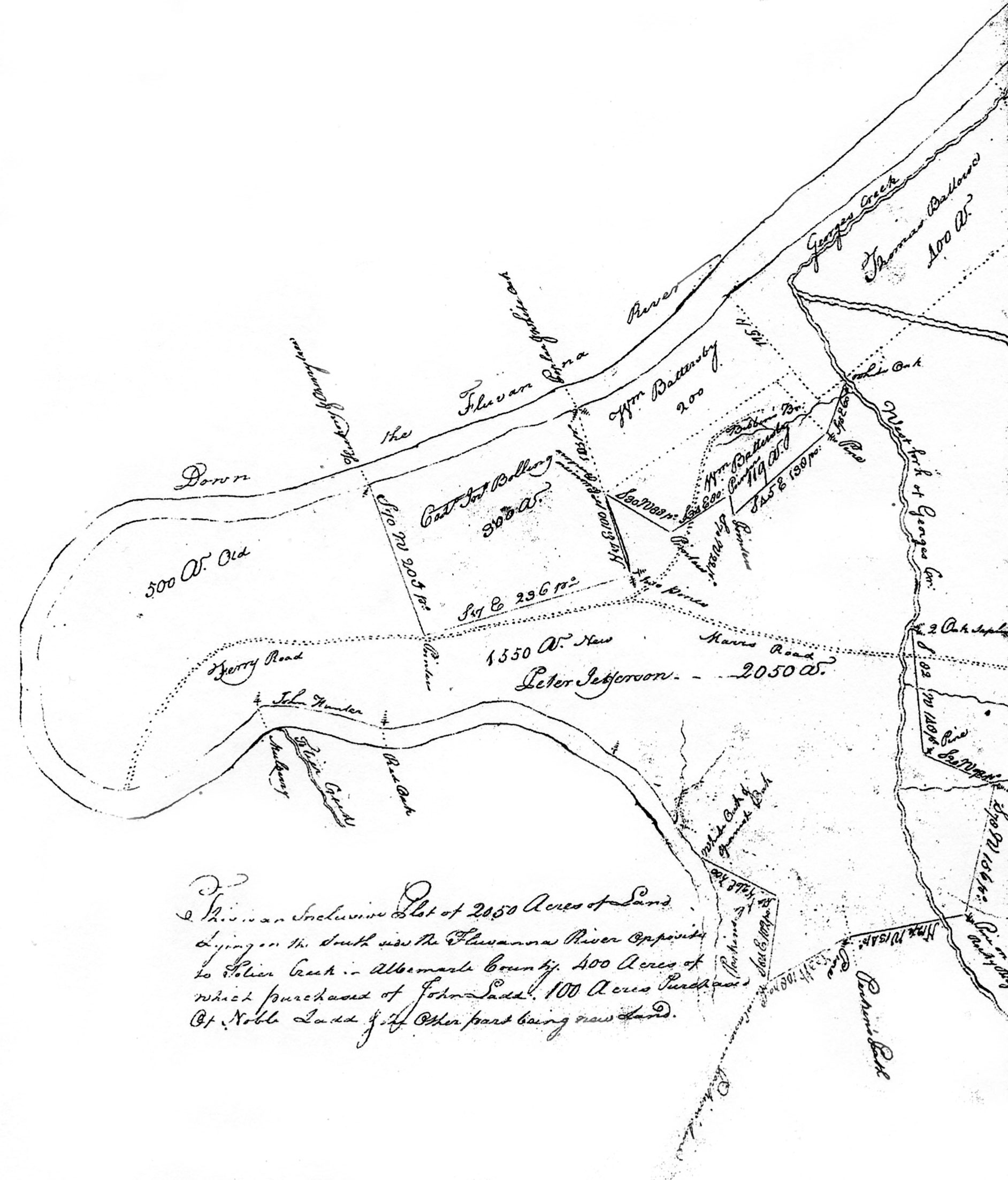
A survey of Peter Jefferson’s “Snowdon”.
Need to catch up? Click here: Snowden: A Plantation in Buckingham County, Part I
The Randolph Jeffersons at Snowden
During Randolph Jefferson’s lifetime, Snowden functioned as a typical Central Virginia plantation, supporting Jefferson and his wife, Anne “Nancy” (Lewis), as well as their five sons: Thomas Jefferson Jr., Isham Randolph (aka Randolph, Jr.); Robert “Lewis”; Peter “Field”; James “Lilburne”; and one daughter, Anna Scott “Nancy” (Jefferson) Nevil. Enslaved African Americans worked the fields which included tobacco, an important cash crop.
From about 1800 to 1809, Jefferson lived at Snowden as widower. His married son, Thomas, and his daughter, Anna Scott, who married Zachariah Nevil, lived with him. The men founded a manufacturing business, “Nevil and Jefferson.” The plantation, a growing Jefferson commune, provided a pleasant home for the young Nevil children, James “Lilburne” and Louise Ann. Thomas, with his bride and cousin, Mary Randolph “Polly” Lewis, lived along side Randolph’s bachelor sons, Randolph, Jr., Lewis, Field, and Lilburne.
In about 1809, Randolph Jefferson’s second marriage to the much younger Mitchie B. Pryor drove a wedge between him and his children. “Nevil and Jefferson” was dissolved and, with the exception of Lilburn Jefferson, Randolph’s extended family departed Snowden.
Life with Mitchie was fraught with disagreements, particularly concerning her lavish spending habits.
Following Jefferson’s death in 1815, there was a contest of two wills. One was written in 1808 and a copy was held by his brother, Thomas. The other was a “death bed will” presented in court by his widow, Mitchie. Unfortunately, details of the outcome of the court case are sparse and the results must be inferred from subsequent ownership of Randolph Jefferson’s property.
Within months of his death, in early 1816, the dwelling house at Snowden burned to the ground. No description of it survives. To date, no foundation has been discovered, nor have the graves of Randolph and Anne (Lewis) Jefferson been located.
Mitchie left Snowden just a few days before the fire, going to the Pryor farm in central Buckingham. There, on March 8, 1816, John Randolph Jefferson was born — never to know his father or life at Snowden.
~
My book, The Jefferson Brothers, is currently discounted online at Braughler Books. Click here to learn more and download a PDF of Chapter 1: The Jefferson Brothers
Coming Next: Snowden: A Plantation in Buckingham County, Part IV
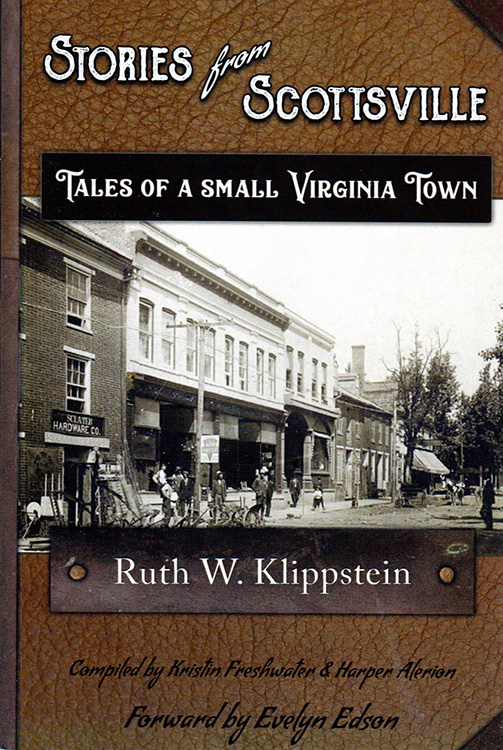
Over the years, many followers of Slate River Ramblings enjoyed Ruth Klippstein’s articles in the Scottsville Monthly. Now you can revisit them in the collection, Stories from Scottsville: Tales of a Small Virginia Town.
Fifty articles were selected by Barry Grove and the publication was completed by his widow, Leanne.
Curious about which topics are included? The table of contents is available at Scottsville Museum’s website: Scottsville Museum: News and Events.
Stories from Scottsville can be purchased online at Amazon.

The road to Snowden. Photo by Joanne Yeck.
Need to catch up? Click here: Snowden: A Plantation in Buckingham County, Part I
Snowden and the American Revolution
Randolph Jefferson’s personal involvement in the American Revolution was brief when he joined General Thomas Nelson’s Corps of Light Dragoons in 1778, however, later in the rebellion, Snowden played an important role.
Just prior to his marriage on July 30, 1781 to his cousin Anne “Nancy” Lewis, Randolph Jefferson came to the aid of the Revolutionary cause.
On June 1, 1781, several men from Buckingham County helped remove military stores from Scott’s Ferry to New London in Bedford County. While Randolph Jefferson did not join them, he loaned the services of one of his slaves and volunteered 20 bushels of oats, 2 barrels of corn, and 38 lbs. of bacon for the guards, as well as a wagon for removing the military stores. The provisions were later valued at £3.18.6.
Beginning in June, the 3rd Regiment of Light Dragoons camped at Snowden for over a month. Randolph eventually claimed the use of his pastures for seventy-three head of cattle for forty-seven days. Feed included seventy-six feet of tops and 600 bundles of fodder which fed seventy-three beeves for twenty days and an additional eight head of cattle for thirty days. This claim alone totaled £6.11.0.
Capt. Presley Thornton of the Continental Army, among the men encamped at Snowden, wrote certificates for donated goods. His presence is a tangible reminder that during the summer of 1781, Randolph Jefferson enjoyed not only troops on his plantation, but also the company of officers. The events of the summer of 1781, particularly the successful protection of military stores at Scott’s Ferry, proved to be a definitive moment in the war. From that turning point on, it was a march towards Yorktown and victory for the Continental Army. Along with other patriotic citizens of Buckingham County, Randolph Jefferson and the fields of Snowden rose to the demands of the day.
~
My book, The Jefferson Brothers, is currently discounted at Braughler Books. Click here to learn more and download a PDF of Chapter 1: The Jefferson Brothers
Coming Next: Snowden: A Plantation in Buckingham County, Part III

“Snowden” marked on the Fry-Jefferson Map
In 1995, I began to investigate my maternal grandmother’s Virginia heritage. This research quickly snowballed into an interest in her native Buckingham County, particularly 19th century plantation life. A branch of my grandmother’s Harris family purchased a farm called Snowden from the estate of Randolph Jefferson. When I discovered this, I hadn’t the faintest idea who Randolph Jefferson was. It didn’t take long to find out. . . .
Since then, my research concerning Randolph Jefferson and Snowden has never ceased and has resulted in multiple publications, including The Jefferson Brothers (2012), Peter Field Jefferson: Dark Prince of Scottsville and Lost Jeffersons (2019), Peter Jefferson’s Snowdon: A History of Settlement at the Horseshoe Bend (2020) and “The Dwelling House At Snowden: A Virginia Historical Inventory Case Study.” (Central Virginia Heritage, Summer 2020).
The series that follows is just a taste of what I believe is a fascinating history of what was once a very valuable plantation, located at the Horseshoe Bend of the James River.
~
Peter Jefferson’s “Snowdon”
In the 1750s, Col. Peter Jefferson, father of future President Thomas Jefferson, assembled a plantation on the south side of the James River, at the Horseshoe Bend, located across from the new Albemarle County Courthouse at Scott’s Ferry. There, Jefferson assembled by purchase and patent over 2,000 incredibly valuable acres consisting of both high and low ground. He named his farm “Snowdon,” after the family’s presumed homeland in Wales. Located at the center of the newly formed Albemarle County, Jefferson envisioned not only the potential for a productive farm, but also a lucrative ferry landing — complete with an ordinary, or tavern, at the river. While he did not live to see his vision realized, Peter Jefferson’s plantation would blossom into an agricultural and commercial success in the decades to come.
When Peter Jefferson died on August 17, 1757, he owned two significant plantations: Shadwell, near the Rivanna River where he made his home, and the distant Snowdon, occupied by a handful of enslaved field hands, a few horses, and some livestock. When Peter’s elder son, Thomas Jefferson, came of age, he chose Shadwell as his own. Here he would eventually build Monticello. As a result, his much younger brother, Randolph, inherited Snowdon. Beginning in 1776, when he reached the age of twenty-one, Randolph would claim Snowdon. Over the years, spelling drifted to Snowden (conforming to pronunciation). There, Randolph Jefferson settled with his bride, raised his family, and remained until his death in 1815.
~
For much more about Snowdon during Peter Jefferson’s lifetime, consult my book, Peter Jefferson’s Snowdon: A History of Settlement at the Horseshoe Bend
Coming Next: Snowden: A Plantation in Buckingham County, Part II

Courtesy University of Virginia
In 1937, Rosa G. Williams surveyed Montevideo for the Virginia Historical Inventory. She began by locating the property, 9 miles west of Buckingham Courthouse on Route 60, then 7.4 miles northwest on Route 56, then 5.1 miles on Route 601. The house sat to the east of the highway.
Established in 1785, Montevideo was also known as Repton. The owners, as determined by Mrs. Williams were: Col. Joseph Cabell, Jr. (1785), Gov. William Cabell (about 1810), Maj. Charles Yancey (1830), Mrs. Charles Morriss (1835), Walter Morriss (1890), and Mrs. Walter Morriss (1920, still the owner in 1937).
The original house burned during the Civil War and, Mrs. Williams remarked, it was said to have been one of the “finest homes” in the county. The side of the house overlooking the James River was made of glass, indicating a spectacular view.
The property carries with it some fascinating tales. Mrs. Williams wrote:
In the year 1785, Col. Joseph Cabell, Jr. moved to Buckingham from Amherst County, and settled on the James River near Warminster. He built a lovely home and named it “Repton”. A number of years later, he sold the place to Governor William Cabell, who changed the name to “Montevideo”. Maj. Charles Yancey won his estate from Governor Cabell in a card game, and gave it to his daughter, Mrs. Charles Morriss.
According to tradition, Mr. Morriss found one of the colored boys asleep while minding the cows, and tied him to a board for punishment. The child’s mother, who was a slave and maid in house, to retaliate, started a fire in the bureau drawers, which destroyed the whole house. The colored boy grew up to be a noted colored preacher.
After the fire, the family moved into the Overseer’s House. It still stands, and is occupied by the widow of Walter Morriss who inherited it from his mother, Mrs. Charles Morriss.
If a Slate River Ramblings reader knows more about the burning of the dwelling house at Montevideo, please comment.
For more about Montevideo, click here For Sale: Montevideo

In 1904, the Appomattox and Buckingham Times reported the death of Lucy McKinney, “a very worthy” colored woman who fell from a cherry tree, breaking her neck. The correspondent from Andersonville in Buckingham County offered these details: “She lived but a short time. She did not speak after the fall. She was buried today (June 27, 1904). The children in the North sent a telegram not to bury her until they came. She lived at the Merryman place, immediately on the road from this place to the courthouse.”
In 1900, Lucy McKinney (age 56) celebrated forty years of marriage. The mother of twelve children, seven still survived. Two sons, John and Pollard, lived with her and her husband, James (age 64). In 1880, the family was enumerated as “mulatto.”
Currently, James McKinney’s possible connection to the family of Governor Phillip McKinney is unknown.
If a Slate River Ramblings reader knows more about Lucy McKinney and her family, please comment.

Following the January 6, 2022 post at Slate River Ramblings, Bob Flippen commented that the Appomattox and Buckingham Times had misidentified William J. Phaup as W. J. Phauk. Click here to read the post: Buckingham Notables: S. R. Morris
Bob kindly gave permission to share his transcription of a much lengthier report in The Farmville Herald, published on August 11, 1894.
Mr. Phaup’s Mournful Death
August 11, 1894
Not in the memory of the writer has there occurred in this locality a more tragic and distressing death than the one which accidentally befell that good man, Mr. William J. Phaup, near Buckingham Springs late Saturday evening. Mr. Samuel R. Morris was hunting not many yards from the roadside and had just shot at a squirrel, Mr. Phaup rode up, with one of his little boys riding behind him on a horse. “Hello, Sam,” exclaimed Mr. Phaup, “I’ll bet you didn’t kill him!”
“Look up the tree and see,” replied “Sam”, at the same time breaking his gun to reload, and as he brought the stock and barrels together, one of the shells went off, the load entering Mr. Phaup’s left side, one or two shot taking effect in the little boys face. As soon as the shot was fired the mortally-wounded man reigned in the frightened horse and reeled in the saddle. Mr. Morris caught him, and let him down as easily as he could to the ground, and as this was being done he spoke his last and only words. They were: “Lord have mercy! My friend, you shot me to the heart and killed me.” It appears that one of the hammers to Mr. Morris’ gun would not stand half-cocked, and hence the premature discharge.
Mr. Morris leaned the dying man against a tree and as tenderly cared for him as it was possible under the circumstances, but he lived only two minutes. A colored boy, named Philip Gray, who witnessed the whole occurrence, was sent after a wagon, and the body taken a short distance to Buckingham Springs, from which place the awful news was dispatched to the family of the deceased, only a few miles off.
Mr. Morris then sent for Mr. P. M. Jones, who is a magistrate of that district, and requested a coroner’s inquest. A jury was at once summoned, and after the evidence of Mr. Morris, G. W. Carter (brother-in-law of Mr. Phaup) and the negro boy who saw the accident, render the following verdict: “We, the jury, find that William J. Phaup came to his death from a gunshot wound, caused by the accidental discharge of a gun in the hands of Samuel R. Morris, and we, the jury fully exonerates said Samuel R. Morris from all blame for the accident.”
The deceased leaves a wife and seven little children. He was the son of Mr. J. J. Phaup, who dropped dead on Main Street in this place last September, and the brother of Rev. Leroy J. Phaup, of the Virginia Methodist Conference.
Mr. Phaup was very highly thought of by not only the people of his immediate community but by all who knew him. He was a valued and valuable man, and the church, in which he was a useful officer, the neighborhood and the state lose an upright and worthy Christian and citizen in his untimely death.
The little son who was also shot at the time of his father’s accident, at last reports was doing very well, and it is hoped no serious results will come of his wound.
The funeral of Mr. Phaup occurred at 5 o’clock from Smyrna church, conducted by Rev. Mr. Proctor, the pastor, assisted by Rev. L. B. Spencer, of Lunenburg, and Rev. R. H. Bennett, of Farmville, and his remains laid to rest by the side of his father in the church yard cemetery. The procession was one of the largest ever seen in that county which attested the high regard in which the deceased was held by those who knew him. A large number of friends from Farmville attended the sad rites. The stricken and greatly bereaved widow and fatherless children, and the neighbor and friend from whose hands the heart-rending accident occurred, all have the unfeigned sympathy of good people.
Robert G. Flippen compiled two volumes of newspaper articles concerning Buckingham County which originally appeared The Farmville Herald: Historical Notes on Buckingham, 1890-1899 and Historical Notes on Buckingham, Volume II, 1900-1909.
To learn more, click here: Buckingham County News: The Farmville Herald

Buckingham Springs (Courtesy Historic Buckingham)
On August 16, 1894, the Appomattox and Buckingham Times ran the following notice for a tragic death in Buckingham County:
A few days since Mr. S. R. Morris, of Buckingham Sulphur Springs, accidentally shot and killed Mr. W. J. Phauk.* Mr. Morris was squirrel hunting and had just killed a squirrel when Mr. Phauk rode up. Mr. Morris was using a breech loader and had put in another shell and was in the act of snapping the gun together again when the gun discharged, the charge striking Mr. Phauk in the heart, killing him almost instantly. Mr. Phauk was buried the following day at Smyrna Methodist Church of which he was a constant member. Mr. Phauk leaves, besides a wife and seven children, a mother and three brothers to mourn his ultimate end
*”Mr. W. J. Phauk” is William J. Phaup.
Click here to learn more about Smyrna Methodist Church.
For much more about the Morris family and Buckingham Sulphur Springs, please search the archive at Slate River Ramblings and consult “’Going to the Springs’ in Buckingham County” in my book, “At a Place Called Buckingham,” Volume Two.
“At a Place Called Buckingham,” Volume Two is currently discounted online at Braughler Books.

The Roanoke Times. Courtesy Virginia Chronicle.
Need to catch up? Click here: Buckingham Crimes: Whiskey Leads to Murder, Part I
On August 3, 1904, the Appomattox and Buckingham Times published news about the murder trial of John Henry Banks, “The trial of John Henry Banks indicated for the murder of John Brown consumed only an hour or two of the time of the court. The jury in a few minutes after retirement, returned with a verdict of murder in the first degree. The judge fixed upon September 30 as… [Illegible].”
Later, on August 24, 1904, the Times printed more about Banks’ fate, the details again submitted by correspondent Quoit.
The colored man Banks who is confined in jail, condemned to be hung on 30 September was visited in his cell by your correspondent… Banks was intently studying the contents of the book he held in his lap when you’re correspondent entered. I inquired as to what kind of book he was reading. He replied it was the Bible. I asked him if he realized that his time was short, and if he was ready to meet his Maker. He replied that he was ready. I then asked him to let me see the book he was reading. He handed it to me [illegible] …I then asked him if he knew that it not the Bible, and if he could read it all. He replied he could read a little, but did not know that the book he was reading was not the Bible. I told him I would send him a Bible if he would like to have one. I was informed that his fellow prisoner, Robert James, who is charged with felonious shooting, was at that time using the Bible and that he could have the use of one whenever he wanted one. He said that he had made his peace with God and was ready to go. But your correspondent was irresistibly impressed that he hardly recognized what he was saying.
John Henry Banks had nearly two months to consider his actions and repent before meeting his Maker.
On October 1, 1904, the Roanoke Times ran a brief statement concerning the hanging of John Henry Banks:
Murderer Pays Penalty.
Richmond, Virginia, September 30 —Special. — John Henry Banks, a negro, was hung at Buckingham Courthouse today the murder in July (sic) last of John Brown, also colored.
~
Readers are left with several questions. Did Elmore Eldridge survive? What was the grievance between John Henry Banks and Preston Eldridge? Did Banks, as the Roanoke Times suggested, also hold a grudge against John Brown?


 slate river ramblings . . . .