

In April of 1958, Charlottesville’s Daily Progress ran an article recounting the story of the American Revolutionary hero Peter Francisco. Unsigned, it was sent to the newspaper from Ransons, Buckingham County and offers a glimpse of the Francisco legend as it was preserved into the mid-twentieth century. The title, “Unusual History Remains Behind Peter Francisco,” prepared the reader for the hero’s mysterious beginnings. The article opened: “There is an old home near the Buckingham-Cumberland County line which is fast returning to dust. It was once the home of Peter Francisco, a giant of a man who served as a Revolutionary war soldier and friend of Gen. George Washington and the patriot Lafayette.”
The reader was informed about a tall, granite monument in Greensboro, North Carolina which marks the spot where Peter Francisco, “a giant of incredible strength,” killed eleven British soldiers, single-handedly. His final resting place, after many adventures, is in the Shockoe Hill Cemetery in Richmond, Virginia.
The article recounts the oft-repeated tale of the orphan Francisco crossing the Atlantic Ocean to be put ashore at City Point, Virginia. The small boy, aged five or six, could not tell the Virginians much about his life somewhere across the sea. According to the article, he had “flashes of memory” of a “splendid home and kind parents.” He even recalled a little sister.
Soon, the boy was discovered by Judge Anthony Winston of “Hunting Towers” (Buckingham County). The judge took Peter home with him, reared and educated him, and did not prevent him at the age of sixteen from volunteering in America’s fight for freedom.
Coming next: Peter Francisco, Part II
“Jones Store House at New Store,” Virginia Historical Inventory.
Courtesy Library of Virginia.
Click here for Jones Store, Part I.
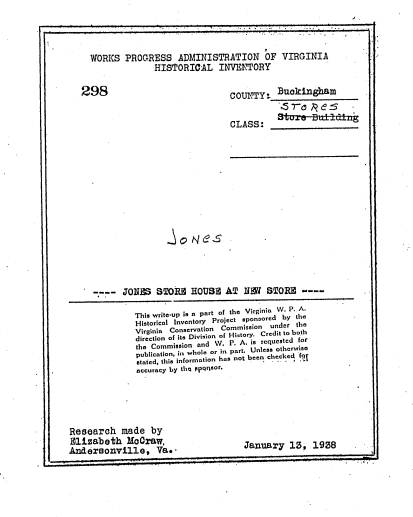
In 1938, when Elizabeth McCraw surveyed “Jones Store House at New Store” for the Virginia Historical inventory, she was doubtless excited about its historical importance, writing:
From the store, [the village of] “New Store” received its name. Mr. Sidney Venable, a Presbyterian Minister from Hampden-Sydney, said his great grandfather built this store house. William Dribell Jones, was married in 1818, kept store here before his marriage, and as the Venables were before him, the store was evidently built in the early 1800s.
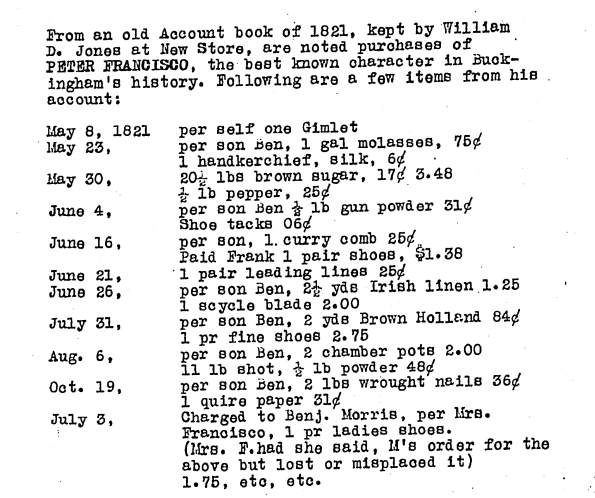
An old account book, dated 1821, which belonged to William D. Jones included purchases by perhaps Buckingham County’s most famous son, Peter Francisco. His accounts reveal that Jones kept a general store, stocking contents that ranged from molasses, brown sugar and pepper to gunpowder and shoe tacks. You could purchase a curry comb for your horse or pair of shoes. There were yard goods for sale, including Irish linen. Mrs. McCraw continued:
William Dibrell Jones conducted an extensive mercantile business at New Store. He bought country produce of any kind, including furs and livestock. It is known that he had on hand at one time, as many as 3000 hogs. He sent great wagons to New York with country produce for sale from his seat of business at New Store in Buckingham County, Virginia.
The great-grandson of William Dibrell Jones, the fourth generation to conduct a store under the Jones name, has his store at Sheppard, Virginia, about four miles distant from the first one. The old store building at New Store is vacant. New Store is a voting precinct and the Democratic Primary is held in this building, as well as the General Elections.
“Jones Store House at New Store,” Virginia Historical Inventory.
Courtesy Library of Virginia.
In 1938, Elizabeth McCraw of Anderson, Virginia, surveyed “Jones Store House at New Store” for the Virginia Historical Inventory. Located on Route #609, Mrs. McCraw estimated the building was built about 1800, noting as usual that the courthouse records in Buckingham County had been destroyed by fire. She identified the Venable family as the first owners, followed by the Jones family in about 1818. At the time of the survey, C. L. Jones was the proprietor. Her description of the architecture was thorough:
This old store building is right by the side of the road, Route #609, and is noticeable, though vacant. The two large windows on the front have shutters made in three sections, also iron crossbars to fasten the shutters securely.
There are two entrances on the front; a double door entrance with transom and a large plain single door entrance. The brick foundation forms the walls to the cellar, which is under the entire building. The large store room which is entered from the front, has the original shelves and several of the old counters are still in place. Wide planks are noticeable in the floor. There are two rooms to the back and one to the side of the large store room. Two of the smaller rooms were for storage and one was the “Counting Room.” The Counting room has a large fire place, over which is a high, plain mantle. The three six panel doors have large iron locks and “HL” hinges. Very wide planks are in the floors. The rooms are ceiled with wide planks too. Overhead the heavy sleepers are left out or exposed, and these are black with the exposure of many years.
Coming next: Historical significance of Jones Store.

In 1905, the Appomattox and Buckingham Times ran an article about the founding of Lithia Springs near New Canton. Located on the farm of Mr. W. L. Boatwright, the newspaper claimed that the springs were very valuable. The article went on to say:
For a hundred and fifty years they have been flowing from large rock on the outside and water has been used by the people in this county and others for stomach, liver and kidney troubles, and skin eruptions. The use of the water was so beneficial to all who drank it that Mr. Boatwright was persuaded to have it analyzed. A sample was sent to Dr. Wm. H. Taylor, State Chemist and when the analysis was completed it exceeded all expectations and proved this water to be one of the most valuable in the world. The springs are now in the hands of a number of capitalists and business men who have formed the Buckingham Lithia Springs Co. They are now rapidly shipping this water to various parts of the United States, and the springs and grounds are being prepared for buildings and baths to accommodate demands for admission from sufferers with these troubles. At present the hospitable home of Mr. W. L. Boatwright has been procured to accommodate all visitors to the springs and a man is kept on the grounds to furnish people who come to the springs for the water.
Curious about health spas and springs in Buckingham County, Virginia?
Consult “’Going to the Springs’ in Buckingham County,” in “At a Place Called Buckingham,” Volume Two.
Rev. Caesar Perkins. Courtesy E. Renée Ingram and Charles W. White, Sr.
Click here for Buckingham County: The Winter of 1872, Part I
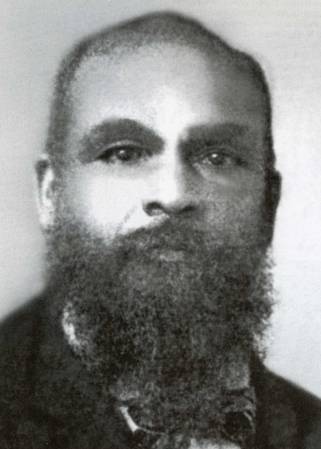
When M. B. D. wrote his letter to Richmond’s Whig in December of 1872, he strove to balance his condemnation of some irresponsible men with the steadfastness of others. His dislike for Radical Republican Frank Moss was shared by many, however, his criticism of Rev. Caesar Perkins is a bit surprising. His letter concluded:
About the Crops.
Notwithstanding the exceeding unfavorableness of the year for all manner of crops, they have not been injured to anything like the extent which was anticipated. Two colored men, James Clark and Ben Moseley, renting land from William Merry Perkins, Esq., working two yoke of oxen, made ninety barrels of corn, several hogsheads of tobacco and other crops, oats, etc. George Shepard and Zach Griffin are two other names from the colored ranks to be placed on a roll of honor as men farming in a farmer-like manner, and living as worthy, upright citizens, supporting their families in independence “laying up something for a rainy day.” How different are these men from Frank Moss (“Hippopotamos”) and Caesar Perkins, of whom it is said that the brutal insolence of the one and the fawning duplicity of the other, have set them apart as objects of scorn and contempt of all well minded persons
M. B. D.
Click for more about Frank Moss.
Click here for a series of posts about the widely respected accomplishments of Caesar Perkins.

Even though today’s holiday remembers the combined birthdays of George Washington and Abraham Lincoln, the folks at Thomas Jefferson’s Monticello are celebrating too.
Haven’t read The Jefferson Brothers?
You can buy a copy online and support Monticello. Visit the Book Store.
If you shop before February 23rd, you can save 20% off purchases totally $125 or more.

Click here for Buckingham County: The Winter of 1872, Part I
In December 1872, Richmond’s Whig printed a letter from Buckingham County, M. B. D. Following a description of lasting drought, the author (whose education included the ability to quote Shakespeare’s Hamlet) condemned irresponsible black men, whom he saw abandon their families to winter’s cruel winds.
Winter In The Country.
Big log fires are very comfortable, and in this well-wooded country they cost little but the trouble of making. Still, they do not answer for clothing or glass and shattered windows. They will not rehang a door swagging on broken hinges, or daub a wall “to expel the Winter’s flaw.” Nor, yet, answer for food for the hungry, nor medicine for the sick, and families there are about the country who know and suffer these privations. In many cases this is the result of the most abject laziness, but instances have come within my observation of negroes who have left their families destitute of food and clothing (and in some cases almost without shelter) and have gone off to the railroads, from whence they only return to vote for some Radical office-seeker and hurry back to the railroad again, perhaps leaving a few dollars to be expended in frippery at some auction stand on court days, leaving wretched, ragged children at “home” to starve to death or burned alive in the flames that often consumed their wretched hovels.
In his final comment, M.B.D. names several honorable black men in Buckingham County, while condemning others.
Coming Next: “About the Crops”
In December 1872, Richmond’s Whig printed a letter from a Buckingham County correspondent. It was signed only with the initials M. B. D. What began as a description of cruel weather during 1872 turned into an opportunity to both criticize and praise black freedmen in the county, naming farmers and two men who represented the county in Richmond. The letter’s lengthy title aptly describes the breadth of its author’s focus.
The Winter Drouth—Cold Weather—Negro Improvidence—
Energy of Colored Farmers—Black Radicals
Buckingham C. H., December 12th, 1872.
A rude gauge, constructed on the most primitive plan, but accurate withal, indicates a decrease of nine inches in the rain-fall of the present year, compared with that of last. This test was obtained about the center of this county, and I suppose is about an average of the Southside section embracing at least one hundred square miles. The drouth has continued into the Winter, and the mills dependent on small streams, as a consequence, are all standing still. The little brooks are reduced to silvery threads winding through the sedge fields, and in the forests they are hidden ‘neath the fallen leaves, and are now frozen. The absolute lack of humidity in the atmosphere gives peculiar zest to the cold and adds a considerable percentage to the doctors’ bills for curing frostbite.
In his next statement, our correspondent found that both Man and Nature could be cruel.
Coming Next: “Winter in the County”

One hundred years ago, December weddings were extremely popular. On January 4, 1905, the Appomattox and Buckingham Times printed the following about a Buckingham County union:
Alcoma.
Davison-Rosin
Miss Anne B. Rosin and Mr. R. T. Davidson, were quietly married at the bride’s home, “Oakland,” on December 18, [1904]. Rev. W. E. Bullard officiated. Mrs. R. I. Morgan was matron of honor and Mr. R. I. Morgan was best man. The parlor was beautifully decorated with holly, ferns and juniper. Mr. and Mrs. Davidson took the C. & O. train at Dillwyn for their new home in Ashland. Attendants were as follows: Miss Bessie Rosin and Mr. Humphrey Steger, Mr. and Mrs. Richard Morgan, Mr. Charles Rosin, Mr. D. M. Word, Mrs. Shellie Saunders and Mr. Irby Saunders.
Mr. C. R. Rosin has just returned from the Valley of Virginia where he received a good price for his cattle and his old friends were very glad to see him.

Buckingham Female Collegiate Institute
Over the twentieth century, several individuals contributed significantly to the history of Buckingham County. Each had their special interests. Some, including Lulie Patteson and Mrs. R. J. Wojnicki, wrote for daily newspapers. Others, including Rosa Williams and Elizabeth McCraw, focused on places in Buckingham and contributed to the Virginia Historical Inventory.
Another Buckingham historian, William Gamaliel Shepard, published numerous articles in William and Mary Quarterly. Keenly aware of losses due to the Buckingham Courthouse fire, he was particularly interested in preserving the contents of original documents, many of which had survived in his family papers. His multipart article tracing the history of Buckingham Female Collegiate Institute is invaluable. During 1937, Shepard also served as an informant for several Virginia Historical Inventory surveys, again providing details about his family homes and surviving papers.
Like so many other aspects of Buckingham County’s history, the works of these individuals are scattered far and wide, and many are destroyed. But all is not lost! A biographical essay of William Gamaliel Shepard can now be found in “At a Place Called Buckingham,” Volume Two.


 slate river ramblings . . . .