

The Prisoners Move to Farmville
On November 23, 1904, Quoit informed the loyal readers of the Appomattox and Buckingham Times of the next development in the Famous Forbes Case – the transfer of the prisoners to Farmville.
Under the guard of Deputy Sheriffs Williams and McCraw and Mr. F H. Spencer and others, Messrs. Charlie Forbes and E. C. Wooldridge were taken to the Farmville jail preparatory to the arrangement for the second time upon the charge of houseburning. The morning before he [Wooldridge?] left he requested that he not be handcuffed en route to Farmville; but the officer informed him that he could not grant the request. As he proposed to take every legal precaution for the safe delivery of his prisoners at their destination. This about terminates the connection of this place with this now famous case. The interest here, however, is still alive, and the final result will be watched with interest.
Though Quoit had lost his front row seat for the next trial and his convenient proximity to Charlie Forbes and Cliff Wooldridge, the Appomattox and Buckingham Times continued to report on the case. In the same issue the editor ran a news article on page four, describing the decision to change the venue to Farmville. The paper reprinted, in part, news from the previous day’s The Times-Dispatch:
Wooldridge was accompanied in court by his two daughters, both comely. They sat by their father with sadden countenances, and only left him when the officers led him and Forbes out of the court room for the jail. [From] Tuesday’s Times-Dispatch.
The prisoners looked very well concerning their long term of confinement. Forbes was seated some distance from Wooldridge – they are not on good terms it is said. Wooldridge was especially talkative and did not appear the least depressed.
Neither Mrs. Wooldridge nor Miss Janie Forbes were present.
Coming next: Jail in Farmville
Need to catch up? Click here for The Famous Forbes Case of Buckingham County: Part I

An Interview with Cliff Wooldridge
On November 9, 1904, an unnamed correspondent from Buckingham County wrote a letter to the Appomattox and Buckingham Times. It read:
Forbes and Wooldridge.
Buckingham correspondent writes as follows:
I went to see Wooldridge and Forbes in jail. Mr. Forbes had just been handed a supper as I entered and to see him devour his food with such avidity reminded one of the fact that he has but lately recovered from his spell of fever; on the other hand, E. C. Wooldridge through his supper out of the window, as he had no appetite.
Wooldridge strenuously denies that he attempted a jail deliverance and said is that the lock had been broken for some time, and that while suffering severely from tooth ache he walked out in the hall of the jail. He is in a very nervous condition, and he realizes this himself, and says that he has been operated on twice before his incarceration, and a man’s nervous system is always impaired by undergoing a surgical operation.
Wooldridge talked freely of his coming trial, expressing confidence in his acquittal, if he gets justice. If he is tried on the charge of jail breaking for which he stands indicted, it will be in the court here, I presume.
A man named Maxey broke out jail here some years ago and was sent to the penitentiary one year therefore.
Under the law an attempt to break jail before conviction and sentence is a misdemeanor, and is not punishable by confinement in the penitentiary. The trial of the cases will hardly be reached before some day in December, when it is understood that Judge Hundley will hold a special term for the purpose.
Judge Hundley moved the cases to Farmville, not for convenience as is alleged by some, but because he was satisfied he would experience great difficulty in obtaining a jury in Buckingham, and in the event of importing a jury the great expense of transportation and hardships a jury would necessarily have to undergo in traveling to and from the courthouse . . . [P]rominent officers of the county say they can get as good a jury has ever went into the box in Buckingham. The judge was not apprised of this statement of the case and in the absence of the attorney for the Commonwealth, and out of an abundance of precaution – that the accused should have a fair and impartial trial he moved the cases to Farmville, where he thinks he can get a jury from the county without any trouble.
Coming next: The Prisoners Move to Farmville
Need to catch up? Click here for The Famous Forbes Case of Buckingham County: Part I

Citizens of Buckingham County Dissatisfied
The October 28, 1904 issue of The Farmville Herald reprinted an article from Richmond’s The News Leader criticizing the change of venue for the Wooldridge-Forbes case. The correspondent was based in Arvonia:
There is widespread dissatisfaction throughout a large portion of this county on account of the change of venue in the noted Forbes and Wooldridge cases, which was granted by the judge at the last term of court. After some preliminary discussion the court agreed that the cases should be tried in Farmville at the next term of Prince Edward court, the third Monday in November.
Judge Hundley stated that he thought it best under the circumstances to make the change of venue for several reasons. The chief reason was the extreme probability that a jury could not be secured in Buckingham of so unprejudiced a mind as to do justice in the case; and to save the bringing in of a jury from elsewhere with its attendant great expense, he thought best to remove the cases to Farmville, a town convenient to a large number of the lawyers and witnesses in the cases, where a jury could be readily obtained from other parts of Prince Edward county.
However strong the argument for the change of venue, the people of Buckingham are generally dissatisfied with the removal. It is openly claimed by some of the most substantial citizens that it is a reproach to the county and a matter of injustice to remove the case. It is strenuously maintained that a jury could, without any possible trouble, have been enrolled in the county. Indeed it is known that venire called at the last term of court contained a number of excellent man, who were ready and willing to serve on the jury–men whom the prisoners themselves did not object to in any possible way. This venire was not even questioned as to their knowledge of the case or their opinions.
It is claimed by the county authorities that revenue is taken from the county. Also that the majority of the hundred witnesses live twice as far from Farmville as they do from Buckingham courthouse. For this reason, and others, there is much dissatisfaction with the change of venue; and an effort will probably be made to bring the case back to this county before it comes to trial in Farmville. While such a step would please few, if any, of the lawyers in the case, it would satisfy the Buckingham people that justice is being done the county; and a retention of the case here would be eminently satisfactory, so far as is known, to the prisoners, whose lives and liberty are at stake.
Needless to say, considerable funds flowed into Maysville during Wooldridge’s first trial. Just feeding all those spectators and lodging some of them was a boon to local merchants, tavern and hotel keepers.
Coming next: An Interview with Cliff Wooldridge
Need to catch up? Click here for The Famous Forbes Case of Buckingham County: Part I
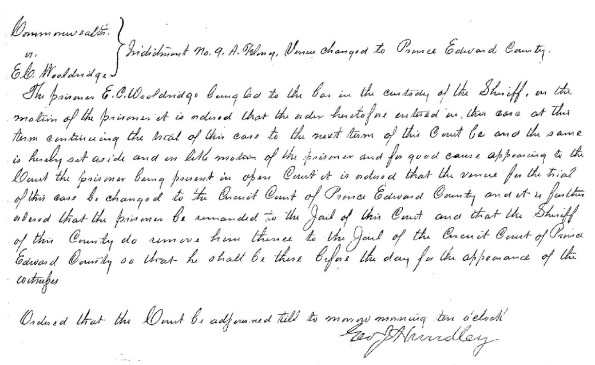
A Change of Venue
Next came a surprising turn of events. On October 26, 1904, The Times Dispatch announced that the trials of Cliff Wooldridge and Charlie Forbes had been moved to Farmville and the Prince Edward County Courthouse. The newspaper noted that the new venue would not only be more convenient for the lawyers but also for witnesses from Appomattox County and the southern part of Buckingham County where the crime took place. This change also meant that Commonwealth’s Attorney E. W. Hubard might have to surrender the prosecution of both upcoming cases to the Attorney for the Commonwealth in Prince Edward County.
A correspondent for The Times-Dispatch wrote from Buckingham Court House:
I heard a prominent county official say that he thought if Mr. Hubard had been here and resisted the motion for a change of venue, that the judge would have had the trials at this place. It will be recalled that nine of the jurors at the trial of Wooldridge voted for conviction. So far as is known no new testimony has been adduced for either side but public interest in the outcome of these cases is unabated, and people are watching the papers to find out any move that is made in the matter.
Charlie Forbes was given the choice of remaining in the Buckingham County jail or being moved to the jail at Farmville. Cliff Wooldridge told the press that he wished to be tried in Buckingham County. There, he had friends and, as the correspondent for The Times-Dispatch put it, “there are people here who have experienced kindness at his hands, while in the adjoining county he would be comparatively a stranger.”
An interesting note concerning the change of venue was printed later in the November 22nd issue of The Times-Dispatch:
Judge Crute thought that an injustice had been done the court in some of the recent newspaper correspondence which had made it appear that Judge Hundley had arbitrarily and without request or consent of the prisoners, removed these cases to Prince Edward. He stated to the court that he had intended correcting this through The Times-Dispatch, but had neglected doing so, hence he would make a statement publicly that it was with the knowledge and consent of his client that the change of venue was granted.
Mr. Flood said that owing to the fact that such an impression had been made upon the public mind, he would say that before asking for a change of venue he had consulted his client (Wooldridge), and that it was at that time the prisoner’s expressed wish that his case be removed.
Did Cliff Wooldridge change his mind? Did H. D. Flood convince him that a trial in Prince Edward County was a good idea? Did the newspaper simply print conflicting reports?
Coming Next: Citizens of Buckingham County Dissatisfied
Need to catch up? Click here for The Famous Forbes Case of Buckingham County: Part I
The Famous Forbes Case
By October 7, 1904, newspapers were rekindling interest in the Wooldridge-Forbes case to be heard on October 11th in Buckingham County’s courthouse. Baltimore’s The American, reprinted a story from Richmond with the blazing headline:
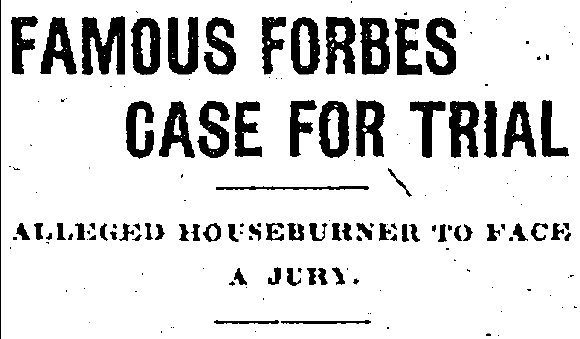
FAMOUS FORBES CASE FOR TRIAL
ALLEGED HOUSEBURNER TO FACE A JURY.
E. C. Wooldridge, Who is Accused of Being the Principal in Firing of Home of John S. Forbes, in Virginia, Will Most Likely Be Put On Trial Again After Forbes’ Case Is Over – Interest Continues at High Pitch and Many Ladies Are Expected to be Present.
The American speculated that Wooldridge would be retried following Charlie Forbes’ trial and stated that the sheriff had summoned twenty men from remote parts of Buckingham County for the trial of Forbes. People living thirty or forty miles away were preparing to attend the trial, including many ladies.
Adding to Charlie Forbes’ troubles, his trial did not begin on October 11th. E. W. Hubard, who was to prosecute, was hospitalized in Richmond at Memorial Hospital. As a result, the newspaper predicted, that Judge Hundley would hold a special term to hear the cases of Forbes and Wooldridge.
Charlie Forbes had been a model prisoner; however, his nerves were frayed not only by months of confinement plus his bout with typhoid fever, but also due to his presumed disappointment of not being tried during the October term and the strain of witnessing the hanging of condemned murderer John Henry Banks which took place just outside Forbes’ cell on September 30, 1904.
Wooldridge, on the other hand, had been a restless prisoner. The October 26th issue of The Times-Dispatch referred to an attempted jailbreak by Wooldridge. Apparently, after Wooldridge was stopped, he claimed that he intended, once out of jail, to surrender himself to officers of the law.
Does that make any sense at all? The officials of Buckingham County thought it did not.
Wooldridge’s attempted jailbreak became the tenth indictment against him. The other nine were for setting fires to nine separate structures on the Forbes estate.
Coming Next: A Change of Venue
Need to catch up? Click here for The Famous Forbes Case of Buckingham County: Part I
Has Forbes Confessed?
During the month of September, when the story of the Forbes case fell quiet in other newspapers, the weekly Appomattox and Buckingham Times kept its readers interested in the outcome of this mysterious crime. On September 7, 1904, the newspaper ran the following sensational headline:
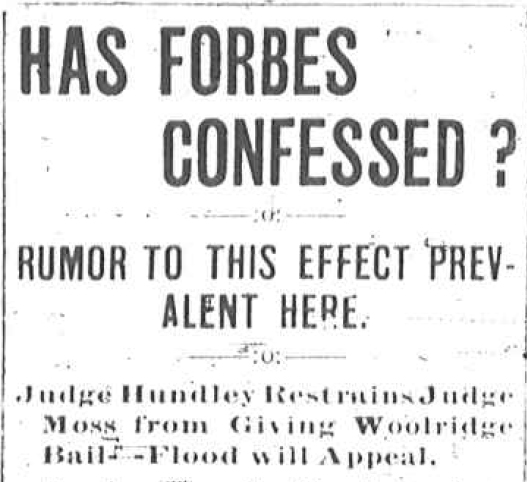
HAS FORBES CONFESSED?
RUMOR TO THIS EFFECT PREVALENT HERE
Sunday Hon. E. W. Hubard, attorney for the Commonwealth, was here on a visit to Congressman Flood. He reported that a rumor was rife in Farmville that Charlie Forbes had made a full and complete confession, and that the language to be used in his confession had been reduced to writing and was in the hands of someone and would be produced at his trial, which is to take place on Tuesday after second Monday in October – the regular term of Court.
A special telegram to our correspondent at Buckingham elicits no response as to the truthfulness of the report, and it is fair to presume that there is nothing in the Forbes’ reported confession.
The rumor spread like wildfire before a cyclone, and the wires to Farmville were soon hot with enquiries. Up to this hour no one has been able to find the originator of the rumor.
The interest in this case has not abated and the good people of the county are determined that no effort shall be spared in running the guilty down; and the public is aiding the Commonwealth in every way it is possible for it to do so.
“The blot upon the fair name of old Buckingham shall be avenged,” said a citizen the other day.
Indeed, the citizens of “Old Buckingham” were understandably concerned about the reputation of their county, as well as the justice due the Forbes family.
On September 14th, unsurprisingly, Quoit commented from Buckingham Courthouse on the rumor about Charlie Forbes:
Our people are at a loss to know how the rumor started that Charlie Forbes had made a confession as to the burning of his father’s property. The rumor seems to have originated a long distance from this place. We had heard no such report, when telegrams were received by the writer, from West Appomattox and Richmond, asking if such was true. Of course we thereupon made diligent inquiry of those who were in a position to know, if such were true, and were informed that there were no grounds whatever for any such report. It seems that the people must have something sensational in this case, even though it has been manufactured out of the solid. Of course it is mysterious, viewed in the most conservative light; and facts are capable of imposing the greatest suspicions, without adding fiction thereto. Forbes’ condition is reported so much improved as to place him out of danger from the effects of the typhoid fever from which he has been suffering.
Miss Janie Forbes, who has been very ill for a week or more past, is going about; and has resumed her vigil about the bedside of her yet feeble brother.
Coming soon: The Famous Forbes Case
Need to catch up? Click here for The Famous Forbes Case of Buckingham County: Part I

Letters from Buckingham Court House
During August and September of 1904, the Appomattox and Buckingham Times continued to print regular letters from Quiot and articles about the Forbes case while the Richmond newspapers focused on other, more pressing, news.
On August 17th, Quoit clarified an earlier correspondence and sent news from Buckingham Court House.
Buckingham.
It seems that my letter, in reference to the application for bail before the Bail Commissioner, made by E. C. Wooldridge, and just after the adjournment of the last term of the Circuit Court here, and which was intercepted by the attorney for the Commonwealth, was misinterpreted by some. It seems that some have understood me as saying that now no more application can be made for bail at all. I did not so mean to say, I thought I made it plain that Judge Hundley stated to counsel for the defense, that he had held himself ready to hear application for bail at any time. I meant to say that no application for bail could be made to the Bail Commissioner ‘till the question of application for writ of prohibition, made by the Commonwealth’s Attorney before the circuit judge, was disposed of in Farmville on September 1, the day set for the hearing of the question of the writ of prohibition.
We regret to report that Charlie Forbes, jointly charged with E. C. Wooldridge with the burning of the Forbes property, is very ill in the county jail with a dangerous type of typhoid fever. That faithful and heroic sister, Miss Janie Forbes, is by his bedside, to render him all the service that lies in her power. It would be grievous indeed if such self-sacrifice, and sisterly devotion as this, exhibited under such discouraging and adverse circumstances, is not finally rewarded, even in this world. While the clouds are heavy and the way now seems dark and threatening, may we not hope that at not a very far distant day the “mist may be cleared away” and there will dawn in the history of this model of womanly Christian devotion, a day of cloudless sky, and the character and reputation of him for whom she is sacrificing her means and physical powers may be cleared of that peace-destroying breath of suspicion? For her sake especially, but it would be so.
Quiot’s interesting ramble about Christian womanly virtues was followed on August 24th by the news that he had spoken to E. C. Wooldridge who was waiting out the hot summer in the Buckingham County jail:
Mr. E. C. Wooldridge, who rests under the same awful charge as Charlie Forbes, who is confined in one of the lower cells of the jail, was visited by your correspondent yesterday. I was glad to find him as well as he was. I had heard that he was in a very nervous and rundown condition. Mr. Woolridge talked calmly and I must say dispassionately about himself and his case. He stoutly maintains that he is innocent, and says that he is praying the Father to give him grace to find in his heart true forgiveness for those who apparently are persecuting him.
Quoit also reported that Charlie Forbes was somewhat improved and his sister, Janie, continued to nurse him and, on August 31st, Quoit added that Charlie was “right much better this morning.” He wrote:
. . . Dr. Morriss, the jail physician, attending him seems in good spirits concerning his case this morning. His sister, Miss Janie, remains with him and will doubtless do so ‘till he is entirely out of danger. . . .
Dr. Morriss was called up into the neighborhood of Manteo to inspect a suspected case of scarlet fever last week. We are glad, however, to add that the cases examined, turned out not to be scarlet fever.
Dr. Morriss, like most country doctors, was always busy.
Coming soon: Has Forbes Confessed?
Need to catch up? Click here for The Famous Forbes Case of Buckingham County: Part I

Charlie Forbes Dangerously Ill
Summers in Virginia brought serious illnesses and the summer of 1904 was no exception. On August 17th, The Times-Dispatch reported that Charlie Forbes had contracted typhoid fever, which was frequently fatal. The front page story, recapped Charlie’s arrest and incarceration, explaining that over the last few days he had developed “a grave case of typhoid fever” and now lay “dangerously ill in his cell.” He was sustaining a temperature of 104°. Dr. Garland Lightfoot Morris, the county physician, attended Mr. Forbes, did everything in his power for the young man, and announced that his case was severe. Charlie’s sister, Janie, remained by his bedside, nursing him. According to the newspaper, she was assisted by her “faithful colored woman.” The article also commented that the jail was old, with wooden floors, many decayed in places and, although it was kept scrupulously clean, there was “something about the building to suggest an unhygienic condition.” Ultimately, contaminated water was blamed for Charlie’s illness. The Times-Dispatch continued:
It is a matter of speculation as to how young Forbes contracted the dread disease. His board is good. He is supplied from the table of the Spencer Hotel, which is noted for its good table. Some think it is the water which he is supplied with; and this is probably the case. During the trial last month many of the visitors, including a number of lawyers engaged in the case, complained considerably about the water of the place, and before court adjourned, quite a number of people were taking medicine.
Charlie Forbes was not the only prisoner who was suffering. E. C. “Cliff” Wooldridge was also complaining. His heart had grown weak, his pulse was difficult to find. A physician told the newspaper correspondent that his debilitation might be due to a serious nervous condition. Both Wooldridge and Forbes were accustomed to strenuous outdoor activity and confinement was debilitating. The reporter observed, “Wooldridge is a man not yet sixty years of age. Since his confinement he might well be taken for a man 10 years older. His nerves are terribly shattered.”
No mention was made concerning the health of the two African-American prisoners, Banks and James.
On August 30, 1904, The Times-Dispatch reported that Charlie Forbes was much improved. It had been twenty days since he contracted typhoid fever. Dr. Morris expected his patient to be entirely well and able to stand trial on October 11th. Likewise, Wooldridge had entirely recovered from his nervous disability.
Coming Next: Letters From Buckingham Court House
Need to catch up? Click here for The Famous Forbes Case of Buckingham County: Part I
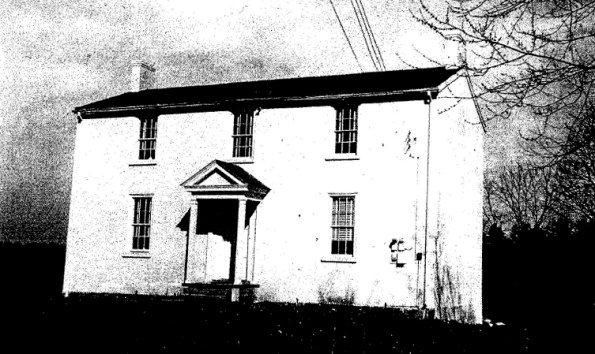
Buckingham County Jail, Courtesy Historic Buckingham
Summer in Jail
On August 5, 1904, Richmond’s The Times-Dispatch announced that the Buckingham jail now contained four important prisoners. The article noted:
The jail here, usually so quiet and uninhabited, has four occupants who are likely to spend at least the rest of the summer in “durance vile.” The Negros, Banks and James (one under a death sentence and the other awaiting trial for shooting his companion), and the two now noted prisoners, Forbes and Wooldridge.
It should be remembered, that Judge Hundley denied bail for Wooldridge until September.
The correspondent, based in Buckingham Court House, continued:
I learn that the expenses of the trial, or rather mistrial, in the E. C. Wooldridge case footed up in costs the neat sum of $1,014, and the end is not in sight.
I hear that the three lawyers who are to appear for Charlie Forbes will get $1,250 as their fee.
On the same day, The Highlander, in its column, “The Old Dominion,” printed a slightly different interpretation of Wooldridge’s ongoing incarceration:
There is unabated interest and intense feeling in Buckingham over the failure to find a verdict against E. C. Wooldridge for the burning of J. H. Forbes (sic) house. It is the general belief that the life of Wooldridge would be in danger if he returned to his home in the neighborhood of the burning. For this reason his counsel kept him in jail previous to the trial, although bail had been granted, and it is likely he will pursue a similar course now.
Coming next: Charlie Forbes Dangerously Ill
Need to catch up? Click here for The Famous Forbes Case of Buckingham County: Part I
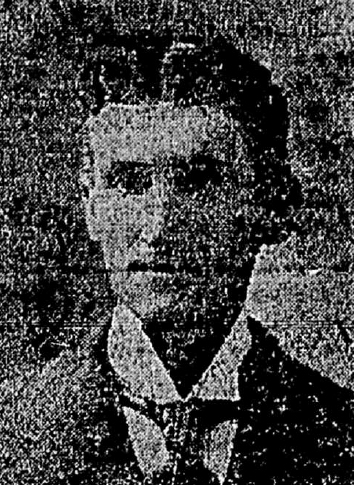
Charles J. Forbes
On July 28, 1904, The Times-Dispatch printed a photo of Charles J. Forbes, son of the late John S. Forbes, accused of burning his father’s home and property. Charlie was twenty-five years old and had been in jail since May 22nd awaiting trial. According to the newspaper:
Young Charlie Forbes is one of the handsomest men in Buckingham county. The picture does not do him full justice. He is a fine specimen of the perfect physical young man; weighs 170 pounds and can carry under each arm a 200-pound bag of guano. He does not talk and will ask to see no one except his sister and his attorneys.
Young. Handsome. Impressively strong. This does not sound like a man with a drinking problem. During his incarceration, Charlie Forbes was a model prisoner.
If he was guilty of arson, what would have motivated him to destroy his father’s property and, by implication, his own inheritance?


 slate river ramblings . . . .