
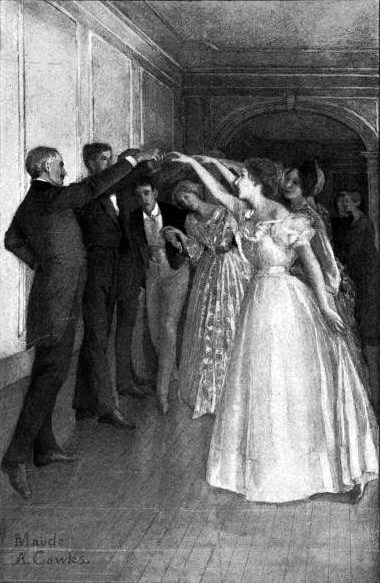
The Virginia Reel.
Impromptu balls were a favorite form of entertainment at Greenwood, c. 1910.
This fall, Harry S. Holman published his first novel based on family history, which includes the Hoopers of Buckingham County. Take Me Down Home Back to Virginia is based in stories Harry’s father told him, as well as decades of studying Virginia history. A genealogist, historian, and high school history teacher, Harry immersed himself in the culture and families of Central Virginia at an early age.
The novel is set at the turn of the 20th century, primarily in and around Cartersville, Cumberland County, Virginia. Excursions beyond the Holman plantation called Greenwood (just outside Cartersville) include visits to Buckingham County, the springs at The Greenbrier in West Virginia, and Richmond for a glimpse at The Jefferson Hotel and horse races. Numerous illustrations further bring the characters and settings to life.
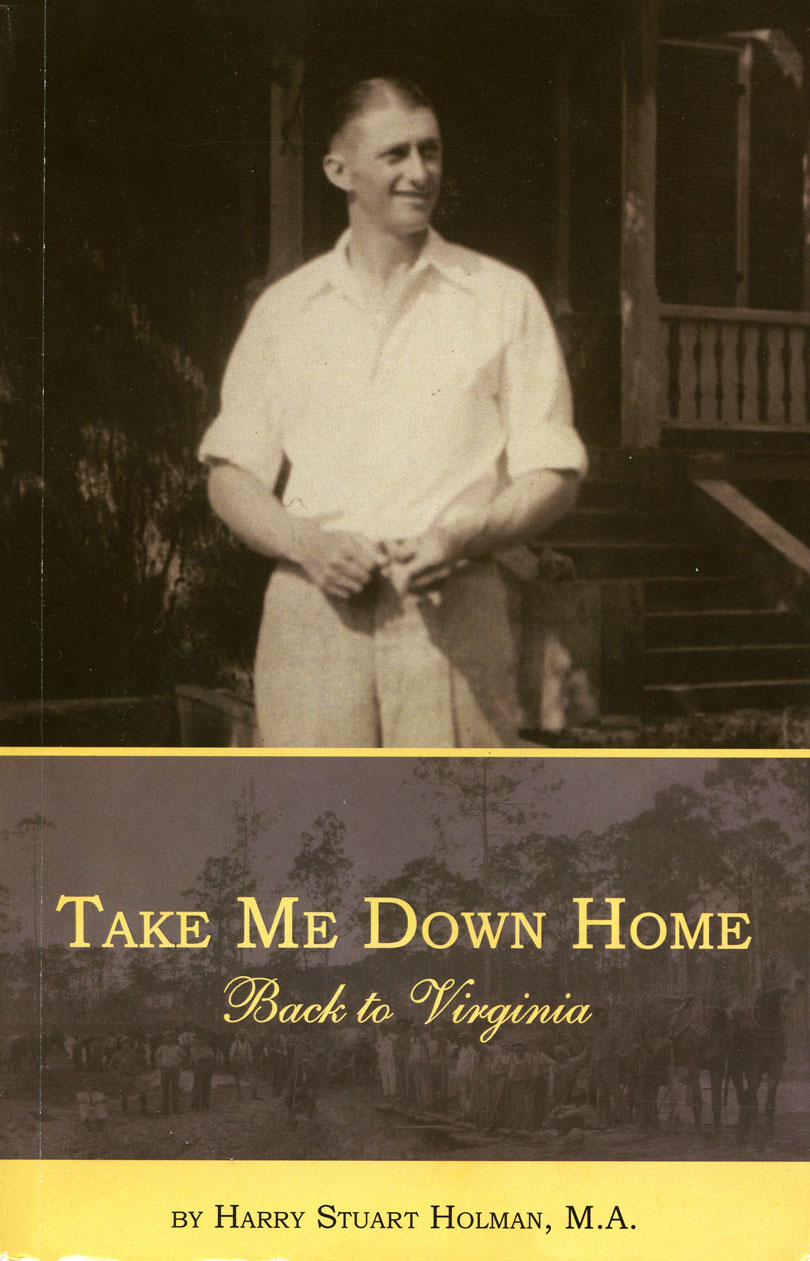
In his preface, Harry explains to the reader that his purpose is “not to distort the past or present a textbook history. I merely retell what was told to me by the people who are characters in this story. To properly portray them, I must place them in the context of their reality, which means allowing them to be untainted by modern-day attitudes.”
George H. Cauble, Jr. praised Take Me Down Home saying, “The scenes and conversations presented in each chapter were filled with clarity, which presented me with vivid images of the simplicities of life that existed in rural Virginia one hundred years ago. I could feel the genuineness of the people who lived ‘down-home’ in Virginia.… Simply said, I loved it and couldn’t put it down.”
The book is printed by Dietz Press. For more information, write to Harry Holman at holmanhs321@gmail.com.


Courtesy Library of Virginia.
In 2013, I shared a post entitled, Buckingham Mystery: Dunn’s Chapel
Some years later, while researching Methodist churches in Buckingham County, I discovered a valuable resource at the Library of Virginia — a reel of microfilm containing a record book created by the Methodist Episcopal Church, South and dated 1852-1881.
The catalog entry contains this information:
Buckingham Circuit first appears in the 1788 Methodist Annual Conference minutes. In 1810, it became part of the Meherren District and later became part of the Lynchburg District. The circuit included the churches of Bethel, Buckingham Institute, Centenary, Dunns’ Chapel, Glenmore, Hanes’ Chapel, Liberty, Rocky Mount, Salem, and Trinity.
Included in the record book is a list of members at Dunn’s Chapel for 1869 and 1870, beginning with Walter A. Ford, Steward. Many familiar families from northern Buckingham worshipped there, such as Allen, Guerrant, Lightfoot, Maxey, and Norvil (sic), Oslin, and Snoddy. Notations mention individuals who had withdrawn or had been removed, including my relations James W. Allen and Margaret E. Allen.
If a Slate River Ramblings reader knows the precise location of Dunn’s Chapel, please comment.

On June 5, 1816, The Richmond Enquirer published the following obituary for Linnaeus Bolling, one of Buckingham County’s most promising young men:
MELANCHOLY EVENT
Extract of a letter to a gentleman in this City dated, Williamsburg, Saturday Evening, 6 o’clock.
“I have a tale of horror to relate! This moment I have received the sad tidings of the death of Mr. Bolling: he went to the College Mill to bathe, and attempted to swim across the pond. — About fifteen yards from the shore, on the opposite side, his feet became entangled in some grass, which grew under the water, and not being able to disentangle himself, was immediately drowned; you can form no idea of the general distress of the Students, and the Inhabitants, for the untimely end of this truly amiable but unfortunate young man — with truth I may add, that all Williamsburg is in tears. He remained underwater two hours before he could be found, and then he was so completely tied by his feet and arms, that it was with difficulty three men drew him out of the grass. The President and all the Professors are greatly distressed, and exclaimed, ‘The flower of William and Mary is gone!’”
COMMUNICATED.
The death of Linnaeus Bolling, a Student of William and Mary College, and son of L. Bolling, Esq. of Buckingham, is announced by letters from Williamsburg. Of the worth and merits of this young man, it would be a difficult task to speak and exaggerated praise — I knew him well — and as a man, I admired him — as a fellow student, I was attached to him — as a friend I loved him, — To the bounties of nature, who had lavished on his person and his heart her richest and proudest favors and elegant manners, heightened by handsome improvements, the fruits of vigorous study and ambitious cultivation — His stern integrity and universal candor had made him the arbitrator of William and Mary — To promote good order and preserve friendly intercourse among his fellows, was a distinguished and truly noble principle in his nature — So honestly zealous and so impartially correct, their differences were often referred to his decision, from which there was never an appeal — I am privileged to speak of this mark in his character, to it I am indebted beyond the power of gratitude to repay.
By his death the gay polished circle of Williamsburg have lost a rich ornament — the students, an excellent monitor — When relaxing from the rigor of close study, he was not to be found in the brothels of dissipation, not in idle and useless amusements, — He preferred either to seek the company of the fair, by whom, for the chaste conversation, and gay enchanting disposition, he was always welcome — Or with kindred souls to pass his hours in cool and rational recreation, where friendship fully exerts her richest powers and bestows delights and improvements, which no other society affords — such was Linnaeus Bolling — The definition is weak and simple — but correct — ask any student of William and Mary College, who was Linnaeus Bolling. You shall be answered “my Friend” — ask a professor — already you have heard them say “the flower of William and Mary”.
~
According to a Markham family tree, Linnaeus Bolling (b. abt 1795 – d. 1816) was the son of Linnaeus Bolling (1773-1836) and Mary “Polly” Markham (1776-1824). For more about this branch of the Markham-Bolling family, see Markham of Chesterfield: Ancestors and Descendants of John Markham.
For much more about the Bollings of Buckingham County, search the archives at Slate River Ramblings.
~
Special thanks to Patt Freedman for sharing her knowledge about the Bollings of Buckingham County.
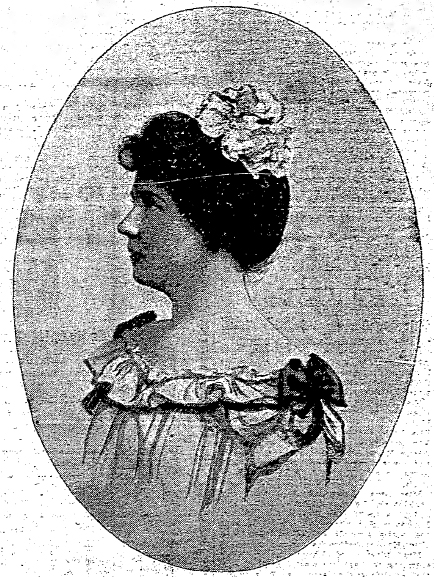
Ella Pauline Morriss. Courtesy Times-Dispatch.
In March of 1904, Richmond’s Times-Dispatch published a lovely portrait of Buckingham County belle Ella Pauline Morriss, accompanied by the following caption:
“Silver Seal” is the title of the delightful story of thrilling romance by Miss Virginia Bayard, of Roanoke. The authoress has dedicated it to one of Virginia’s fairest daughters, Miss Ella Pauline Morriss, of Buckingham, whose picture is given above. Miss Bayard’s story is laid in the Blue Ridge and is quaint, pathetic and fascinating from beginning to end. The story is now ready for the press. The authoress is a young lady of talent and bids fair to take her place in the brilliant galaxy of Virginia writers.
Miss Morriss, to whom she dedicates the work, is the daughter of Mr. and Mrs. Garland Morris (sic), of Sutton, Va., also the granddaughter of the late Charles Y. Morriss, of Richmond, known as “the Shoestring Millionaire,” because of his eccentricity of wearing a shoestring for a watch chain when, his fortune was rated at a million.
It is understood also that Miss Morriss figures prominently as one of the characters in “Silver Seal.”
Born on Christmas Day, 1884, Ella Morriss was the daughter of Garland and Ella (Sutton) Morriss and lived in Buckingham County’s James River District. Public records reveal that her life was fraught with challenges. By 1900, three of her ten siblings had died. Married in 1909, she was widowed by the aged of thirty. As an adult, she went by the name Pauline and, on November 30, 1916, her name was recorded as Pauline E. Sparks when she married Charles G. Human. They were divorced in Richmond, Virginia on December 23, 1922 on grounds of desertion.
To date, nothing more has been learned about the writing career of Virginia Bayard and no evidence has been found that “Silver Seal” was ultimately published.
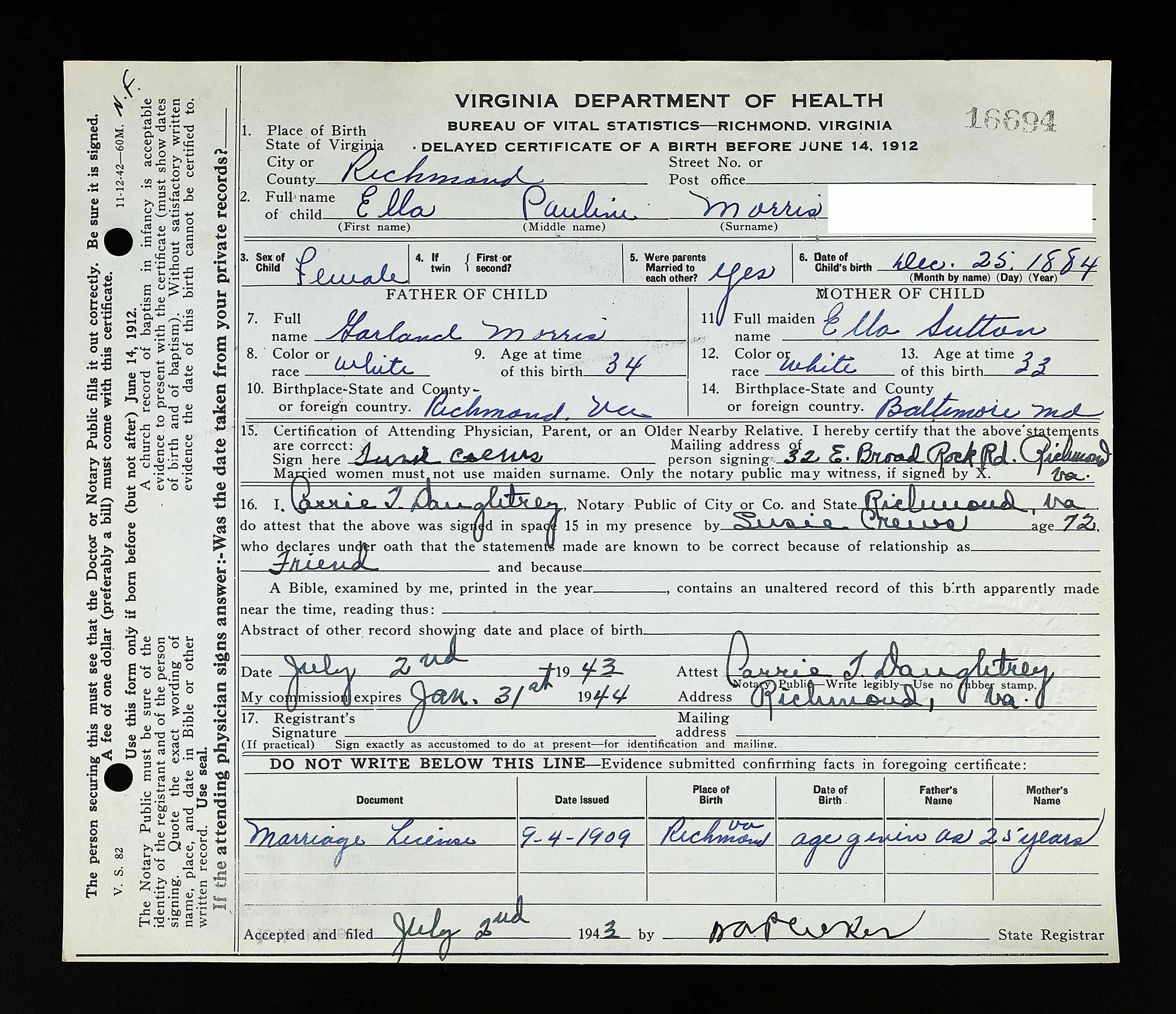
Birth Certificate for Ella Pauline Morriss.

Divorce Record for Pauline E. Human.
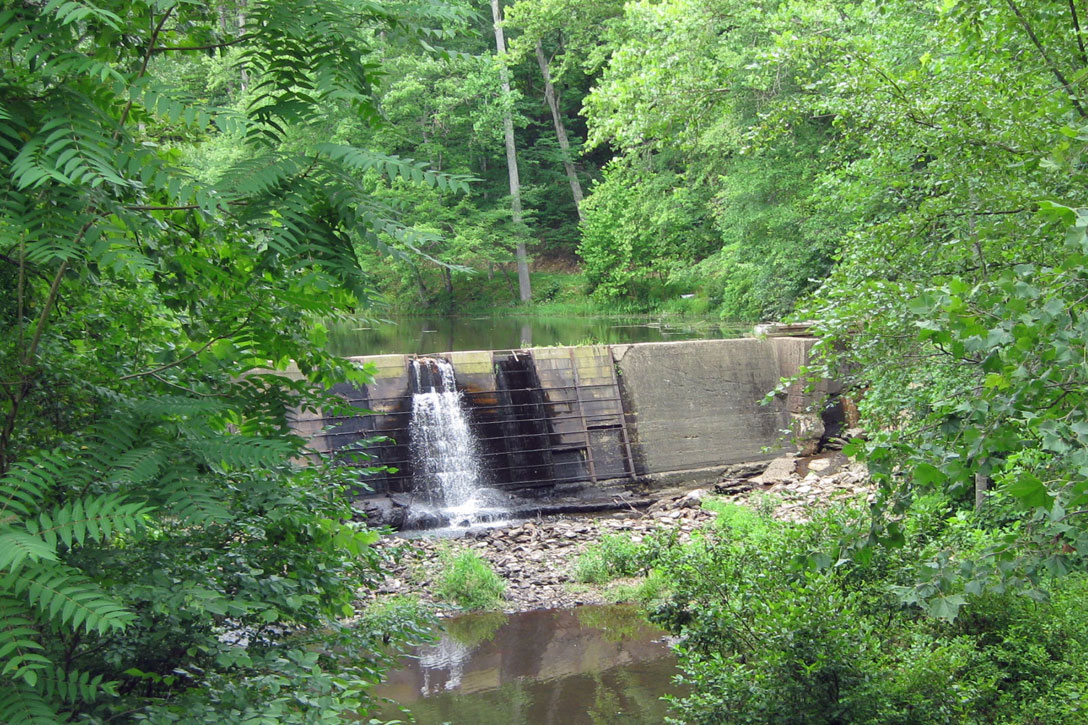
Payne’s Pond, 2010. Photo by Joanne Yeck.
In March of 1959, Buckingham County historian Lulie Patteson published an article in Charlottesville’s Daily Progress detailing the history of Payne’s Landing. Located on land owned by Nathan T. Payne, this spot in northern Buckingham on the James River once bustled with commerce.
Click here to catch up: Payne’s Landing, Part I
Unfortunately, the two images taken by Patteson which accompany the article did not transfer well to microfilm. The captions, however, highlight more details about the Payne plantation. They read as follows:
PLANTATION RUINS — the ruins above are all that is left of the “old Pete Jefferson” house on the Payne plantation. The ruins were torn down recently because of the danger to cattle in falling into the basement of the old four-room brick building.
OLD MILL — a small mill which is still in operation as it was in the years before the Civil War, stands on little Georgia Creek north of Payne’s Mill Pond in Buckingham County. The mill is said to have once been located nearly a mile away on Big Georgia Creek. This is a remnant of the huge Payne plantation.
~
To learn more about Payne’s Mill, click here: Buckingham Mills: Payne’s Mill, Part I
~
Lulie Patteson’s mention of the ruins of old Pete Jefferson’s house is particularly intriguing. The 1900 census records an African-American named Peter Jefferson (b. 1857) living in Buckingham County’s James River District but no one by that name was enumerated in Slate River District.
Did this building date back to the mid-19th century? While it is doubtful that Peter Field Jefferson was ever known as “Pete” and he never lived on the Winfrey Tract which became Payne’s plantation, the old four-room brick building could have been built by Jefferson. It seems likely that Lulie Patteson’s informants no longer knew that Randolph Jefferson’s son had once owned this land. If they had been aware of the link to Thomas Jefferson’s nephew, surely they would have mentioned it!
~
For more about Peter Field Jefferson’s purchase of the Winfrey Tract, consult my book Peter Field Jefferson: Dark Prince of Scottsville and Lost Jeffersons.
~
For much more about Lulie Patteson’s life, search the archives at Slate River Ramblings and consult “Miss Lulie Patteson: Early Buckingham Historian” in my book “At a Place Called Buckingham.”
Special thanks to Phil James for sharing Lulie Patteson’s work published in The Daily Progress.

Courtesy Find A Grave, Photos by Brian Gallagher.
In March of 1959, Buckingham County historian Lulie Patteson published an article in Charlottesville’s Daily Progress detailing the history of Payne’s Landing. At that time hardly a trace was left of a once busy community.
Click here to catch up: Payne’s Landing, Part I
~
Lulie Patteson concludes her article, writing:
Only a chimney of brick remains of the first home. From the debris left at the site the home seems to have had four rooms. It was a two-story dwelling. A two-room frame house still stands nearby. Later the new house (the one now dilapidated) was built. It led to the small, gray house which was used as a kitchen.
Family history reveals that a runway from the house to the kitchen shed was built so Mrs. Payne, who lost a leg in middle life, could scoot her wheelchair to the kitchen.
One barn now stands where there used to be many barns and stables for the working animals.
A large family of children were reared here and their descendants are widely scattered over Virginia and elsewhere. N. T. Payne was attacked by pneumonia on a timber trip to Sussex or Southampton counties (the exact place is uncertain). He died away from home. Mrs. Payne lived to an old age and was cared for by a devoted daughter after the other children had left home.
On a lovely slope above the home location is one of the most attractive private cemeteries ever seen in a rural section. Here great maple trees guard the graves of Mr. and Mrs. N. T. Payne, their children and their grandchildren.

Courtesy Find A Grave, Photos by Brian Gallagher
Explore the Payne family cemetery at Find A Grave: Payne Cemetery
Coming Next: Payne’s Landing, Part V

Buckingham County Postal Routes, 1896
In March of 1959, Buckingham County historian Lulie Patteson published an article in Charlottesville’s Daily Progress detailing the history of Payne’s Landing. Located on land owned by Nathan T. Payne, this spot in northern Buckingham on the James River was once home to thriving businesses and an industrial complex.
Click here to catch up: Payne’s Landing, Part I
Lulie Patteson continues, conjuring a vivid picture of life at Payne’s Landing:
Besides the landing there was a post office, a store and freight depot. Elsewhere on Georgia Creek, a tributary, there were mills. A grist mill ground flour and meal and a sawmill provided lumber.
Payne was said to have been exempted from military service in the Civil War because he supplied lumber to the Confederacy. About the Payne home located a blacksmith’s shop, a cooper’s shop, a bone mill and a foundry. The farm and sawmill required the use of 50 to 60 mules and horses.
The foundry manufactured skillets, lids and plowpoints. The name of the blacksmith, Aaron Scott, has come down through the years because of his work in handling the numerous jobs of shoeing the many horses and mules. An aged Negro man who worked at the Payne home recalls how he used to tremble in terror when the 50 or 60 work animals were turned loose snorting and kicking down the lane heading toward the creek for water.
The same man’s mother was a washer woman for the Paynes. He said after the war the Yankees came and cut “hoops and staves.” He also recalled how Patrick Jones, head teamster for F. M. Maxey of Well Water, brought a wagon load of bark and “hoops” with a double yoke of oxen to Payne’s Landing.
Since the lumbering and sawmilling were large operations and many employees were needed, the Payne plantation provided everything that was needed. No one had to go to Scottsville for anything . . . except perhaps whiskey.
Of all the projects around the Payne place, the one least needed would seem to be the bone grinding mill. But with the lack of fertilizer in those post-war days, and a starvation diet for cattle, most farms felt it necessary to utilize everything possible.
~
Patteson’s prose depicts a busy and vital 19th century service center typical of the era. Today, various sources help document her history.
In 1880, Nathan T. Payne’s grist mill, long active in Buckingham County’s Slate River District, was included in the county’s industrial census.
Population censuses confirm Aaron Scott’s role as the neighborhood blacksmith. In 1870, an African-American blacksmith named Aaron Scott (age 50) was enumerated with his family in the James River District of Buckingham County. By 1880, Scott had relocated to Slate River District, living just a few households from Nathan Payne, supporting the story that he worked at the Payne’s Landing complex.
In 1880, Nathan Payne’s son John clerked in a store, perhaps the one Lulie Patteson mentioned.
According to national postal records, the post office at Payne’s Landing was established when mail delivery to Bolling’s Landing was discontinued on February 4, 1880. Bolling’s Landing was on Robert M. Bolling’s land, adjacent Payne’s. Samuel L. Burks, who married Alice Virginia Payne, served as postmaster at Payne’s Landing from its inception until January of 1883. Click here for more about Burks: Postmaster Samuel L. Burks, Jr.
Patteson also mentions F. N. Maxey who founded Well Water after the Civil War. For more about his important contribution to Buckingham County history, search the archives at Slate River Ramblings and consult “F.N. Maxey and His Community at Well Water” in my book “At a Place Called Buckingham.”
Currently, others who owned businesses in the complex at Payne’s Landing are unknown. If a Slate River Ramblings reader knows more, please comment!
Coming Next: Payne’s Landing, Part IV

In March of 1959, Buckingham County historian Lulie Patteson published an article in Charlottesville’s Daily Progress detailing the history of Payne’s Landing, located 23 miles north of Buckingham County’s courthouse. In 1874, the tract was bounded by the lands of Robert Bolling, Putney, James F. Hamner, Dr. Gantt, John L. Harris’ Estate (Snowden), and W.H. and L. Nicholas.
Click here to catch up: Payne’s Landing, Part I
Relying on memories passed down in the Payne family, Lulie Patteson makes several puzzling statements, including this one: “. . . [F]amily history states that the great tract of land was purchased from a man named Sam Allen and that Allen’s slaves remained on the plantation when the Payne family took possession.”
Since Nathan T. Payne did not acquire Winfrey’s Tract until after 1871 (and may not have taken possession of it until 1874), any African Americans working or living on the farm had long been emancipated. It is possible, though, that former slaves remained where they had previously lived, working for Payne or others in the neighborhood.
Miss Patteson’s next detail, while charming, is equally confusing: “. . . Payne’s Landing was doing a bang up business in shipping before the Civil War. N. T. Payne had two canal freight boats of his own (one descendant in or near his 90s says the names of these two boats were ‘Maude’ and ‘Johnson’).”
Today, documents which were not easily accessible to Lulie Patteson help establish a different chronology of Nathan Payne’s residences and businesses. With the passage of time, I suspect two locations (possibly even two spots called “Payne’s Landing”) became conflated. Indeed, Payne may have operated freight boats prior to the Civil War though likely not from what was once Winfrey’s Tract.
In 1870, Nathan T. Payne, a 45-year-old lumber dealer, was enumerated in Buckingham County’s James River District, indicating that he was not yet occupying Winfrey’s Tract, which lay in Buckingham’s Slate River District. Payne’s status as a “dealer” easily could have included shipping. Additionally, the 1870 Industrial Census for Buckingham County lists N. T. Payne as the operator of a grist mill and a steam saw mill, both in James River District. By 1880, he was enumerated in Slate River District, indicating his move to Winfrey’s Tract — the place that Lulie Patteson would know as Payne’s Landing.
Coming Next: Payne’s Landing, Part III

Courtesy Historic Buckingham
I’m delighted to announce that a fifth volume of Buckingham Burials is now available from Historic Buckingham.
If you live near Buckingham, copies are for sale at the Adams Museum.
You can also purchase the book by mail from Historic Buckingham.
Members: $10.00, plus $5.00 postage
Non-members: $15.00, plus $5.00 postage
Send your check to: Historic Buckingham Inc., P. O. Box 152, Buckingham, VA 23921.
Follow this link for more books available from Historic Buckingham: Our Store
If you aren’t already a member, consider joining: Membership Information
Lastly, a hardy thank you from Slate River Ramblings to all who contributed to this series over many, many years.
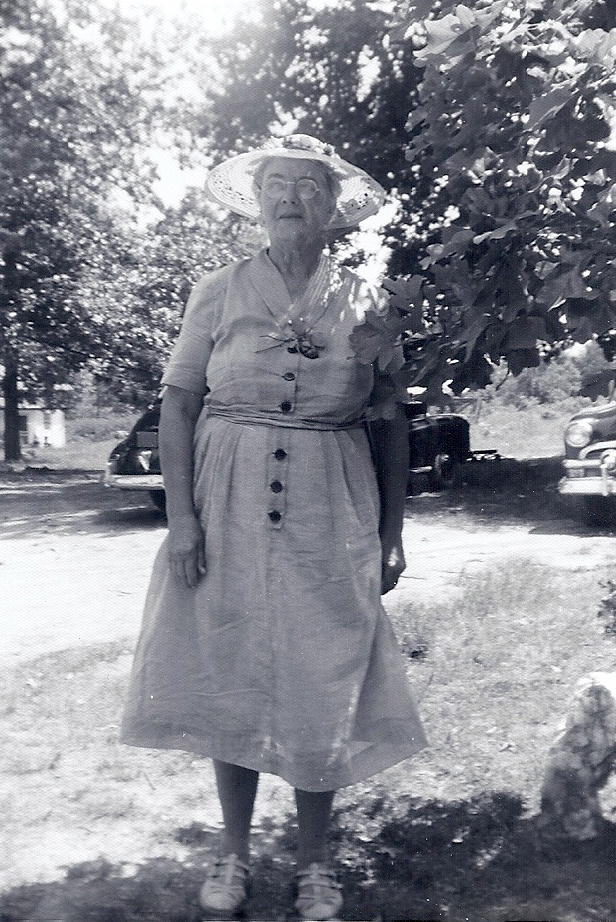
Lulie Patteson
Courtesy Gordon G. Ragland, Jr., Maxey/Patteson Family Collection
In March of 1959, Buckingham County historian Lulie Patteson published an article in Charlottesville’s Daily Progress entitled, “Payne’s Landing Disappeared from the Contemporary Scene.” As always Miss Patteson’s description of this once bustling community in northern Buckingham County is colorful and engaging. The article begins:
Payne’s Landing on the James River in Buckingham County was once a canal boat dock and a busy outlet of a huge plantation. Not a vestige of its business activities of 100 years ago remains. It is identified by a railroad siding built at a later date and now discontinued.
Large plantations along the James and its tributaries shipped and received much freight at various landings in canal boat days. It eventually led to almost every farm having its private Landing — such as Bolling Landing, Brown’s Landing, etc.
Crowning a stately hill rising from the south bank of the James is a dilapidated residence which belonged to those whose lives were spent there and who gave Payne’s Landing its name.
Just when this plantation (said to have been one of the largest in Virginia) came into possession of N. T. Payne is not clear. The records of Buckingham County were destroyed in a fire just after the surrender of the South in the Civil War. All deeds vanished.
However, family history states that the great tract of land was purchased from a man named Sam Allen.
~
As is often the case, oral history is less than accurate but can be peppered with clues to follow. Clearly, Lulie Patteson understood that Nathan T. Payne had acquired this property before 1869 when Buckingham County’s courthouse burned. However, research concerning Peter Field Jefferson and my kinsman James Harris reveals another story.
Samuel Allen, remembered by the Payne family, was the son-in-law of James Harris, who owned considerable land in this section of Buckingham. At the time of Allen’s death on November 15, 1871, he was likely managing what was then known as “Winfrey’s Tract” and later became known as “Payne’s.”
James Harris had purchased this 2,285 acre plantation from Peter Field Jefferson in October of 1858. While large by Buckingham County standards, it was far from “one of the largest in Virginia.” On November 22, 1871, Harris sold the farm to Nathan T. Payne for $13,000, however, in a complicated settlement, the deed was not transferred until 1874, two years after James Harris’ death.
~
For more about Peter Field Jefferson’s purchase of the Winfrey Tract, consult my book Peter Field Jefferson: Dark Prince of Scottsville and Lost Jeffersons.
Coming Next: Payne’s Landing, Part II


 slate river ramblings . . . .