

Buckingham County’s Most Mysterious Trial
On July 17, 1904, the front page of The Times-Dispatch featured an article concerning the upcoming trial of Wooldridge and Forbes, complete with a photo of the burned ruins of John S. Forbes’ dwelling house and a portrait of E. C. “Cliff” Wooldridge. The jury for the Woolridge trial had been chosen though the names had not yet been made public.
It had been over three months since the destruction of Forbes’ property, however, interest in the case had not abated. In fact, insisted the newspaper, it had increased:
It is thought there will be a larger attendance at this session of the court than has ever been known, and it is certain that the case will be by far the most interesting one ever known in the history of this county.
If this was even remotely true, it seemed that many prominent citizens felt strongly about Cliff Wooldridge – one way or the other. Apparently, long before he was accused of destroying his neighbor’s property, Wooldridge was strongly disliked for his vocal politics and behind-the-scenes power.
The article included a generous recapitulation of the crime, highlighting the “weird and uncanny” story of Charlie Forbes’ disappearance the day of the fires, adding new twists to the tale. Describing Charlie as twenty-five years old and “very handsome,” the article detailed the rumor that he had been murdered and, in this version, that he was buried in the grave of his uncle, who died several years ago. Rumors maintained that “Young Forbes’s [dogs] had been seen to go frequently to this grave and dig into it; and many thought that an infallible sign that young Forbes was buried there.”
The article also added new details concerning the day that Charlie was arrested on the train between Prospect and Farmville. According to the correspondent, Charlie’s trousers were wet up to his knees. He had two valises and more than $100, as Edloe Spencer had testified at the preliminary trial. Charlie had resisted arrest, stating that he boarded the train in Cincinnati yet he’d been seen getting on in Prospect.
Wet up to his knees? That is an intriguing addition to the story.
And why would Charlie say he’d come from Cincinnati when he had boarded the train in Prospect? Was he attempting to establish the fact that he had not only been out of Buckingham County but had also been on a long trip up North?
Coming Next: Janie Forbes Takes the Stand
Need to catch up? Click here for The Famous Forbes Case of Buckingham County: Part I

The arrest of E. C. Wooldridge certainly had some unexpected consequences. A terrifying story appeared in The Times-Dispatch and in The Farmville Herald on July 8, 1904, when it printed a report from New Store dated July 4th:
Buckingham excited.
During the early part of last week all this section underwent a scare such as few ever desire to experience again. The fright was brought about by a young negro, James Saunders, who, proclaiming loudly in a wild and reckless course, that Cliff Wooldridge and others were after him, took his breach-loading shotgun and a belt of shells, and proceeded to hurry through highways and hedges, threatening everybody and everything in sight. Hastening to the houses of respectable colored people, he told a pitiful story of a fantasized pursuit, ending with wild gesticulations and unbounded threats, swearing that he would kill every white man in the county and everybody else who came in his path.
The reports of Saunders’s insanity and reckless journeyings spread like wildfire, and the entire colored population was well-nigh frenzied with terror. It is said that whenever families saw any one approaching their homes they stood not upon the order of their going, but went at once, oftentimes scattering down through the pines without order or care for result, so the fury of Jim Saunders was escaped.
And the scare was not confined to the negro element. When the report of Saunders’s wild raids came to the ears of Mr. Louis D. Jones, a justice of the peace here, he literally kept the phone wires hot between New Store and Buckingham Courthouse until the deputy sheriff was in sight prepared to make the arrest. The reports had come to Mr. Jones in the most exaggerated form, and as he told the graphic story with full force over the telephone wires, he stirred up the people from Farmville to Slate River, and from Cut Banks to Cumberland Courthouse. From the many wild conversations that went on over the wires that day and night one might have thought that the jungles of India had turned to loose their hordes upon old Buckingham to devour her people.
Deputy Sheriff Charles McCraw finally took possession of Saunders and took him to the courthouse, where he was examined by a commission of lunacy. By this time Saunders had come to his senses and exhibited no marks of insanity. He was, on account of the lucid interval, allowed to return to his home near here. This action kindled anew the anxiety among all classes, the expectation being that Jim Sanders will appear at any hour, armed with his gun, prepared to shoot a multitude of his imaginary pursuers, and the fear is that in his delusion he will murder a number of innocent people.

The Grand Jury
Quiet did not last long in Maysville. On June 16, 1904, a grand jury gathered to consider the indictments prepared by the Commonwealth’s Attorney and hear selected witnesses. At this juncture in the process, the grand jury hears only the Commonwealth’s side of a case and does not determine the guilt or innocence of those accused. According to The Times-Dispatch the grand jury for the Wooldridge-Forbes case found a “true bill” (i.e. a valid case) against the three man: Charlie Forbes, Cliff Wooldridge, and his son, Dan. The newspaper article continued enthusiastically about one witness in particular — Nancy Morgan:
The testimony of old “Aunt” Nancy Morgan, the colored woman, who was in the house at the time of the fire, is looked forward to with much interest. A grand juror, of much intelligence and experience, said she made by far the best and most dramatic witness he had ever seen in his life. Her uncanny and weird account of the fire will be told with full force early in the trial.
In a later issue of the Appomattox and Buckingham Times [6/22/1904], the paper expanded on “Aunt” Nancy’s testimony, stating:
Old Aunt Nancy Morgan, a splendid type of the old-time negro, talks intelligently, but must have time to chew and smoke. She says Mars [Master] Charlie didn’t have anything to do with the fire. The old negro sticks to Miss Janie Forbes and the Forbes brothers, in the belief of young Forbes’s innocence.
Anticipating the trial to come, The Times-Dispatch printed:
Witnesses will be brought from Lynchburg to testify that Charlie Forbes was in that city on the night of the fire and the night following.
Miss Janie Forbes will give the most valuable evidence in the whole case. She is a young girl of fine sense and great personal beauty, and is one of the most popular girls in the county.
Taking everything into consideration, the case will be the most remarkable one of its kind ever tried in the State, and there is little doubt that the sensations already brought out will be vastly augmented by others.
There will be probably between fifty and seventy-five witnesses, the majority of them being Commonwealth witnesses. All of the attorneys employed in the case, will be at hand fully prepared to enter a legal battle seldom equal in the history of the State.
~
By June 17th, Cliff Wooldridge was being tried in the newspapers. Baltimore’s The Sun stated that though there was “no direct evidence” against him, it was being said that Wooldridge had burned John Forbes’ buildings “in order to depreciate the value of the Forbes farm and then annex it to his own at the cost of a few dollars an acre.” The Sun continued:
When Forbes died, Woolridge wrote to the county newspaper, saying that he had lived without an enemy and otherwise paying tribute to his memory. Soon after [that] he was arrested and put in jail.
Wooldridge is a keen-eyed, grizzled man of 55 or 60 years. He has struggled from poverty and a humble position in life to be a landowner, magistrate and political power. Many years ago he eloped with and married a niece of the man whose home [he is] charged with having burned. What the members of the Forbes family thought of this alliance was expressed by one of the young Forbes with an ax on the head of Wooldridge.
Wooldridge’s neighbors at that time expected his departure for another world, but he recovered.
Assuming all that The Sun reported about Wooldridge’s past association with the Forbes family was true, theirs was, at best, a rocky relationship. Deep grudges often fuel violent action and preliminary testimony had already indicated that Wooldridge had an excitable personality.
Coming Next: Buckingham County’s Most Mysterious Trial
Need to catch up? Click here for The Famous Forbes Case of Buckingham County: Part I

Freedom for Cliff Wooldridge
According to coverage in The Times-Dispatch, until nearly dark on June 14, 1904, discussion continued at Buckingham Courthouse concerning a possible change of venue for those accused of burning the buildings of John S. Forbes. Destined to be tried in Buckingham County, Charlie Forbes was returned to the Buckingham County jail. The next day, his beautiful and heroic sister, Janie, and two of her brothers appeared at the courthouse, attempting to provide security for their brother’s release from custody. His bail remained at $5,000. It was deemed, however, that their security was insufficient and Charlie remained in custody.
Congressman Flood and Benjamin Davidson had succeeded in providing security for Wooldridge’s $5,000 bail. At dusk on June 14th, Cliff Wooldridge left Maysville and incarceration behind, driven out of the village by his son, Dan, who was also out on bail. In a couple of days, Cliff and his wife would return to Maysville on business. At that time, he looked “remarkably well” and she had recovered from her recent indisposition.
That same day, as darkness fell at Buckingham Courthouse, attorney Jack Lee was seen heading for Lynchburg, accompanied by a young woman who had been summoned to testify on behalf of Charlie Forbes. She was to return to Buckingham County when the case was tried in July.
Why did she go unnamed in the newspaper? Was this a ploy on the part of the correspondent, intending to add allure to an already “mysterious” case?
~
On July 15th, the Appomattox and Buckingham Times printed an update on the case written by correspondent “Quoit.” Heavy with opinion, he offered few new facts.
Buckingham.
The Board of Supervisors is in session at this writing, with not a very large crowd in attendance. The people of the county and other counties will doubtless turnout in considerable numbers on the morrow, expecting to hear the now celebrated burning case aired in the court. Those who are acquainted with the facts as developed at the examination of this case before the magisterial court readily agree with your reporter as to the facts developed. While there is absolutely no danger whatever threatening the prisoners from any outside violence, the extreme gravity of the charge, commands the most serious interest of peace and order-loving citizens of this community. It is somewhat amusing though to see here and there an isolated [?] writer bobbing up and declaring it will be hard to find a jury in the large and fair-minded county of Buckingham prepared to give the prisoners a “fair and impartial trial.”
And I asked for my part, and I think I know something of the people of Buckingham, I am truly of the opinion that, it will be an easy matter to find a jury qualified to try the case.
New council has been employed for the defense of Charlie Forbes. Messrs. Lee & and Howard, of Lynchburg, will appear [?] for his defense. It will be readily understood that in each of these cases every inch of ground will be stoutly contested, and we may expect a battle royal or a complete route [?] in the beginning of the fight. It is not thought that there will be any standing room on any “middle ground.”
On page four of the same addition, the Appomattox and Buckingham Times, ran an update summarizing the case thus far. Importantly, it listed the men who sat on the grand jury, calling them “nine of the most prominent citizens of Buckingham county.” They were: L. F. Lightfoot, George W. Patterson, John J. Spencer, W. G. Edwards, Charles L. Glover, Joseph J. Irving, Brice Glover, Thomas R. Shan and W. R. Silvey [?].
Coming Next: The Grand Jury
Need to catch up? Click here for The Famous Forbes Case of Buckingham County: Part I
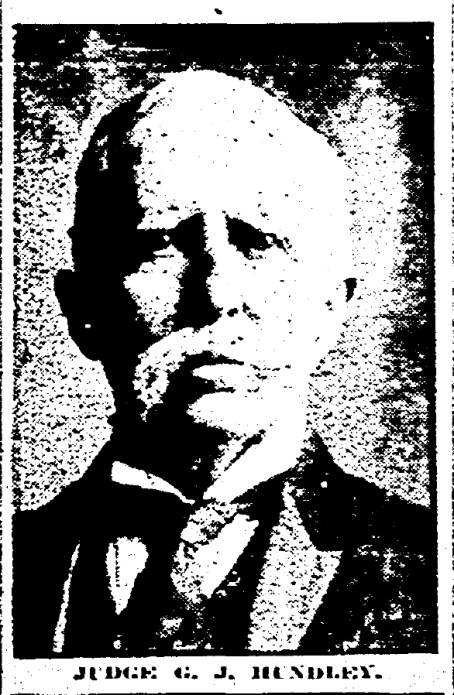
George Jefferson Hundley, a key player in “The Famous Forbes Case,” was born near Mobile, Alabama on March 22, 1838. The son of Virginians Josiah and Cornelia Jefferson Hundley, he was educated at a private law school in Lexington, qualifying for the bar just as the War Between the States broke out. He served in the Confederate Army and, following the war, briefly taught school. He first made his home in Amelia County; later in life, he resided in Farmville, Prince Edward County. He was eighty-six years old when he died in March of 1924.
In 1870, he served as a State Senator for four years and was later elected to the House of Delegates for several terms. In 1909, in the capacity of Circuit Court Judge, Hundley presided over the cases concerning the murder of the Stewart brothers in Buckingham County. He was incensed when the venue was changed to the Hustings Court in Richmond.
Click here for the entire story: “The 1909 Buckingham Murders.”
His obituary in the Richmond Times-Dispatch closed with this comment:
An eloquent and forceful speaker, he rendered valuable service to the Democratic party in various State and national campaigns. Since 1898 when he was elected to the circuit bench, he was a member of the judiciary, and his record on the bench was a distinguished one.
Judge Hundley’s wife, who was Miss Lucy Waller Boyd, of Nelson County, preceded him to the grave many years ago.

Fry-Jefferson Map
Why not celebrate this Independence Day learning more about President Thomas Jefferson’s younger brother, Captain Randolph Jefferson of Buckingham County?
The Jefferson Brothers is not just a biography of Randolph Jefferson, it’s a history of Buckingham County from its beginnings through the Revolutionary War into the dawn of a new century, as well as a fresh look at Thomas Jefferson in retirement at Monticello.
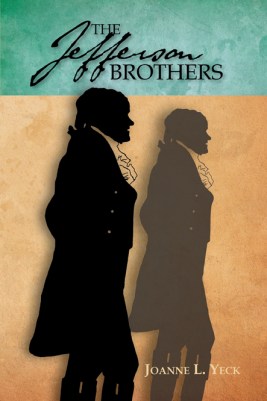
In the days when Buckingham was still part of a much vaster Albemarle County, their father, Peter Jefferson, established Snowden, a day’s travel from what would become Monticello. There, Randolph Jefferson ran a successful plantation and, quite unlike his brother, lived the life of a typical gentleman farmer.
Click here to download the first chapter of The Jefferson Brothers and purchase the book.

Change of Venue
By 2:00 PM on June 14, 1904, the cases against Wooldridge and Forbes were underway. In a courtroom crowded with citizens and visiting lawyers, the attorneys for the defense, Flood and Howard, argued that the case should be moved to Farmville in Prince Edward County where they could select an impartial jury.
The men insisted that “tremendous excitement and bitterness” existed against the prisoners in Buckingham County. They pointed out that Buckingham County’s Clerk of Court, Peter A. Forbes, was the younger brother of the late John S. Forbes whose property was destroyed and that he had contributed money to prosecute the suspects. The attorneys also noted that there was already a secret and malicious league “ready to do violence to the prisoners in case of their release.” This “coterie of men” lurking near Buckingham Courthouse and were, in Wooldridge’s case, “thirsting of this man’s blood by misrepresentation, misstatements and falsehoods.” Flood stressed that “this is a mysterious case, and it becomes more mysterious every day.”
Congressman Flood dramatically stated that his affidavit for a change of venue was not an indictment of “the character or integrity of the Buckingham people” but, rather, “was intended to avoid a tremendous conspiracy.”
A. H. Browning, a horse trader of Appomattox County, was sworn in and gave a shocking statement that supported Flood’s point. Browning reported that Charles Henry Coleman, also of Appomattox, said there were fifty rifles with fifty bullets ready to shoot Cliff Wooldridge upon release. According to the newspaper, Browning himself would like to “see the guilty party tied to a stake and burned on the site of the fire.” Apparently, there were numerous men who were not presuming Wooldridge was innocent until proven guilty.
Conversely, the prosecution produced many witnesses who felt that Wooldridge and Forbes could receive a fair trial, including E. V. “Van” Anderson, one of the magistrates who sat for the preliminary trial and half-uncle of Charlie Forbes; Sheriff William Williams; Peter A. Forbes, Clerk of Court and brother of the late John S. Forbes; William C. Chattell of New Store, the chairman of the Democratic County Committee; Henry E. Chattell, deputy treasurer; Rev. John Spencer and Rev. Mr. Ballard both of Maysville; and William D. [G.?] Edwards of Arvonia.
Ultimately, Judge Hundley denied the motion for a change of venue and scheduled the trial to begin the third Monday in July.
Coming Next: Freedom for Cliff Wooldridge
Need to catch up? Click here for The Famous Forbes Case of Buckingham County: Part I
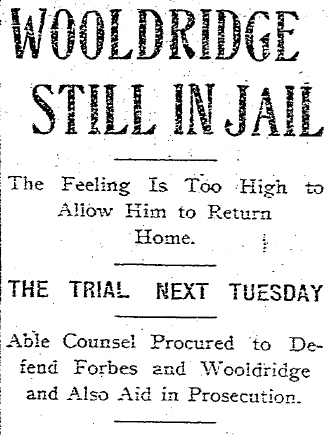
Still in Jail
The June 10, 1904 issue of The Times-Dispatch announced that the Wooldridge-Forbes case was to open on Tuesday, June 14th, with Judge George J. Hundley on the bench. The case would be called at noon.
John W. Lee, of Lynchburg, and his partner, Mr. V. E. Howard, with Judge Crute assisting, would defend Charlie Forbes. Congressman H. D. Flood would represent E. C. Wooldridge. The prosecution team remained Edmund W. Hubard and Aubrey E. Strode.
Since the preliminary trial, Wooldridge and Forbes had been held in the Buckingham County jail. Each were offered release on $5,000 bail. Forbes could not meet the amount and, although Congressman Flood, Benjamin Davidson, and one other individual made up Wooldridge’s bail, all involved decided it was best for the prisoner to remain in jail, feeling it might be unsafe for him to return home. Citizens in the county were sharply divided in their sentiments concerning Wooldridge’s participation in the crime. One group of men volunteered themselves as a posse to accompany Wooldridge to his home. Clearly, he had some very loyal friends.
Hyperbole continued to pepper the articles of The Times-Dispatch, which printed:
Never before has the county been so thoroughly stirred. Men who were never before known to be excited are now wrought up to a pitch bordering on desperation.
More importantly, the newspaper noted that, considering the highly charged situation in the county, it was not known if a suitable, impartial jury could be found within Buckingham. Perhaps, the attorneys for the defense would request a change of venue.
Coming Next: Change of Venue
Need to catch up? Click here for The Famous Forbes Case of Buckingham County: Part I

In Defense of the Good Citizens of Buckingham
On June 8, 1904, the Appomattox and Buckingham Times printed the following front-page report from “Quiot” at Buckingham Court House:
With the thermometer registering ninety and news of an interesting nature in the extreme, I will endeavor to acquaint you with the happenings around old Buckingham since your last visit to our village.
Since the examination of the parties accused of the burning of the property of the late Jno. S. Forbes, which took place here last Tuesday, which was then, the all absorbing topic of conversation, things have quieted down considerable. The prisoners remained in jail and did not give the bond required by the bail commissioner. I am informed that after consultation with the prisoners by their counsel, it was considered the best thing to do, in view of all the circumstances. I hear whispered that a change of venue is being some what considered.
I cannot see why this is at all necessary. I am sure this is a law abiding, and liberty loving county.
And there are sections of this county, I venture to say, that are totally unacquainted with the circumstances attending this now celebrated case; and are well prepared to give all of the parties a fair and impartial trial. Of course the trial or rather examination, which was not attended with any evidence for the defense, was calculated to produce an impression upon the mind of any unprejudiced party, not very favorable to the prisoners. It is however possible, not to say probable, that these impressions can be entirely removed. In this country of ours, under our grand old customs and laws, even the vilest criminals are presumed to be innocent of a charge “until proven guilty” by legal evidence. And such rights will be accorded these men by the trial court.
It surely is not the innocent that our country desire convicted; but we do sincerely pray that the guilty in this case, if not caught, may be caught, and proved guilty “beyond a reasonable doubt.”
~
In the same issue of the Appomattox and Buckingham Times, the paper reprinted the letter that “M” wrote to The Times-Dispatch – which charged that “this morning’s paper is calculated to produce a wrong impression as to the trial here on yesterday of E. C. Wooldridge and Charlie Forbes” — and was printed on June 3rd.
The reprint was followed by this comment from the editor of the Appomattox and Buckingham Times, A. H. Clement, revealing him to be the author of the “special report” from Buckingham Court House.
I do not desire to be placed in the sight of the public as being desirous of prosecuting any citizen of the Commonwealth or prejudging any man charged with a crime, as the reader of the above article would naturally infer. The author of this article could not have heard the evidence as detailed from the stand, or he never could have made the statement that my report of the examination was “calculated to make an altogether are erroneous impression.” My only desire was to give a perfectly fair portrayal of the matter, which I contend was done; I did not attempt to give the exact evidence in all respects, but I will cheerfully print the evidence of the defense if they will provide me with the stenographic report which they have. A. H. Clement.
Coming Next: Still in Jail
Need to catch up? Click here for The Famous Forbes Case of Buckingham County: Part I

Can you trust what you read in the newspaper?
On June 3, 1904, The Times-Dispatch ran an editorial condemning the report of the Forbes Case which ran in the June 1st edition of the newspaper. Signed “M” in Buckingham Court House and dated June 1, 1904, it contradicted many points made in the newspaper’s coverage of the preliminary trial. Which version was correct? Would the Richmond newspaper intentionally print erroneous facts, as the letter charged? Was this a case of sloppy reporting? Time would tell. Here is what “M” wrote:
EVIDENCE ONLY CIRCUMSTANTIAL.
Editor of the Times-Dispatch:
Sir. — Your “special” from this place in your this morning’s paper is calculated to produce a wrong impression as to the trial here on yesterday of E. C. Wooldridge and Charlie Forbes, upon the charge of burning the residence of John S. Forbes on the night of March 3rd.
The testimony of Edloe Spencer, who arrested Wooldridge, was as your correspondent reports it, that Wooldridge, when arrested said “I have been expecting this for some time.” The fact is that Wooldridge having heard that he was suspected wrote a letter to Peter A. Forbes, clerk of the court (and brother of John S. Forbes), saying that he had heard he was suspected, and would like to be arrested at once and have the matter investigated and cleared up.
Again the testimony of Spencer, as reported in your paper, was that Wooldridge told him that Charlie Forbes was within four and a half miles of the place namely, Forbes postoffice. The fact is that Mr. Fogus, chief of police of Farmville, testified that he was present on this conversation took place, and that Spencer first told Wooldridge at Forbes postoffice that Charlie Forbes had been seen by Joel Harvey to pass his house on Saturday morning.
Wooldridge then gave Spencer the written memorandum, which you publish, directing him to telephone Winston McKinney to see Joel Harvey and find out all about the matter of Forbes being seen in the neighborhood. Fogus said there was no impression made on his mind at all tending to implicate Wooldridge.
Again, your special says the measurement of the shoe tracks corresponded with Wooldridge‘s shoe shown in court. The fact is the witness stated that the shoe tracks was made by a shoe with either a good “new heel or one that had a flat countersink of iron,” whereas the shoe shown in court had the heel entirely torn off. There was no correspondence.
Again, Spencer testified, according to your special, that Wooldridge said, “You have one of us now; why don’t you get the other two?” Fogus said that Spencer told Forbes there were the shoe tracks of three men, and that [Wooldridge] then said, in a bantering way, well, as you have one, why don’t you get the other two? but that it was said in a way which made no impression whatever of a confession of participation in the crime by Wooldridge.
The commissioner of bail to-day granted bail to Wooldridge and Forbes in the sum of $5,000 each. The friends of Wooldridge were present in large numbers ready and able to give ten times that amount of bail required, but on account of the bitterness of feeling among the large Forbes connection in Wooldridge’s neighborhood, which might seem to threaten violence to Wooldridge, and also on account of the deeply indignant feeling of Wooldridge against those who caused his arrest, which might lead him (being a high-tempered man) to some violence against them, Wooldridge’s counsel and friends thought it best for him to remain in jail for the present, and he yielded to their advice. But he can be liberated at any moment he desires, as can also Forbes if he gives the required bond.
I write you this hasty communication to counteract the altogether erroneous impression which your today’s “special” is calculated to make. The result of the trial on yesterday was a widely expressed sentiment that nothing more than vague suspicion was elicited, and no specific fact whatever implicating Wooldridge in the crime. And, indeed, there are nothing but suspicious circumstances to implicate Charles Forbes.
M.
Buckingham C. H., June 1, 1904
In 1904, the publisher of The Times-Dispatch was John Bryan. According to the Library of Congress, “Formed in 1903 with the merger of the Times and the Dispatch, the Times-Dispatch of Richmond quickly emerged as Virginia’s primary newspaper of record. . . . The editorial outlook of the Times- Dispatch during those early years sometimes swayed from one political or social viewpoint to another.”
Coming Next: In Defense of the Good Citizens of Buckingham
Need to catch up? Click here for The Famous Forbes Case of Buckingham County: Part I


 slate river ramblings . . . .