

On May 18, 1904, the Appomattox and Buckingham Times ran a brief notice from Wert commenting that Andy (sic) Forbes and his sister, Miss Janie, had left for North Carolina, where they would reside in the future due to the destruction of their father’s property. If the Forbes siblings did indeed start for North Carolina they were not there long. By June 1st, the newspaper reported that the siblings stayed in Buckingham. The reason will be made clear below.
Sensational Arrest!
On May 23, 1904, an excited report concerning the destruction of John S. Forbes’ property was sent to Richmond from New Store, Buckingham County, appearing the next day on the front page of The Times-Dispatch. Leslie Fogus, chief of the Farmville police force, assisted by Hopkins H. Gilliam and Edloe Spencer, a prominent citizen of Farmville, and Richard and Reece Morgan (of Buckingham County), arrested E. C. Wooldridge at his home in Buckingham. Charged with the burning of John S. Forbes’ property on the night of March 3rd, Wooldridge was taken to Farmville where he was placed in the Prince Edward County jail.
This was shocking news. E. C. “Cliff” Wooldridge, Forbes’ neighbor, was one of the best known citizens of the county though clearly not one of the best loved. According to The Times-Dispatch:
He has always taken an active part in politics, and has for a number of years been a judge of elections at the New Store Precinct. He is a school trustee for Francisco District of Buckingham county, and has made an excellent record for sound judgement and common sense in all school matters. He has an acute mind and is a fine conversationalist, and while he has many political enemies he has also many friends who expect him to be cleared of all suspicion of the crime.
On May 24, 1904, The Times-Dispatch concluded:
The case has caused intense excitement all through this section and its latest developments, with all the many complications, promise a case worthy of the creation of the fertile brain of a Conan Doyle or a Wilkie Collins.
Indeed!
~
Cliff Wooldridge was intensely partisan in his politics. At one time, he lived in Richmond, appointed by the State to a position in the Capitol building. Ultimately, he disliked the job and returned to Buckingham County.
Some called Wooldridge “shrewd” and “a political wire” – a man who pulled strings behind the scenes. His political influence may have been significant. What was it based in? One of Cliff Wooldridge’s politically-related jobs was to sit on the Registration Board for Francisco District, serving with W. C. Trent and J. O. Morris. Following the establishment of Virginia’s new constitution in 1903, Registration Boards wielded increased power to decide who could and who could not register to vote.
In weeks to come, he will be called the richest man in Buckingham County. While this is likely an exaggeration, Cliff Wooldridge possessed both wealth and power. Why would he want to destroy his elderly neighbor?
His relationship to the people of Buckingham County was clearly complex. As the weeks and months passed, and his case became more and more convoluted, Wooldridge’s prominence in the county would not always be stressed in the newspaper coverage. Knowledge of his stature was, apparently, assumed. Readers should keep in mind this initial, shocking headline in The Times-Dispatch:
One of Best Known Citizens of Buckingham Arrested for Arson
It’s a solid reminder of why the courtrooms were packed and the phone lines buzzed with gossip about what became known as “The Famous Forbes Case.”
Coming Next: A Second Warrant
Need to catch up? Click here for The Famous Forbes Case of Buckingham County: Part I

On April 6, 1904, the Appomattox and Buckingham Times reprinted an editorial from Lynchburg’s The News concerning the death of John S. Forbes. It revealed that he had a nephew living in Lynchburg who was a policeman. The report offers a gripping summary of the case thus far.
THE MOTIVE A MYSTERY.
But the Fire Was Certainly of Incendiary Origin
A few weeks ago, The News contained an account of the burning of the home in Buckingham of Mr. John S. Forbes, an uncle of Policeman Forbes, of Lynchburg. As stated that the time, Mr. Forbes had a very narrow escape from being burned to death. It is now known certainly that the fire was of incendiary origin. The Governor has offered a reward of $300 for the capture and conviction of the parties, and the Board of Supervisors of Buckingham county have offered $150 for a like purpose, and it is probable that the amount raised by private citizens will reach $150, making a total of $600.
No doubt a much larger sum can be raised if it is found necessary, but this is thought to be sufficient. The crime continues to be the one topic of conversation in Buckingham, and the more it is discussed the more the enormity of the crime is fully realized, the excitement is more intense. No arrests have been made yet, but there are strong suspicions against some parties and it is expected that some arrests will occur shortly.
Mr. Forbes’s dwelling was entered and robbed about three years ago. A fire was started in the woods near the house on a Sunday to attract the family from the house. Part of the family was at church, but those at home when immediately to extinguish the fire in the woods as soon as it was discovered, leaving no one at the house, and when they returned they found the house had been entered and a lot of clothing and $370 were gone.
It was several days before any arrests were made, but at last one of the parties who was suspected, confessed, and implicated the rest of the party. There were four of them. One was sent to the penitentiary for ten years; one for three years; one for one year; and the other, a youth, was acquitted.
The one who was sent for one year has served his sentence, and is at home, and it was first thought that he with the aid of others might be the party that did the last burning, but this theory has been thoroughly investigated and it has been found they were not connected with it in any way.
The motive that caused the fire is yet a mystery, as it seems strange that all buildings were fired to hide the robbery of the dwelling, and as the facts become more fully known, it is plainly demonstrated that the crime was committed by someone that was thoroughly acquainted with the premises, and some people have advanced the idea that the dwelling was robbed in the day; that it is impossible for anyone to open the trunk in the night and take money from the bottom of the trunk and leave it in the condition they found it. This remains a mystery, and it may require some shrewd work to clear it up.
Another mystery connected with the affair is, how did the party that did the firing know that there was no one at home but Mr. Forbes’s daughter and an old colored woman, none of them able to defend themselves. – Lynchburg News.

John S. Forbes
On March 31st, Floyd Forbes of Lynchburg received word that his father, John S. Forbes, was dying. On April 3rd, the old man died of complications of exposure. The next day, The Times-Dispatch ran a brief obituary:
John S. Forbes
Wert, Va., April 4. – Mr. John S. Forbes, of near this place, died yesterday at the advanced age of eighty-seven years. Mr. Forbes had his entire property destroyed by an incendiary about thirty days ago, and the excitement and exposure incident to the fire is thought to be the immediate cause of his death.
He was surrounded by his children and relatives and his death caused no surprise owing to his extreme old age and the trying ordeal through which he has just passed. Interment will take place to-morrow in the family burying ground.
Presumably, Floyd Forbes arrived from Lynchburg before his father’s death. Annis and Janie were no doubt by his side. John’s son, Charles J. Forbes, however, was not in attendance. He had not returned home since the night of the fire.
On April 6, 1904, the Appomattox and Buckingham Times printed:
Gone to “enter into his rest” is the spirit of the late Mr. Jno. S. Forbes. Never having recovered from the awful effects of the unprecedented and unmerciful and fiendish burning of which he was made the victim not long since, he lingered in a semi-conscious state until yesterday evening at four o’clock, when his spirit “returned unto the God who gave it.” This is the sequel to the most awe-inspiring and shocking piece of the incendiary’s work that was ever wrought in this county. Such was the effect upon the family, who alone witnessed it, that the impression was made upon their minds that the day of judgment had arrived. And this was a perfectly natural impression. In fact, I cannot well see how any other impression could well have been had of this awful scene, when one awakens out of sleep to find nine or ten buildings on fire at the same time. Like the great civil war, it was “sufficient to try the very souls of men.”
Mr. Forbes will be buried on the place where the burning took place, at the old homestead, on Tuesday, April 5, at one o’clock.
Coming Next: Sensational Arrest!
Need to catch up? Click here for The Famous Forbes Case of Buckingham County: Part I

A Vivid Rendering of the Terrifying Night
Numerous correspondents from various parts of Buckingham County contributed news and editorials to the Appomattox and Buckingham Times. On March 23, 1904, this evocative report was submitted from Andersonville:
The news came this evening that Mr. John Forbes has pneumonia; Dr. Nowlin pronounced it as such. Truly the old gentleman is going through deep waters. Your readers have heard of the burning, but one will have to go on the premises and see the situation to appreciate the horror. Mr. Forbes had probably the best out houses [barns, stable, smokehouse, etc.] of any one in this end of the county. They were comparatively new, having been built since the war — substantial and of the best timbers. To awake at midnight with the cry of fire in your ears, and to find the granary and tobacco barn on the west; the barn on the north; the two corn houses, stables and smoke-house on the east; barn on the south, and the dwelling on the north side, all on fire. Well might Janie [Forbes] say, ”Oh papa, it’s the judgment!” No two ever did so much in so short a time, I don’t suppose, as did Janie and “Aunt Nancy,” the old colored woman; and here, let me ask those who abuse the colored race to please leave “Aunt Nancy” out. The first thing done was an effort to extinguish the fire in the dwelling. Failing in this, the smoke house being nearest, they succeeded in putting that out, as they supposed. Then the cattle that were penned in between the two barns on the west were saved, next the pigs near the corn house; then it was noticed that the smoke-house was again on fire, and no water. On wings of the wind Janie rather flew than ran to the spring, and this time succeeded. Then they proceeded to carry things out of the house until it fell in. I asked what hour that was. Janie pointed to the clock then on the mantle at Mrs. Sam Forbes’ and said, “It was the last article carried out; it pointed 12:45.” Three times did they have to move the things which were saved.
No one saw the fire and no one came; the bell rope had been severed by dastardly hands in the beginning. After the sun rose Mr. Forbes went for Dick, leaving Janie and Aunt Nancy exhausted from excitement and labor. A little bird perched in a tree overhead commenced a sweet song. Janie said, “Aunt Nancy, the birds are singing and let us sing, too.” Then she went to the branch and washed her face, conscious of the “House of Many Mansions” prepared for all such as love and believe in Him.
This is the only suggestion that the feeble Mr. Forbes was drugged. According to this report, however, he was revived and up with the sun. Dick’s identity is, as yet, unknown.
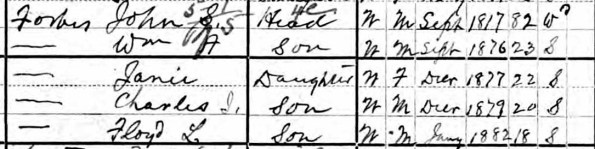
The John S. Forbes, 1900. Buckingham County, Virginia.
Charlie S. Forbes
Reports insisted that the persons who fired John Forbes’ property and systematically stole his money were familiar with both the outbuildings and the location of the trunk within the house. After all, it was the middle of the night and completely dark when the crime took place. Later reports would add that important papers were stolen, as well.
In 1900, the Forbes household included: John S. Forbes (82), William A. Forbes (23), Janie Forbes (22), Charles J. Forbes (20), and Floyd L. Forbes (18). Despite marrying late in life, widower John Forbes produced a healthy and extremely attractive family. They lived in the Francisco District, residing among other Forbes families and cousins. By 1904, when the crime took place, Floyd was living in Lynchburg. Apparently, it was William, called Annis, who had gone to Farmville with the tobacco the night of the fires.
It also seemed likely that the criminals timed their attack when only the elderly John Forbes, Janie, and “the old colored woman” were at home and defenseless. Normally at least one or two of Forbes’ sons would have been at home as well. Following the fire, John Forbes became very ill, having caught cold from exposure on the night his home was burned.
On the day of the crime, Charlie had been at home until about noon, when he “disappeared.” He had not been home since. His family was unaware of his intention to leave and did not know where he was. According to The Times-Dispatch, “Young Mr. Forbes, being of an eccentric disposition, leaving as he did, is not much thought of by those who knew him well.”
Was the “disappearance” of Charlie Forbes a coincidence? Was he somehow involved in the burning of his father’s property? What could be his motive?
Coming Next: John S. Forbes
Need to catch up? Click here for The Famous Forbes Case of Buckingham County: Part I

Big Reward!
On March 22, 1904, The Times-Dispatch predicted that a combined reward of $600 would soon be offered for information leading to the capture of the person or persons who destroyed John S. Forbes’ property. The Governor had committed $300 for the capture and conviction of the guilty parties. The Buckingham County Board of Supervisors offered $150 and the newspaper suggested that the citizens of Buckingham County would raise another $150.
According to the newspaper, Forbes’ neighbor, E. C. Wooldridge took an active part in securing these rewards. Two detectives were employed and made their headquarters at Wooldridge’s house.
As the case unfolds, it became increasingly clear that the newspapers would often rather speculate and repeat rumors than wait for confirmed facts. Retractions came later (or not at all). The papers would print anything to keep the story alive and thrilling. The amount and length of coverage is impressive, though much of it is redundant and contradictory.
The article printed on March 22nd ensures the readers that they are part of a thrilling, unfolding mystery:
The crime continues to be the one topic of conversation, and the more it is discussed and the enormity of the crime is fully realized, the excitement is more intense. No arrests have been made yet, but there is strong suspicion against some parties, and it is expected that some arrests will occur shortly.
It is now recalled that Mr. Forbes’s dwelling was entered and robbed about three years ago. A fire was started in the woods near the house on a Sunday to attract the family from the house. Part of the family was at church, but those at home went immediately to extinguish the fire in the woods, as soon as it was discovered, leaving no one at the house, and when they returned, they found the house had been entered and a lot of clothing and $370 [?] were gone.
These burglars were caught. One was sent to the penitentiary for ten years, one for three years, one for one year, and one, a youth, was acquitted. By March of 1904, the individual who had served one year was out of the penitentiary and at his home. An investigation proved he had no part in the recent arson and burglary. The newspaper did not disclose the particulars of the investigation.
Was John Forbes’ wealth the only target for this earlier crime?
Coming Next: Charlie S. Forbes
Need to catch up? Click here for The Famous Forbes Case of Buckingham County: Part I
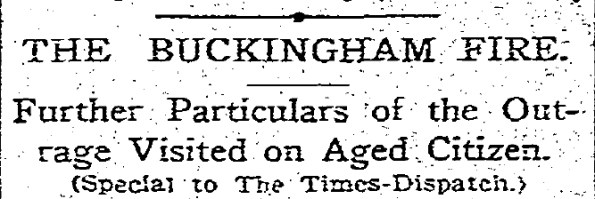
Further Particulars
Three days following the initial story in The Times-Dispatch, the newspaper ran a follow-up sent from Wert in Appomattox County. According to this report, the Forbes burned dwellings included a granary, stable, three tobacco barns, two corn houses, and the dwelling house. The horses were spared because one of Forbes’ son had driven to Farmville with a load of tobacco. The loss was now estimated at $8,000 and it was reported that $200 was taken from Forbes’ trunk. John Forbes only carried $500 of insurance on the dwelling house; the outbuildings were not covered. It was safe to say he was ruined.
Miss Janie Forbes, along with “an old colored woman” (as yet unnamed), were heroically drawn for carrying John Forbes out of the burning building and for saving the smoke house. Miss Forbes’ “wonderful presence of mind” and “strong nerve” was admired.
The site was examined and tracks suggested that three, possibly four, individuals were responsible for the fires. The motive remained mysterious. The article claimed: “Mr. Forbes did not have an enemy in the world, so far as known.” Though there was a robbery, it could have been accomplished without setting fire to “every building on the premises.” The conclusion: “There must have been other motives than robbery.”
The article, printed on March 9, 1904, in The Times-Dispatch, continued:
This is one of the most dastardly crimes ever committed in the county, and so far there have been no arrests, but there is strong suspicion, and some tracks have been identified. There is strong excitement, and every means possible will be used to catch the guilty party, and if caught it is feared that the people will not allow a trial, but that justice will be administered in short order.
This is just the beginning of reports filled with melodrama, sensationalism, and hyperbole. Buckingham County had never known such an outrage! A possible lynching was implied. The villains must be apprehended – and without delay! Clearly, John S. Forbes and his family were well-liked and respected in the community. Still, sensationalism did and does sell newspapers!
Coming Next: Big Reward!
Need to catch up? Click here for The Famous Forbes Case of Buckingham County: Part I

Courtesy The Times-Dispatch
During 1904 and 1905, a mysterious case of arson, tried in the Buckingham County and Prince Edward courts, fascinated the citizens of both places for many months. Readers of Richmond’s The Times-Dispatch, The Farmville Herald, and the Appomattox and Buckingham Times reveled in the details of Buckingham’s elite and their handsome sons and pretty daughters. While it apparently did not become national news, readers in Baltimore and Washington D.C. also followed this mysterious crime story.
Unlike the serial crimes committed by “The Buckingham Outlaws,” who terrorized the good people of Arvonia in 1908, or the murders of the reclusive Stewart brothers in 1910, this crime involved prominent Buckingham families, both as victims and as alleged perpetrators.
While the trials of The Buckingham Outlaws and the men charged with the murder of the Stewart brothers suggested possible irregularities in Buckingham County’s justice system, the crime that came to be called “The Famous Forbes Case,” reveals the machinations among men of power. This is no backwoods clan fight. This story suggests white collar enmity, fueled by long-standing grudges among families.
The great legal minds of central Virginia once again take the stage. Buckingham County’s Commonwealth’s Attorney Edmund W. Hubard headed the prosecution, aided by Lynchburg’s Aubrey E. Strode. The defense was primarily in the hands of Congressman H. D. Flood.
The story opens on March 9, 1904 when The Times-Dispatch reported two fires in Buckingham County, one at White Hall (Dillwyn) where the burning of the R.M. Anderson Company threatened the town and one at the farm of Mr. John Forbes:
DASTARDLY OUTRAGE.
A most dastardly outrage was committed at the home of Mr. John Forbes, an old man eighty-seven years old, last Thursday night.
Mr. Forbes and his only daughter were at home, his son having gone to Farmville with a load of tobacco, when some miscreant fired his dwelling and several outhouses and tobacco barns. In all, eight buildings were burned. His daughter was aroused by the fire, and succeeded in putting out the fire on the meat house and hen house. All of his provender, including over fifty barrels of corn, farming implements and two good buggies, were destroyed. The loss is estimated to be at least seven thousand dollars. The trunk in which they kept their savings was robbed of something like a hundred dollars. Mr. Forbes, who is very infirm on account of his age, had to be carried from the house by his only daughter.
The same day, the Appomattox and Buckingham Times, a weekly paper published in Appomattox County, introduced to its readers what would become a much discussed local saga. The regular correspondent from Buckingham Court House at that time signed his articles “Quiot.” His rendering of the tragedy offered an interesting detail which would not be repeated:
Our entire county is greatly shocked at the terrible calamity that befell Mr. John S. Forbes, an old man in his eighty-seventh year, and the brother of our county clerk, Mr. P. A. Forbes.
On Thursday last his son, Mr. Annis Forbes, went on a trip to Farmville, on business, leaving no one at home except the old gentleman, Miss Janie Forbes, the sister of Annis and daughter of Mr. John Forbes, and an old colored woman….
[After they discovered the blaze . . .] These two women succeeded in bearing old Mr. Forbes from the burning buildings out into the yard, where they laid him on a bed that they had but that moment dragged from the house, and he immediately fell asleep while all the buildings were still burning – leaving the impression on the minds of many with whom your correspondent has talked, that he was drugged, and that the object of the burning was robbery.
. . . That the work was that of an incendiary there cannot be any doubt; as while the dwelling was burning the smell of kerosene oil was plainly noticeable.
The “fact” that John S. Forbes was drugged will disappear from future reports.
What party or parties wanted to destroy the property of a helpless, eighty-seven year old man?
Coming Next: Further Particulars
Need to catch up other true-crime serials at Slate River Ramblings? Click here:

Joanne L. Yeck, writer. 1959. Photo by John D. Yeck
I’m happy to announce a new project, recently launched at Instagram.
“A Family Memoir” is a serialized family history told in images and very few words. The story begins with the Harris family, Virginians who leave their farms in Buckingham County and migrate to southern Iowa where they prosper in the monument business. Please join me as their story unfolds. Click here and follow at joanneyeck.
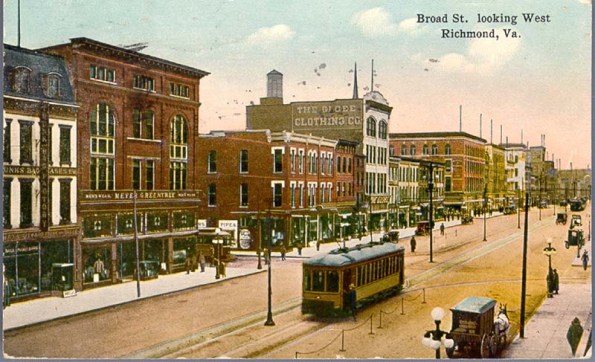
Turn-of-the-century Richmond, Virginia
After reading “The Buckingham Outlaws,” which ran during 2015-2016, several Slate River Ramblings readers wondered . . .
“Can we really believe what was printed in the newspapers?”
“Did the reporters sensationalize the conditions in Arvonia?”
“Were some of the ‘facts’ really fiction?”
Good questions. Whether today or 1900, it is best to read news reports with a critical eye. Sometimes, outrageously false stories are printed. This was once the case with my Buckingham-born ancestor, John T. L. Woodson, who moved to Richmond, Virginia, in 1894.
~
In the summer of 1905, John T. L. Woodson was one of a reported 7,000 people attending a performance of The Great Payne. On July 22, 1905, Richmond’s The Times-Dispatch ran a story about the evening. The reporter claimed that John had a “miraculous” cure when Payne applied his remedy. The report got Woodson’s name wrong, but his address was correct. The article read, in part:
When Mr. T. L. Woodson, a machinist, of No. 112 Randolph Street, displayed a stiff hand, maimed by machinery, Payne announced his doubt of giving relief, but volunteered to make an application. In two minutes Mr. Woodson was able to use the hand, and shouted his appreciation to the audience, with prolonged applause.
John T. L. Woodson was moved to correct this report and his letter to the editor was printed on July 27, 1905. It read as follows:
Was Not Cured By Payne.
Editor of The Times-Dispatch:
Sir. – Please correct the statement which appeared in Saturday’s Times-Dispatch, under the head of “Great Applause Accorded Payne.” In that article it is stated that Payne, with his marvelous remedy, perfected such a miraculous cure upon me, and that I had acknowledged my appreciation to the audience, all of which is entirely erroneous. As a matter of fact, I did subject my hand to his treatment (one application), but he did not benefit me in the least. From what Payne announced to his audience and from said article it would be construed that my whole hand was disabled, which is not true.
Several years ago I had an attack of inflammatory rheumatism, which affected my whole hand, but it only permanently disabled my index finger. To do justice to your own paper, which you claim to be fair to all – to the medical profession (especially Drs. Carrington and Nelson), who undoubtedly saved my hand – and to the people of Richmond, I request that you give this communication the same prominence which was given Payne in your edition of 22d instant. I am no machinist, nor was my hand injured by machinery, as stated in said article.
Very respectfully
J. T. L. WOODSON.
112 Randolph Street
Richmond, Va., July 24th
~
Next Monday, Slate River Ramblings will begin a new true-crime serial. Get ready for a lengthy and intricate visit to Buckingham County, 1904-1905. “The Famous Forbes Case” will run for over fifty posts.
As with previous serials, reports from several different newspapers will be interwoven. As before, I will occasionally comment on or call into question the “facts” as reported.
Over the coming months, as you read about the Forbes case, with all of its twists and turns, keep in mind John T. L. Woodson’s letter to the editor of The Times-Dispatch and, don’t forget, you can’t believe everything you read in the newspaper!
Missed “The Buckingham Outlaws?” Click here for: The Buckingham Outlaws: Part I


 slate river ramblings . . . .