

There was a time when New Canton, in Buckingham County, was a bustling town on the James River. In December of 1843, an advertisement ran in the Richmond Whig which suggested changes were a foot in the little town. In 1850, Louisa Daniel, who offered the following property for sale, lived in Cumberland County with her husband, Robert, and numerous children. She was presumably the heir (daughter?) to at least this part of John Anderson’s estate.
NEW CANTON PROPERTY FOR SALE
Will be offered for sale in the town of New Canton, on Saturday the 23rd of December next, all the Real Estate belonging to the late John Anderson, deceased, viz: a large and commodious Tavern House, well constructed, two Stores, two spacious rooms below, a passage, a flight of stairs running up in the passage, four rooms above, two fireplaces, a passage, porches above and below, on both sides of the house, a dining room in the cellar, with a fireplace, lock room, &c., a good Stone Kitchen, Smoke House, dairy, office &c., a large Stable and Carriage House, entirely new, has very spacious gardens, rich, three or four acres of land attached. This is the most splendid situation in the town, commanding a view up and down the river and canal for several miles. Also a Store house with a half acre lot, corner east of the street leading to the ferry. All will be offered for sale on the following terms: One fourth of the purchase money in hand paid, the balance in three equal annual payments, bonds with approved security, with a deed on the property to secure the payments. Time of delivering the property will be made known on the day of sale, can do so at any time by application to Mr. James Wren, who will take pleasure in showing the property – if the above named today should prove a unfair, then the next Monday following.
JAMES M. FORD, agent for Louisa B. Daniel
Due to the loss of Buckingham County land deeds from this period, we must rely on implied deeds based on land tax records to follow land transfers. What happened to John Anderson’s property? A successful sale does not appear to happen in the 1840s. Was the tavern rented, making it a source of income for the Daniels?
Anderson had only recently purchased (in 1841) one half of New Canton’s ferry from Edward W. Sims. That land was not sold out of Anderson’s estate until 1868 when it was transferred to John Davis.
In 1861, Robert Daniel and his wife sold some of the estate’s property to R. M. Stone.
If a Slate River Rambling reader knows more about Anderson’s Tavern, please comment.
Click here for more about Edward W. Sims.

The profile of Mary Payne which ran in the Richmond Times-Dispatch in 1954 was indeed unusual. It not only characterized Mary as a rare female miller in mid-century central Virginia, but also provided a picturesque portrait of life in Buckingham County. The article entitled, “Buckingham County’s Woman Miller Finds ‘Daily Grind’ Just a Lot of Fun,” remains delightful.
Click here to catch up: Buckingham Mills: Payne’s Mill, Part I
~
Correspondent Hamilton Crockford continued:
Worked All Right
It worked all right, she said. The children went to school then in a one-room schoolhouse built right on the farm by an earlier Payne. “If they didn’t do right, I’d make it up to them at night. – I could watch them right out of the window of this mill,” she chuckled.
Since 1922
“I’ve been running it (the mill) now ever since 1922.”
Customers? – “Oh, my goodness, we get them from almost to Charlottesville and Albemarle; from Buckingham, a lot from Fluvanna. . . . They used to come on ox carts. Now a lot put the bag on the back of a horse and ride in. Sometimes they come at night. We have to turn on the lights. We operate any time they come. Nearly every day there someone.”
She laughed again. “Right now, people come to the house and say, ‘I wonder if I could get a little meal ground.’ When I tell them I’ll be down in a few minutes, they look at me like they wonder who is coming down.”
It’s Mary Payne, all right. Said her daughter: “I can turn the water on and off, I haven’t learned about the stone.”
Does It All
Mrs. Payne does it all. – “I can sharpen those stones, too,” she smiled. “I do it now.” The only time she has had any male help is once every six months when she does sharpen them, she says. She has to have a man to lift the big stone. – “But I ‘pick’ the stones – pick those little holes in the surface to make the stones rough so the meal will grind right, you know.”
AND THE MEAL? – “I like it so fine and clean,” she said. AND THE MILL? – It’s the most clean-swept mill you ever saw.
And Mrs. Payne? “I don’t want to keep house,” she said. “I have a good time outside.”
Don’t talk to her about the grind. Just watch her dust.
~
Know more about the school house at Payne’s? Please comment.
Many thanks to the Payne family for saving and sharing this wonderful article!

Courtesy Richmond Times-Dispatch
Many Slate River Ramblings readers remember Mrs. Annie White and her mother, Mrs. Mary Cecelia Payne, who lived and worked at Payne’s Mill. Buckingham County was rarely the subject of feature articles in the Richmond newspapers; however, Mary Payne proved a lively exception. On December 3, 1954, the Richmond Times-Dispatch ran a lengthy article, written by Hamilton Crockford, entitled, “Buckingham County’s Woman Miller Finds ‘Daily Grind’ Just a Lot of Fun.”
Submitted from Centenary, the article’s dateline was December 2nd. It began by identifying Mary as N. Tom Payne’s widow. She was a mere seventy-six years young. Crockford insisted that she was the only “lady miller” anyone in Buckingham had ever heard of anywhere. Indeed, in 1954, she was the only miller of any kind remaining in the area. Crockford wrote:
Payne’s Mill sits down at the bottom of a lonely hill a few miles above this tiny spot; on the lonely road almost at the north edge of Buckingham County – almost, it seems, at the end of the world. A long jump and you’d be across the James River near Scottsville. It’s the only water powered mill running in the county, they say.
Mrs. Payne’s been running it, she reckoned, for 32 years.
What amazes her is, strangers still look amazed.
Why, it’s only one of the things she does since her husband died six years ago last March, she said. With a help of her daughter, Mrs. Annie White, the only other person on the place, she tends 26 head of Hereford cattle, 17 pigs, and 100 chickens, and looks after the whole 600 acres.
Then when they run out of something to do, they go down to the dam at the beautiful old mill pond stocked with fish, and fish.
Clearly the biggest joke Mary Payne ever heard was somebody’s idea that she should sell the place and clear out where she could take life easy.
“I have to live somewhere,” she allowed, “and as long as I can make a living here I might as well do it.”
Why, she practically married that mill, she said.
She was born Mary Cecilia Arnold in Lebanon, Pennsylvania and married Tom Payne, of Buckingham County, on the last day of 1900. According to Mary, “He had $6 and I had $11.”
Tom’s great grandfather built the dam and the first mill before the Civil War; however, three days after Mary’s wedding, the dam broke again and the mill washed away. A week later, she and Tom bought the site from his grandfather. (What did they purchased the mill with?)
Another three months went by and the Paynes had a little mill that ground cornmeal. Tom worked away from home; he was a “steam shovel man.” He wasn’t satisfied with the man he hired to run the mill. So, when their oldest son was ten years old, he was taught to run it. At the same time, Mary learned how to operate the mill. She raised five children, kept house, and filled in at the mill. She told the reporter that Tom used to say, “Mammy, can you run the mill a little while this morning?” Then he’d be gone all day!
Coming Next: Payne’s Mill, Part II
Our “Observer,” who so beautifully described the prosperity of Fluvanna County (the Cocke home, “Bremo”) and Albemarle County (the home of Col. Henry Gantt) continued his essay by reprimanding Buckingham County for its backwardness. One wonders if The Farmville Mercury printed any editorials in response.
Click here to read Buckingham County: 1874, Part I
The letter to the Editor continued:
Buckingham has followed
THE RETROGRADE MOVEMENT
too long already for her own well-being, and unless the people display some energy and put these works through, and that at once, they and their lands will never be mentioned, unless cited to prove the stupidity of not seizing hold of and executing its only work which can save them and their county from utter and absolute ruin.
Albemarle is ready and anxious to help you out with your narrow-gauge railroad; and it was with the feelings of deepest shame, when questioned by some of the prominent men of that county as to how Buckingham would vote on the railroad appropriation, I had to admit that I thought the appropriation was likely to be voted down. You had far better give half of everything you are worth than not to have the railroad, for if you get the road your half will be doubled in value to your property at present, and unless you do, in ten years from to-day, if you own land, you won’t be worth one continental.
Hoping these remarks made be productive of some good, I remain, Mr. Editor, your friend,
AN OBSERVER.
Buckingham County, February 20.
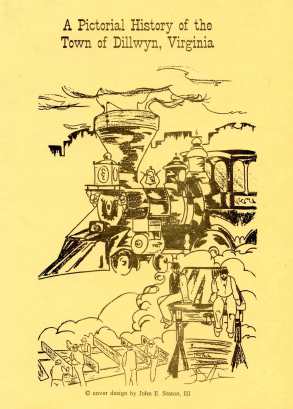
According to “A Pictorial History of the Town of Dillwyn, Virginia,” in 1879, Virginia’s General Assembly passed a bill incorporating the Buckingham Railroad Co. That company failed to build a railroad in the county. In 1883, the General Assembly passed another bill for a Buckingham railroad. Money was raised; however, by 1884, the company was bankrupt. By 1892, the C&O started building a line in Buckingham and, by 1897, it had merged with the Buckingham Branch. Tracks eventually ran from Bremo Bluff on the James River, through Dillwyn, to Willis Mountain. From there was transported mainly timber, quarried rock, and the rare kaolin clay mined at Willis Mountain.
Was Buckingham County really so stuck in its ways? Were its people not forward-thinking? Were they just cautious to invest? Or, perhaps, were politics at play? Who stood to benefit if a narrow-gauge railroad did not connect Buckingham County to Charlottesville and the east-west traffic on the north side of the James River?
All comments and thoughts are welcome.

Courtesy Harper’s Magazine
The period of Reconstruction was an extremely difficult time across the southern United States, Buckingham County included. Much in society changed, while the land stayed put and the James River flowed on. In 1874, this reflective article appeared in The Farmville Mercury and was reprinted in at least one Richmond newspaper, The Whig. Signed anonymously by AN OBSERVER, it is a pity that we will never know who wrote this evocative and persuasive prose.
ALBEMARLE AND BUCKINGHAM COUNTIES.
Having just returned from a visit to Albemarle, I thought your readers might like to hear of the state of agriculture in that county, and at the same time I thought I would contrast the two counties, Albemarle and Buckingham, their present and past condition. I crossed the James at New Canton, then up the tow-path to Scottsville. The scenery along the route is extremely picturesque, that canal winding around the base of immense bluffs of solid granite on one side with waters as smooth and quiet as if oil had been poured upon their bosom, while upon the other rushes the headlong James, in its impetuous course to its ocean home. Up and down the river flying slowly but noisily were large flocks of ducks and geese. These last mentioned birds when in flight so nearly imitate a pack of hounds in full cry that it is difficult to divest yourself of the idea that you’re not in close proximity to a fox chase.
About 3 or 4 miles up the tow-path and you reach “Bremo,” the former residence of General Cocke, who many years ago created quite a stir in Virginia by his strenuous efforts in behalf of the cause of temperance.
His temperance fountain, which is an immense iron pitcher, still stands and pours a clear stream of pure water into the canal. It was a
SAD REMINDER OF DEPARTED WORTH,
and standing at the clear James which afforded a very refreshing draught to wash down a good dose of old Bourbon which my companion and I had just taken to keep off the rheumatics, we felt deeply gratified. The estate formerly owned by the General, and now in possession of his son, is one of the most magnificent tracts of land upon the James; the low grounds, five hundred acres, a mile in width and soil of endless depth are worth forty miles rides to be gazed upon. From “Bremo” up the canal bank is dotted with barns loaded with hay, oat stacks greet the eye on all sides, and wheat straw is to be seen without limit; the fields of wheat along the route were green and much more forward than ours; corn and tobacco lands already plowed, and everything indicated plainly that the people of Albemarle had found the “open sesame.”
A mile from Scottsville and you reach the residence of Col. Henry Gantt, who is justly held to be the most energetic, successful and enterprising farmer in the county. His residence crowns one of the largest river bluffs and from his porch you can always hear the booming of the river constantly reminding us of those beautiful lines,
“Men may come, and men may go,
But I go on forever.”
The Colonel’s farm contains only six hundred acres of land. His hay crop alone last year netted him seven thousand dollars; his crop on hand will bring him ten thousand. This, when we consider the small surface in cultivation and the number of hands required to manage the crop (he only works four by the year), convinces us that for the capital invested it pays well. His barns just upon the brink of the canal, his bales of hay go directly from barn to boat. When we glance back forty or fifty years and take a peek into the condition of Albemarle, how did she appear? As Buckingham is to-day, no railroads, no canals, lands grown up in briars and broom sedge; to her internal improvements alone her success is due, and until the people of Buckingham put their shoulders to the wheel, and push manfully, never tire and or stopping, until they have built their narrow-gauge railroad, or at least revived the old Willis’s navigation to Curdsville, they must not, cannot expect to succeed. Men who never think are always saying: “A railroad for this county to Charlottesville won’t pay, we don’t make enough to support one.” When I hear a man talk such nonsense is this, I set him down as an old fogie.
Coming Next: Buckingham County: 1874, Part II
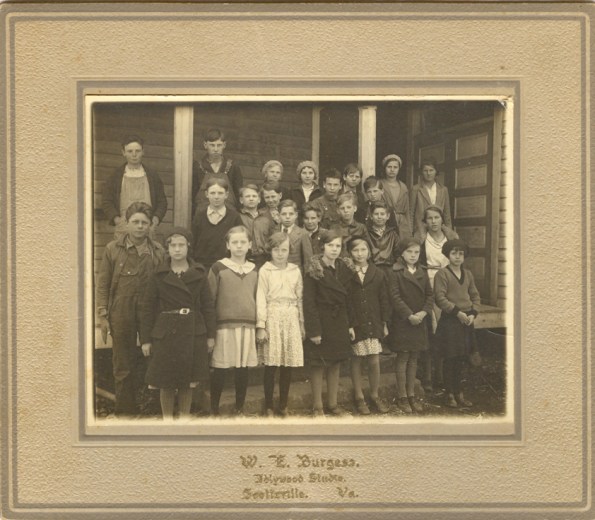
Well Water School, Laura Patteson Hayes Collection (click image to enlarge)
This class portrait of the students of Well Water School in Buckingham County. The image was made by the distinguished Scottsville photographer, W. E. Burgess.
For more about Burgess and his studio, click here: Kodak Party.
Laura Patteson, who saved her class photo, is standing in the front row, third from the right.
Can a Slate River Ramblings readers identify more students pictured here?
Interested in learning more about Well Water? Search Slate River Ramblings for lots of tidbits or consult “F.N. Maxey and His Community at Well Water” in “At a Place Called Buckingham” for the story of Frank N. Maxey and the founding of the community at Well Water.

Well Water School, Courtesy Carole Jensen
Buckingham County schools are always a favorite subject with readers of Slate River Ramblings. Well Water School is one of my favorites because both my ancestor, John T. L. Woodson, and Buckingham County historian, Miss Lulie Patteson, taught school there.
For more about Lulie Patteson, search Slate River Ramblings or consult “Miss Lulie Patteson: Early Buckingham Historian,” in “At a Place Called Buckingham.”
Special thanks to Carol Jensen for sharing the photo above. Her mother, Revis Baber, attended Well Water School.
Coming Next: Well Water School, c. 1930s.
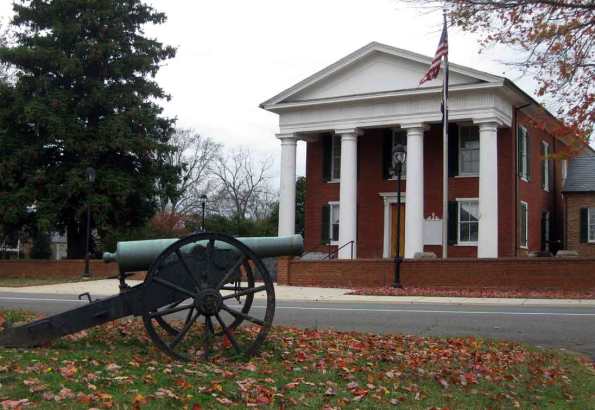
Buckingham Court House, Photo by Joanne L. Yeck
Dr. James M. Austin
Dr. James M. Austin was the son of Grace Richardson (Booker) and Archibald Austin. His first wife was Susanna Eldridge, daughter of Rolfe Eldridge, Clerk of Court in Buckingham County. They were married on May 28, 1833 and the nuptials were announced in the Richmond Whig. Later, he married Lucy Moseley, daughter of Mary (Branch) and Benjamin Moseley, who built the house at Richmond Hill for the couple. See: Richmond Hill a.k.a. Derby.
In 1843, James Austin of Buckingham County offered for sale two farms on Slate River. One was sold, in 1847, to James W. Haskins. See: Slate River Lands for Sale!
Following the sale to Haskins, Dr. Austin remained in Buckingham where he was enumerated on the 1850 census. A widower, age sixty, he lived with three adult children: Agnes, Archibald, and James.
A founding member of the Buckingham Medical Society, Austin’s prominence in the county is clear in this brief article which ran in the January, 1852 edition of The Stethoscope, and Virginia Medical Gazette:
Buckingham Medical Society.
A meeting of the physicians of Buckingham county was called at the courthouse on Monday, the 12th day of April, for the purpose of organizing a County Medical Society; whereupon, the following gentlemen enrolled their names as members:
Drs. James Austin, W. P. Moseley, W. M. Swoope, W. J. Eppes, W. P. Hall, C. F. Moseley, C. E. Davidson, W. E. Osborne, A. Moseley, L. Bolling, D. W. Moseley and John Austin.
On motion, Dr. James Austin was appointed president, and Dr. W. J. Eppes, secretary pro tem.
On motion, the election of permanent officers for the society was then proceeded with, and resulted as follows:
P. Moseley, M. D., President.
James Austin, M. D., 1st Vice President.
M. Swoope, M. D., 2d Vice President.
E. Davidson, M. D., Secretary.
P. Hall, M. D., Treasurer.
On motion, a committee of three was appointed by the chair, to draft a constitution for the society, composed of the following gentlemen, viz: Drs. Wm. M. Swoope, William P. Hall and Charles E. Davidson; which committee reported, and the constitution was adopted.
On motion, Drs. Wm. P. Moseley and James Austin were appointed a committee to draft a code of medical ethics, and report at the next meeting.
Dr. Wm. P. Moseley was unanimously elected to represent this society in the American Medical Association to be held at Richmond, Va., on Tuesday, May 4th, 1852, and Dr. W. J. Eppes to represent us in the State Medical convention to meet at Richmond on the 27th of April.
The society then adjourned to meet again on the second Monday in May.
E. DAVIDSON, Sec’y.
Interested in learning more about physicians in Buckingham County? Enter physician and/or doctor in the search box at Slate River Ramblings and enjoy the results!

Courtesy Historic Buckingham
Richmond Hill, a.k.a. Derby
Originally known as “Richmond Hill,” John W. Haskins renamed the former Austin family property Derby. That name stuck and, in 1937, when Rosa G. Williams surveyed the dwelling house for the Virginia Historical Inventory, the place was known as Derby. Mrs. Williams described the location as 0.4 miles east of Buckingham Court House, on US Route 60, thence 1.6 miles north on Route #631, thence northwest on a private road about 75 yards.
Tradition states that Benjamin Moseley, a prosperous planter, built the house for his daughter, Lucy, when she married Dr. James M. Austin in 1833. It was, at that time, according to Rosa G. Williams, “one of the better types of homes in the county.” By 1933, however, it was in “a very poor state of preservation.” Mrs. Williams continued:
The house was built of the very best material by the best workmen. The timbers were all hands sawed, the weatherboarding is beaded, and the very large chimneys are of stone with brick stems. The small front porch leads into a very wide hallway. The steps leading to the second floor are in this hallway. Two very large rooms open into this hallway also. The rooms are all plastered and have wide wainscoting. The mantels are very high and hand-carved.
There are still several old locks in use, but most of them have been replaced by modern ones. The floors are all of hand-sawed, heart-pine, tongue-and-grooved boards.
An old office that was Dr. Austin’s Office still stands. That too is in good condition. Many of the original oaks still stand in the yard.
Coming Next: Dr. James M. Austin

Slate River Lands for Sale!
In 1843, concurrent with Grace Austin’s advertisement for the sale of her lands, her son, Dr. James M. Austin, also advertised in the Richmond newspapers, offering for sale his farm on Slate River.
As is often the case, these advertisements, rich in detail, give us a window into life in 19th century Buckingham County.
SLATE RIVER LANDS FOR SALE!
The subscriber offers for sale his Lands near Buckingham Court house. This land consists of two separate tracks, containing together 730 acres, and lie each about two miles from Buckingham, Court-house, near enough to each other to work both places with the same hands. 12 or 15 hands may be worked to advantage. The Slate river track contains 350 acres, 250 cleared – one hundred acres of this is first rate Slate river bottom, surpassed by none in richness and fertility on the stream. The high land is undulating as most of the land on the river is, but very durable and free from washing, possessing a quality highly retentive of manure, and well adapted to clover and plaster. The improvements on this farm consists of a good two story dwelling house, with 8 rooms, passage, &c., barn and threshing machine, tobacco houses, ice house, and other necessary houses, an excellent spring of pure water, and a young orchard of well selected fruit trees, garden, &c. The other farm contains 380 acres — lies remarkably well, and well watered with two strong and bold branches running through it, affording some fine meadow land, also plant land. There is not more than one hundred and forty acres of this cleared, the balance finely timbered. — This land produces fine tobacco, and of the fine manufacturing kind, and produces wheat remarkably well. I invite those who may wish to purchase such property to come and view it. If this property should not be sold privately, it will be exposed to sale, by public auction, on the 1st of September next.
JAMES AUSTIN
Buckingham, July 4, 1843.
Buckingham County’s land tax records indicate that, in 1847, Dr. James M. Austin transferred 346 acres on Slate River, two miles northeast of Buckingham Courthouse, to John W. Haskins, attorney. This was the tract containing his dwelling house.
Coming Next: Richmond Hill a.k.a. Derby


 slate river ramblings . . . .