

Buckingham County, North River – Photo by Joanne L. Yeck
For Sale: Estate of Archibald Austin
Advertisements for the sale of plantations in Buckingham County frequently offer interesting details about life in the 19th century. This advertisement, which ran in the Richmond newspapers, in the spring and summer of 1843, was for the estate of Archibald Austin. It is striking that his widow, born Grace Richardson Booker, is referred to as Mrs. Grace Austin, rather than Mrs. Archibald Austin. (Grace was a Booker of the Booker Gold Mine.) Additionally, it reveals that, by mid-century, many of the oldest cultivated lands in Buckingham County may have been worn out and, that progressive planters, like the Austins, were already revitalizing their tracts by planting clover and plaster. This advertisement ran in Richmond’s The Whig:
BUCKINGHAM LAND FOR SALE.
THE undersigned will sell the Tract of LAND, of which the late Archibald Austin, dec’d, died, possessed, and upon which his widow, Mrs. Grace Austin now resides, in the county of Buckingham, containing about 966 acres. This land is located about 8 miles from the Court-house, 7 miles from the landing at Hardwiksville (Wingina) on the James and Kanawha River Canal, seven or 8 miles from an excellent Manufacturing Mill, and 1 ½ miles from the Slate River Academy. The north fork of Slate River and Austin’s Creek run entirely through this tract, affording 127 ½ acres of excellent bottom land; eighty-five acres of which on north river, are now in fine condition to produce Tobacco, Wheat and Corn. The flat land on Austin’s Creek is sufficiently fertile to produce grain of every kind without any aid whatever, and with judicious cultivation might be made rich enough to produce Tobacco of a very fine quality. All the cleared high land was originally a very superior quality, and is susceptible of a very high degree of improvement as is very apparent from the fact, that some 40 or 50 acres of the oldest and most worn parts of the tract, have, within the last few years been converted by the use of Clover and Plaster alone into rich and productive Tobacco lots. Between three and four hundred acres of the high land is now in original growth, one hundred acres of which is first rate Tobacco land. There is on the tract a great abundance of excellent plant land. The improvements are an excellent two story Dwelling House, entirely new, large and commodious, having two rooms and a passage above and below stairs, and a wing; a new Stable, Granary, Threshing Machine, two framed Tobacco Barns, all built of the very best materials, and all out-houses necessary for so large and establishment, in excellent repair. This land is well watered and situated in a healthy, agreeable, intelligent and moral neighborhood. A more particular description is unnecessary, as it is presumed all persons wishing to purchase will view the land and judge it for themselves.
The undersigned will also sell another Tract of Land adjoining the above, containing between 12 and 1300 acres. There are several Creeks running through this tract affording some three or four hundred acres of land, of very fine quality, which produces good crops of Grain, Grass and Tobacco. The Tobacco raised on this land at all times commands the highest prices, much the largest portion of this land is yet in original growth, heavily timbered with Pine, Oak and Chesnut (sic). As all the persons interested in the above tracts of land are desirous to remove to Missouri, the undersigned will sell them upon the most liberal and accommodating terms. – The lands will be shewn to persons wishing to see them by Thomas Austin, or either of his brothers living on them, or Dr. James M. Austin, who resides at Buckingham Court-house.
GRACE AUSTIN, Executrix and
THOMAS AUSTIN,
JAMES M. AUSTIN,
Executors of A. Austin, deceased.
The Enquirer will copy.
~
The move to Missouri was either postponed or never happened. In 1850, Grace Austin still resided in Buckingham County with her son, Thomas, and her daughters, Frances and Grace. Dr. James M. Austin lived at Buckingham Court House.
Land tax records indicate that some or all of the land was transferred to the children and/or husbands of the Austin family, including the Wrights and Twymans.
Click here for more about Slate River Academy.
Was the Manufacturing Mill mentioned Fallsburg Mills? Click here to learn more about that property:
Coming Next: Slate River Lands for Sale!
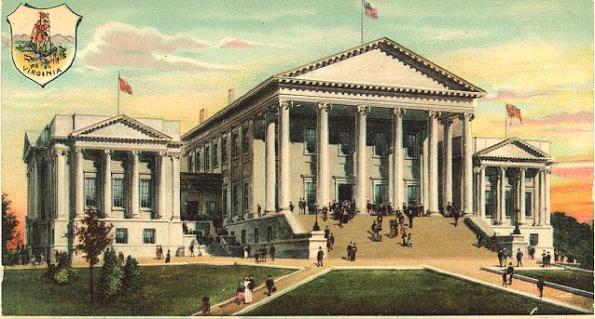
Virginia State Capitol
Archibald Austin, deceased
The obituary for Archibald Austin, which ran in the Richmond newspapers in October of 1837, is one of the longest I have found from this era for a citizen of Buckingham County. His political service, not only locally but also to the state and the nation, was significant.
OBITUARY NOTICE.
The spirit of the true Israelite without guile has departed this life; ARCHIBALD AUSTIN, Esq., of the county of Buckingham, aged about sixty-five years. He labored under a chronic breast affliction [?], greatly aggravated by a residence in Richmond the last two winters as a member of the Legislature; and it may be truly said, that he lessened the number of his days from his patriotic devotion to stand to his post in the service of his country, when he had neither health nor physical power to do so. It is true, that the Court of Buckingham, at whose bar he stood about forty years as a worthy and successful advocate, has adopted resolutions honorable to his virtuous and well-spent life – yet the author of these lines, an old and devoted friend of the deceased, would reproach himself to be longer silent in adding his small tribute of respect and high regard to so much departed worth. As a husband, he was loving and kind; as a father, tender and affectionate; as a friend and neighbor, the bewailings of his neighbors and friends far and near speak forth his claims; as a master, he was humane an uncommonly indulgent– more than thirty years a worthy number of the Anabaptist Church, fellowshipping with the virtuous of every denomination, denouncing none, his walk in all the great Christian duties is a bright example for others to imitate and to pursue. Mr. Austin is favorably known to the public, having represented this District in Congress, and several years a member of the State Legislature. With the origins of the two great parties, Republican and Federalist, Mr. A. attached himself to the former party; believing they were the true friends of free, representative Government, to be administered within the prescribed limits of the Constitution; from which principles he never deviated to the day of his death one jot or tittle, steadfastly opposed to a National Bank, a protective Tariff, and public improvements on the part of Congress as so many usurpations of power on their part.
Let friendship’s faithful heart his bier attend,
Heave the sad sigh and imitate his latter end.
He died near Buckingham on October 16, 1837 and was interred on his estate, on the family cemetery, with his wife, Grace.
Coming Next: For Sale: Estate of Archibald Austin
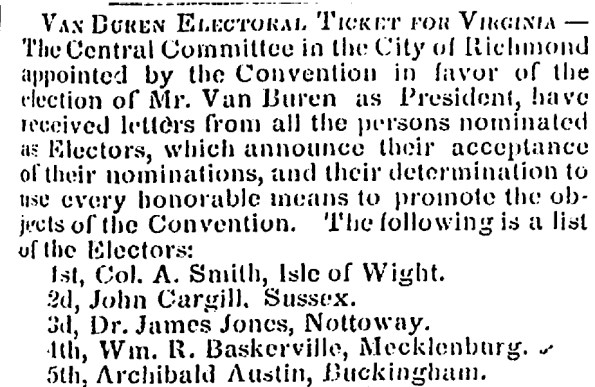
To Archibald Austin, Esq.
This open letter, addressed to Archibald Austin, Esq., of Buckingham County, appeared in Richmond’s The Whig. Written by an anonymous Slate River voter, the letter reminds us that, throughout the 19th century, the elite of Buckingham County closely followed the Richmond newspapers. One wonders if Austin replied via The Whig.
For The Whig
TO ARCHIBALD AUSTIN, ESQ.
Having understood that a “Caucus” at Buckingham February court, determined to “run” you as one of the Jackson candidates for a seat in the next Legislature, and doubts having risen as to what course you would pursue (if elected) in relation to the next Presidency, I have taken occasion to present the following interrogatories to you through the newspapers. I make no apology, sir, for addressing through that source: This is an “interesting crisis,” and great necessity exists that the sentiments of those that are candidates (whether voluntarily so, or whether thrust forward by a Caucus.) for those votes of freeman, should be made known without the least reserve. With a view therefore to know your opinions upon the above named to subject, I propose to enquire –
First – Whether or not you are now inclined to support Martin Van Buren, Esq. Of New York, as the next president of the United States? And
Secondly – If not now inclined to his support, would you or not vote for an electoral ticket pledged to his support in preference to Hugh L. White, Esq. of Tennessee?
A Slate River Voter.
Buckingham, 20th Feb. 1835.
Coming Next: Archibald Austin, deceased
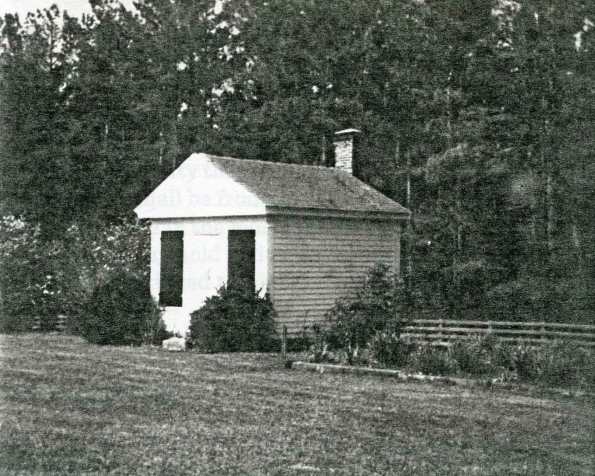
Austin’s Law Office, Photo Courtesy Jeanne Stinson
Archibald Austin (1772–1837)
Archibald Austin was born near Buckingham Court House, studied law, was admitted to the bar, and began his practice in his home county.
He served as a member of the Virginia House of Delegates from 1815 to 1817 and, in 1816, he was elected to the Fifteenth Congress (4 March 1817 – 3 March 1819). When Austin was not nominated again to run for Congress, he resumed his law practice in Buckingham. In 1832 and 1836, he served as a presidential elector on the Democratic ticket, first for Andrew Jackson and Martin Van Buren and then for Martin Van Buren and Richard Mentor Johnson. During 1835-1837, he again served in the Virginia House of Delegates. He was also recommended to serve as Governor of Virginia.
Austin’s law office, pictured above, sat at his plantation, Westfield. His legal papers are now housed at the College of William and Mary. Because Archibald Austin’s papers predate the 1869 burning of Buckingham Courthouse, they are extremely valuable, shedding light on late 18th and early 19th century life in the county. Wills name heirs and human property. Receipts reveal chancery cases Austin argued for his clients. The papers include, among many other interesting documents, proof of an 1806 chancery suit between Randolph Jefferson and his cousin, John Jefferson.
For more about their relationship, see The Jefferson Brothers.
For much more about Archibald Austin’s life as an attorney, consult Early Buckingham County, VA Legal Papers. Compiled and transcribed by Jeanne Stinson. Athens, GA.: Iberian Pub. Co. 1993.
Also see the “THE AUSTIN-TWYMAN PAPERS, 1765-1939” at Swem Library, The College of William and Mary.
Coming Next: “To Archibald Austin, Esq.”

After the death of Buckingham Notable Col. Thomas M. Bondurant in 1862, his newspaper was put up for sale following the end of the Civil War in 1866. The owners then included his heirs: Thomas L. Bondurant, Alexander J. Bondurant, George P. Bondurant, and his daughter’s husband, William P. Hall. The following advertisement ran in the Whig on October 30, 1866.
THE RICHMOND WHIG NEWSPAPER FOR SALE.
The undersigned, proprietors of the RICHMOND WHIG NEWSPAPER, conducting the same under the firm of BONDURANT, ELLIOTT & SHIELDS, have agreed to terminate the existing partnership, and have determined that this can be most readily and satisfactorily accomplished by a sale of the paper, in view of the fact that the partnership is numerous, made so by the death of Colonel Thomas M. Bondurant, whose heirs became owners of his interest in the WHIG at his death.
Accordingly they announce that the paper is for sale, and will be sold privately to any one who may meet the conditions at the time before THURSDAY, the 22nd day of November next.
If not sold prior to that date at private sale, it will on that day be offered at public sale, at the office of the WHIG, and 11 o’clock A.M.
We deem it unnecessary to say much in regard to the WHIG, its present or its past status, before the Virginian and Southern public. For thirty five or forty years past the face of no paper has been more familiar to the Southern public than that of the WHIG, and during that period it has yielded, with unerring certainty to its proprietors, an annual average profit equivalent to six per cent on $100,000.
Of its present status it may be said that its business for the last eighteen months has been larger than in any like period of its history, and that its legitimate field is now more fully occupied over Virginia and the South than ever before the war, except where it has been unavoidably shut out by continued lack of mail facilities.
We confidently say – and this upon the faith of the two oldest proprietors, one of whom has managed the paper for the last twenty years, and the other in conjunction with him, for the last twelve years – that with a moderate amount of capital, skill and energy in the business department, and the accustomed ability and independence in the editorial, there is no better property in Virginia.
Applications addressed to BONDURANT, ELLIOTT & SHIELDS, proprietors of the WHIG Richmond, Va, will receive prompt attention; or personal application may be made to either of the proprietors at the office.
WYATT M. ELLIOTT,
JOHN C. SHIELDS,
WILLIAM P. HALL,
THOMAS L. BONDURANT,
ALEXANDER J. BONDURANT,
GEORGE P. BONDURANT.
It is remarkable that two cousins from Buckingham County, Thomas M. Bondurant and Alexander Moseley, would both contribute so significantly to this illustrious newspaper.
Click here for more about Thomas M. Bondurant.
Click here for more about William P. Hall.
For more about Alexander Moseley, consult “The Man behind Alexander Hill: Alexander Moseley,” in “At a Place Called Buckingham,” Volume Two.
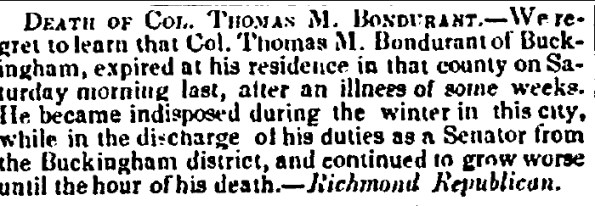
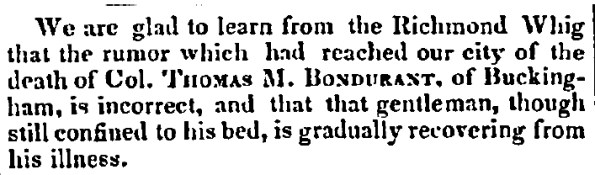
In 1848, the death of Col. Thomas M. Bondurant was prematurely announced in the Richmond Republican, then quickly retracted.
~
In May of 1862, when Col. Thomas M. Bondurant died suddenly, a long and laudatory letter ran in his newspaper, Richmond’s Whig.
Death of Col. Thomas M. Bondurant.
The shocking intelligence was received in this city yesterday of the sudden death of Col. Thomas M. Bondurant, of Buckingham, the day before, by a fall from his horse. Thus, in this time of general trouble and bereavement, by an instantaneous and unexpected stroke of fate, is ended this career of a [illegible] old Virginian, [illegible] and patriot. Almost from its foundation, he has been principal proprietor of this journal. Now, that his connection with it ceases forever, it cannot be considered unbecoming to say, that it would be impossible for the relation between proprietor and conductor of the journal to be more generous, or upon more honorable footing, then that maintained by him towards the different gentleman who have had the editorial conduct of the Whig during his ownership. That relation has been one of the entire independence on the part of its editors – but rarely, and then in the most unobtrusive and modest way, trammeled even by counsel. Nor did it ever enter his mind to use the great power he held, in this way, to promote any object of private advantage, or to avenge any personal grievance – if such he had. Let this be remembered to his honor. Over a third of a century ago, he entered the service of the State, as a Delegate from the populace, wealthy and intelligent county in which he was born, and after a life of some sixty odd years, has died. Most of the times since, he has been a member of one or the other branch of the General Assembly – devoting himself with marked assiduity and practical sagacity to this substantial interests of the Commonwealth, and, with especial zeal and [illegible] its public works. For a number of years past, he has been [a director ?] of the James River and Kanawaha [illegible] . . .
. . . [H]e was one of the first and most decided if his party to declare that they should be defended out of the Union. As a private citizen, and in his domestic connections, Col. Bondurant was a type of [illegible] we imagine of a true man. His energy and judgment were displayed and rewarded in the accommodation of a large estate – and his household virtues were illustrated in the sacred relation of a husband and father, and in the patriarchal care of his numerous dependents – as well as in the hospitable and neighborly offices that give such charm and dignity to the life of the Virginia country gentleman. His death at this time, when manhood and devotion and public spirit and generosity are so much needed, is scarcely less than a public than a private bereavement.
While this tribute to Thomas M. Bondurant is unsigned, it is entirely possible that it was written by Whig Editor, Alexander Moseley, Bondurant’s cousin, admirer, and dear friend. For more about Alexander Moseley, consult “The Man behind Alexander Hill: Alexander Moseley,” in “At a Place Called Buckingham,” Volume Two.

In 1831, Thomas M. Bondurant, one of Buckingham County’s wealthiest citizens and publisher of Richmond’s Whig, purchased Fallsburg Mills with his partner, William Lewis. In 1834, Bondurant purchased the nearby tan yard from Thomas Miller. Within a little over a decade, the complex was again advertised for sale. This advertisement ran in the Whig in 1846:
TO MANUFACTURERS.
FALLSBURG MILLS
For Sale
THE advertiser proposes to sell, for manufacturing purposes, his property in Buckingham County, Va., known as FALLSBURG MILLS. It consists of a substantially built Brick Mill, 50 feet square and four stories high; — there are also on the Mill Lot four other brick buildings, which are admirably suited for the families of operatives. Attached to the same property, there are 650 acres of good Farming Land, which will be sold in conjunction with the buildings, if desired, or separately.
LOCATION. – The property above described is about 90 miles from the city of Richmond, on the James River, from which stream there can be obtained, along with the set property, water-power sufficient to carry on a number of additional Mills or Factories. The Canal is also within a short distance of Fallsburg Mills, through which channel the Richmond market is easily reached.
As there are no Manufactories of Cotton or Wool in the section of country immediately in the vicinity of Buckingham, a rare opportunity is now afforded to enterprising gentlemen for the establishment of Factories.
The author of the above property would be willing to take a liberal portion of Stock in a Company that might be formed for manufacturing purposes; and he would make the terms of sale moderate.
Address THOMAS M. BONDURANT, the owner, Buckingham Court house, Va. Or ROBERT H. GALLAHER, of the Richmond Whig.
January 16, ’46.
Bondurant continued to advertise over the next two years. In 1848, Bondurant described the property as at Goodby’s falls, eighty-six miles above Richmond, within a few hundred yards of the canal. He mentioned the Millhouse, the four brick dwelling houses, as well as a “Tan Yard and Bark Mill.” Clearly, the property was a small and varied industrial center.
In 1859, the Virginia House of Delegates passed: “An act to incorporate the Fallsburg woolen, cotton, iron and leather manufacturing company in the county of Buckingham.” Of course, Virginia was on the verge of entering the Civil War. Was the industrial complex at Fallsburg successfully expanded?
It is unclear from the tax records whether or not T. M. Bondurant sold this property before his death in 1862.
If a Slate River Ramblings Reader knows more about the development of industries at Fallsburg Mills, please comment.

Fallsburg Creek, in Buckingham County, flows into the James River, just downstream from Goosby Island. Above it is Mill Creek. Click image to enlarge.
In 1829, Fallsburg Mills, located on the James River, in Buckingham County, was advertised for sale in Richmond’s Enquirer. In 1821, Edmund Anderson and his wife had transferred the property to Fleming Turner and James Brown, then a surviving trustee of the exchange. An auction of the property was set for March of 1829 and the advertisement described the property as simply 318 acres attached to “said Mills.” Presumably the advertisement was so brief because the property was so well-known.
If the auction was held, it was unsuccessful. Thus, in July of 1830, James Brown and George Booker, Trustees, placed a new and much more thorough advertisement in the Enquirer:
TRUST SALE. – By virtue of the deed of trust executed to us by George Woodson, which deed is duly recorded in the clerk’s office of the county court of Buckingham, we shall, for purposes in said deed expressed, and at the request of the creditors of Edmund Anderson, proceed to sell, for cash, on the premises, on Thursday, 22 July next, if fair, if not the first fair day thereafter, that valuable and well known property called the
FALLSBURG MILLS,
With 318 acres of good land attached thereto. This property is situated on James River in the county of Buckingham, about one mile above Warren, and has on it a large brick Manufacturing Mill, with two pair of Burrs and one of prime stones for grinding corn; a good brick dwelling-house, a brick store and a lumber house, with several wooden dwelling-houses and other valuable improvements, such as, the barn, tobacco houses, stables, &c. Acting as trustees, we shall convey to the purchaser or purchasers, the title vested in us by the deed aforesaid, which, however, is believed to be good.
The above property is to be sold subject to a prior lien thereon created by deed of trust executed by Edmund Anderson to James Brown, Jr. and Fleming Turner, trustees, to secure the payment of a debt, whereof a balance of about $2,000 remains unpaid.
JAMES BROWN, GEO. BOOKER, Trustees.
June 25.
Coming Next: Fallsburg Mills: Part II

Unidentified photo, believed to be Taggart School, Ella Richardson Collection
During the 1920s, my cousins, Ella and Bessie (and, possibly, their sister Mary) Richardson, taught public school at Taggart, a spot in northeastern Buckingham County which was little more than a post office, a store, and a two-room schoolhouse. The site is marked today on Bridgeport Road, at Route 719, just south of the James River.
In 1898, Willie R. Taggart was the postmaster there and mail was collected at Taggart until October 12, 1933 when delivery was consolidated and Taggart’s mail moved to Arvonia. On the 1900 census, Willie R. Taggart is identified as a storekeeper. Likely, the post office and store were at the same place.
Goldie Boggs (1911-2011) attended school at Taggart for 2nd or 3rd grade and recalled that Minnie, Edna, and Virginia Davis taught there. Goldie also remembered Taggart as a two-room school house. The younger children studied on one side, the older children on the other. Goldie must have enjoyed her time in school, becoming a dedicated and beloved school teacher. See a tribute to Goldie at Thacker Brothers’ website: Goldie Ann Boggs Stargell.
If a Slate River Ramblings reader knows more about Taggart, especially Taggart School, please comment.
Special thanks to Peggy Moseley for sharing Goldie’s memories!

Perry Hill, Courtesy Virginia Department of Historic Resources
Judge Alexander Stuart Hall has been the subject of several posts at Slate River Ramblings. His father, Dr. William P. Hall, of Perry Hill in Buckingham County, earned an especially lengthy obituary in the Staunton Spectator on April 11, 1888. Many thanks to Mary Carolyn Mitton for sharing it!
Death of Dr. Wm. P. Hall.
Dr. William Paxton Hall, eldest son of the late Alexander S. Hall, long a leading Staunton merchant, and one of its most honored citizens, died at his residence, “Perry Hall” (sic) Buckingham county, on the 2nd instant, in the 66th year of his age. The deceased, after acquiring a good education, studied medicine with the late Dr. Addison Waddell, and afterwards graduated at Jefferson Medical College, Philadelphia.
He commenced, the practice of his profession at Prince Edward C. H., but soon removed to Howardsville, a thriving commercial town on James River in Albemarle county, where he soon became proficient in his profession and very popular with the people.
A few years after his location there, he married the only daughter of the late Col. Thomas M. Bondurant a distinguished member of the Virginia Senate, one of the largest property-holders in Buckingham county, and for thirty years preceding his death, the largest holder of the stock of the Richmond Whig newspaper establishment.
After marriage, Dr. Hall settled upon a patrimonial estate near Buckingham Court-house where he continued to reside to the close of life. An only daughter died some years since. He leaves a widow and three sons, Alexander S., Judge of Buckingham County Court, one in Lynchburg, and one at home.
Of his brothers and sisters, four reside in this city, Mrs. Wm. B. Kayser, Mrs. C. H. Tipping, Mrs. Virginia L. Thompson, and Edward. Three other brothers, Dr. Lucien and Major Houston in Albemarle and Alexander in Maryland, also survive him.
On his maternal side, Dr. Hall was descended from the Paxtons of the North River Valley in Rockbridge, distinguished for their adherence to the tenets of the Presbyterian church and in upholding the cause of civil and religious liberty in colonial times. From both father and mother he inherited sterling qualities which were prominent through his life. He was highly esteemed by the people with whom he cast his lot, and all mourn his death.
Click here for more about Perry Hill.


 slate river ramblings . . . .