
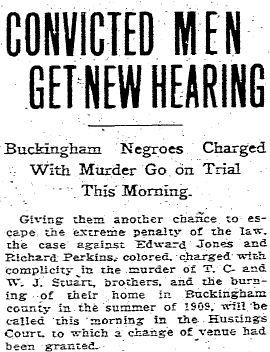
A New Trial for Jones and Perkins
On June 22, 1911, The Times-Dispatch reported the opening of Edward Jones’ trial in Richmond’s Hustings Court. Jones was not present; he was “seriously ill with inflammatory rheumatism in the City Jail.” The article went on to note that Jones and Perkins would be tried separately.
The following day, the newspaper reported new evidence presented in court:
After a short argument between the opposing sides, Judge Witt allowed the reading of the testimony of Moreman Carter, son of former Deputy Sheriff Carter, now dead. Carter is out of the State, and therefore beyond the reach of a summons. His evidence was to the effect that he and his father, armed with an alleged fake warrant, went to the home of Richard Perkins, one of the accused, at night, and placed him under arrest. A short distance from the house the negro was taken from the deputy sheriff and the boy was later told that the mob strung him up to a tree in an endeavor to wring from him a confession. Obtaining nothing from him, they released him. Then the deputy sheriff allowed him to return home.
Mr. Hallard, who had been a guard at the Buckingham County Jail during the incarceration of Johnson and Jackson (witnesses for all three cases), was introduced by the defense as an important witness in the afternoon. He testified to having heard the two negroes quarrel when Jones stated to his partner that he knew nothing of the murder and was not going to tell his story because he had received no payment. It was related that Johnson had said that the authorities told him they would kill him if he didn’t stick to his story. After the quarrel Jackson was placed in a cell to himself, from where he could neither see out nor be seen. Hallard stated on the stand that he informed the jailer of what had transpired between the two negroes and was told to keep his mouth shut. Then, he stated, he went to see Commonwealth’s Attorney Edmund W. Hubard, who said, “By George, keep that quiet. Don’t say anything about it.” Later he called on Attorney Boatwright and told him the same thing.
“That is the Mr. Boatwright who I defeated for Commonwealth’s attorney, isn’t it?” asked Mr. Hubard dryly.
“Yes. Sir.”
If Hallard was telling the truth, Jailer Frank Spencer, Commonwealth’s Attorney Edmund Hubard, and other unnamed officials were now implicated in the possible bribing of Edward Jones and the intimidation of Johnson as a witness to the crime.
Were Moreman Carter and guard Hallard afraid to offer this testimony while the trials were held in Buckingham County? Carter was safely out of the state and, apparently, Hallard, who was enumerated as “Willy Hillard” on the 1910 census, was no longer a guard at the county jail.
The June 23, 1911 edition of The Times-Dispatch additionally reported that Willie Jackson’s testimony of the particulars of the crime contradicted several details of his previous testimony. He now denied that he had stated that Deputy Sheriff Carter had instructed him on the details of the case and that Carter had offered both him and Johnson $60.00 each. Instead, Jackson stated that guard Hallard had offered him $60.00 to change his evidence. Hallard flatly denied the accusation.
If Willie Jackson was telling the truth, guard Hallard could now be included as one of “the officials” implicated in possible bribery.
The newspaper went on to report that Aylett Johnson took the stand. The facts presented in Johnson’s version of the events that took place the night of the crime both agreed with and contradicted Jackson’s story.
Could this intricate web of contradictory testimonies ever be sorted out?
Had, in fact, the testimony of these men been manipulated by officials, with the intention of making any judgement impossible?
Coming Next: Acquittal and Pardon
Need to catch up on The 1909 Buckingham Murders? Part I: June 1, 2015
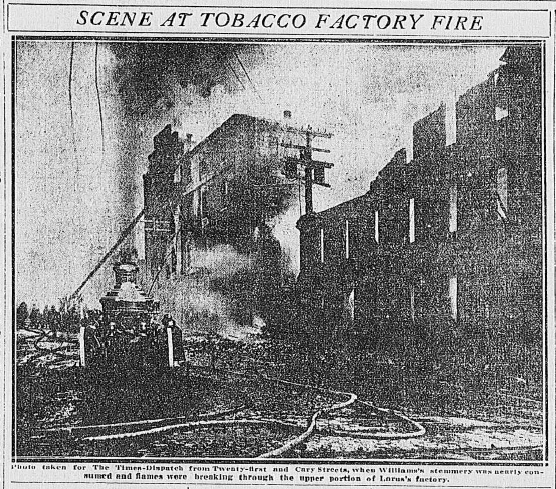
Tobacco Factory Fire, Courtesy The Times-Dispatch
On February 25, 1911, the front page of Richmond’s Times-Dispatch featured the photo above adjacent these dramatic headlines:
STUBBORN BLAZE DESTROYS PLANT
Williams’s Tobacco Stemmery Consumed in Spectacular Fire.
LARUS’S FACTORY BADLY DAMAGED
Loss May Reach $100,000, Protected by Insurance –
Prisoners in Henrico Jail Removed as Precaution –
Fireman Overcome, but Serious Injury Is Averted.
Among the prisoners held in the Henrico County Jail were Dallas Wright, Edward Jones, and Richard Perkins. The front page article included general comments about the situation at the jail:
Part of the burned buildings adjoin, in almost actual contact, the Henrico county jail, which soon became surcharged with suffocating smoke. Sheriff L. H. Kepm called on the city police force to aid him in removing the prisoners to a place of safety. . . thirty-three prisoners, among them being three men convicted of murder, brought here from Buckingham county, were transported to the City Jail. Fireman fought to prevent the fire from spreading to the jail and courthouse.
A second story on page two, detailed the evacuation of the jail, including “Negroes Rescued From Roof.” The article went on to note that “W. Dallas Wright and the two negroes, Richard Perkins and Ed. Jones, convicted murderers of Buckingham county, who are awaiting a new trial, were sent to the city lock-up in charge of W. N. Grubbs.”
What more could happen to these men? Flood? A plague of locusts?
Need to catch up on The 1909 Buckingham Murders? Part I: June 1, 2015
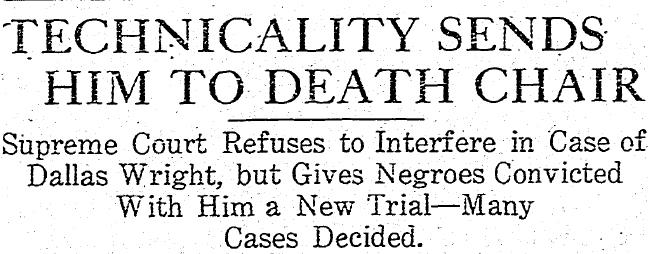
Dallas Wright’s Appeal Denied on Technicality
Months dragged on. Autumn turned into winter once again. Edward Jones and Richard Perkins, who had been granted new trials in Richmond, were moved to Richmond’s City Jail where they waited until June of 1911.
Dallas Wright, now held in an Henrico County jail, had little reason to be optimistic. The request for his change of venue and new trial was denied on a technicality. His attorneys had failed to file their petition within the time allotted. Wright, who was sentenced to death for the murders of the Stewart brothers, awaited execution while Edward Jones and Richard Perkins were granted trials in Richmond’s Hustings Court.
Given the tenor of the times, this was an uncomfortable situation. Two black men were afforded new trials while the white man in the case was sentenced to death. According to the January 13, 1911 edition of The Times-Dispatch:
In view of this unique condition of affairs, Judge George M. Harrison, voicing the opinion of the court, says that tribunal deeply regrets that it is not in [a] position to give the same measure of relief to Wright that it grants to the negroes. . . .
This will almost undoubtedly be followed by an appeal to Governor Mann for at least a stay of execution pending the retrial of the cases against the alleged accomplices. Inasmuch as the evidence is the same, the presumption is that the result of the coming trials will determine Wright’s fate, unless the Governor should see fit to interfere in all three instances.
This is precisely what happened. Governor Mann granted Wright a stay of execution until Richard Perkins and Edward Jones were tried and sentenced. Since the evidence applied to all three men equally, the Governor stated that Wright’s sentence would be identical to the decision for Perkins and Jones.
Coming Next: A New Trial for Jones and Perkins
Need to catch up on The 1909 Buckingham Murders? Part I: June 1, 2015

A Stay of Execution for Edward Jones
On September 18, 1910, Richmond’s Times-Dispatch carried the sensational story of Edward Jones’ stay of execution for the murder of the Stewart brothers:
With a margin of only seventy-two hours of life, Ed. Jones, sentenced to be electrocuted next Tuesday for the murder of W.J. Stuart and T.C. Stuart, in Buckingham county, was yesterday granted a writ of error by the Supreme Court of Appeals. The case will be placed on the Commonwealth docket and will therefore be among the first to be heard in the November term of court.
Originally, Jones’ case had been heard by Judge Gordon who had set aside the verdict, saying that the evidence on which Jones was convicted, given primarily by Willie Jackson and Aylett Johnston, “challenges human belief, is absolutely and utterly untrustworthy, unsatisfactory and incredible.” Gordon also heard Dallas Wright’s case, which originally in a hung jury.
The Times-Dispatch also took this opportunity to print a lengthy recapitulation of the now two-year long story of the murder of the Stewart brothers, reasserting that the alleged feeling in the county was such that a change of venue was necessary.
Was it primarily the inciting editorials of the James River Clarion that influenced public opinion against Dallas Wright, Edward Jones, and Richard Perkins? Or were officials in Buckingham County pushing for a decision before the cases fell apart due to lack of credible evidence?
Coming Next: Dallas Wright’s Appeal Denied on Technicality
Need to catch up on The 1909 Buckingham Murders? Part I: June 1, 2015

Amanda Perkins and family, 1910 census. Click to enlarge image.
Richard Perkins, Condemned to Death
Richard Perkins was enumerated twice on the 1910 census, once in the Buckingham county jail and once with his family. His father, Jesse Perkins, died sometime between 1900 and 1910, leaving his wife, Amanda, living with their six children. In 1900, Jesse and Amanda Perkins had been married twenty-seven years. That year, Richard was working as a farm laborer.
Richard Perkins’ family appears stable and, in April of 1910, his younger brother, Callis, proved loyal if foolhardy. On April 5, 1910, Richmond’s Times-Dispatch reported the following from Buckingham County:
Willie Jones, Jim Davis, and another negro named Perkins are in jail here, having been fined and given a jail sentence for disorderly conduct and threatening to open the jail and turn the prisoners out. The Perkins negro is a brother of Richard Perkins, who is in jail under sentence of death for complicity in the Stewart murder. All of the negroes seem to have been drinking, and they planned to overpower the jailer and take the jail keys and turn Dallas Wright, Richard Perkins, and Ed. Jones out. The plot was poorly planned, and utterly failed when the negroes looked down the barrel of Jailer Spencer’s gun.
On April 28, 1910, when the census was enumerated “Culler” Perkins, age twenty, was being held in the Buckingham County jail along with Dallas Wright, Eddie Jones, and Richard Perkins. He appears on the 1900 census as “Callice” (b. May 1888) and on the 1910 census, with his family as “Cullis,” in prison.
A month later, on May 23, 1910, The Farmville Herald printed the following from a Buckingham County correspondent:
Mr. W. J. Hubard, clerk of the Circuit Court was engaged a good part of the past week copying the records in the Wright and Perkins cases which are to be reviewed by the Supreme Court at Wytheville. It seems to be a question as to whether the court officers will receive any pay for their extra services in the Richard Perkins’ case, as he is without means, and his case is taken up under the pauper clause. The copying of the records in these two cases entailed a great amount of extra work on the part of Mr. Hubard and he got Mr. Earnest Jones to assist him in the work as his deputy was unwell at the time.
As a single, African-American man, “without means,” Richard Perkins was an easy target for many things, including intimidation and, possibly, false accusations of murder. How fortunate he was that one of the best criminal lawyers in Virginia took up his cause, believing him to be innocent.
It is notable that The Mathews Journal printed a similar story about Edward Jones, convict, and H. Stewart Jones, clerk of the Virginia Supreme Court of Appeals stating:
It may be of interest to note, this connection, that Convict Jones’ case will not bring a penny in the way of fees to Clerk Jones, for the negro has appealed “in forma pauperis” and the Commonwealth, therefore, is footing all the bills.
Need to catch up on The 1909 Buckingham Murders? Part I: June 1, 2015

A Change of Venue for Jones and Perkins
On June 14, 1910, The Times-Dispatch reported that a change of venue had been granted for both Richard Perkins and Edward Jones.
Attorney A.S. Hall had successfully argued that public sentiment had been worked up against the men, particularly fueled by editorials published in Arvonia’s weekly newspaper, the James River Clarion. According to The Times-Dispatch:
In these articles [in the James River Clarion] the jury system was severely criticized because of the influence exerted by the criminal lawyers, who are called “imported specialists.” Elsewhere there are references to “trickster lawyers” and “professional criminal clearers,” the intention evidently being to refer to the trials of the indicted men who were accused of the murder.
Months later, in February of 1911, when the Supreme Court of Virginia ordered that the men be sent to Richmond for their trials, Judge Hundley, who sentenced Wright, Jones, and Perkins to death, refused to enter the necessary order for the change of venue. As a result, Judge S.B. Witt, of the Hustings Court of Richmond, sat in Buckingham and granted the order. Judge Hundey stated that he would not have sent the men so far away and that they could have had a fair trial in a neighboring county. Incensed and insulted by the change of venue to Richmond, Judge Hundley’s lengthy remarks were printed in The Times-Dispatch. He bitterly concluded:
[T]he order of the Supreme Court appears to lack that fine spirit of courtesy and comity which one court has the right to expect of another, and especially of a court possessing the power and prestige of a court of last resort. A sense of proper respect for himself, for the dignity of the office which he holds and for the high tribunal which issued the order, impels him most regretfully to say this much.
Coming Next: A Stay of Execution for Edward Jones
Need to catch up on The 1909 Buckingham Murders? Part I: June 1, 2015

Commonwealth’s Attorney Hubard Defends Senator Gayle
Buckingham County’s Commonwealth’s Attorney Edmund W. Hubard was quick to defend his law partner, Senator Sands Gayle. On June 12, 1910, The Times-Dispatch printed Hubard’s statement which read in part:
The imputation as contained in the petition that Senator Gayle advocated a bill in the Legislature having any bearing on the case of Dallas Wright, is without any foundation in fact. I know that that bill was offered and fought on purely sentimental grounds. Buckingham was the county in which Judge Hundley stepped upon the threshold of life, and it was merely a matter of sentiment on the part of the people of the county that he should have his old county under his jurisdiction. . . .
I will further say that Judge Hundley, in my opinion is the ablest circuit judge in the State, pure and incorruptible, and that Sands Gayle is a thoroughly conscientious attorney.
I desire to further state that the assertion that the law firm of Hubard & Gayle, or either of its members, had been employed in the Wright case, is misleading and untrue.
The fact is that at the preliminary hearing I was ill, and my partner, through courtesy, appeared for me. Senator Gayle made a speech at the first prosecution through kindness to me and without any fee. He took no part in any of the cases and had no feeling or concern in the matter.
Whether or not Senator Gayle directly influenced the “emergency clause” that moved the trials to Judge Hundley’s district remains unknown; however, the attorneys for the defense were careful not to make any direct accusations. The change of district, however, had a swift and negative impact on both the cases of Edward Jones and Dallas Wright, resulting in decisions their attorneys were eager to have reversed in another court.
A change of venue and new trials might result in just that. . . .
Coming Next: A Change of Venue for Jones and Perkins
Need to catch up on The 1909 Buckingham Murders? Part I: June 1, 2015

Attorney for the Defense: John L. Lee
John Lynch Lee, a Lynchburg-based attorney, was a critical member of the team who defended Dallas Wright, Edward Jones, and Richard Perkins, the three men charged with the murders of the Stewart brothers.
By 1908, Richmond’s Times-Dispatch was already calling Lee a “famous criminal lawyer.” Indeed, he was both celebrated and successful, defending cases across Virginia, as well as in other states. His obituary ran in the Richmond Times-Dispatch on November 16, 1926, revealing that Lee was a native of New Orleans where his parents died when he was about ten years old.
He was educated at Sewanee School (now Sewanee: The University of the South), then schools in Germany and in Amherst County, Virginia. After attending classes at the University of Virginia, he was admitted to the bar in Amherst County in about 1884 where he served as Commonwealth’s Attorney from 1886–1894. Ultimately, Lee preferred the role of defender to that of prosecutor and, over the years, was involved in numerous celebrated cases. According to the obituary in the Richmond Times-Dispatch:
Mr. Lee probably had a larger acquaintance among lawyers of this and other States than any other Lynchburg attorney. He was recognized as one of the most brilliant and ablest lawyers this State has ever produced, and during his career he was identified with more notable murder cases than any other lawyer of the State during his time.
The obituary concluded:
Mr. Lee was one of the most delightful entertainers in the State, one of the most interesting talkers to be found. He was a profound scholar and philosopher. Noted for his independence of thought and action, he was the soul of chivalry, always one of the most considerate of men and he was noted for his many acts of charity.
It is currently unknown how John “Jack” L. Lee came to take the case of Dallas Wright, Edward Jones, and Richard Perkins. One thing is certain, Buckingham County’s Commonwealth’s Attorney Edmund W. Hubard faced a mighty opponent in the courtroom.
Need to catch up on The 1909 Buckingham Murders? Part I: June 1, 2015
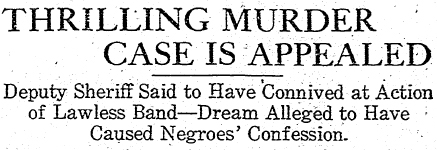
“Writs of Error”
Despite the fact that The Times-Dispatch reported that Dallas Wright proved to be a good witness on his own behalf, his second trial, held in March of 1910, ended in a charge of murder in the first degree. Judge Hundley ordered the death penalty for both Edward Jones and Dallas Wright for the murders of the Stewart brothers.
The Farmville Herald reported that Richard Perkins had been found guilty on March 23rd:
When the jury in the case against Richard Perkins brought in verdict of murder in the first degree here to-day, Judge Hall moved to set aside the verdict, but his motion was overruled by Judge Hundley.
Dallas Wright, convicted last week, was then brought into court, and he and Richard Perkins were both sentenced to be executed on the 3rd day of June. The court granted a postponement of execution for nineteen days from the adjournment of this court to allow the defendants to apply for a writ of error and sixty days in which to file a bill of exceptions.
Attorneys for the defense prepared petitions based on “writs of error” in the cases of Dallas Wright, Edward Jones, and Richard Perkins to submit to Virginia’s Supreme Court of Appeals. They claimed several reasons why the men had not been and could not be fairly tried in Buckingham County. Sensational headlines kept interest in the cases high. On June 11, 1910, The Times-Dispatch reported:
Serious accusations against Deputy Sheriff Ed. Carter, of Buckingham County, are made in a petition for a writ of error in the case of Dallas Wright, under sentence of death for murder. . . .
Carter is said to have had “knowledge and connivance” of a band of men which took Richard Perkins, a negro, accused of the same crime, from others and strung him up several times in order to force a confession. The petition of Attorneys Aubrey E. Strode and Jack Lee says plainly that Carter lied to Perkins,” and calls the officer a “hypocritical deputy sheriff.”
Carter, who died in 1909 as a result of a buggy accident, was not alive to counter the accusations. Later, Judge S. G. Whittle, who granted a new trial to Edward Jones and Richard Perkins, wrote in his opinion, “It is not possible to read the evidence bearing upon this episode . . . without being satisfied that the deputy sheriff connived at this partial lynching of his prisoner.” Additionally, the court found that other officials must have had some knowledge of the event, for they refused to testify on the grounds that they might incriminate themselves. The Times-Dispatch called the treatment of Richard Perkins an “outrage.”
Counsel for the defense also cited the reassignment of Buckingham’s Court from the Twenty-ninth to the Fifth Judicial Circuit during the process of these complex cases as a reason for a change of venue. The newspaper noted, “Without argument or accusation of improper conduct, which is apparently left to implication, it is merely said that Senator [Sands] Gayle, whose firm was engaged to assist the prosecution, was a member of the Senate.” Whether or not Senator Gayle had any direct involvement in the creation of the “emergency clause” which caused the reassignment of the Buckingham County Court is currently unknown.
Additionally, counsel for the defense argued that George E. Bolton’s “visionary” dream unduly influenced the testimonies of Willie Jackson and Aylett Johnston. The newspaper went on to summarize the defense attorney’s opinion of Jackson’s and Johnson’s testimony, “. . . either a miracle has happened in Buckingham county or the dream had been ground into the superstitious temperaments of the two negroes.”
Prosecuting Attorney Edmund W. Hubard wasted no time responding to the claims asserted by the attorneys for the defense.
Coming Next: Commonwealth’s Attorney Hubard Defends Senator Gayle
Need to catch up on The 1909 Buckingham Murders? Part I: June 1, 2015
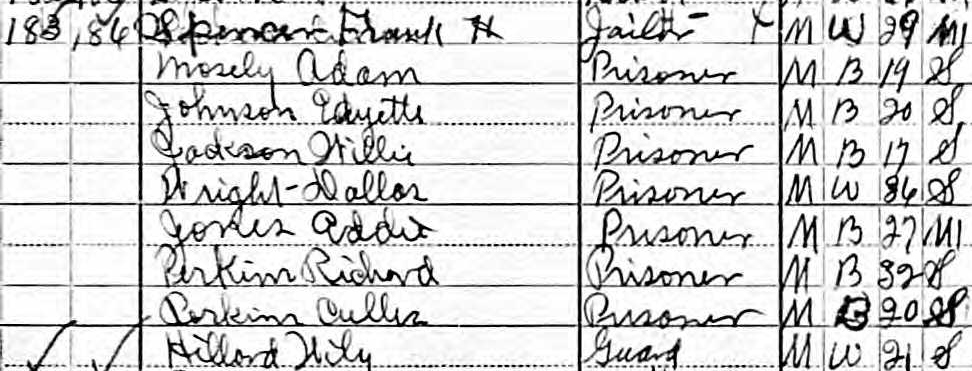
1910 Federal Population Census, Buckingham County Jail
One Year Later
Dallas Wright, Edward Jones, Richard Perkins, Willie Jackson, and Aylett Johnson spent the fall and winter of 1909-1910 in the Buckingham County jail. The wheels of justice were indeed grinding slowly. Edward Jones had been found guilty, Dallas Wright expected a new trial, and Richard Perkins was yet to be tried. Their youth (if not their lives) was slipping away from them. The Federal census for 1910 recorded that Aylett Johnson (19), Willie Jackson (20), Dallas Wright (36), Eddie Jones (27), and Richard Perkins (20) resided in the county jail. Frank Spencer (29) was the jailor and Wily Hillard (21) was enumerated as the guard.
Why were Johnson and Jackson held in jail throughout this process despite their confession and the fact they were never indicted?
The Time-Dispatch noted that Mr. John L. Lee, who had defended Dallas Wright, seemed “to be putting forth every effort in defense of his client.” The newspaper went on to say, “He and his associates expressed in public and in private their entire belief in the innocence of the accused, and also they express the belief that the negro Ed. Jones, who has been found guilty, is also innocent.”
In early 1910, while the men awaited their fate, a bill was passed in the Virginia Legislature which had an unexpected, and potentially profound effect, on the cases of Wright, Jones, and Perkins. An “emergency clause” added to this bill moved Buckingham County’s Court from Judge Gordon’s jurisdiction to that of Judge Hundley.
In the summer of 1909, Judge Gordon had found Edward Jones guilty of murder. Jones’ sentence was pending the trial of Richard Perkins and a new trial for Dallas Wright, whose initial trial ended with a hung jury. Ten members had been convinced of his guilt while two members were convinced of his innocence.
As a result of this change of district for Buckingham’s court, Judge Hundley would determine the sentence for Edward Jones’ case, which he had not heard. In March of 1910, a new trial for Dallas Wright was announced with Hundley on the bench.
Coming Next: “Writs of Error”
Need to catch up on The 1909 Buckingham Murders? Part I: June 1, 2015


 slate river ramblings . . . .