
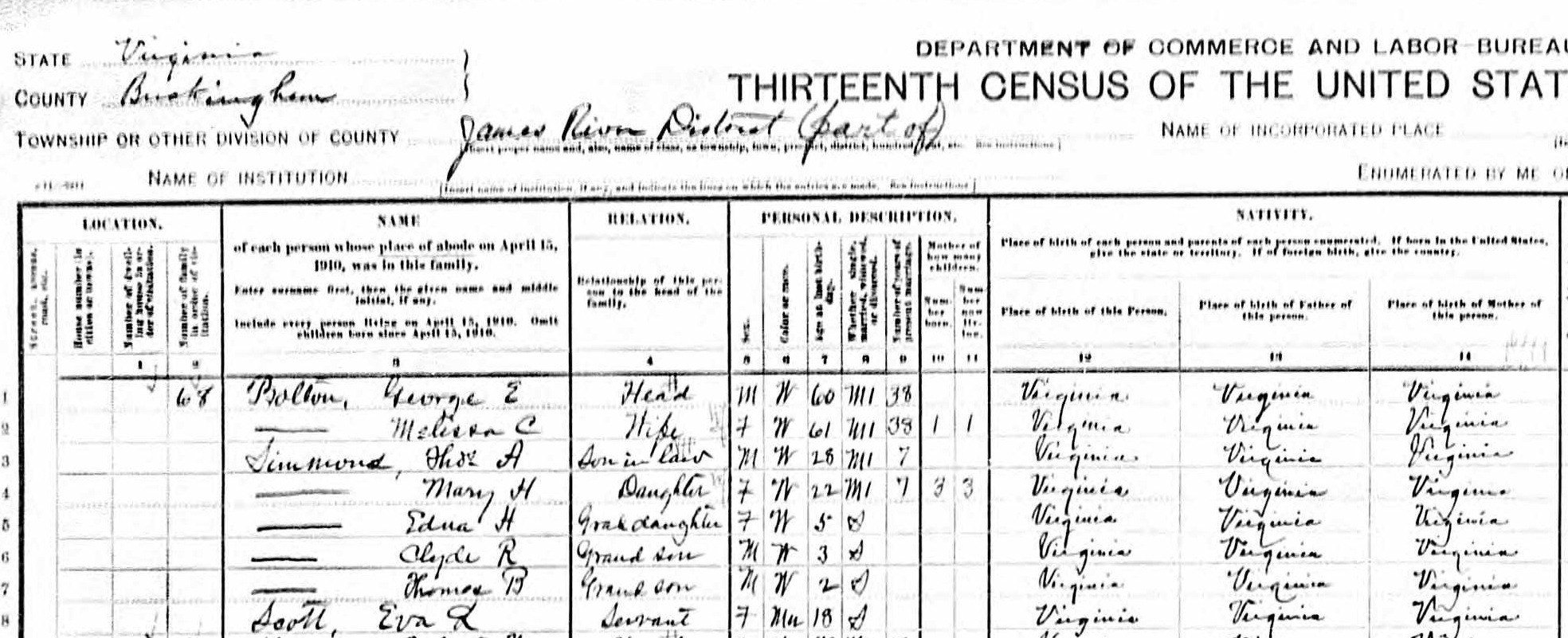
George E. Bolton and family, 1910~ Click on image to enlarge.
Will the real George Bolton please stand up?
A man named George Edwin Bolton, a merchant in Buckingham County, gave important testimony in the trials concerning the murders of the Stewart Brothers. The details of his dream the night of the crime greatly influenced the cases.
In an initial report in the Alexandria Gazette and Virginia Advertiser, he was misidentified as Edward Bolton. In a later article in Richmond’s The Times-Dispatch, he was called George C. Bolton.
Slate River Ramblings reader Ed Ayres recognized George Edwin Bolton (b. 1850) as the son of George Andrew Bolton who operated a tan yard on Route 56 in Buckingham County. In 1910, G. E. Bolton was living near Mt. Tabor Methodist Church on Route 56. His father and mother were no longer living; however, his father’s widow, Judith (Harris) Bolton, lived nearby at the tan yard with her son-in-law and daughter, James Daniel and Frances Elizabeth (Bolton) Ayres.
In addition to operating a store, George Edwin Bolton was appointed postmaster at Hubard, Buckingham County on May 21, 1906, a position of trust and responsibility. Perhaps, his role as postmaster at the time of the Stewart murders gave additional credence to his dream. He served as postmaster until the mail moved from Hubard to Wingina on September 30, 1913.
Bolton died in 1917 and is buried in the Mount Tabor United Methodist Church Cemetery. Whether or not he collected any reward for the capture of Dallas Wright, Ed Jones, and Richard Perkins is currently unknown.
Need to catch up on The 1909 Buckingham Murders? Part I: June 1, 2015
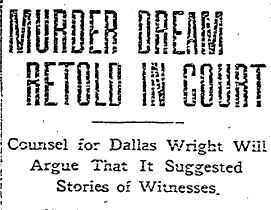
Bolton’s Dream Revisited
Testimony in the case against Dallas Wright for the murder of the Stewart brothers continued and, on September 8, 1909, The Times-Dispatch reported that merchant George E. Bolton once again graphically recounted the visionary dream he had on the night of the crime:
I had a dream, he said, on the night the Stuarts were burned. I awakened about 2 o’clock in the morning very much excited. I had dreamed I saw four or five men go into a log house. Then I heard them rumbling and scuffling, then I dreamed I heard a shotgun fired and saw one man fall.
I saw three men scuffling. Two of them threw the other down and cut his head off with an axe. Then I saw the men pass out of the house and separate in the woods. The next day I heard of the murder of the Stuarts. I noticed my dream fitted very well with what had been done. . . .
Richard Perkins had an axe in his hand, and I also recognized Dallas Wright as one of the men. I told the dream to my home people. I did not tell the names of those I saw in the dream. I got up about 3 o’clock in the morning and saw a light in the direction of the Stuart home and I could see the light till daybreak.
Jack L. Lee, counsel for the defense, then suggested that witnesses Willie Jackson and Aylett Johnson had based their testimony on Bolton’s dream, making their testimony completely unreliable.
On September 9, 1909, the Alexandria Gazette reported that, after five days, the jury “failed to agree” in the trial of Dallas Wright though ten members were in favor of conviction. Additionally, the newspaper noted that it had been shown in court that the reward for information pertaining to the murder which was now set at $800 (the reward of $500 offered by the Governor had been increased by the Buckingham County Board of Supervisors which offered $100 for each perpetrator identified) might be “a possible cause” for witnesses to turn a dream into “alleged facts.”
As the autumn of 1909 approached, Edward Jones awaited his sentence and Dallas Wright awaited a new trial as a result of a “hung jury.” Richard Perkins was yet to be tried.
Coming Next: One Year Later
Need to catch up on The 1909 Buckingham Murders? Part I: June 1, 2015
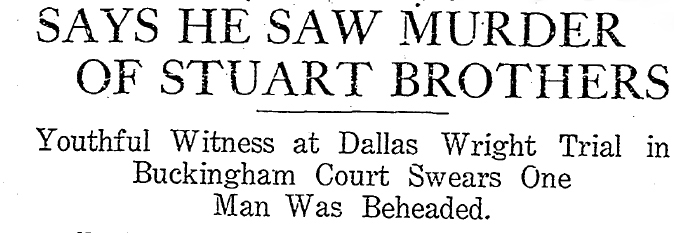
“Willie Jackson, Star Witness”
The September 5, 1909 issue of The Times-Dispatch reported that Willie Jackson proved a “star witness” in the trial of Dallas Wright. According to Jackson, Wright threatened to kill him if he didn’t go along with the murderers. The newspaper quoted Jackson’s testimony:
“I went,” he continued, “and saw them kill Thomas Stuart. They found $150, of which Dallas Wright got $50. Richard Perkins $50 and Ed Jones $50. I did not get a cent. I went home after the money was counted, and did not tell of the murder because I was afraid Dallas Wright would kill me. . . .”
“Richard Perkins chopped the head of one of the Stuarts off at one stroke. Ed. Jones was sitting on his feet and Dallas Wright on the middle of his body.”
Jackson also stated that he stood in the door while the killing was going on and that he saw Aylett Johnson peeping through a crack in the house. Bill Stuart, he said, was shot in the forehead and lay dying on the bed. The money was discovered under a rock of the hearth. Someone threw a gallon of coal oil on the bodies and, according to Jackson, Ed Jones started the fire.
If Willie Jackson stood at the door during the killing of Thomas and William Stewart and Aylett Johnson was peering into the house, watching the murders, these two men were not merely acting as comparatively innocent and “coerced” sentinels standing by the road. At this point in the proceedings, the testimony of the prosecution’s star witness was beginning to show signs of being unreliable.
Jackson concluded his testimony, saying, “I went to Sunday school Sunday morning and I was scared. It looked like I could see folks after me. I did not tell anybody about it at Sunday school because I was scared.”
During Wright’s trial, others testified concerning evidence found at the site of the burned cabin. McKim Wright, Dallas Wright’s cousin, stated that he went to the cabin at sunrise the morning of the murders and saw the decapitated body. John Staffer, who knew both of the Stewarts, stated that the brothers and Dallas Wright had had “a difficulty.”
Staffer’s indication that Wright and the Stewart brothers had a less than friendly relationship did not help Dallas Wright’s case.
Coming Next: Bolton’s Dream Revisited
Need to catch up on The 1909 Buckingham Murders? Part I: June 1, 2015

Aubrey E. Strode, Courtesy Library of Virginia
Aubrey Ellis Strode (2 October 1873 – 17 May 1946), one of a team of attorneys that defended Dwight Wright, Edward Jones, and Richard Perkins charged with the murders of the Stewart brothers, was a Democrat who served three terms as a Virginia State Senator, representing the 19th district.
Born in Amherst County, Virginia, he studied at Clemson College, the University of Mississippi, Washington and Lee University, and the University of Virginia Law School.
Strode’s obituary published in the May 18, 1946 issue of the Richmond Times-Dispatch related:
Judge Aubrey Ellis Strode, former State Senator, member of General Pershing’s staff in World War I and judge of the Lynchburg Corporation Court for nine years, died tonight at 8 o’clock at “Kenmore,” the family home in Amherst County.
Known for his interest in social legislation Judge Strode drafted the Virginia sterilization act which became a model for other States, and was patron of the first Virginia prohibition enabling act and the first bills to establish student loans and a State College for Women in connection with the University of Virginia.
Today, Strode’s controversial legacy includes Virginia’s 1924 sterilization law. He also acted as legal counsel to the Board of Directors of the Virginia State Colony, representing the Colony in the landmark case concerning the sterilization of Carrie Buck. Paul A. Lombardo, in his book Three Generations No Imbeciles: Eugenics, the Supreme Court, and “Buck v. Bell,” commented:
Aubrey Strode was a politician who understood this formula for local prosperity. He studied liberal arts and law at the University of Virginia, then opened a law practice in Amherst, Virginia. In 1905, as a new member of the Virginia Senate, he found a use for arguments that favored building a colony in his legislative district. The son of the first president of Clemson University, Strode was a social progressive and political pragmatist. His motives for supporting a new [epileptic] colony may also have been personal. Both of his parents had died in state institutions only a few years earlier, minds enfeebled with the infirmities of the aged.
In stature and experience, Aubrey E. Strode was certainly a good match for Buckingham County’s Commonwealth’s Attorney Edmund W. Hubard.
Need to catch up on The 1909 Buckingham Murders? Part I: June 1, 2015
With the death of Deputy Sheriff Carter, the cases concerning the murders of the Stewart brothers lost a very valuable witness.
Given the new evidence that Carter set up the intimidation of Richard Perkins, do you think his death was an accident?
See: The 1909 Buckingham Murders: Part X
Cast your vote!

The Perkins Affair
On September 4, 1909, The Times-Dispatch called the “Perkins Affair” an “open secret” in Buckingham County:
It has seemed to be an open secret that one or more negroes were strung up to a tree and threatened with death if they did not tell what they knew about the murder of the Stuart brothers. The counsel for the prosecution denied that any undue influence was brought to bear on either of the witnesses Jackson or Johnson, or any of the accused.
The newspaper also informed readers:
Mr. Strode, of counsel for the defense, yesterday presented a paper detailing the alleged persecution of Richard Perkins in an effort to intimidate him and make him disclose the whereabouts of the perpetrators of the murder of the Stewart brothers. The council for the defense also charged that Richard Perkins was arrested without a warrant.
Months later, on June 11, 1910, The Times-Dispatch reported that Deputy Sheriff Carter likely apprehended Perkins on a bogus warrant. He then took Perkins away from his house to a spot where they were set upon by a band of armed men, “with the knowledge and connivance” of Carter. These men threated to hang Perkins unless he confessed to the crimes against the Stewart brothers, which he refused to do. After stringing him up several times without inducing a confession, they released him.
Obviously, the intimidation of Richard Perkins took place before he was indicted and jailed. What led Deputy Sheriff Carter and these men to think that Perkins was involved in the murders?
Assuming that this event happened as reported, Carter had abused his powers as deputy sheriff. Additionally, if he had survived his buggy accident, Carter could have identified several Buckingham citizens involved in the intimidation of Richard Perkins. Of course, if he had disclosed names, he would have incriminated himself, as well.
Before his death, did Carter pressure some of the men involved in the intimidation of Richard Perkins?
Several men of Buckingham might have wanted to see Carter silenced and his death appeared increasingly convenient.
Despite these new complications in the case of the Stewart murders, the court overruled the motion for a change of venue and Dallas Wright’s trial was set for September 5th at Buckingham Court House.
Coming Next “Willie Jackson, Star Witness”
Need to catch up on The 1909 Buckingham Murders? Part I: June 1, 2015
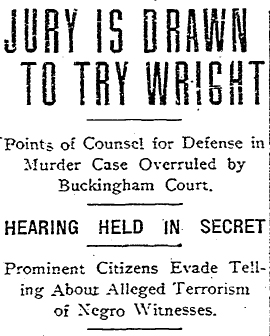
The Plot Thickens
Following the request for a change of venue for the trial of Dallas Wright, fifteen men of Buckingham County were interviewed by the attorneys. They were questioned separately and all gave their opinion that Wright could receive a fair and impartial trial in Buckingham County.
Concurrent with the interviews, a shocking story appeared in The Times-Dispatch on September 4, 1909. Several of the men interviewed knew persons implicated in “swinging” Richard Perkins, one of the black men accused of the crimes against the Stewart brothers. Perkins had been raised repeatedly into a tree “in an effort to make him tell who was engaged in the Stuart murder.”
In later reports, this action would be referred to as a “partial lynching.”
The men who knew about the intimidation of Richard Perkins maintained silence about the incident. The Times-Dispatch related the following:
When asked for the names of these men the witnesses refused to give them, though warned by the court that if they refused they were liable to be punished for contempt. Persisting in this refusal, they were taken in charge by the sheriff.
One of the number who refused information said if he gave names he would tend to incriminate himself, and the court, recognizing his right under the Constitution, excused him, and finally the other witnesses who availed themselves of their constitutional privilege gave the same answer. . . .
Some of these men are said to be prominent, and desired an examination behind closed doors.
The article went on to say that John L. Lee, counsel for the defense, was “quite severe” in his cross-examination of some of the men who may have been involved in the intimidation of Richard Perkins.
Coming Next: The Perkins Affair
Need to catch up on The 1909 Buckingham Murders? Part I: June 1, 2015

Put Local History on Your Summer Reading List!
~
In Virginia
Buckingham: Housewright Museum (U.S. Route 60, in the village of Buckingham)
Buckingham: Nancy’s Gift Shop (U.S. Route 60, in the village of Buckingham)
Scottsville: Baine’s Books and Coffee (485 Valley Street)
Monticello: Monticello’s Gift Shop [The Jefferson Brothers]
Charlottesville: Michie Tavern General Store [The Jefferson Brothers]
Charlottesville: Albemarle Charlottesville Historical Society (200 Second Street, NE)
Appomattox: Baine’s Books and Coffee (205 Main Street)
Richmond: The Library of Virginia: The Virginia Shop (800 East Broad Street)
Not in Virginia? Shop online at:
A Fair Trial
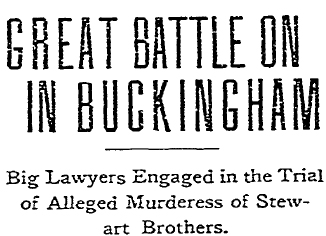
Unsurprisingly, Dallas Wright’s attorneys questioned whether or not an unbiased jury could be found in Buckingham County and approached presiding Judge Gordon for a change of venue which would allow Wright to be tried in another county. If Judge Gordon refused, The Times-Dispatch reported that counsel for the defense would likely request a continuance, delaying Wright’s trial.
Commonwealth’s Attorney Edmund W. Hubard, who was in charge of the prosecution of the case, boldly told The Times-Dispatch that he anticipated “no difficulty in securing a competent jury in Buckingham” despite the fact that so much had been published concerning the murders. Earlier in August, the newspaper reported that “citizens hoot at the idea [of a change of venue] and assert that there is no feeling other than a desire to see anyone who may be found guilty of this atrocious crime punished.”
While Dallas Wright awaited trial, the case developed a new wrinkle. Deputy Sheriff J. E. Carter, who had gathered the initial evidence against the accused men and “caused” their arrest, met with an accidental death following Edward Jones’ trial. Attorney Hubard insisted this was not material to Dallas Wright’s upcoming trial.
Was Deputy Sheriff Carter’s death really an accident? According to the August 14, 1909 edition of The Times-Dispatch: “some people are slow to believe that no violence was done to Mr. Carter . . . but Mr. Carter assured those who went to see him when he had regained consciousness that his injuries were caused by an accident, and that he fell from his buggy when within calling distance of his home.”
Surely some citizens in Buckingham County continued to wonder. . . .
Coming Next: The Plot Thickens
Need to catch up on The 1909 Buckingham Murders? Part I: June 1, 2015


 slate river ramblings . . . .