

Buckingham Female Collegiate Institute
In 1856, something was stirring in Buckingham County.
A significant number of valuable Buckingham farms and other businesses were advertised for sale in the Richmond newspapers. Did sellers attempt to take advantage of a strong market? Did they anticipate a dip? Was the climate in Buckingham shifting towards increasing industry, making those properties more valuable? Did the political battles over the Kansas Territory concern Buckingham County slaveholders? Was it just coincidental?
Among these advertisements was a personal ad placed by William N. Page, indicating that the Buckingham Female Collegiate Institute was at the end of its financial rope. “Pecuniary necessities” threatened to force its closing in December of 1856. Page’s ad read:
SITUATION WANTED. – The subscriber, who has had some thirty years experience in teaching, and for the last four years and a half been a Professor in Buckingham Female Institute, on account of its pecuniary necessities, according to the records of its Board of Directors – desires a situation as Principal of a Female Seminary, or a professorship to some Female College. An elder in the Presbyterian Church himself, he would prefer a place where his family could enjoy gospel ministrations with brethren of his persuasion. His success in teaching is deemed sufficient reference. For terms &c address
Wm. N. Page, A.M.
Gravel Hill P.O. Buckingham County, Va.
Whatever the situation was in 1856, the Institute did not close that December. According to Buckingham historian William Shepard, “it seems that most of the students were removed from the school by 1862.” Indeed, on the 1860 census, Rev. John C. Blackwell was enumerated as President of Buckingham Female Collegiate Institute, along with other teachers, a Steward and a Matron.
For more about Buckingham Female Collegiate Institute see “At a Place Called Buckingham.”

Mount Ida (2014), Courtesy Mount Ida Farm
In the summer of 1995, James Brady Murray purchased the mansion house at Mount Ida in Buckingham County and moved it, in its entirety, to a similar site in Albemarle County. Today, Mount Ida sits on the foundations of the ruins of Pleasant Dawson’s home, built in 1799. Once known as Bell Mount, Albemarle’s Mount Ida Farm consists of approximately 422 acres, including nearly a mile of frontage on the Hardware River. Among other things, it serves as a popular wedding venue.
According to the owners of Mount Ida Farm:
The original house, built in 1795, includes the front door, hall and the portion of the house to its left. The historic addition to the right of the front door was originally built from 1830-1845. Exterior brickwork is all historic brick from Mount Ida, reclaimed and moved with the original house. The mortar color was meticulously matched to the original mortar with the bonding pattern and “penny” mortar joints faithfully duplicated from the original construction. Original elements include all sashes, jambs, doors, heart pine floors and most door hardware. Where window glass replacement was necessary, antique window glass was reused from early windows salvaged from other old houses. The walls are conventional hand-applied and -finished plaster, consistent with the historic construction. The basement ceilings were raised slightly to increase headroom and to accommodate modem HVAC climate control ductwork and utilities.
Exterior elements of the woodwork, cabinetry and moldings were designed by Floyd E. Johnson, FAIA, noted conservation architect who assisted on the restoration of Monticello and many other famous classical Virginia estates.
~
In 1986, Mount Ida was listed on the Virginia Landmarks Register and in 1987, was listed by the U.S. Department of Interior on the National Register of Historic Places. In 1995, with the condition of the house rapidly deteriorating, the Department of Historic Resources agreed to a process whereby the house would be meticulously disassembled, each part numbered, documentary photographs taken, measured drawings prepared and the house moved to a preapproved location. If such a move was satisfactorily completed, the Department agreed it would be relisted on Virginia Landmark’s Register and re-nominated for the National Register of Historic Places. It is believed that such action never before occurred with a listed Landmark.
To learn more about the restoration and relocation of Mount Ida, visit Mount Ida Farm.

Mount Ida, Courtesy Historic Buckingham
In 1937, when Garnett Williams surveyed Mount Ida for the Virginia Historical Inventory, she preserved two legends.
It is said seven men came over from Ireland, who had become involved in some kind of trouble and wished to escape punishment. They came to this home for protection, and it was they who did the lovely carving on the inside of the rooms.
One of the first owners is said to have had a very daring son who indulged in drinking. On one occasion he rode his horse in the house and up the winding stairway. What is said to be the print of a part of the house shoe on the steps may still be seen.
Mrs. Williams’ informants included Mr. Ben Boatwright, Miss Edna Boatwright, and Mrs. Percie (Piercy), all of New Canton.
Can a Slate River Ramblings “informant” comment about the legends of Mount Ida?
Perhaps add a third?
There must be a ghost, or two….
Coming next: Saving Mount Ida
 James River at New Canton and Cannon’s Landing, Photo by Joanne Yeck
According to the nomination form for Mount Ida to the National Register of Historic Places:
It seems likely that the second William Cannon was the builder of Mount Ida sometime between 1785 and 1805. He is also the most notable figure associated with the property. At various times he served as vestryman for Tillotson Parish, recorder of the county list of tithables, and county sheriff. A ferry was established in the county in 1776 on Cannon’s land (which) later served as a boundary point in a 1778 transfer of land from Buckingham County to Cumberland County. During the Revolution, Cannon was a captain in the Buckingham County militia. Records of claims for impressed property show his authority to requisition goods and transportation for the militia, as well as his own contribution of stores to the Continental Army. His requisition activities were associated with the movement of the Buckingham Militia to aid General Nathaniel Green in the North Carolina campaign of 1781.
In the mid-19th century, the Leitch family owned Mount Ida. Irishman William Leitch (1790-1871) purchased the plantation c. 1833–1834. A wealthy merchant and tobacco planter, Leitch later elaborated the house.
For the complete nomination form for Mount Ida: Mount Ida
Coming next: Legends of Mount Ida
 Courtesy Library of Virginia
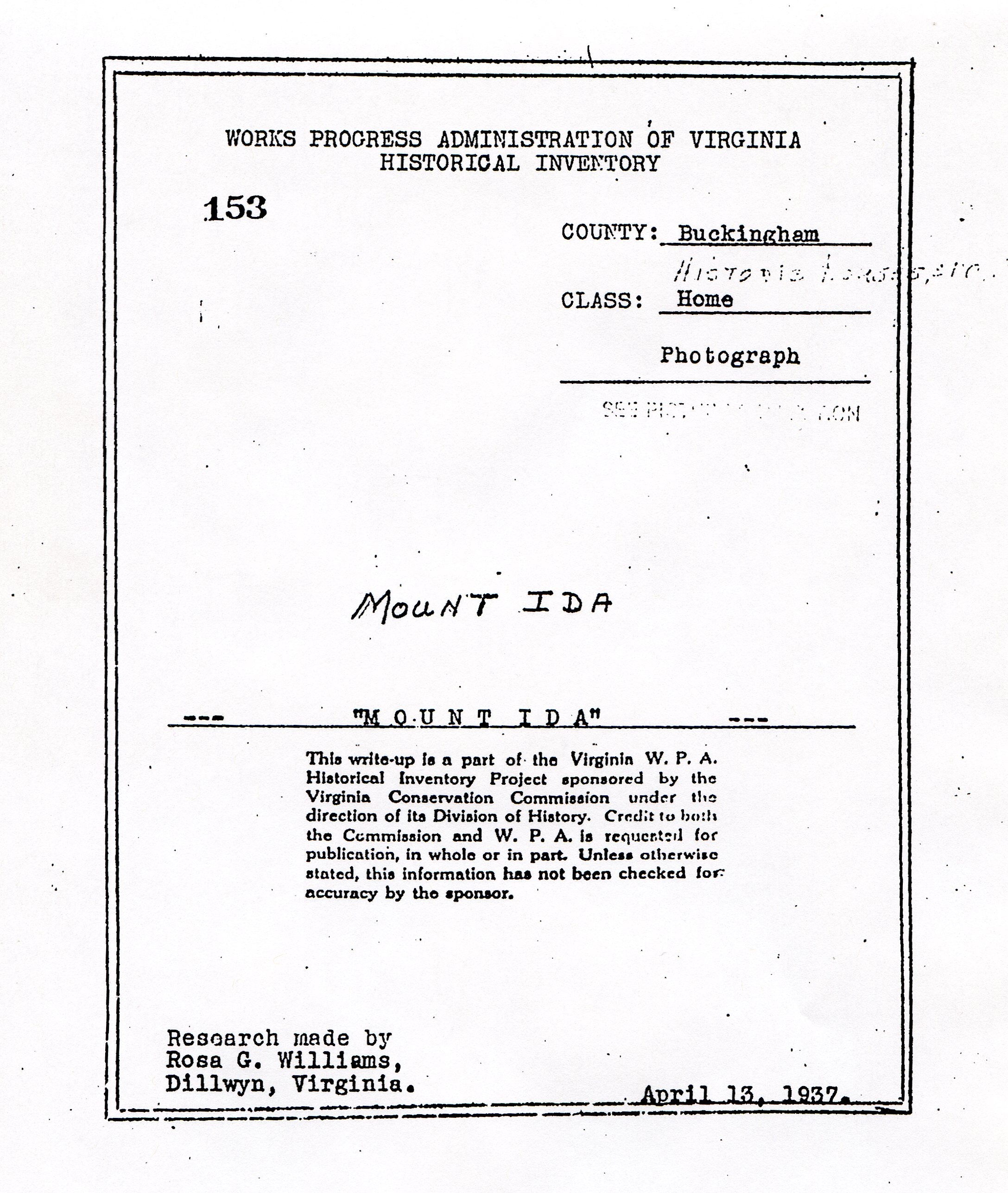
The dwelling house at Mount Ida was once one of Buckingham County’s grandest homes. Its story will be told over four posts here at Slate River Ramblings.
In 1937, Garnett Williams surveyed Mount Ida for the Virginia Historical Inventory. The burning of Buckingham Courthouse in 1869 made a typical deed search impossible. She began with William Leitch, unaware of previous owners.
Originally a plantation of at least 1,000 acres, Mount Ida sat not far from New Canton and the James River in northeastern Buckingham County.
Mrs. Williams described the impressive dwelling:
The dwelling is a lovely eleven room house. From the small square front porch one enters into a lovely hallway. Facing the hallway is a winding stairway leading to the second floor. To the right of the hallway is a large bed room with plastered walls and wide wainscoting, while to the left is a room known as the living room, with the most expensive hand carved trimmings, lovely hand carved mantels, plastered walls with wide wainscoting, and large cross panel doors with shop made hinges and large imported locks with brass knobs. All the rooms on the second floor have plastered walls with wide wainscoting. The weatherboarding is of heart pine.
There is a picket fence around the yard. The old rock style that was used many years ago can still be seen by the front gate, in the beautifully kept, one acre yard.
In 1937, many outbuildings were still standing at Mount Ida, including the kitchen, with its wine-cellar/basement, and the old dairy.
Coming next: William Cannon: Builder of Mount Ida

Crossing Sharps Creek, Photo by Joanne Yeck
In early 2013, Slate River Ramblings introduced the mystery of Dunn’s Chapel.
Many questions remain. Was there a physical church or meeting house? Where exactly was it? Who were the pastors?
Methodist records of the Buckingham Circuit reveal that the church was active in 1869–1870 and 1881, which may be the year the congregation dissolved and merged with another church.
The surnames on the 1869–1870 class roster support the fact that Dunn’s Chapel was near Sharp’s Creek, Slate River, or Hunt’s Creek. Guerrants, Snoddys, Oslins, Stegers, Norvels, and Woodfins worshiped there, among many others. The Steward during 1869–1870 was Walter A. Ford. My cousins, Sarah J. (Harris) Allen and her children, James Woods and Margaret E. Allen, were also members in 1869–1870.
If a Slate River Ramblings reader knows more about Dunn’s Chapel, please comment.
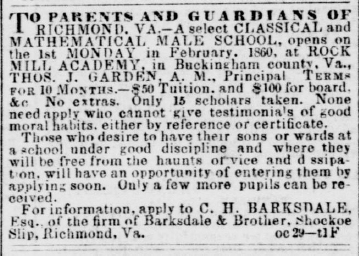
Thomas J. Garden, who wrote the memorial tribute to Philip W. McKinney, stated, “after we left college he induced me to take a school at New Store.”
Garden’s first teaching positions are unknown; however, in early 1860, he planned to open a new academy. He advertised in the Richmond Dispatch:
A select CLASSICAL and MATHEMATICAL MALE SCHOOL, opens on the 1st Monday in February 1860 at ROCK MILL ACADEMY, in Buckingham county, Va., THOS. J. GARDEN, A. M., Principal
TERMS for 10 Months. — $50 Tuition and $100 for board, &c No extras. Only 15 scholars taken. None need apply who cannot give testimonials of good moral habits, either reference or certificate.
What would certify “good moral habits?”
In his advertisement, Principal Garden promised that the school and its environs in peaceful Buckingham County were “free from the haunts of vice and dissipation.”
In July of 1860, Thomas J. Garden was enumerated at a teacher in Buckingham, although, no students appear to be boarding in the immediate vicinity. Did Garden successfully establish Rock Mill Academy? With war on the horizon, it likely did not survive long. In 1870, he was married and living in Prince Edward County, still teaching school.
If a Slate River Ramblings reader knows more about Thomas J. Garden and his career in education, please comment.

Monument to Elder Poindexter P. Smith (1793-1845)
Fork Union Baptist Church Cemetery, Fluvanna County, Virginia
Courtesy Find a Grave
In the early 1820s, Baptist minister Rev. Poindexter Patteson Smith was ordained and devoted himself to churches in Buckingham, Fluvanna, and Cumberland counties. They included Mulberry Grove and Buckingham Baptist. Each month, he traveled eighty miles on horseback to serve his congregations. He was pastor of Chestnut Grove Baptist Church from 1835 to 1845, the year of his death.
In 1840, Rev. Smith conducted a school in northeastern Buckingham County. That year he enrolled fifteen scholars; his neighbor, Elijah G. Hanes, taught thirty-eight pupils at nearby Humanity Hall Academy.
Rev. Smith came late to his own education. According to biographer James Barnett Taylor:
Having entered the ministry, and being conscious of the deficiency of his early education, he connected himself with a school in the vicinity of his residence, devoting himself chiefly to the study of English grammar. He afterwards taught school. . . . The need of due preparation for the work of preaching the gospel was felt. “I would recommend,” he afterwards said, “all young ministers to strain every point to obtain a good education. I speak from a knowledge of the want of it.”
Was Rev. Smith an adult pupil of Elijah G. Hanes at Humanity Hall Academy? It was certainly in “the vicinity” of Smith’s Buckingham farm.
If a Slate River Ramblings reader knows more about Rev. Smith’s school and/or his education, please comment.

Chestnut Grove Baptist Church. Courtesy Historic Buckingham.
Nineteen Buckingham County churches were referred to in Thomas Baldwin’s Gazetteer of the United States (1854). Thus far, fourteen likely candidates have been identified. Here’s number fifteen — Chestnut Grove Baptist Church.
In 1828, the Appomattox Association minutes recorded the first official meeting of Chestnut Grove Baptist Church. In 1831, the congregation of thirty-one members joined with other Buckingham County churches in the James River Association.
Over the years, the church building has been expanded. Today, the original building is the sanctuary.
Two volumes of the church’s records, covering 1881-1950, are available on microfilm at the Library of Virginia.
To read previous posts featuring Buckingham’s mid-19th century churches, just type Thomas Baldwin in the search box and enjoy the results!
Coming next: Rev. Poindexter P. Smith, pastor, Chestnut Grove Baptist Church.
 Ridley Moseley Harriss, Courtesy Fran Harris-Hill
Ridley Moseley Harriss was born in Buckingham County in 1812 and died there in 1901. The daughter of William C. Harris, Jr. and Judith (Grizzle Harris), in 1835, Ridley stitched a sampler, signing her name with a double “ss.” Filling out the alphabet line, she included her initials. Beneath them, she placed the initials W.B.M. (See sampler below.)
Who was W.B.M.? A cousin? A suitor? Her intended husband?
At twenty-three, Ridley might have been eager to marry; however, she remained a spinster.
In a letter dated April 30, 1847, written by William D. Spencer of Buckingham to his Uncle Levi, Spencer wrote, “tell Ridley there is a young man in my acquaintance over here that wants to see her very bad I think and she had better come over in search of him as he does not know the way so far from home as to come to see her.”
Levi was Ridley’s brother and, at the time, she lived with him in Charlotte County. Did Ridley pursue the ardent young man? If so, nothing came of it. In 1853, she returned to Buckingham and, on April 5th, married James Monroe Flood, a widower with seven young children. At forty-one, she had her work cut out for her.
Can a Slate River Ramblings reader help identify the mysterious W.B.M.? If so, please comment.
Many thanks to Fran Harris-Hill for sharing Ridley Moseley Harriss’ story.


 slate river ramblings . . . .