

View from Old Buckingham Church, Photo by Joanne Yeck
In 1767, when Churchwardens John Ferne (a.k.a. Fearn) and Joseph Cabell were granted one acre and an half on which to build an Anglican church, the spot was near the headwaters of Powers Creek. The metes and bounds description of the land also mentions an early Buckingham resident, Anthony Sherroon, who, on January 5, 1754, had surveyed 398 acres, lying at the head waters of Powers Creek, in what had been Albemarle. Sharroon also appears on an earlier Albemarle road order, dated March 13, 1746 (OS), in which William Allen, who owned land on Hunt’s Creek, is named as the overseer responsible for the “Horn Quarter Road to the County Line.”
Sherroon is listed as one of the male tythables to do work under Allen. When the 1767 patent, Sherroon’s 1754 survey, and Allen’s 1746 road order are compared, it seems the headwaters of Powers Creek and the first glebe land in Buckingham County were in the northeastern part of Buckingham, not far from Hunt’s Creek. Indeed, the “mother” church, known as Buckingham, was located near present-day Gold Hill in that part of the county.
Does anyone know more about Powers Creek? Was it named after an early Albemarle/Buckingham family named Powers? And what about the Horn Quarter Road?
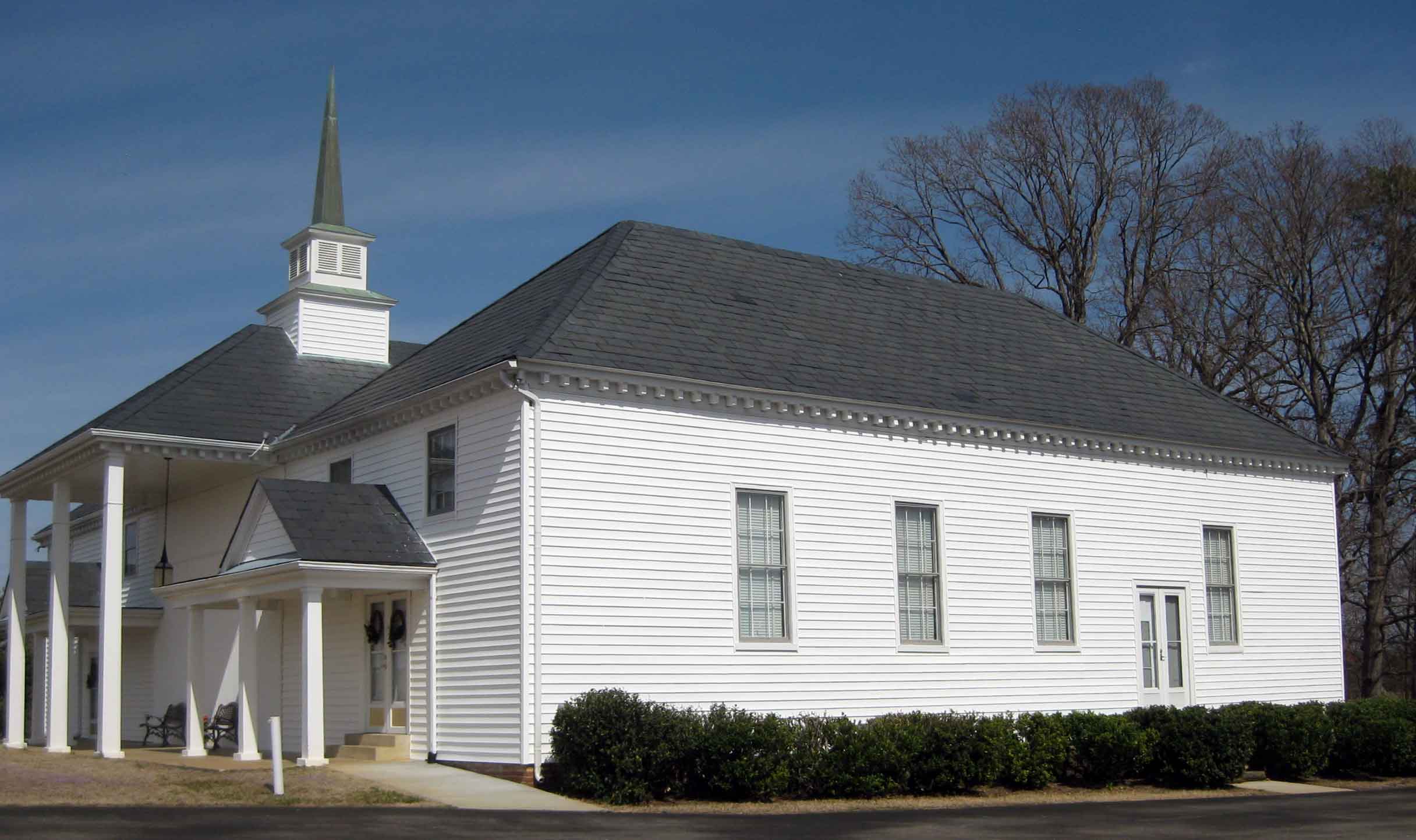
Buckingham Baptist Church. Photo by Joanne Yeck.
One of the nineteen churches mentioned in Thomas Baldwin’s Gazetteer of the United States (1854) Buckingham Baptist Church was founded in 1771, and its first pastor, the popular Rev. Chastian (1741-1823), contributed greatly to its growth for several decades, ultimately serving the church for fifty-three years. In the survey written in 1937 for the WPA’s Virginia Historical Inventory, author Rosa Garnett Williams apparently confused the founding date of the Baptist church with its assumption of the parish property, offering a somewhat disjointed, yet nonetheless interesting, version of the “merging” of the two bodies:
Buckingham Baptist Church was first known as the Church of England, built in the early 1700s. At one time it ceased to be a place of worship and was used as a Tavern. In the year 1771 the Baptists took it over, and since that time it has been known as the “Buckingham Baptist Church,” the first Baptist church established in this county. It is a very quaint old building with a gallery. . . . The Baptists had no deed to this property until 1898, when Professor Boatwright purchased a tract known as the “McKenna Tract.” The Church building was on this tract. Mr. Boatwright gave a deed to the church, spring, cemetery and several acres of land besides, to be used as the Baptists saw fit.
Note: In the photo above the section of the church in the foreground is the original Anglican Buckingham Church incorporated into Buckingham Baptist Church.
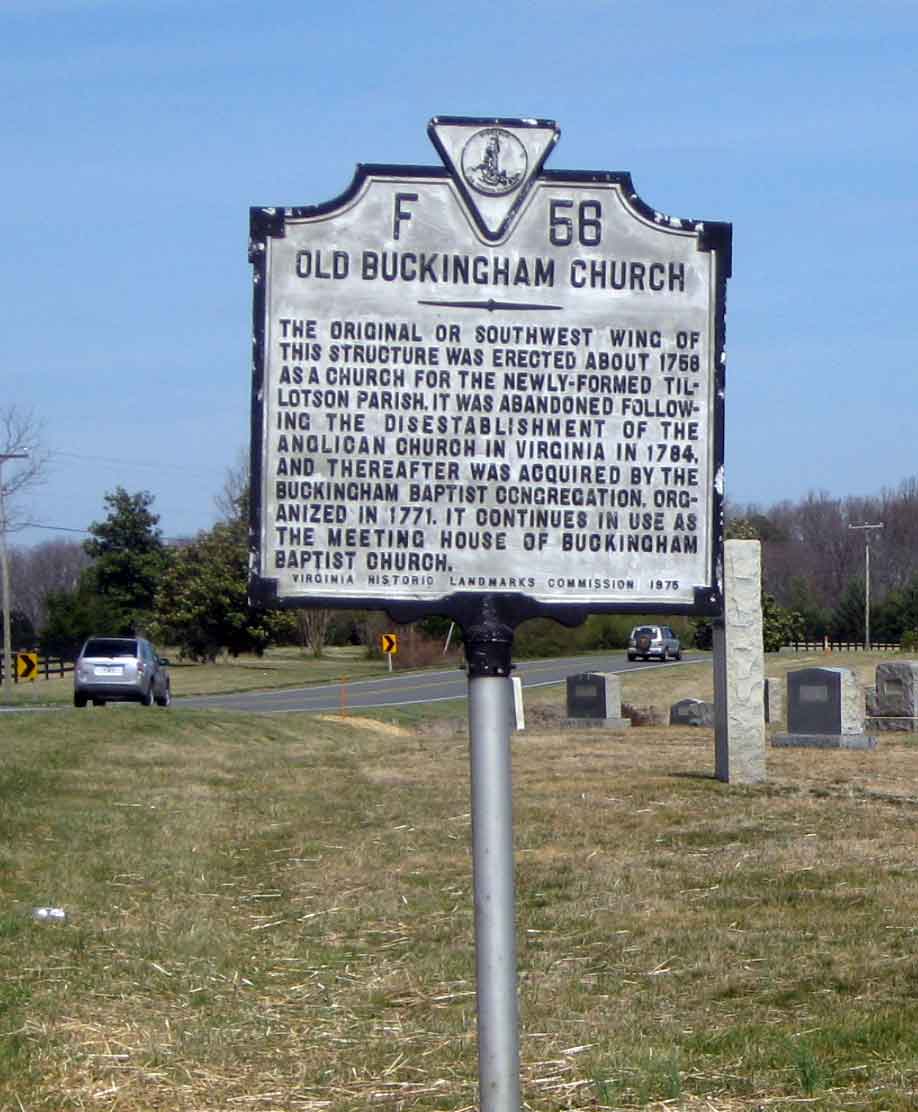
The “mother” church, known as Buckingham, was located near present-day Gold Hill in that part of the county and this first glebe land was in the northeastern part of Buckingham, not far from Hunt’s Creek. By 1774, there were four churches in Tillotson Parish. In addition to Buckingham Church, Buck and Doe Church was named for a stream near Willis Mountain and New Store, in the southeastern section of the county Maynards was the third, and Goodwin’s Church (a.k.a. Goodlin’s and Goodings) was located about eleven miles north of Buckingham Courthouse, near today’s Highway 20.
Following the American Revolution and the severing of ties with the Anglican Church, Tillotson Parish’s mother church, Buckingham, was eventually claimed by Rev. Rene Chastain and the congregation of Buckingham Baptist Church. The exact timing of this is unclear but the Baptists used the structure long before they finally held a deed to the property in the late 19th century.
If anyone can help with the location of Maynards Church, please let me know.
Coming next: Buckingham Baptist Church

It is notable that the Buckingham County’s only parish carried neither a saint’s name nor a place name, which was typical in Virginia. The parish was named for Rev. John Tillotson (1630-1694), who served as Archbishop of Canterbury from 1691-1694. A posthumous, 18th-century collection of his work,” The Works of the Most Reverend Dr. John Tillotson, Late Lord Archbishop of Canterbury: Containing Fifty Four Sermons and Discourses, On Several Occasions,” became very popular in Virginia, spreading Tillotson’s influence. Known for his pragmatic, non-dogmatic, tolerant approach to theology and preaching, Tillotson was a sort of New World ideal.
In the autumn of 1767, six years after Buckingham County was created, Churchwardens John Ferne (a.k.a. Fearn) and Joseph Cabell were granted land on which to build a church. Royal Governor Francis Fauquier signed the land grant. It read in part, “We have given granted and confirmed and by these presents for us our Heirs & Successors Do give grant and confirm unto John Ferne and Joseph Cabell Churchwardens of Tillotson Parish in the County of Buckingham and to their successors for building thereon a Chapel. . . one acre and an half.”
Coming next: Buckingham County’s first Anglican churches

Buckingham produced one Virginia governor, Philip Watkins McKinney (1832-1899).
The son of Charles and Martha Guerrant McKinney, he was born on March 17, 1832 at New Store, graduated Hampden-Sydney College (1851), and studied law under Judge Brockenbrough at Washington College (now Washington and Lee University).
Governor from 1890-1894, McKinney is noted for his impact on Virginia’s economic recovery during the “New South” era. During his term of office, he eliminated the state debt which had burdened Virginia since the 1820s. One of his programs gave prison inmates meaningful work, while adding significant revenue to the state coffers.
See the detail map for Sheppards, Curdsville, and New Store for the location of the McKinney home.
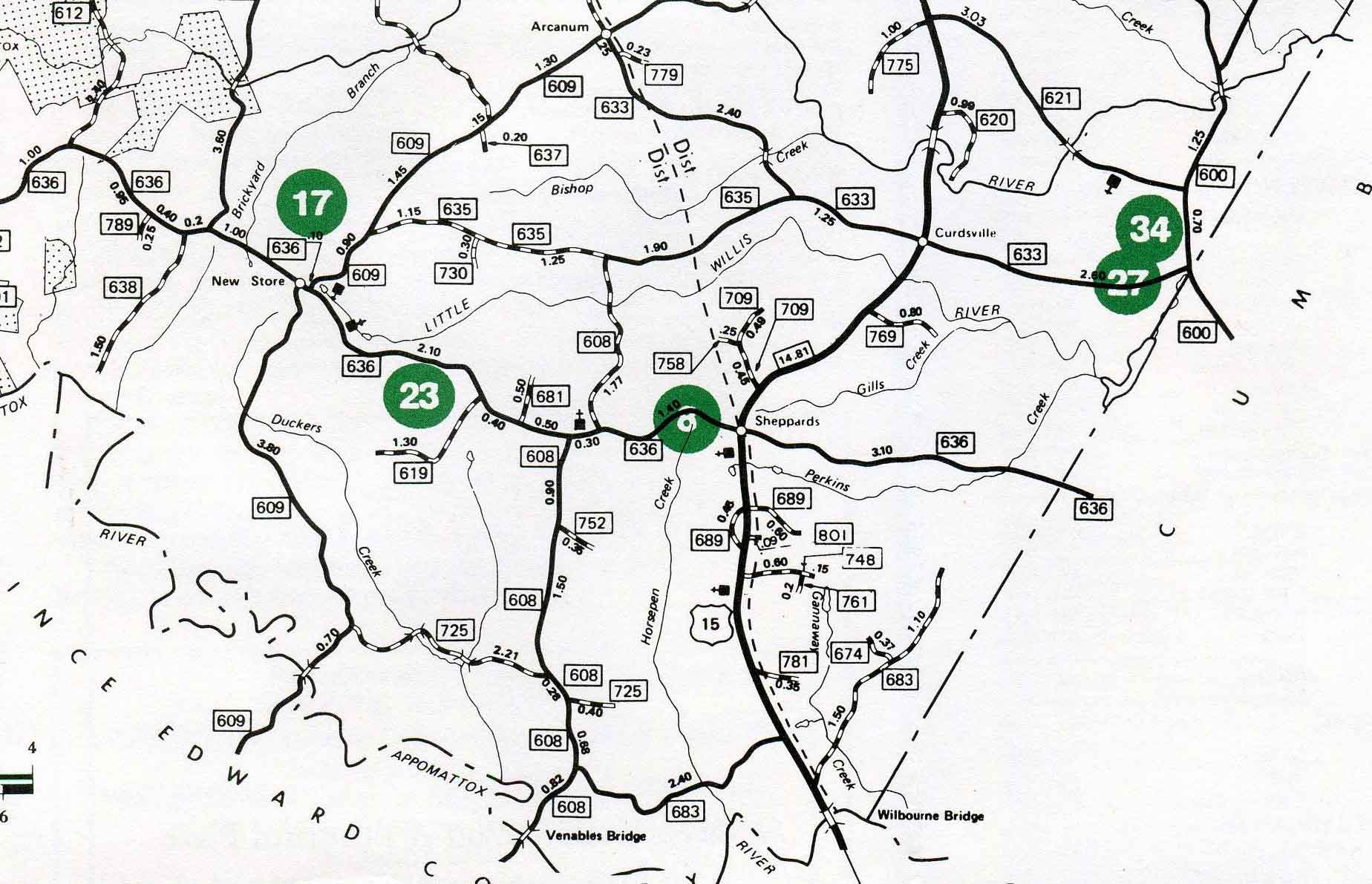
Here’s the second of a series of detailed maps of Buckingham County. This is the southeast corner of the county. To the south is the Appomattox River and Prince Edward County. To the east is Cumberland County.
This detail includes Sheppards, Curdsville, and New Store. All will be mentioned in future posts. This is the territory of Revolutionary War hero, Peter Francisco, and the once thriving resort, Buckingham Springs.
If you click on the map, a separate image will open and you can enlarge any area you are interested in.
Note: This map was created c. 1989 and, therefore, is not completely current; however, change comes slowly to Buckingham so it remains useful.
Key for the “Points of Interest” in green, roughly from north to south:
17: Governor McKinney’s Home (location only), 34: John Wayles Eppes Grave, 27: Millbrook (Eppes Plantation), 23: Hunting Tower – Judge Winston’s Home Site (location only), 8: Clifton (historic home).
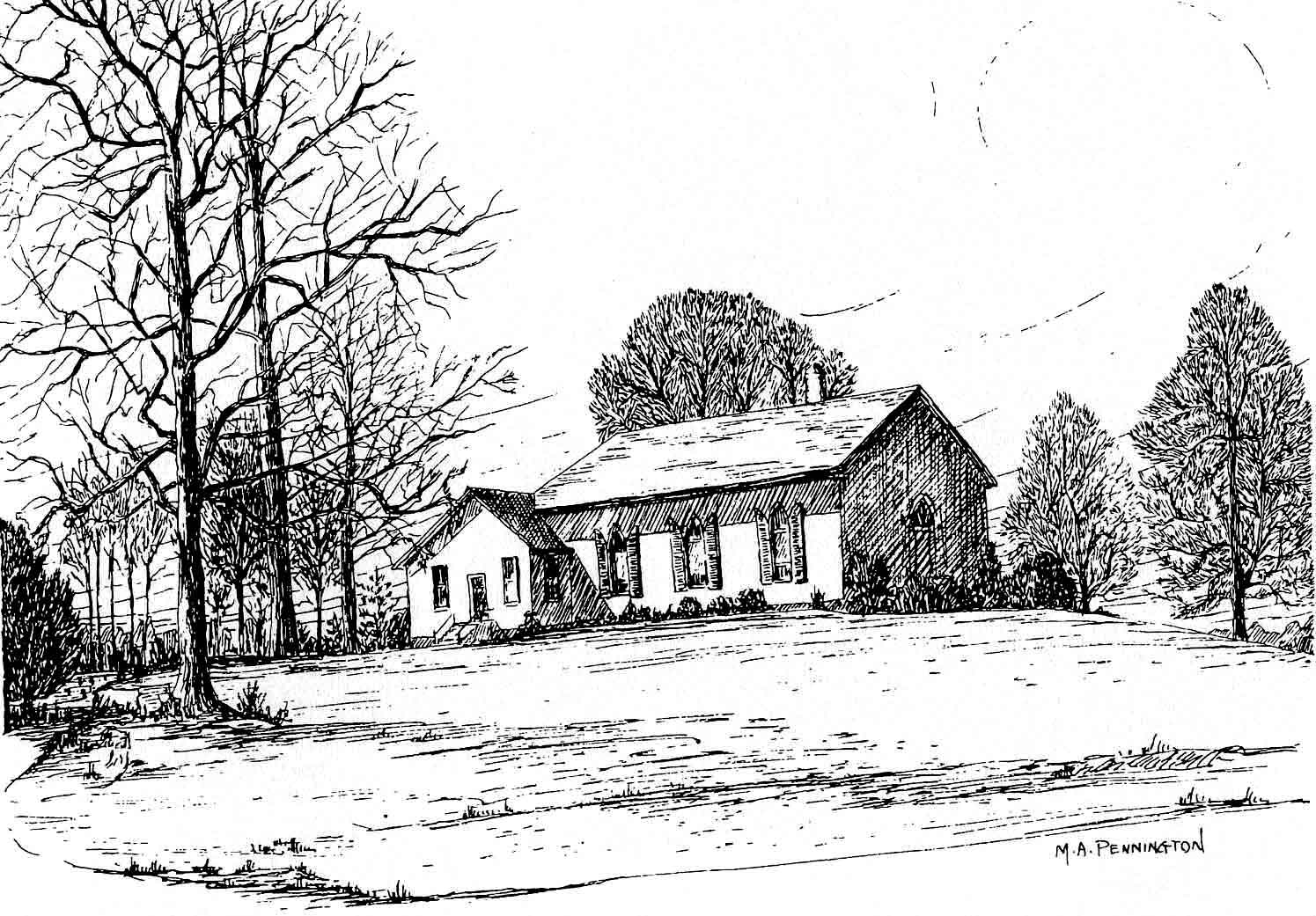
Smyrna United Methodist Church (Courtesy Historic Buckingham)
Another of the nineteen Buckingham County churches mentioned in Thomas Baldwin’s Gazetteer of the United States (1854) is likely Smyrna Church, located near Sheppards on Route 15 in the southeastern part of the county. According to the Virginia Historical Survey, it was founded in 1825, gifted to The Virginia Methodist Conference by William Sheppard. In her 1937 survey, Mrs. Rosa Garnett Williams goes on to say that the original church was torn down in 1883 and a new one was built, “Using the same rock foundation and old sills of the original church, they are said to have been of heart pine, and were twelve inches square, hewn by hand.”
The sketch above comes from “The Courthouse Burned,” Book I by Dr. Margaret A. Pennington and Lorna S. Scott. In it, the authors describe Smyrna Church as being founded in 1773 on land donated by Zadeck Lackland. In 1837, it was moved to its present site on land secured from the Sheppard-Crute-Jones estates.
I welcome any and all comments to help clarify these varying descriptions. History is full of them!
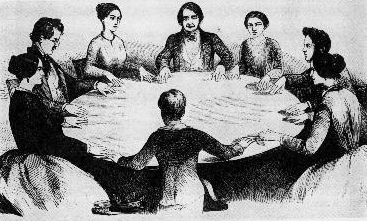
In Virginia Ghosts by Marguerite DuPont Lee, the author goes on to tell the story of Col. John Cabell’s return to Green Hill:
“Long after his death in 1815 one night the family and some friends were trying ‘table rappings.’ After calling for several Spirits, someone asked for Col. John Cabell. Again and again the mortal demanded the return of Colonel Cabell. No response at length caused him to exclaim, ‘Oh, he was a hot tempered, contrary man when living and he is the same man when dead.’ At this moment the large mahogany-table with heavy marble top rose up bodily high into the air, flinging the candles to the floor and crashing down again, scattered those formerly gathered around it never to gather again!”
Do you have a Buckingham County ghost story to share? If necessary, I will change names to protect mischievous Spirits!
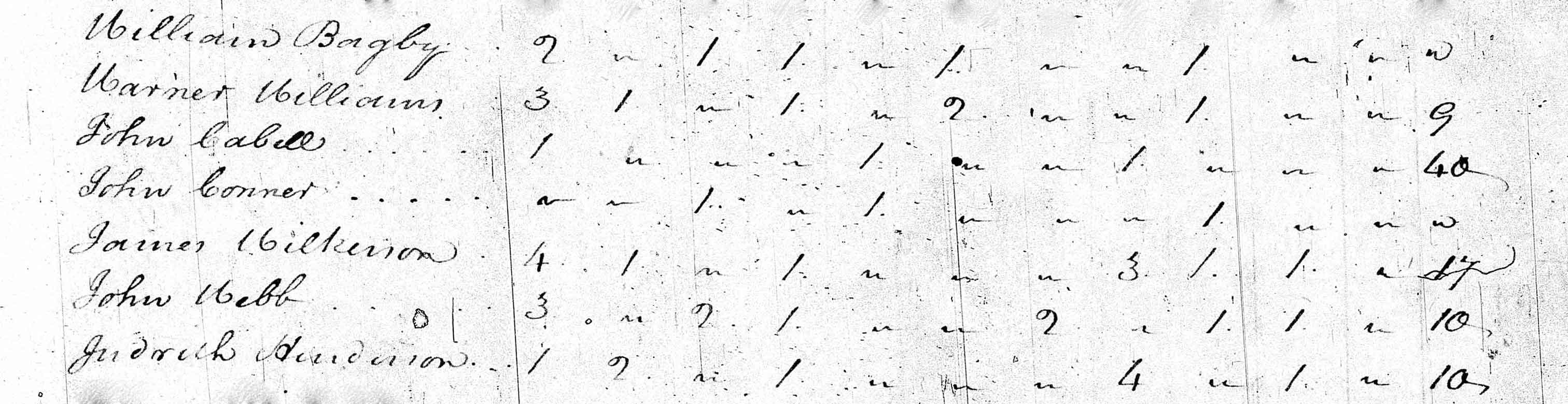
1810 Census Buckingham County, Virginia
Col. John Cabell, a young male, a female, and forty slaves
On January 10th, Teresa posted a comment about the ghosts of Green Hill, the James River estate of Col. John Cabell (1735-1815) who was one of Buckingham County’s leading lights. A politician for many years, Cabell led his county through the Revolution, later serving as Sheriff of Buckingham and as a member of the county militia. He attended the Fifth Revolutionary Convention and served several terms in the General Assembly. In 1815, the year of his death, he owned at least forty slaves. He was known to be a “man of fiery temper and strong will.”
Teresa found the Cabell ghost stories included in a book called Virginia Ghosts by Marguerite DuPont Lee. Published in 1966, Lee describes Green Hill sitting on a “high grassy hill overlooking the very wide and deep river a quarter of a mile below.” The first haunting appeared in Col. Cabell’s lifetime. Lee writes:
“Like many of his time, Colonel Cabell had his superstitions, and he also had Spirits to overlook his welfare. In his early days it seems he was not a religious man. One night, probably after the death of his second wife in 1802, he was lying in the big parlor before a huge log fire. Suddenly the great hall upon which the parlor opened was filled with an unearthly wind. Turning to see what was causing this Colonel Cabell saw, standing by a large table upon which rested the family Bible, three female figures. The pages of the Bible were turning rapidly, from beginning to end, although no hand touched it. Colonel Cabell felt this was a call to him to study the Holy Book, which from this time he did, and became a devout believer.”
Were these three women known to Col. Cabell? What was their investment in his religious education? Two Mrs. Cabells (Paulina Jordan and Elizabeth Brierton Jones) were already deceased, presumably former mistresses of Green Hill, and familiar with Col. Cabell’s strong-willed ways. Interestingly, this experience did not keep him from taking a third wife (some sources say they never married) and having a family with her. According to N.F. Cabell, John Cabell died about a mile below Green Hill at another farm he owned known as Elm Cottage. (For more see The Cabells and Their Kin by Alexander Brown.)
Coming next . . . Part Two: Col. John Cabell’s Ghost
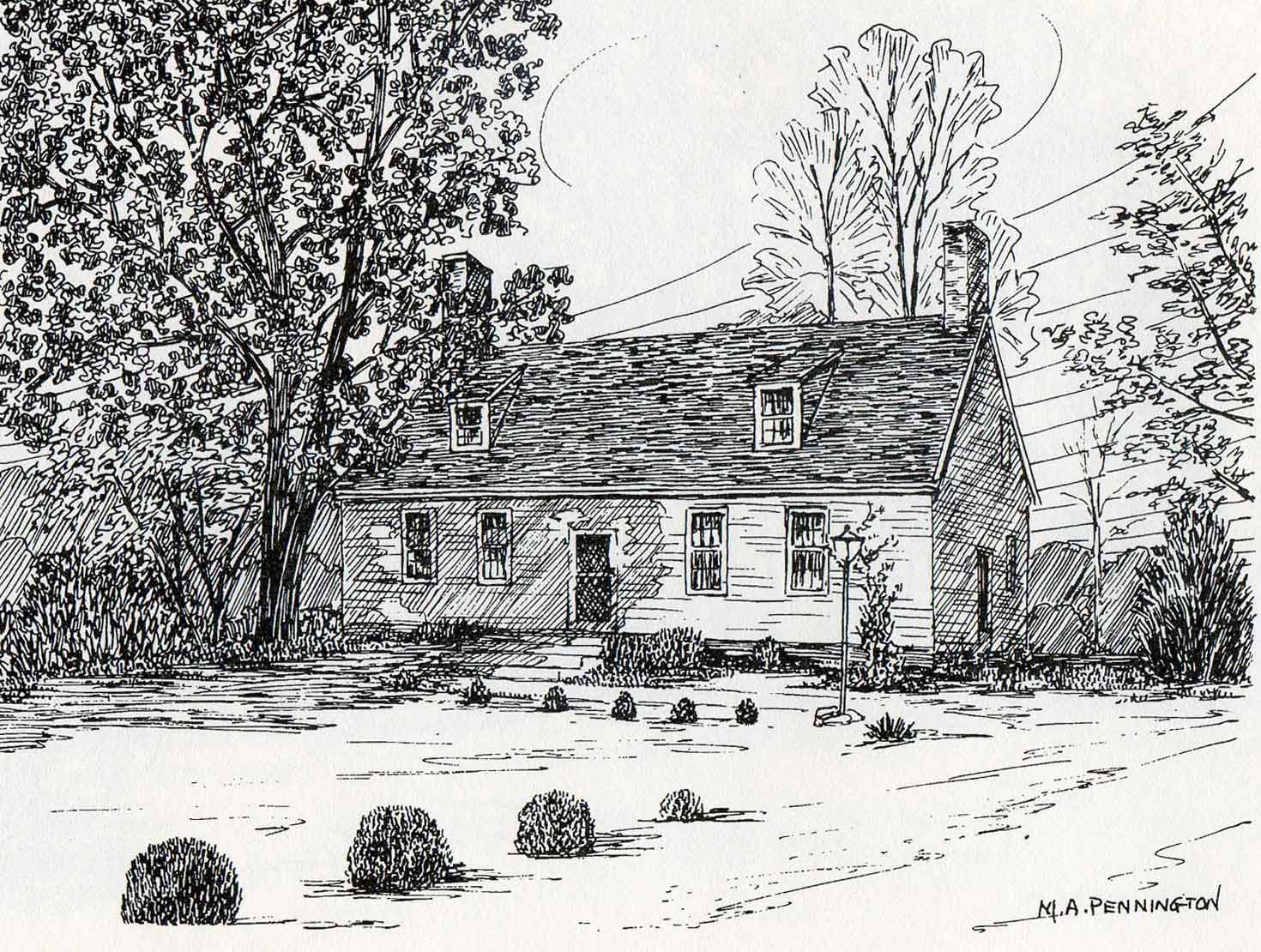
For those of you who asked for more about the Bell’s dwelling house at Bellmont. . .
In 1937, when Rosa Garnett Williams surveyed the once lovely Bell home, it likely had passed its 180th anniversary and the “quaint old house” was in “a very deplorable condition.” The decades had taken their toll on the Bell seat and the Great Depression made timely restoration unlikely. Describing the 18th century house in great detail, she wrote: “It is situated on a knoll, and is surrounded by several of the original old oaks, there are also several boxwood and a large magnolia tree at the end of the porch. A small front porch with a large six panel door opens into a large reception room. . . .” At the time, the house contained “lovely” paneled wainscoting and four of the doors were said to have been imported from England. Shop-made nails, wooden pegs, and hand-sawed timber, all bespoke the house’s beginnings in what was then Virginia wilderness.
To access my article, “Bellmont: An Early Buckingham Plantation” (Buckingham Beacon, June 2012), follow this link:
“Bellmont: An Early Buckingham Plantation”


 slate river ramblings . . . .