
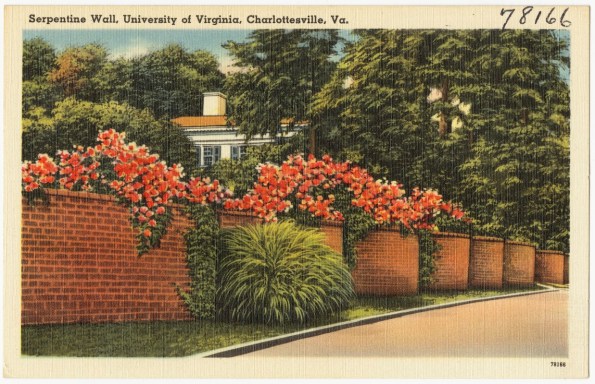
Serpentine Wall, University of Virginia. Courtesy Boston Public Library.
Need to catch up, click here: Buckingham County Houses: Saratoga, Part I
The gardens at Saratoga were also impressive. Elizabeth McCraw wrote in 1938: “The original flower garden at ‘Saratoga’ was enclosed by a serpentine brick wall which Mr. Jefferson afterwards copied at the University of Virginia. Colonel Hubard did not like the ‘prison like walls’ erected by his father, so he had them torn down and two double slave quarters built from the brick.”
Twenty-two years later, Mrs. R. J. Wojnicki discussed the gardens at Saratoga in an article for The Daily Progress, writing: “The flower garden once contained 150 varieties of roses. . . . An attempt was made to relocate the flower garden and all the roses were killed.”
In her article, “’Saratoga’ Was Birthplace of Many Notables,” Mrs. Wojnicki described the mansion house as it stood in 1960:
The original house, which still stands, is made of yellow stuccoed brick. Timbers were hand-sawed and hewn by hand. Frame additions later were joined to the main house.
The entrance to the home is through a small portico cornered with white columns. The heavy oak door has six panels and is framed with its original pattern in cranberry cut glass. The huge brass knocker is still attached to the door.
At that time, the main floor housed a spacious library and a large reception room, with folding doors leading to the dining room. Some of the original wallpaper could still be seen, in addition to a few original window treatments.
Part of the foundation for the old kitchen was visible in the yard, as well as a brick tunnel which ran from the house to the kitchen. Dr. John Hubard’s old office building was located to the left of the main house. According to Mrs. Wojnick, the office was built on the foundation of old slave quarters.
In 1960, the owners were the parents of Mr. Eugene Hammond of Cleveland Ohio, who had purchased Saratoga in 1943.
~
Thanks, once again, to Phil James for sharing Mrs. Wojnick’s article.

This week, Slate River Ramblings, along with over 730 enthusiastic followers, celebrates its seventh anniversary.
Thanks to all of you for your dedication to the history of Buckingham County, Virginia.
As many of you know, the Slate River Ramblings archive is packed with nuggets of Buckingham gold. As of December 2019, there are over 950 posts and nearly 3,000 comments by thoughtful readers.
Take some time to search the archives for your favorite topic or surnames.
Please invite your family and friends to join us as we continue to ramble through Buckingham County’s history. There’s more to come in 2020!

E. W. Hubard. Courtesy Find A Grave.
Need to catch up, click here: Buckingham County Houses: Saratoga, Part I
A number of Buckingham County notables lived at Saratoga and Elizabeth McCraw wrote about them in her survey for the Virginia Historical Inventory:
Around “Saratoga” the old Hubard home in Buckingham, a good deal of historical interest centers. The place was named from the Battle of Saratoga of the Revolutionary War.
Dr. James Thurston Hubard practiced medicine from Petersburg up into Buckingham County. He married Susan Wilcox of Nelson County, May 20, 1805, and moved to “Saratoga” where he lived until his death in 1812. The estate became the property of his son, Edmund Wilcox Hubard about 1829.
Colonel Edmund Wilcox Hubard was a Colonel of the Militia in Buckingham County 1834. He served in the United States Congress three terms, 1841 to 1847. While serving in this capacity he was appointed by Congress to prepare a report on tobacco, which is still the standard authority. He attended every Democratic Convention from the first, which met in Baltimore in 1832, to the beginning of the War Between the States. He was appointed during the War Between the States, with Colonel Gibboney and William Hamner by President Davis as Appraisers to fix the price of all farm products in the Confederacy, which position he held until the close of the war. . . .
Thomas Jefferson was a frequent guest at “Saratoga”, as Mrs. Hubard was a half-sister of his grandson, Francis Eppes.
As with many oral histories, the comment that Thomas Jefferson was a frequent guest might be taken with a grain of salt, despite the Eppes family connection.
Mrs. McCraw continued:
At the death of Colonel Hubard the estate went to his son Edmund W. Hubard, Jr. who owned it until 1930, when Mrs. Tellie E. Sutton purchased the estate for $3500, at public auction. The place was sold again in 1933 to A. F. Bullock, the present owner, who has done much to restore it to its former beauty. For a century and a quarter this was the Hubard Home, a family prominent in the social, political and religious life of the county.
The family burying ground is at “Chellowe”, the Bolling-Hubard estate near by.
Coming next: Buckingham County Houses: Saratoga, Part IV
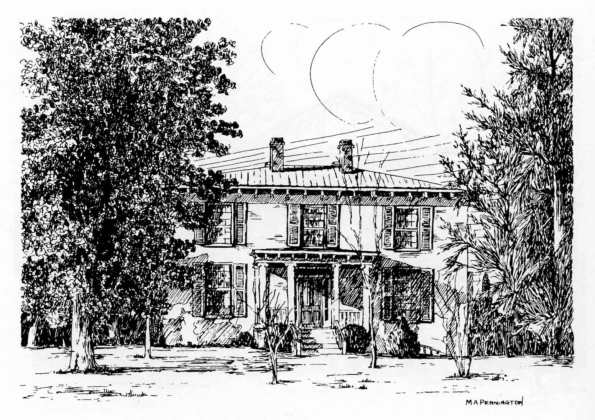
Saratoga. Courtesy Historic Buckingham.
Need to catch up, click here: Buckingham County Houses: Saratoga, Part I
As is often the case with country houses, Saratoga was built in parts, possibly expanded over many years. Elizabeth McGraw goes on to describe its eclectic design for the Virginia Historical Inventory:
The house is built in three parts or sections. The front part contains eight rooms and is of brick covered with stucco. The middle and back parts are framed. The middle part is two and a half stories, while the back part is only one story. The interesting features of the frame part are the large iron locks and strap hinges on the heavy six panel doors. There are three one flight winding stairways in the frame part of the house. The cellar or basement has four large rooms and several small rooms or halls. Large wooden locks and shop-made hinges are on several of the cellar doors. Large fireplaces and old brick wood fired furnace of Ante-Bellum days are still to be seen in the cellar. The windows in the front part of the house are large and extend from the floor to the ceiling, while those in the older, or frame part are small windows with panes 8×10 inches in size. The upper and lower sashes upstairs are different in size.
Under historical significance, Mrs. McCraw added:
Colonel Hubbard had the front part of the original house at “Saratoga” torn down and the present eight room addition built about 1850. (From a family record). It is said that “Saratoga” was one of the three country homes in Virginia lighted by gas prior to the War Between the States. This gas was manufactured on the estate. The house too was heated by a wood fired furnace. This brick oven like affair is still to be seen in the cellar. It is said to have burned a cord or more of wood a day.
Colonel Hubard’s trained slaves built the newer part of “Saratoga”. Nelson and Jim Trent were the main carpenters. Colonel Hubard had the walls rebuilt nine times before they met his requirements of exactness.
Coming next: Buckingham County Houses: Saratoga, Part III
Saratoga. Courtesy Historic Buckingham.
In 1938, Elizabeth McCraw surveyed Saratoga for the Virginia Historical Inventory.
Located 4.3 miles south of Sprouses Corner, she located the house off Route #15 on a private road. Believed to be built about 1805, owners included Dr. James T. Hubard, Col. Edmund Wilcox Hubard, Edmund W. Hubard, Jr., Mrs. Tellie E. Sutton, and A. F. Bullock, who was the owner in 1938.
Mrs. McCraw described the property as follows:
The approach to this house is very pleasing, as the house can be seen about .2 mile from the highway. The private road from the highway winds around the edge of the woods and fields. Along this road is Scotch Broom, especially beautiful in the spring. The trees about the house are also very noticeable. Two large holly trees, several yews, magnolias, hemlock, shade mulberry and many very large oaks. Small shrubs are here.
The round handsome columns with ornamental tops on the small front porch a rather unusual, and the decorated cornice of wood around the front part of the house shows beauty and completeness of architecture. A heavy four panel door with transom and side lights leads to the spacious hall. A broad two flight stairway leads to the second floor from near the rear of the hall. There are two large rooms with sliding doors between on each side of the hall. Each room is about twenty feet square, having an interior cornice of plaster about fourteen inches wide, the plain rolled type, but with an elaborate decoration in the center of the ceiling from which hangs a handsome Chandelier. The two rooms on the left side of the hall still have the original wall paper in splendid condition. And other walls are plain white plastering. There are eight white marble mantels in the house.
Coming next: Buckingham County Houses: Saratoga, Part II
Slate River Press
In need of a gift idea this holiday season? Give the gift of local history!
Here’s where you can purchase these books (and many others) about Buckingham County and Virginia:
In Virginia
Buckingham: Adams Museum (13016 W. James Anderson Hwy)
Buckingham: Housewright Museum (U.S. Route 60, in the village of Buckingham)
Buckingham: Nancy’s Gift Shop (U.S. Route 60, in the village of Buckingham)
Scottsville: Baine’s Books and Coffee (485 Valley Street)
Monticello: Monticello’s Gift Shop [The Jefferson Brothers]
Appomattox: Baine’s Books and Coffee (205 Main Street)
Richmond: The Library of Virginia: The Virginia Shop (800 East Broad Street)
Not in Virginia? Shop online at:

Jefferson Davis Stamp, 1862.
This envelope addressed to William C. Agee at Gravel Hill in Buckingham County is of interest not for its postmark but for its stamps. Issued in 1862, the face on this five cent, Confederate States stamp is CSA President Jefferson Davis. According to Mystic Stamp Company:
When the Civil War erupted, the U.S. demonetized (made worthless) its postage stamps and issued new ones to prevent the South from using U.S. stockpiles. The Confederate Post Office was organized in February 1861 and took over postal operations on June 1, 1861. Some Confederate post offices used the old system of paying cash for postage, others used their own provisional issues.
The addressee, William C. Agee, born in 1822, was the son of Frances Crutchfield Snoody and Thomas Bransford Agee and was first cousin to my ancestor, Mary Elizabeth Agee, who married his brother, Thomas Meredith Agee, in 1857.

The Winter 2019 issue of Central Virginia Heritage is now available at Amazon.
Articles include: Robert Watkins of Campbell County, VA; Susan J. Diuguid Spiller, born in Virginia and died in Texas; Marriage Announcements in the Daily Progress (Charlottesville, VA) for January 1895; Forty-Two-Year Family Search in the Age of DNA; a list of Sheriffs of Amelia County, VA; and more.
Click here for details at Amazon:
Central Virginia Heritage, Winter 2019
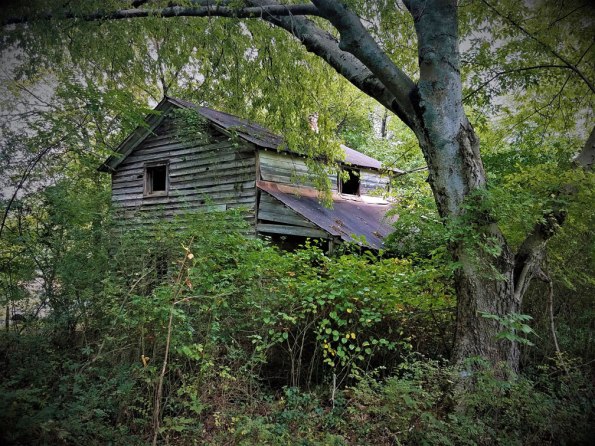
Tucker store and post office, 2019. Photo by Jeremy Winfrey.*
In the 19th century, rural post offices were typically located at stores and mills, which often provided mini service centers for a “neighborhood” of farms.
Tucker store and post office was located near Sharps Creek close to the house known as Millbrook which was built by Randolph Jefferson’s son, Robert Lewis Jefferson, and later owned by his son, Elbridge G. Jefferson.
The post office at Tucker appears to be comparatively short-lived. Beginning in June 1890, Ida M. Baber was postmistress. In June 1919, Addie Baber failed to qualify for the job and the mail was rerouted to Diana Mills, effective 31 December 1919.
Today, the remains of the store are slowly disintegrating, leaving an evocative ghost of a once bustling business.
How Tucker got its name is currently a mystery. Does a Slate River Ramblings reader know anything about the Tucker behind the store’s name? If so, please comment below.
Coming Next: Buckingham County Post Offices, Part IV
* Since this post, Jeremy Winfrey has learned that this structure was known as the “Greene Davis house.” The Tucker Post Office was on Sharps Creek Rd, near the small Baber family cemetery.
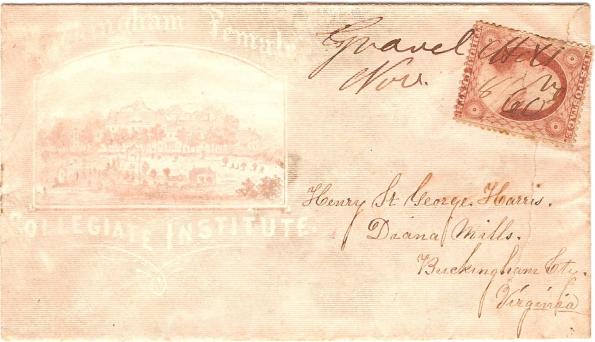
Courtesy Gene Lightfoot Collection.
This beautiful envelope was mailed from Buckingham Female Collegiate Institute at Gravel Hill. The handwritten cancelation reads November 8, 1860. An example of intra-Buckingham mail, the letter was only going as far as Diana Mills to Henry St. George Harris. The sender is unknown.
Postmasters at Gravel Hill included: Beverly A. Brown (1839), John B. [last name and date illegible], Beverly A. Brown (1853), Mrs. Sarah West (1866), Mattie J. West (1875), and Laura W. Claiborne (1901). The mail delivery moved to Dillwyn, effective June 26, 1905.
Beverly A. Brown was also an initial trustee of The Institute.
It’s easy to imagine the lovely young ladies of The Institute coming and going to the post office, visiting West’s country store, eager to send and receive news via the US mails.
Coming Next: Buckingham County Post Offices, Part III


 slate river ramblings . . . .