
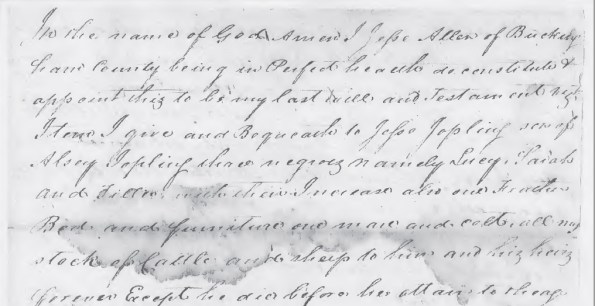
Jesse Allen Will. Courtesy Library of Virginia.
The Fall 2018 Issue of Central Virginia Heritage includes three Allen family wills transcribed by Jean L. Cooper. These wills inspired “The Allens of Hunts Creek.”
Need to catch up? Click here: Buckingham Notables: The Allens of Hunts Creek, Part I
~
Some of William and Mary (Hunt) Allen’s children remained in Goochland and Cumberland counties; others moved west with their parents. One son, named John, married Betheniah Thomas (a. k. a. Nevil), c. 1748. Their son, Jesse Allen, is the author of the first transcribed will published in Central Virginia Heritage (Fall 2018). Written on July 27, 1780 and entered into court on June 3, 1782, his will may have been recorded in Amherst and Albemarle counties, as well as Buckingham.
Jesse Allen was in his mid-thirties when he died, unmarried and childless. He had a brother, Samuel Allen, who married Hannah Jopling, providing an important clue to Jesse Allen’s connection to the Joplings named in his will.
Legatee Jesse Jopling, son of Alsey Jopling, received three Negro slaves: Lucy, Sarah and Tillis, along with their increase. Jesse Jopling also received one feather bed and furniture, one mare and colt, and all of Jesse Allen’s stock of cattle and sheep. At the time of Allen’s death, Jesse Jopling was still a minor. If he died before his twenty-first birthday, this legacy would go to the children of Jesse Allen’s brother, Samuel.
Jesse Jopling does not appear in Rev. Wicker’s genealogy of the Allen family. It did not take long, however, to discover that he was kin to Jesse Allen. A Jopling genealogy revealed that Jesse Jopling was the son of Ralph and Alsey (Allen) Jopling, the daughter of John and Betheniah Allen. Jesse Jopling was a nephew and a namesake. Jesse Allen had a sister named Alsey who was unknown to Rev. Wicker!
Other members of the Jopling family witnessed the will: Thomas Jopling, Jr. (likely Hannah’s brother), Betheniah Hilton, and Thomas T. Jopling, Sr. (probably Hannah Allen’s father, who was elderly and signed with his mark).
Coming next: Buckingham Notables: The Allens of Hunts Creek, Part III

Central Virginia Heritage (Fall 2018)
If your families settled in Buckingham County in the late 18th or early 19th century, and lived in the northeast corner of the county, you might have an Allen in your family tree.
The Fall 2018 Issue of Central Virginia Heritage includes three Allen family wills transcribed by Jean L. Cooper. These rare documents go a long way toward illuminating one of Buckingham County’s earliest settlers and inspired the following series at Slate River Ramblings: “The Allens of Hunts Creek.” Images of the original wills can be found here:
Library of Virginia: LOST RECORDS LOCALITIES DIGITAL COLLECTION
~
During the 18th century, one Allen family migrated west from New Kent County, Virginia to Henrico/Goochland/Albemarle/Buckingham counties. The patriarch, William Allen, would become one of the founders of the newly formed Albemarle County where he was involved in the establishment of the courthouse at Scott’s Landing.
In the 1990s, Rev. Richard Fenton Wicker, Jr. compiled a thorough genealogy of this Allen family entitled The Allen Family of England, Virginia, North Carolina, Tennessee, Mississippi, Texas and Illinois, 1600–1995. While some of his conclusions have since been disproved, his work is full of primary source references and clues for more research. Throughout this series, I rely on his work, which includes this statement about Capt. William Allen:
Mr. Allen also had the contract for the construction of the new courthouse for Albemarle County at Scottsville. This courthouse was to be a duplicate of the ‘fine courthouse’ in Goochland County. (The bond for the Courthouse read as follows: Sealed with our seals & dated 27 June 1745. The condition of this obligation is such that Samuel Scott shall by or before the last day of June 1747; build at his own charge and expense, a court house, prison, stocks & pillory for use of Albemarle County. The prison is to be built first, according to the dimensions of those in Goochland County. Samuel Scott (seal), William Allen (seal).
William Allen and his family came west over several decades. Following the death of his first wife, Hannah, Allen left New Kent County, Virginia sometime after the spring of 1720 and moved westward to Fine Creek in Goochland County. There, his neighbor was Peter Jefferson (father of President Thomas Jefferson). Together, they served the county as Gentleman Justices.
William Allen’s second wife, born Mary Hunt (1695–1763, was the widow of Robert Minge. (After William Allen’s death, Mary married Field Jefferson, brother of Peter Jefferson.)
The Allens began their family in 1721, rearing at least nine children. In about 1745, Allen sold his Fine Creek property, relocating to Albemarle County, south of the James River, near Slate River at Hunts Creek. Between 1735 and 1756, he accumulated six patents in what would become Buckingham County.
This William Allen wrote his will on August 15, 1751 and it was recorded in Albemarle on June 11, 1752. In it he named his widow, sons, daughters, and various grandsons. Some of these individuals will appear again in the wills transcribed in Central Virginia Heritage.
Coming next: Buckingham Notables: The Allens of Hunts Creek, Part II
~
Available at Amazon: Central Virginia Heritage (Fall 2018)
Also featured in this issue is my article, “Out of the Frying Pan and into the Fire: Tracing My Harris Ancestor from One Burned County to Another.”
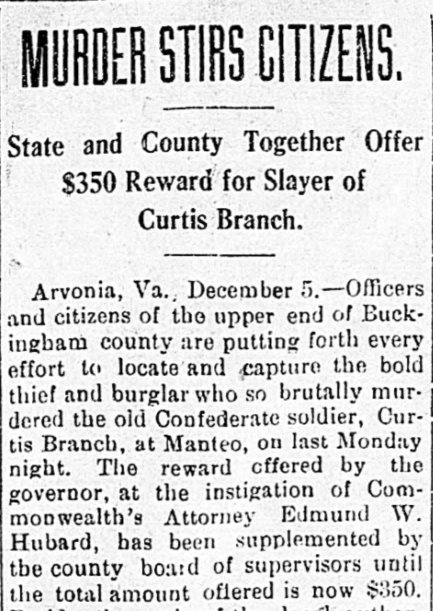
Courtesy Alexandria Gazette.
In 1911, Curtis N. Branch was murdered in Buckingham County. Click here to catch up:
Buckingham County Murder: Manteo Killing, Part I
The news of the murder of Curtis Branch was published across Virginia, including notices in the Alexandria Gazette and Newport News’ Daily Press. The story was even reported beyond the state, including an article in The Cincinnati Enquirer.
Richmond’s Times-Dispatch followed printed a new report in its December 4, 1911 issue, announcing that there was a reward of $350 for information about the slayer of Curtis Branch. This article indicated that not only was Buckingham County’s Commonweath’s Attorney Edmund W. Hubard involved in the case but also that the US government had sent a detective to investigate because the looting of the post office included the theft of postal funds and stamps.
Here the story ends. No further coverage in Virginia newspapers has been found.
If a Slate River Ramblings reader knows more Curtis Branch, his family, or about the capture of his murderer, please comment below.

Buckingham County Postal Map, 1916.
In 1911, Curtis N. Branch was murdered in Buckingham County. Click here to catch up:
Buckingham County Murder: Manteo Killing, Part I
The cast of characters in the murder of Curtis Branch now includes the victim, the unknown assailant, William White (who discovered the body), D. W. Patteson (rural mail carrier), and George W. Patteson (store owner and postmaster). Consulting the 1910 census, taken the year before the killing, resulted in the following information:
Curtis Branch, age 71, lived in James River District with his wife and adult son, Charles Branch. Extended members of the Branch family lived nearby.
George W. Patteson, merchant, age 66, likewise lived in the James River District with his wife and four children.
William White is likely William H. White, age 52, who also resided in the James River District with his wife and worked as a “grader” for the railroad.
As yet, D. W. Patteson has not been located on the 1910 or 1920 census. Perhaps, there was a misprint in his initials.
~
The article in the Staunton Spectator and Vindicator went on to note that recently there had been other disturbances in the Manteo area. On July 18, 1911, the station at Manteo had been robbed of between $12 and $20. Shortly after this break-in, the home of a ferryman near Manteo was burglarized and burned. Fortunately the ferryman was not at home or, as the journalist suggested, there might have been another murder. Were these incidents connected? Would the murderer of Curtis Branch be found?
Coming next: Buckingham County Murder: Manteo Killing, Part IV

In 1911, Curtis N. Branch was murdered in Buckingham County. Click here to catch up:
Buckingham County Murder: Manteo Killing, Part I
The report given in the Staunton Spectator and Vindicator was full of speculation, some details, of course, might have been accurate. The article continued:
No Chance to Defend Himself.
Branch probably did not know what killed him. From every appearance it looks as if he was not given the least chance to defend himself. The man who was a Confederate veteran, was alone. The house, in which he slept at night, was about twenty or thirty feet from the store, which he was guarding.
A view of the room, in which he was slain, can be had from the front steps or porch of the store in daylight, but it is not believed that his assassin could have seen him in the total darkness of the night, especially in view of the fact that the blinds were closed. It is argued that Branch’s slayer knew the old man’s accustomed sleeping place and fired at the spot where he thought the charge would most likely find its mark. In this he did not err.
Assassin Did Effective Work.
Although the shot was fired from a distance of thirty or more feet, it was as effective as it would have been had the muzzle of the gun had been pressed against the victim’s side.
A shotgun was used by the assassin. An empty cartridge, the one believed to have done the deadly work, was picked up in the front of the porch of the store by D. W. Patteson, a near relative of the postmaster of Manteo, and a rural mail carrier for this part of Buckingham county.
The murder of Branch or rather the fact that the post office and store had been robbed, was first discovered by William White, a negro, who visited the place about 7 o’clock yesterday morning for the purpose of making a purchase. White found the front door open and the lock thereto broken off.
Unsurprisingly, given the newspaper article’ s sensational prose, it also detailed the murder of the Stewart Brothers which had taken place in Buckingham County some years before.
Coming next: Buckingham County Murder: Manteo Killing, Part III

Give the Gift of Local History
More than a biography of Randolph Jefferson, The Jefferson Brothers is a history of Peter Jefferson’s plantation, Snowden, inherited by his younger son, Randolph, and located at the Horseshoe Bend of the James River.
Learn details about everyday life in Buckingham County in the 18th and early 19th century. Meet Snowden’s neighbors and the slaves who worked the fields. Get to know the Jefferson family, including Uncle Thomas, who lived at Monticello.
For the entire month of December 2018, Braughler Books is offering $10.00 off The Jefferson Brothers.
Use Code: JEFFERSON10
Please share the holiday discount code with your friends, family, and anyone interested in learning more about Buckingham County, as well as life among the planters in Central Virginia.

Courtesy Staunton Spectator and Vindicator
In 2015, Slate River Ramblings reported on the 1911 shocking murder of a man named Curtis Branch, as reported in Richmond’s The Times-Dispatch. Click on the links below to read but we knew at that time:
Since then, a lengthy report printed in the Staunton Spectator and Vindicator has been found. Its distressing headline, “ANOTHER CRIME ADDED TO BUCKINGHAM’S LIST,” indicates ongoing unrest in Buckingham County. The subheading, “SECTION HAS WITNESSED MANY BRUTAL MURDERS,” referring to the gruesome murder of the Stewart brothers, confirmed it. Click to read the series about the Stewarts:
The 1909 Buckingham Murders: Part I
~
With the dateline of Manteo, Buckingham County, Va., Nov. 29, 1911, the article called the killing of the aged Curtis Branch a “foul assassination.” Struck down by an unknown murderer, Branch was slain in his sleep. This accounting offers more details (and speculations) then the news report previously found. The Staunton Spectator article continued, in melodramatic prose:
It is believed that he was murdered because his slayer, who was at that time either engaged in, or bent on the robbery of the store of George W. Patteson, which building also housed the postoffice of Manteo, feared that he would thwart him in his plans. The robber probably reckoned that Branch, who was engaged by Patteson to guard the store and postoffice at night, would awaken and detect [him] in the act of burglarizing the place and give the alarm or perhaps take the initiative and shoot him down….
It is argued by some, but those who take this view are in the minority, that Branch heard the thief or thieves at work and being hardy and something of a daredevil, boldly went forth to put a stop to their depredations.
Those who incline to this view would believe that the old man threw up the sash of the window by which he slept, thereby warning the nocturnal marauders of his presence. For this imprudence, it is argued, he forfeited his life.
Coming next, Buckingham County Murder: Manteo Killing, Part II
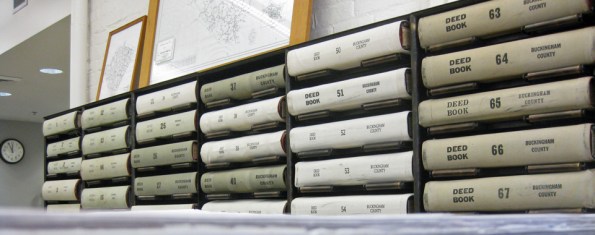
Deed Room Treasures. Buckingham County Courthouse.
Today, Slate River Ramblings, along with its nearly 700 enthusiastic followers, celebrates its sixth anniversary.
Thanks to each and every one of you for your dedication to the people and places of Buckingham County, Virginia.
The Slate River Ramblings archive is loaded with nuggets of Buckingham gold. As of December 2018, there are over 850 posts and more than 2,600 comments by thoughtful readers. Try searching the archives for your favorite topic or surnames.
Please invite your family and friends to join us as we continue to ramble through Buckingham County’s history. There is much more in store for 2019!

Edward Bushrod Stahlman (1843-1930), Publisher of the Nashville Banner.
Courtesy Wikipedia.
Recently, I heard from a Slate River Ramblings reader who expanded on posts about Oak Grove Academy and its founder John Tanner Claiborne (1801–1864).
In 1850, John T. Claiborne headed Oak Grove Academy. Ten male pupils lived with his family in Buckingham County. By 1860, Claiborne and his family had removed to Nashville, Tennessee, where they purchased a boardinghouse. There he continued to teach English Grammar, supporting his wife Sarah Anne (Bransford) and five daughters.
Previously, Mr. Claiborne had taught at Buckingham Female Collegiate Institute, which his two eldest daughters, Eliza Frances “Fannie” and Laura Virginia Claiborne, attended. As was the case with many young ladies educated there, their experience set them apart from the other girls of the day. Fannie married John Wilson Otley and their daughter, Louise, attended Longwood College, becoming a schoolteacher in Augusta County, Virginia, continuing the Claiborne family value of higher education for women.
The Claibornes’ youngest daughter, Mary Tanner called “Molly” (b. November 5, 1848/49 in Buckingham County), married Edward Bushrod Stahlman, a German immigrant, self-made man, and publisher of the Nashville Banner for forty-four years.
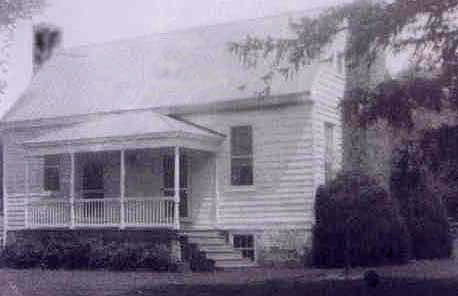
“Melrose,” 12016 Old Buckingham Road

Traube’s Tavern, 11940 Old Buckingham Road
Courtesy Huguenot Houses in Powhatan and Chesterfield Counties.
In 1912, an odd editorial ran in Richmond’s The Times-Dispatch entitled “An Episode of ‘The Buck and Game Road’.” Sent to the editor by Charles Macon Wesson of Fine Creek Mills, Powhatan County, it read, in part, as follows:
Sir. —The Buck and Game Road is incorrectly but almost universally called the Buckingham, for it does not even run to or extend into the county of that name, now made famous by its fine slate quarries. The aforesaid road is simply a broad, old-fashioned country highway, starting in Chesterfield, going through Powhatan and Cumberland, up to Prince Edward, I think, not extending beyond the thrifty town of Farmville.
The cognomen of Buck and Game Road was arrived at on account of the great perfusion of game, inclusive of deer, squirrels, old hares and “possums,” wild geese, duck and partridge. Said denizens held high carnival in “ye olden” stage days, when the cumbersome things rolled along in high state of the old Buck and Game Road, before the rampant locomotives, with their rumble and hysterical shrieks, drove the timid deer from there quiet, leafy coverts on the arrowy Appomattox or more classic James, when far-famed and justly celebrated Virginia hospitality was “in flower”: when mother, wife and maid were the real goddesses of the homes and firesides, yea, when butter was not oleo-margarine and the various as well as multitudinous adulterations of today were not known, if so, not practiced.
The author of the editorial then goes on a lengthy rant about Virginia’s halcyon days, when its citizens were God-fearing and the God-loving people and politicians less divisive. The author longed for the day when the maiden was “shy and coy” and her gallant cavalier was “brave, tender and true.” The episode, referred to in the title, concerns a certain church and its preacher, located somewhere on the “Buck and Game Road.”
Did the so-called “Buckingham Road” never really run into Buckingham County? What were the stage roads or old-fashioned country highways in the county called?
If a Slate River Rambling’s reader knows more, please, comment.

Old Buckingham Road Today


 slate river ramblings . . . .