

Healthy, peaceful Buckingham County, Virginia. Photo by Joanne Yeck.
Many advertisements in 19th-century newspapers described Buckingham County as both prosperous and healthy. Compared to the malaria-ridden waters further east in Virginia, residents of Buckingham did enjoy a comparatively healthful environment, making it a safer place to send your children to be educated. Elisha G. Hanes, founder of Humanity Hall Academy, stressed this in his frequent notices in the Richmond newspapers. Perhaps just as important to prospective parents was the fact that a country education removed their children from various dangers of city living. This particular advertisement ran in late 1850:
HUMANITY HALL ACADEMY.
The annual exercises of the school will be resumed on 15th January, 1851. Board, tuition, washing, lodging, &c. will be furnished for $100, for a term of ten months. The school is located midway between Buckingham Court House and the Female Collegiate Institute, in a remarkably healthy and desirable neighborhood, remote from the haunts of vice and dissipation. Very particular attention will be paid to the moral development of those entrusted to my care. Address Chambers Mills, Buckingham county, Va.
ELIJAH G. HANES.
For much more, consult: “Elijah G. Hanes and Humanity Hall Academy,” in “At a Place Called Buckingham,” Volume Two.

Harris Cemetery. Green Creek, Albemarle County, Virginia. Photo by Joanne Yeck.
When exploring family history, the death of children is especially moving. In the case of Buckingham County resident Henry St. George Harris, he lost his only son to a deadly snake bite. In 1862, Harris wrote to his mother, Mary Woods (Harris) Harris, of the death of her grandson, Hampden:
It is my sad and [afflicted] lot to record the death of my beloved little boy Hampden, which took place on yesterday about 4 o’clock in the evening. His death was caused by the repeated bites of a venomous moccasin snake on his foot, the evening before, as he was returning out of the cellar from the supper table.
This awful occurrence has fallen with overwhelming effect, upon every member of my little household. I can scarcely realize the fact that my bright, my beautiful, my lovely little boy, gifted with a degree of intelligence and sprightliness that I have never seen surpassed, has passed away from Earth forever, no more to give joy to our vision or gladden our hearts again. I intend to place his dear little remains today by the side of the loved little ones and their Grandparents, who have gone before. Adieu my mother, my love to all.
Hampden Harris was buried in the Harris family graveyard in Albemarle County, near Green Creek.
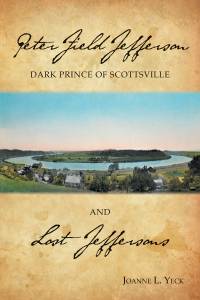 Many thanks to Sue Miles for her review of Peter Field Jefferson: Dark Prince of Scottsville & Lost Jeffersons in the May issue of the Buckingham Beacon.
If you live in or near Buckingham County, pick a copy.
If not, you can download a PDF at Valley Publishing:
“A Fascinating Look at Peter Field Jefferson.”
Happy reading!

While exploring in the woods in Buckingham County, my Virginia cousins impressed upon me a new respect for snakes. Some, of course, can be poisonous and they are the last thing you wish to encounter while looking for grave sites or foundations of ancient dwelling houses. In 1908, the Appomattox and Buckingham Times printed this snake-related story:
A few days ago a young lady of this place [Buckingham Court House] had occasion to go to her dining room between meals and on reaching the table to get what she went for she put her hand on a snake. She didn’t scream, she didn’t faint, as most women would have done, but there being no man in the house she called in a gentleman friend who took the snake up in the tongs and killed it. It was an unusually large specimen of its kind and the frightened inmates of the house imagine a snake is around to frighten them all the time.
It is good to know that our unidentified young lady retained her composure and that her gentleman friend was chivalrous.
Coming next: Buckingham County: Snakes, Part II

Mary Ann Davis gravestone. Photo by Joanne Yeck.
In addition to the Jeffersons and Jefferson descendants (Foland and Moulton) found in the cemetery at Mount Walla, there are several members of a Davis family, including:
Chas. Barney Davis, 10 May 1834–8 January 1894
Mary Ann Davis, 13 February 1841–25 July 1914
Emily A. Davis, 23 September 1869–21 July 1949
Chas. Arthur Davis, 1885–1916
Mary Ethel Davis, 1888–1900
Roger M. Davis, 1908–1919
Charles Barney and Mary Ann Davis were husband and wife. C. B. Davis was at one time a postmaster at Woodridge outside of Scottsville. Their daughter, Emily A. Davis, was a school teacher.
According to Mary Ann’s death record, her father was James “Straiten” and her mother was Harriet Woods. I believe that her parents were James and Harriet Straton, making Mary Ann a sister-in-law to Peter V. Foland. Here are the Stratons on the 1850 census:

If a Slate River Ramblings reader knows more about the relationship between the Davis family and the Folands, please comment below.
Read Harriet Straton’s opinions about Peter Field Jefferson in my newest book: Peter Field Jefferson: Dark Prince of Scottsville & Lost Jeffersons.

MayFest, 2017. Photo by Martha Louis.
Saturday, May 12, 2018, is MayFest in Buckingham County!
Join the fun. 10:00 am – 2:00 pm at the Historic Village at Lee Wayside.
84 Lee Wayside Rd. – 2 miles west of Sprouses Corner.
Historic Buckingham will be selling signed copies of Peter Field Jefferson: Dark Prince of Scottsville & Lost Jeffersons. When you purchase a copy, you help support the preservation of Buckingham County history!


Peter V. & Bettie Foland gravestone. Photo by Joanne Yeck.
Peter V. Foland (1845–1915) and his wife Bettie (1845–1921) spent their married life at Mount Walla situated above Scottsville and are buried in the cemetery near the dwelling house.
According to the 1900 Federal Population Census, they had eight children together. Six were living in 1900. One child remains unidentified. Mary Ellen Foland (1873–1891) is buried in the Mount Walla cemetery.
Three sons—James Gates Foland (d. 1926), George W. Foland (d. 1962), and Clark Valentine Foland (d. 1967)—all died in West Virginia. Three more daughters—Frances (1867–1943), Harriet (1869–1955), and Elizabeth (1884–1946)—are buried in the Mount Walla cemetery. In December of 1894, Frances Foland married Calvin Hollis Dunkum (1866–1951), who is buried with the Foland family at Mount Walla. Harriet Foland’s husband, William Thomas Moulton (1861–1930), is also buried there.
Read about Frances Foland’s wedding at Mount Walla in my newest book: Peter Field Jefferson: Dark Prince of Scottsville & Lost Jeffersons.
Coming next: Mount Walla Cemetery, Part III

Peter Field Jefferson, Jr. gravestone. Photo by Joanne Yeck.
In 1836, Randolph Jefferson’s son, Peter Field Jefferson purchased Mount Walla, a dwelling house sitting high above the town of Scottsville, Virginia. Over eighty acres came with it, providing an orchard, room for a substantial kitchen garden, and plenty of timber for Jefferson and his family.
He lived there the remainder of his life, dying in 1861. His widow, Jane Woodson (Lewis) Jefferson, remained until her death in 1864. Mount Walla was inherited by their grandson, Peter V. Foland, and Jefferson descendants retained the house until 1951.
A well-maintained cemetery, within sight of the dwelling, is surrounded by a decorative iron fence and contains numerous Jefferson family graves. While it is presumed that Peter Field and his wife, Jane, are buried there, to my knowledge, their graves are unidentified.
Their son, Peter Field Jefferson, Jr., and his wife, Elizabeth, are remembered with the marker pictured above, probably placed there in the 20th century. They both died just outside of Scottsville, at Bleak Hill, the Jefferson home at Albemarle Mills (a.k.a. Jefferson Mills). Elizabeth A. (Wood) Jefferson died in 1876 and Peter Field Jefferson, Jr. followed her in 1881.
Learn more about Bleak Hill and Jefferson Mills in my newest book: Peter Field Jefferson: Dark Prince of Scottsville & Lost Jeffersons.
Coming next: Mount Walla Cemetery, Part II

Baine’s Scottsville. Photo by Joanne Yeck.
Autographed Copies Available
Baine’s Scottsville
485 Valley St ~ Scottsville, VA ~ (434) 286-3577
Baine’s Books and Coffee
Mon – Wed 7am – 8pm • Thurs – Fri 7am – 9:30pm
Sat 8:30am – 9:30pm • Sun 9am – 5pm
205 Main Street ~ Appomattox, VA ~ (434) 352-3711
Learn more about the descendants of Randolph Jefferson
Peter Field Jefferson: Dark Prince of Scottsville follows the rise and fall of Randolph Jefferson’s most successful son. Nephew to President Thomas Jefferson, Peter Field proved that at least one member of the family had a head for business. The story of his life parallels that of the changing cultural landscape of the James River’s Horseshoe Bend across seven decades—rising from virtual frontier to the establishment of Scottsville in Albemarle County, through the building of the James River and Kanawha Canal, and culminating in the early months of the Civil War. Jefferson’s success as a self-made man is tainted with great personal loss, making his story a distinctively American tragedy.
Lost Jeffersons is a collection of essays which follows descendants of Randolph Jefferson and their kinfolk. Their fates reveal, in part, the genetic decline of one branch of the Jefferson family. A microcosm of Virginia’s gentry, multiple generations of cousin marriage resulted in a concentration of undesirable traits—including alcoholism, idiocy, and insanity—compromising individuals who might otherwise have led productive and useful lives.
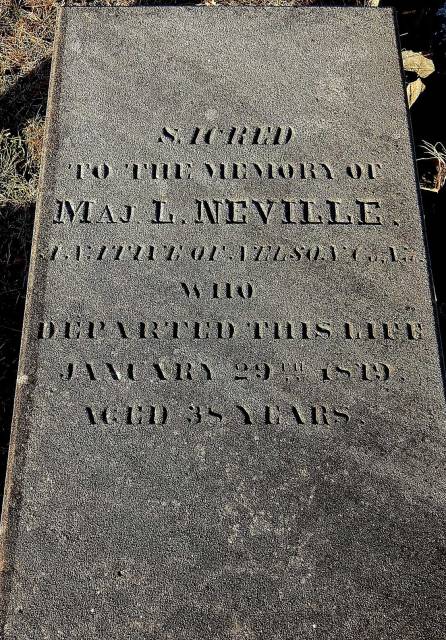
Lafayette Neville, Old City Cemetery, Lynchburg, Virginia.
Need to catch up with the Nevil family? Click here: Anna Scott Jefferson
Lafayette Nevil was the third child of Anna Scott (Jefferson) and Zachariah Nevil. He was studying at the University of Virginia when his father died in April of 1830. Lafayette returned to Nelson County, where he assumed responsibility for his younger brother, Jefferson Madison. Eventually, he qualified as an attorney and, in 1835, Lafayette married Mary Joyce Labby, whose father would soon become the mayor of Lynchburg. The Lafayette Nevils resided in Lynchburg, as well as maintaining the Nevil home plantation Locust Grove, which Lafayette had purchased from his father’s estate.
Lafayette did not enjoy the Jefferson longevity, dying before his 40th birthday paralyzed from an unknown illness. He is buried in the Labby family plot in Lynchburg’s Old City Cemetery.
Click here to learn more about Lynchburg’s beautiful, historic garden cemetery: Old City Cemetery.
Read more about Lafayette Nevil (a. k. a. Neville) and the tragic fate of his brother, Jefferson Madison, in my newest book: Peter Field Jefferson: Dark Prince of Scottsville & Lost Jeffersons.


 slate river ramblings . . . .