
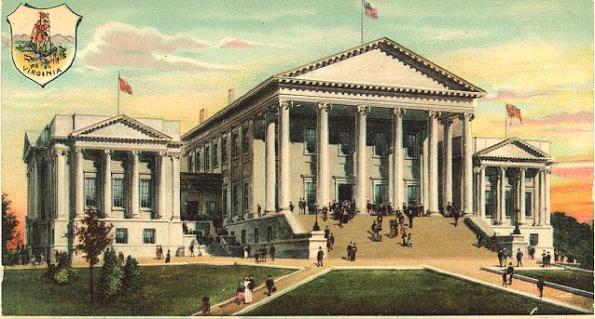
Virginia State Capitol
During the Reconstruction Era, Francis “Frank” Moss represented Buckingham County at the Virginia Convention of 1867–1868 and, later, was elected Senator. An outspoken and controversial Republican, in 1871, Senator Moss opposed the acquisition of a portrait of Robert E. Lee to hang in the Capitol building.
In a post at the Library of Virginia blog Out of the Box entitled “STATUE STORIES: THOMAS J. JACKSON AND CIVIL WAR REMEMBRANCE,” Frank Moss’ opinion was mentioned:
In 1871 the state had proposed an acquisition of $600 for a portrait of Robert E. Lee to hang in the Capitol. Senator Frank Moss, an African American legislator from Buckingham County, took the floor to object to the appropriation. Moss felt that as “Gen. Lee had fought to keep him in slavery…he couldn’t vote to put his picture on these walls.” While Moss’s opposition made the newspapers, the portrait purchase was approved. By 1875, Moss was serving in the House of Delegates. Together with three white Republican lawmakers—Charles G. Bickings, Godfrey May, and George W. Young—Moss and fellow African American delegates Peter Jacob Carter, Matt Clark, Henry Cox, William Gilliam, James P. Goodwyn, Ross Hamilton, H. Clay Harris, Henry C. Hill, Rufus S. Jones, and Robert H. Whitaker, voted against the Jackson [statue] appropriation. They were outnumbered, and the bill was passed.
Was Frank Moss a former slave? His entry at Wikipedia claims that he was born a free black man, a member of an African-American family that had been free for several generations.
Can a Slate River Ramblings reader shed light on this discrepancy? If so please comment.

In 1937, Rosa G. Williams surveyed the cemetery at Solitude for the Virginia Historical Inventory. Located four miles west of Buckingham Court House, about one mile south of Hwy 60, Mrs. Williams noted that the oldest grave in the cemetery was dated 1820. The flat, slab marker set on a two-foot rock foundation, marked the grave of William H. Perkins, Sr. the inscription reads:
Sacred to the memory of
William H. Perkins
he was born
9th Sept. 1780
and died 11th. December 1820
In death society has lost a valuable citizen, his wife, an affectionate husband and his children a tender father, his servants a kind master.
Lived beloved, died lamented by all who knew him.
Mrs. Williams survey was mislabeled “Solidute Cemetery”—a reminder to always search a subject with multiple terms. I discovered the survey not by searching “Solitude” but by searching Perkins and Buckingham.
Slate River Ramblings readers can dig into the Virginia Historical Inventory at the online catalog of the Library of Virginia.
For more about the Perkins family, see Buckingham Notables: William H. Perkins (1824–1892).

Maysville Presbyterian Church.
Sketch by Margaret Pennington. Courtesy Historic Buckingham.
Many members of the Perkins family belonged to Maysville Presbyterian Church.
According to the obituary of Rev. Caesar Perkins, William Harding Perkins (1824–1892), son of William Harding Perkins, Sr. (1740-1806), was his former master.
The details of Caesar Perkins’ emancipation are unclear. It is possible that he purchased his freedom or that he was freed by the Perkins family prior to emancipation. To date, however, no evidence has appeared that he was freed before the general emancipation.
~
Private collections often hold Buckingham County treasures. The “Perkins Family Papers, 1806-1874” is an excellent example. Part of the Robert Alonzo Brock Collection at The Huntington Library in San Marino, California, its contents are available on microfilm from the Library of Virginia.
The Library’s finding aid provides the following genealogical information about the family:
William Harding Perkins (1780-1826) was born in Buckingham County, Virginia, to William Perkins (1740-1806) and Elizabeth Lee Fearn Perkins (1750-1839). William H. Perkins established his home at “Solitude” in Buckingham County. Perkins was a tobacco farmer and served as deputy sheriff in Powhatan County, Virginia, and as sheriff of Buckingham County. He married Mildred Walker Merry (1794-1841), and they had five children: Thomas Fearn Perkins (b. 1820), Catherine Merry Perkins (1821-1889), Eliza Mildred Perkins (b. 1823), William Harding Perkins (1824-1892), and Anne Frances Perkins (1827-1907). William Harding Perkins represented Buckingham County in the House of Delegates in 1853-1854.

On September 30. 1910, The Farmville Herald ran a lengthy obituary for Caesar Perkins, which reflected the tone of the times and its still divisive politics. In 1910, many Virginians continued to dwell on the “dark days” of Reconstruction. It is not known who provided the details of Rev. Perkins’ life, though, surely it was someone who knew him well, including his original training as a brick mason. His obituary did not stand alone in the newspaper but was included with news from Buckingham County on page seven.
The body of Caesar Perkins was buried at his old home place here on the twenty-fourth. Perkins at one time was one of the most prominent negroes in the State, and he was for a time a potent factor in shaping affairs in Buckingham. In the dark days of Virginia’s history, when the Republicans ruled and when the negroes held the balance of power, Caesar Perkins had a great influence with his race, and he was not slow to claim his share of the loaves and fishes from his white fellow Republicans, and he usually had the claims allowed too. However, Perkins was more conservative in his views than many who ruled at that time, and with all he was intelligent to a degree. He was a member of the legislature of Virginia and also served as a member of the Board of Supervisors of this county. By trade Perkins was a brick mason and a very good workman. As a public speaker he ranked far above any negro of this county and in the days of Republican ascendency, he was listened to by the whites as well as the negroes. There were not many Republicans, white or colored, that could get the best of him in debate. As a slave Perkins was owned by Mr. Wm. H. Perkins, of this county, and he often spoke of Mr. Perkins as “my master,” and he seemed to have the highest regard for the people whom he had served as a slave.
While the unknown author of this obituary focused on Rev. Perkins’ political contribution to Buckingham County, he completely overlooked his state-wide dedication to African-American churches and schools. In any case, it is good to know that Rev. Perkins was a forceful public speaker and debater.
Special thanks to the Library of Virginia’s Virginia Chronicle for making The Farmville Herald available online.
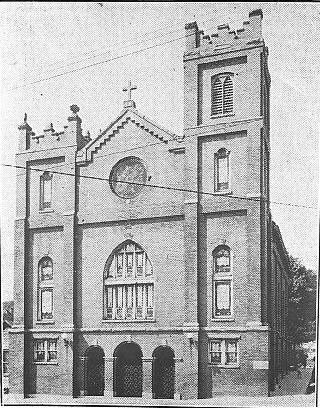
The “New” Main Street Baptist Church. Clifton Forge, VA.
To catch up, follow this link: Reconstruction in Buckingham County, Part I and Reconstruction in Buckingham County: Caesar Perkins, Part I
Beyond his involvement in politics, Caesar Perkins was a leader in the African-American religious community. By 1868, he was a Trustee of Fork Union Baptist Church, which included a school for African-American children. According to the Encyclopedia Virginia:
On August 16, 1870, Perkins purchased for $1,675 the 628 acres in Buckingham County where he had been raising corn, oats, tobacco, and wheat on the farm he rented. In January 1873, however, he signed over his considerable amount of personal property to lien holders to secure the remainder of the purchase price. He also operated a store in Buckingham Court House and in June 1871 received a license to sell alcohol there. In 1872 he was licensed to keep two ordinaries in the county.
Later in the decade, Perkins served as assistant assessor for the county and served as a Supervisor for Maysville Township, fulfilling Lt. Jordan’s confidence in him.
By 1877, Caesar Perkins completed a divinity degree, was ordained as a Baptist minister, served as pastor at Zion Grove Baptist Church in Buckingham County and, later, served as Treasurer of the Slate River Baptist Association. Over the years, he officiated at numerous marriages in Buckingham County.
According to the Encyclopedia Virginia, in the early 1890s, Caesar Perkins moved west to help establish a new church in Clifton Forge, Alleghany County, Virginia:
By 1891 Perkins had moved to Clifton Forge, where he acquired property and operated a brickyard for the nearby Iron Gate Land and Improvement Company. He suffered financial difficulties and his property was sold at public auction in 1896. While living in Clifton Forge, Perkins helped establish Second Baptist Church (later Main Street Baptist Church), of which he was pastor, and facilitated the transfer of property to the church in 1897.
According to The Clifton Forge Woman’s Club holiday tour guide of historic building in Clifton Forge:
The Main Street Baptist Church was organized in 1895 and was the inspiration of the Rev. Cesar Perkins, a slave born in Buckingham County, Virginia. . . . He purchased a small wooden building which had been used as a church from a white congregation for $13,350.00 that same year. In 1921 the wooden building was replaced with the beautiful brick church you see today at a cost of $75,000.00. The sanctuary seats 250 members, many of whom, in years past, mortgaged their homes during the depression to maintain the church and its parsonage.
In 1900, Perkins and his second wife, the widow Lucy J. Claiborne, were enumerated twice on the Federal Census, in Clifton Forge and in Buckingham County. In November of 1904, in Buckingham, he helped found a chapter of the Colored Knights of Pythias, a fraternal and benevolent association, eventually becoming the District Deputy Grand Chancellor for the county and organized additional lodges. According to the Encyclopedia Virginia, “He donated a house and lot to the Maysville school district in August 1910.” He died on September 22, 1910, in Richmond, Virginia, following a long illness. He is buried on his property near Dillwyn in Buckingham County.
Coming next: Reconstruction in Buckingham County: Caesar Perkins, Part III

Caesar Perkins. Courtesy E. Renée Ingram and Charles W. White, Sr.
To catch up, follow this link: Reconstruction in Buckingham County, Part I
In 1870, Caesar (a.k.a. Cesar) Perkins, “Mulatto,” lived in Buckingham County’s Maysville Township. Thirty years old, he was probably the youngest African American on Lt. Col. Jordan’s list. His contribution to Virginia’s post-Civil War government earned him a lengthy entry at Encyclopedia Virginia. What follows is a summary of his political career and some of his other accomplishments.
According to the 1900 census, Caesar Perkins was born in March of 1839. In 1870, his mother, Clarisse (a.k.a. “Clarissy”), age forty-seven, and Joseph Moseley (a.k.a. Mosley), age seventy, lived together in Buckingham’s James River Township; their relationship is not stated on the census. Several sources identify them as husband and wife, despite their age difference. It has been suggested that Perkins adopted the surname of his “last,” former owner, William H. Perkins, who was a member of the Virginia House of Delegates during the 1853–1854 session.
Caesar Perkins first married a woman named Susan (a.k.a. Susannah). Her maiden name may have been Eldridge. In 1880, her sister, Lavinia Eldridge, was living with the Perkins family. Together, Caesar and Susan had two daughters, Mary A. (born abt. 1862) and Mildred (born abt. 1868).
In an election on July 6, 1869, Caesar Perkins and a man named James H. Noble defeated candidates of the Conservative Party, winning by about 225 votes, earning two seats in Virginia’s House of Delegates. They would be among the men to ratify the Fourteenth and Fifteenth amendments to the U.S. Constitution.
For more about the forming of the Conservative Party in Buckingham County click here:
Reconstruction in Buckingham County, Part VIII
In the fall of 1869, Caesar Perkins attended a convention of Radical Republicans. The goal was to reorganize and strengthen the party against the Conservatives who had been victorious in recent elections. During 1870–1871, Perkins was on the Committee of Claims in the General Assembly.
Significantly, in January of 1873, Perkins was named by the Governor of Virginia as one of the curators to oversee the educational fund for Hampton Normal and Agricultural Institute (later Hampton University). Click here for more about Hampton Normal and Agricultural Institute.
Simultaneously, Perkins continued his work with the Republican Party and, in 1884, he was named as an alternate delegate to the Republican national convention in Chicago. In 1887, he served a second term in the Virginia House of Delegates, representing Buckingham and Cumberland counties.
For much more about African American politicians, educators, and religious leaders in Buckingham County, Virginia, consult Buckingham County by E. Renée Ingram and Charles W. White, Sr.
Coming next: Reconstruction in Buckingham County: Caesar Perkins, Part II
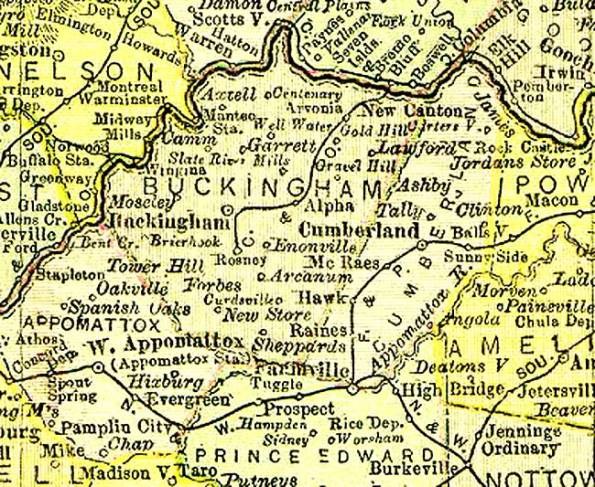
Post Offices, 1895. Buckingham County, Virginia.
Today, Slate River Ramblings celebrates its fifth anniversary and we just crested 670 followers.
All of you help make the blog a success. Thanks to you for caring about the people and places of Buckingham County, Virginia.
Another year means there are more golden nuggets in the Slate River Ramblings archive. As of December, 2017, there are over 700 posts and 100s of comments by thoughtful readers. On a snowy winter day, where ever you are, dig into the archives!
Please invite your family and friends to join us as we continue to ramble through Buckingham County’s history. There is much more in store for 2018, including a new book about Randolph Jefferson’s clan and the early years of Scottsville, VA. Watch for it Summer 2018!

Courtesy The Times and Library of Virginia
To catch up, follow this link: Reconstruction in Buckingham County, Part I
While little more is known about Solomon Brown, he and his wife, Harriet, had a son, Solomon Brown, Jr., born about 1868. Shockingly, in 1898, he was murdered by Brown family neighbor and friend Allen Eppes. Richmond’s The Times reported:
TWO TRAGEDIES IN BUCKINGHAM.
The Insane Slayer of Solomon Brown Placed in Jail.
Tries to Commit Suicide.
Buckingham C. H., VA., Dec. 22. — Special. — Allen Eppes, a well-to-do and respected colored man, on yesterday shot and killed Solomon Brown, also colored. For some time past Eppes has shown signs of insanity, and the killing of Brown is regarded as the act of a crazy man. It appears that Brown worked a part of Eppes’ farm, and the two were upon terms of intimate friendship. Yesterday Brown went to Eppes’ house and they had a talk in a perfectly friendly way. When Brown got up to leave and passed into the hall, Eppes grabbed a shot gun and fired both barrels at Brown, inflicting such injuries that he died in a short time.
EPPES ARRESTED.
Eppes was promptly arrested, and on his way to jail stated to Mr. Joe Cox, the special constable, that Brown was the best friend he had, and that the devil made him kill Brown. When Eppes arrived at jail and was given a cell he tried to kill himself with a stick of wood. The scene of the shooting was near Curdsville, twelve miles distant from here.
The general impression is that Eppes is crazy. Previous to this he has borne good character and has been very popular with the whites.
While the murder of Solomon Brown, Jr. tells us nothing about his father’s involvement in Buckingham County politics, intriguing questions remain. How was Allen Eppes connected to John W. Eppes, son of John Wayles Eppes (1773–1823) of Millbrook, Buckingham County and Eppes’ second wife, Martha Burke Jones, originally of Halifax County, North Carolina, and kin to Francis Eppes, grandson of President Thomas Jefferson? Watch for much more about the Eppes family, coming to Slate River Ramblings in 2018.
Coming next: The sixth African American, “Cesar” Perkins, named by Lt. Col. Jordan proved to be a man “acceptable to both classes,” and left a sterling legacy in state-wide politics.

Slate River Press
In need of a gift idea this holiday season? Give the gift of local history!
Here’s where you can purchase these books (and many others) about Buckingham County and Virginia:
In Virginia
Buckingham: Housewright Museum (U.S. Route 60, in the village of Buckingham)
Buckingham: Nancy’s Gift Shop (U.S. Route 60, in the village of Buckingham)
Scottsville: Baine’s Books and Coffee (485 Valley Street)
Monticello: Monticello’s Gift Shop [The Jefferson Brothers]
Charlottesville: Albemarle Charlottesville Historical Society (200 Second Street, NE)
Appomattox: Baine’s Books and Coffee (205 Main Street)
Richmond: The Library of Virginia: The Virginia Shop (800 East Broad Street)
Not in Virginia? Shop online at:
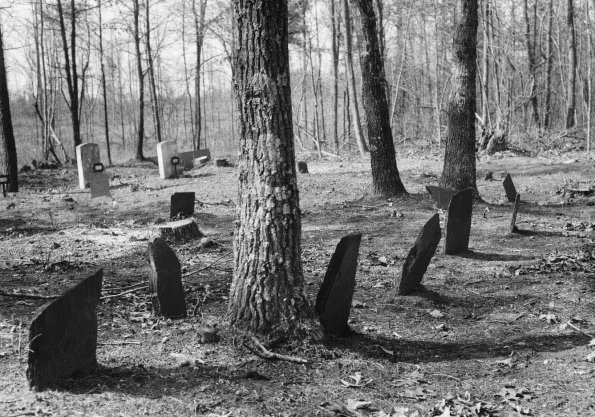
Stanton Family Cemetery, Courtesy Virginia Department of Historic Resources
To catch up, follow this link: Reconstruction in Buckingham County, Part I
And what of the African Americans on Lt. Col. Jordan’s list? With one exception, evidence of these men participating in government remains elusive.
In 1870, a man named Woodson Washington (“Mulatto,” age 40) lived in Curdsville Township and Peter Fontaine (Black, age 56) was enumerated in Marshall Township. The John Stanton on the list is likely John Stanton (“Mulatto,” age 34), living in the northeast section of Buckingham County, a member of the well-known and established “Free Black” Stanton family. For more about the family and their cemetery, click here:
Buckingham Notables: The Stanton Family & Stanton Family Cemetery
There were multiple John Scotts living in Buckingham County in 1870. One John Scott (Black, age 40) was enumerated in Curdsville on the same page as Solomon Brown (Black, age 57). Living between them was John W. Eppes (White, age 53), of Millbrook, and an African American named Allen Eppes (Black, age 25).
In 1866, Solomon Brown was contracted by Eliza J. Eppes (with her brother-in-law and agent E. W. Hubard) to serve for one year as “headman and supervisor” at the Eppes plantation Millbrook. Perhaps, his record as a foreman came to the attention of Lt. Col. Jordan. Any government service by Solomon Brown is yet to be found.
Coming Next: Reconstruction in Buckingham County, Part X


 slate river ramblings . . . .