
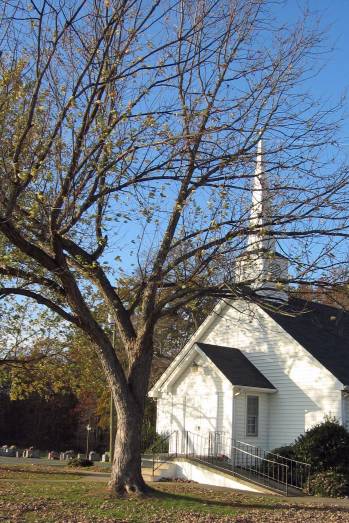
 Brown’s Chapel. Photo by Joanne Yeck.
In 1937, Rosa G. Williams surveyed Brown’s Chapel, built about 1880, for the Virginia Historical Inventory. She wrote:
This is a very plain structure, built through the efforts of this community, after the “Old Buckingham Female Institute” ceased to be. It was there that the first Methodists of this community worshiped. When the Institute buildings were being torn down the people knew if they continued they would have to erect a building. Col. Brown a member of this little band, and a large land owner of this community gave 1 ½ acres of land on which to build the church. The money was soon raised by subscription and otherwise. Many men gave their services, and the building was soon erected and it was dedicated in the year 1881. There are two entrances from the front of this church, through double doors. The walls are plastered with wide wainscoting. The ceiling is made of wood like the wainscoting. Varnish was used on the wainscoting and ceiling when the church was built, and it is as bright today as when it was put on. The ceiling is made of very wide boards.
Mrs. Williams also noted that the old bell which called the congregation to worship in the 1930’s was once used to call the young ladies of Buckingham Female Collegiate Institute to worship and to their classes.
For much more about Buckingham Female Collegiate Institute, please consult:
“A Noble Idea: Buckingham Female Collegiate Institute,” in “At a Place Called Buckingham”

In 1904, the Appomattox and Buckingham Times printed the following humorous correspondence from Enonville:
I enjoyed very much, reading the letter of your correspondent from Andersonville, and could not keep from noting the difference between this letter and the one from in Enonville.
Your correspondent states that we “old fogies” can hardly look “up-to-date gentleman,” in the face, and usually make a hasty exit when one approaches. Yes, we do usually make a hasty exit when some of the so-called, self-styled, up-to-date gentlemen approaches. But we do it for the same reason that we flee from a certain little animal that has a white stripe on its back, and a wide bushy tail. We acknowledge we are afraid of some of these “up-to-date gentleman,” who make their living by “playing sharp” on their fellow man.
Yours truly, OLD FOGIE.
~
Can a Slate River Rambling reader elaborate on the phrase “playing sharp?” If so, please comment below.
Special thanks to Virginia Chronicle for the digitized copies of the Appomattox and Buckingham Times.
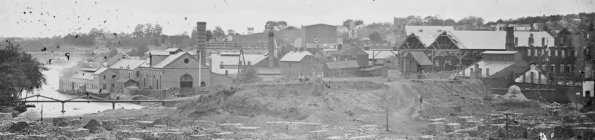
Ruins of Tredegar Iron Works. Courtesy National Archives.
In the early twentieth century, there was occasionally news of former slaves who distinguished themselves following Emancipation. Among them was Edmund Hall of Buckingham County. In 1904, the Appomattox and Buckingham Times reported the following:
Edmund Hall, a former slave belonging to Mrs. A. B. Hall, of this county, has recently visited his home, having been away about 40 years, having been in the employ of the “Tredegar [Iron] Works” in Richmond 39 years. He showed his attachment for his old mistress and young masters by coming back to see them once more, and said he wanted to carry home something to remember them by, if only a stock [?] or a switch from the place where he was raised. Uncle Edmund stands well in a business way in his city, and having raised a family there who has followed his good example and deserve honorable mention. His devotion to his old mistress and young masters is an unusual thing now-a-days.
In 1900, the widow, Mrs. A. B. Hall, was living with her son Alexander S. Hall (a lawyer) and her son Robert A. Hall (a schoolteacher) in the James River District of Buckingham County.
Looking back to 1870, Edmund Hall was already living in Richmond with what appears to be a large extended family. The census page is very faint, and there may be errors in this transcription. They were living in the Monroe Ward and enumerated as follows:
Samuel Dowpson [Dawson ?], 45, head of household, laborer
Lucy Dowpson, 25, housekeeper
William Dowpson, 1, at home
Betsy Dowpson, 77, at home
Susy Hall, 45, at home
Daniel Hall, 50, laborer
Wallace Hall, 20, porter
Edmund Hal, 28, laborer
George Hall, 23, tailor [?]
James Hall, 2, at home
Eliza Hamilton, 14, at home
If a Slate River Ramblings reader recognizes the Hall family, please comment below.

Taylor Lodge. Courtesy Jeremy Winfrey
In early 1904, a few months following Frank N. Maxey’s death, the Appomattox and Buckingham Times printed a salute to this well-loved man, sent from his Masonic Lodge brothers. It read as follows:
In Memoriam.
Whereas it has pleased the All-wise to remove from us our beloved Brother, F. N. Maxey, the oldest member of our Lodge from time to eternity
Resolved. That the members of Taylor No. 117 A. F. and A. M. bow with humble submission to the will of our Heavenly Father, trusting and fully believing that our loss is his eternal gain.
2nd. That to the bereaved wife of our beloved Brother who mourns the loss of a kind and affectionate husband, we offer our sincere and heartfelt sympathy.
3rd. That in the death of Brother Maxey, the county has lost a true and loyal citizen, Sharon Church a faithful worker and a true christian gentleman. Our Brother lived not for self alone, but spent his life and means for the upbuilding of the community in which he lived. He was a Mason 63 [?] years and lived to the old age of 83 years, and died trusting in the faith of the Lion of the Tribe of Judah.
M. L. A. Moseley, Robt. M. Agee, Robt. B. Agee, Committee.
~
M. L. A. “Matt” Moseley was the executor of Frank N. Maxey’s estate and, in early 1904, in an effort to settle the estate, was still advertising in the Appomattox and Buckingham Times, addressing Maxey’s creditors and individuals indebted to him.
There is no doubt that Frank Maxey was an unusually generous and ingenious citizen of Buckingham County. How unfortunate that he had no children of his own and that his two adopted nephews died during the Civil War. In a way, all of the Well Water community became his children and benefited from his largess.
To learn more about the life of F. N. Maxey and the unusual details of his death, please consult:
“F. N. Maxey and His Community at Well Water,” in “At a Place Called Buckingham.”

Sharon Baptist Church, Photo by Joanne Yeck
In 1957, when Lily Patteson looked back on the growth of Well Water in Buckingham County and wrote about it for Charlottesville’s Daily Progress.
Click here if you need to catch up: Frank N. Maxey’s Well Water: Part I.
Among the diverse industries at Well Water, there was a saw mill and a cabinet maker. Not all of Mr. Maxey’s experiments were equally successful. Miss Patteson explains:
Cabinet Maker
Perhaps the one industry, after the buying and selling of tobacco, which brought Well Water into wider prominence than any other was the building of a cabinet maker’s shop and securing the services of an experienced maker of furniture. Here in the midst of paint and varnish, lumber and tools, were constructed pieces of furniture that at first seemed marvels of ingenuity to longing housewives. Later the glamour faded somewhat, when the drawers refused to “draw” and beds came apart unexpectedly, as is often the case when an article has to be produced cheaply to meet a low price demand.
A sawmill in connection with the gristmill and meat route delivery to Arvonia, where the newly arrived slate workers from Wales were clamoring for fresh meat, especially beef, were some new trial occupations. In all we are told there were 14 or 16 separate businesses being conducted on the now very large plantation. Approximately 50 workers were employed in the busiest season.
The quiet and retiring, Mr. Maxey was by no means conservative and has been sometimes called too progressive for his own profit. That widely-heralded soil panacea now so commonplace on farms, was first sowed in Buckingham County, it is said, by Mr. Maxey on the fields of old Well Water.
Miss Patteson went on to note F. N. Maxey’s connection with Sharon Baptist Church, his role as the Sunday School superintendent, and that he was a charter member of the Board of a Baptist orphanage in Salem, Virginia. Closing with her signature, romantic style, she wrote:
One bright December afternoon, when Mr. Maxey had journeyed quite some years into his eighties, he quietly bade old Well Water and his achievements there “Farewell,” and went to render his account to the Great Auditor. Surely he was greeted, “Well done thou good and faithful servant”.
~
Special thanks to the University of Virginia for making available digitized copies of The Daily Progress and to Phil James for sharing this gem of an article by Lulie Patteson.
Coming next: F. N. Maxey, Freemason

In 1957, The Daily Progress printed Lulie Patteson’s eloquent ode to Well Water and its founder, F. N. Maxey.
Click here if you need to catch up: Frank N. Maxey’s Well Water: Part I
In the months immediately following the Civil War, Frank N. Maxey, like many men in Buckingham County, had little with which to start a new life. He saw his neighbors living hand to mouth and was determined to do something about it. Lulie Patteson continues her story of life at Well Water in The Daily Progress:
What poverty there was on every hand! How could it be otherwise? No money, no fertilizer; land depleted in fertility; men low in physical strength from wartime hardship; teams in pitiful shape from near starvation (if, indeed, one was fortunate enough to have a team); no seeds; no farming implements — all of this and more stirred the heart of F. N. Maxey as he came in daily contact with the people.
His modest, little labor requirements seemed utterly inadequate for the unemployment situation about him. But he dared to install a youth from a widowed home nearby—where the wolf of hunger was pressing hardby the door—as a clerk in his store. Strange as it may seem, the store began to increase in business. There was no mill nearby, so he ventured to purchase a track of land—how gladly large acreages sold for small prices — and soon mill wheels were turning on the banks of Muddy Creek. The father of a large family of children was installed as miller and so bread, at least, was insured for them. Thus his small, erstwhile farming operations gradually increased to include a large area and this drew further on the surrounding population for both white and colored help.
In the meantime, the merchandise business continued to flourish. How? Only the Keeper of the Infinite Storehouse knows, with mostly poverty-stricken patrons to deal there. One thing, Mr. Maxey bought every conceivable kind of product . . . ashes, stable fertilizer, rags, etc. as well as the usual farm produce. Somewhere he must have found sale for it else he could not have continued to buy. It is said that he had one resource for cash—a commission merchant in Richmond who developed a deep interest in Mr. Maxey’s efforts, and is said to have loaned him large sums of money to increase his activities.
~
As the years passed, Maxey steadily expanded, adding a foundry, which among other things, produced farm bells. There was a small house for a shoemaker, who also repaired shoes. According to Miss Patteson an “expert negro cobbler” was employed there. Additionally, Maxey decided to breed specialty chickens, ducks, turkeys, and guineas. There was beekeeping. He bought and sold tobacco. There was a blacksmith and a wheelwright shop. In this thriving village, F. N. Maxey kept money moving in Buckingham County.
To be continued…

Frank N. Maxey. Courtesy Emily Jenkins, Memories of Buckingham.
In 1957, Lily Patteson wrote, once again, about the conception of Buckingham County’s village at Well Water. Click here if you missed the first installment: Frank N. Maxey’s Well Water: Part I
Miss Patteson continues with F. N. Maxey’s biography in her article for The Daily Progress:
Close by the veranda, where he and Mrs. Maxey so often sat in the twilight, sleeps F. N. Maxey, friend of the community through all the span of his life and a tower of strength for those about him in the Reconstruction Days, “that tried men as by fire.”
Franklin N. Maxey was a broad-hearted, reverent-spirited man, who like Esther at the court of King Ahasurus, “seem to have come to the kingdom for a time,” as these days of hardship and to play out his part in the magical development of business at Well Water, as the post office there was called.
Born in a humble home, trained in the stalwart virtues of honesty and truthfulness, Mr. Maxey spent the years of his life until almost middle-age, in a quiet, unobtrusive way. Wedded to the sweetheart of his youth, they seemed destined to go into life’s end with no special significance attached to their passage. They had no children of their own but years before there had come the slow traveling message from the Deep South, that yellow fever had claimed his younger brother and wife, leaving two small sons. Mr. and Mrs. Maxey had taken these nephews into their hearts and home until they reached the years of young manhood and answered the call of the Southland at the beginning of the war. Sorely, they grieved when after two years of fighting, notice came that Ned and Fred would not come home ever again . . . that they had offered life’s supreme sacrifice on the battlefield.
Surrender
So when Appomattox had received its immortal name as the Surrender Ground of the Confederacy and the survivors of the Southern Army began to straggle home by one, twos or threes, something seem to be born in the heart of F. N. Maxey that was to reach out in blessing to the families far and wide in his neighborhood, his county, and even in “the regions beyond.” Something born of his own heartache over the two nephews, gone before this hour of humiliation, and perhaps of his compassion for the needy and suffering about him that drew his interest and sympathies towards seeking ways and means of assisting them. Though as yet no crystal ball revealed that he would one day count his industries on the fingers of both hands and more, and that the name “Well Water” would one day hold more significance from a construction standpoint than any other place for many miles beyond.
To be continued…

Well Water School. Courtesy Carole Jensen
Buckingham County historian Lulie Patteson was devoted to Well Water and its past. She taught at Well Water School and, several times, wrote about the village and its founder, Frank N. Maxey.
In 1932, The Farmville Herald printed her article, “When the War Was Over: Or, the Story of Old Well Water.” In the 1950s, the same newspaper published her story, “Ruins at Well Water Are Reminders of ‘Maxey Idea,’ Which Worked, in ‘65, as Marshall Plan Forerunner.” Ever eager to introduce Well Water to new readers, in 1957, Charlottesville’s Daily Progress printed Miss Patteson’s lengthy observations under the headline: “Buckingham County Humanitarian Contributed to Post Civil War Economic Rise.”
This version of Well Water’s history contains some of Patteson’s most evocative writing. Clearly, she felt deeply about the man and the place. Her article in The Daily Progress begins:
The recent discussion of eminent historians in the conference at Gettysburg as to the effect of the War Between the States on our national progress, both North and South, seems to have brought out a wide divergence of opinion. As, for instance, one authority thought the southern man a good fighter, but co-operated poorly as a soldier; while another challenged this statement with the assertion that Gettysburg had proven his soldiering ability, also.
However, relative to the failure of the South and its long-delayed return to prosperity, one observation was strikingly true: That the economic ravages of the war and the social upheaval cut far deeper in the South than in the North. Hence, the South had cause for remembering it longer and had a harder struggle to recover.
The story of Old Well Water in Buckingham County vividly pictures conditions throughout the southland at the close of the strife and the heroic efforts of its people to survive. It is a story of a plantation that grew up—contrary to the usual origins of plantations—AFTER the war and grew OUT of the needs of the war aftermath.
The gray, old farmhouse that still sets with a lonely, brooding air on the crest of the sloping fields of wooded hills of the remnant of that plantation seems dreaming of the days long gone when at the evening hour, workers from the fields, mill, foundry and shop, and the many other projects, gathered in either for the evening meal and night’s rest under the hospitable roof of the old “Manor House,” or to their own homes many of which were not far away.
To be continued…

In 1904, the Appomattox and Buckingham Times ran a lengthy and fascinating story of “true romance.” It was an unusual article for the newspaper to run. Thankfully, it has been preserved at the Library of Virginia’s Virginia Chronicle. Click here to catch up: A True Romance of the Civil War, Part I.
The story continued:
Some days after Lucy had refused to either write or see Walter Girty, Hamilton Ashby came and took Lucy out driving. On passing through a beautiful piece of woods they saw a package of letters in the road. And picking them up Hamilton Ashby saw one addressed to Lucy. The mail boy had dropped them on the way to the office. Lucy open the letter addressed to her and these were the words:
“I am now on my way to Chicago, perhaps never to return, but before I go I will crush the heart of the little rebel who refused me. I have in my possession a watch and metal belonging to your father the rebel, Captain Morgan, who was killed by my company at the Crater fight near Petersburg, Va.,
“Walter Girty.”
When Lucy read these lines, she fainted in the arms of Hamilton Ashby, whose wife she had just promised to be. She was long [illegible] the happy wife of Hamilton Ashby and she tells the story to her children of the Civil War. Nor can she ever forget what an awful escape she made.
Walter Girty never returned to the Morgan family the watch and metal, neither did he ever return to Virginia but committed suicide in a western city.
Mrs. Morgan lived to see all of her sons and daughters marry happily to southern men and women.
Wm. Warden Patteson.
~
Written and published in 1904, the story of “Lucy Morgan” and her persistent Yankee suitor was not unique, despite its shocking outcome. In my family, a similar story had a very different conclusion. Almost immediately after the surrender at Appomattox, a former Union soldier named William Hebener settled in Buckingham County. He met and married my ancestor’s sister, Ida Alice Harris. The marriage was a great success. They were the parents of nine children and moved to a small town in Iowa. There, Hebener’s intelligence and Yankee work ethic helped bring the extended Harris family back to their pre-war prosperity, making and selling monuments in Leon, Iowa.
For more about the Hebener and Harris families, visit: A Family Memoir.
In 1904, the Appomattox and Buckingham Times ran a lengthy and fascinating story of “true romance.” It was an unusual article for the newspaper to run. Thankfully, it has been preserved at the Library of Virginia’s Virginia Chronicle. Click here to catch up: A True Romance of the Civil War, Part I.
The story continued:
Mrs. Morgan had two sons and two daughters, the oldest being Lucy, who was twenty years old at the time of the Girtys buying their home. She taught her children to love the memory of their father and the cause for which he gave his life. Hers was a sad and hard lot after his death. Like many thousands of southern women, she had to leave her home and seek refuge with friends in a distant part of the state, where they would not see the devastation and suffering brought on by an army composed of the great part of men of the most brutal type, and who took pleasure in offering insults to defenseless women and children (which thousands now living can testify to.)
The Girtys had a daughter by the name of Frances. She was a few years older than Lucy Morgan. Frances Girty had been left quite a fortune by the death of [an] aunt. She was fond of horses and drove a nice turn out. She sometimes came and took Lucy out driving – going to the village shopping, or take her to her home. ‘Twas there she met her brother, Walter Girty, who fell desperately in love with her on first sight. He did everything in his power to win this beautiful southern girl, for she was a most attractive woman, having many admirers. Lucy was beautiful, with dark hair and a most bewitching pair of hazel eyes. Her mouth still bore the marks of the scar inflicted by the ruffian’s pistol. One of Lucy’s most ardent admirers, and the one she thought a great deal of was Hamilton Ashby, a young Virginia then living in Texas – a civil engineer. She had met him only twice, but that was enough to make Lucy’s heart go pitty pat. He was to come to Virginia that summer. His family lived in the adjoining county of – – –, about twenty-five miles from Lucy’s home.
Walter Girty called so often as three or four times a week to see Lucy, and would gladly have called every day had she permitted him to do so. His heart seem to be wrapped up in the southern girl. He was of a very jealous, vindictive nature and could not bear to see any other man with her. This she soon found out. He was cold and distant; had much of the western ways. After eight years his visits were not looked on with favor by her mother, who could not bear to see him with her, as he was so different from a southern man. He had expressed his sentiments a little too freely on some subjects, which was very distasteful to southern people, but he was most careful when with Lucy never to discuss any subject touching on the war. He had held a captain’s commission in the yankee army, and commanded a company of negro troops when Grant’s army besieged Petersburg. This he had never told Lucy, knowing it would greatly injure any prospects of ever winning her love. He offered Lucy many handsome presents, all of which she politely refused. Lucy’s brother heard him make some remark about the women of the south; he told his mother and she wrote to him to never put his foot in her house again. This greatly offended him; as he thought his wealth and standing was as good as that of any one and it made him more determined than ever to make Lucy his wife, under any circumstances. He offered to give her $50,000 to run off with him, but Lucy spurned his offer and told him that she was not for sale. From time to time many things came to the ears of the Morgans about his unkind remarks about southern people, and Lucy refused to see him after hearing this. He made the remark that he would humble that little rebel and her family yet. The Morgans knew little of the sorrow in store for them.
To be continued…


 slate river ramblings . . . .