

Appomattox and Buckingham Times. Courtesy Virginia Chronicle.
Need to catch up? Look here: Buckingham Crimes: Whiskey Leads to Murder, Part I
In June of 1904, John Henry Banks shot and killed John Brown in Buckingham County, leading to his immediate arrest. He blamed whiskey for stimulating his act of violence.
On June 29, 1904 the Appomattox and Buckingham Times ran an article written by correspondent Quoit who visited Banks in the Buckingham County jail.
The writer interviewed Banks in his cell this morning, and he seems to be frightened to utter dejection, imbecility and apparent helplessness. He asked in a hopeless tone of voice if I thought he would be hung for his crime. I, of course, could offer him no reasonable hope from human hands, pointed him to Him [Illegible] … to call upon Him early and earnestly.
Banks claims that the awful deed was the result of too much whiskey which was purchased of a respectable (?) white lady from him by his uncle, Joe Banks.
Readers what do you suppose the state of your feelings would be if you were made conscious of the fact that your illegal act was the cause of the death of one of your fellow creatures in this world? This seems to be the fact in this case. Banks says that he can give no reason for his crime except that he was crazed by liquor. It is strange, however, to relate that this same Banks is the nephew of Jim Banks, who, it will be remembered, about a year ago killed Mary Etta Brown, his niece, and half-sister of John Henry’s, and at the same time burned the body together with the house in which it laid, made his escape and is now at large somewhere, it is supposed in West Virginia. Although heavy rewards were offered for his capture, he has never been apprehended.
The connection between John Henry Banks and Jim Banks sheds light on the relationship between the Banks and Brown families. John Henry’s mother had children with at least two men, one named Banks and the other named Brown. Robert E. Brown, enumerated with John Henry in 1900, may have been his half-sibling. Does the “E” in Robert’s name stand for Eldridge?
John Henry was married to the daughter of Preston Eldridge. In 1900, Preston and his wife, Bettie, had been married 28 years. Numerous children and grandchildren were living with them, including the wounded Elmore who was born in May of 1881, making him 23 years old at the time of the shooting. The Eldridges lived in Marshall District where Preston owned his own farm and his son Ned was a slate quarryman.
Coming Next: Buckingham Crimes: Whiskey Leads to Murder, Part III
I’m delighted to announce that “At A Place Called Buckingham” is now available at Amazon, Barnes & Noble, and many other online bookstores.
These booksellers also carry my titles Peter Field Jefferson & Lost Jeffersons, Peter Jefferson’s Snowdon, and The Blackest Sheep: Dan Blanco, Evelyn Nesbit, Gene Harris and Chicago’s Club Alabam.
Thanks, as always, for your ongoing interest in Buckingham County’s fascinating history.
Follow these links to learn more:
Appomattox and Buckingham Times. Courtesy Virginia Chronicle.
On June 26, 1904 the Roanoke Times ran a short article, “Negro Kills Another Negro.” Simply stated, John Henry Banks had shot and killed John Brown near Johnson Depot in Buckingham County and the newspaper suggested a possible motive. “Brown some time ago had the boy arrested for disturbing preaching at a colored church. He was a deacon of the church and was highly respected by all who knew him. But for the interference of white men Banks would have been lynched by negroes of the neighborhood.”
John Henry Banks was hardly a boy. Based on his age recorded in the 1900 census, in June of 1904, he had just turned 22. Later reports place his age at 24. In 1900, he was living in Marshall District with his 71-year-old grandmother Polly Banks. Three of the four grandchildren living with Polly had the surname Banks. The fourth was an 11-year-old named Robert E. Brown, revealing a connection between the Banks and Brown families
On June 29, 1904 the Appomattox and Buckingham Times ran a detailed article written by a correspondent named Quoit, filling out the story and mentioning the wounding of Elmore Eldridge.
It seems that Buckingham is getting to be the Fayette county of West Virginia. Dark and damnable crimes seem to be coming of common occurrence. While the sale of whiskey in the county of Buckingham is forbidden by the laws of the land, in consequence of the violence of this well known set of principles, with penalty attached, there is languishing in the jail of this county one John Henry Banks, a negro of the age twenty four years, from Marshall District, charged with the terrible crime of murder.
Banks, on the night of June 24, near Johnson’s depot, in this county, shot to death an old colored man by the name of John Brown, and wounded a young man by the name of Elmore Eldridge, after firing thirty or more shots to frighten away and terrify the crowd that had assembled at the house of the parents of the wife of this man Banks — to offer prayer for her restoration. — Banks’ wife being a consumptive and having gone to the home of her parents, Preston Eldridge and wife, against the protest of Banks — in his absence. The shot that ended the life of John Brown, a man who bore an exceptionally good reputation for a colored man, was, it is agreed, intended for Preston Eldridge or his wife, both of whom Banks had declared he intended to kill.
Coming Next: Buckingham Crimes: Whiskey Leads to Murder, Part II
~
The incarceration of John Henry Banks took place concurrently with a long and involved case of arson. Click here to read the Slate River Ramblings series about The Famous Forbes Case of Buckingham County.
For much more about Prohibition in Buckingham County, click here: The Buckingham Whiskey Wars: Part I
If you enjoy reading about Prohibition, flappers, speakeasies, and Al Capone’s Chicago take a look at my book, The Blackest Sheep: Dan Blanco, Evelyn Nesbit, Gene Harris and Chicago’s Club Alabam.


Sharon Baptist Church. Photo by Joanne Yeck.
This week, Slate River Ramblings celebrates its ninth anniversary.
Thanks to all of you — over 830 followers — for your continuing interest in the history of Buckingham County, Virginia.
New to Slate River Ramblings? Catch up by exploring the blog’s archive which is a rich depository filled with nuggets about the people and places in Buckingham. As of December 2021, there are over 1,110 posts and nearly 3,500 comments by thoughtful readers. To explore the archives just enter your favorite topic or surnames in the search box.
If you aren’t already familiar with my books, click on the covers on the right to learn more. Titles from Slate River Press are always available online at Braughler Books.
Please invite your family and friends to join us as we continue to ramble through Buckingham County’s history. More to come in 2022!

Humanity Hall. Courtesy Historic Buckingham.
In 1958, Buckingham County’s beloved historian Lulie Patteson published her article “Elijah Hanes set Lofty Standards,” in Charlottesville’s Daily Progress.
She begins by describing Elijah Hanes’ arrival in Buckingham County to tutor for the Brown family, who lived at Physic Springs. Hanes married a Miss Baughn of Hanover County and started a family in Buckingham. Later he bought property not far from Buckingham Female Collegiate Institute and established his own school, Humanity Hall Academy.*
The entire Hanes family was engaged in education. Miss Patteson wrote, “Col. Hanes had as instructors, among others, his two sons, Maj. Garland Hanes and James Hanes. When Major Garland Hanes married Miss Elizabeth Blackwell, daughter of Dr. J. C. Blackwell, president of Buckingham Female Collegiate Institute, another teacher was added to the faculty. Later, Miss Josie Blackwell, sister of Mrs. Maj. Hanes, also taught in the school.”
Patteson found the academy’s name apt. “The school seems to have been appropriately named, for there are many graduates from Humanity Hall Academy who rendered special services to humanity, such as ministers, teachers, lawyers and doctors, as well as in humbler, but no less necessary, work.”
Patteson goes on to explain that Elijah Haynes was a deeply religious man. As there was no church convenient to Humanity Hall, he and others constructed Hanes Chapel, located about a mile northeast of the academy, at what was then called Stony Point. Later, the original chapel was moved to the Hanes farm and a new building constructed about a half mile east of the school.
By 1958, traces of the once prestigious school had disappeared in the Buckingham landscape. Patteson writes, “The dormitories and classrooms are all gone. Only the mansion and an old office building beside it remain. The sole reminder of the site of the dormitories is a grave with a heavy stone slab over it. Here lies a young man named Clarke, from Madison County, who it is said was visiting one of Col. Hanes’s daughters when he had taken ill of fever. After lingering sometime he died and was interred here.”
To learn much more about Elijah Hanes, Humanity Hall Academy, and Hanes Chapel please search the archive at Slate River Ramblings and consult “Elijah G. Hanes and Humanity Hall Academy” in my book, “At a Place Called Buckingham,” Volume Two.
“At a Place Called Buckingham,” Volume Two is currently discounted online at Braughler Books.
* Elijah Hanes came to Buckingham from Hanover County, where he may or may not have married a Miss Braughn. Once in Buckingham, he boarded with the Brown family and eventually married Garland Brown’s daughter, Mary Jarman, on December 2, 1824. Did Lulie Patteson confuse Brown and Baughn? Why would she note specifically that Miss Baughn was from Hanover County? Did Hanes marry twice? If a Slate River Ramblings reader knows more about Miss Baughn, please comment.
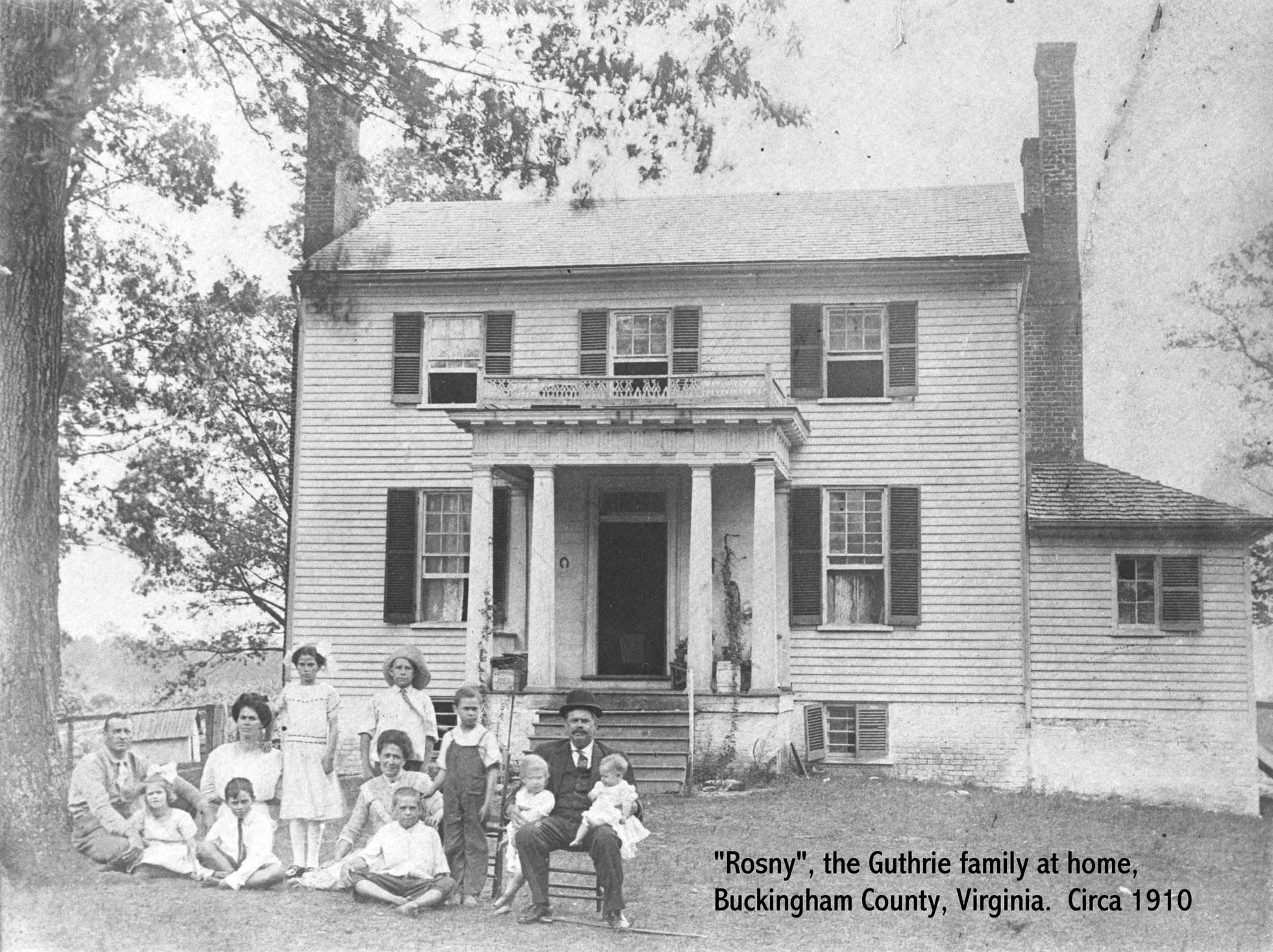
Courtesy Forrest Guthrie Family and Mary Carolyn Mitton.
Need to catch up? Click here: Buckingham Houses: Rosny, 1959, Part I
In 1959, Charlottesville’s Daily Progress published “Historic ‘Rosny’ Built as Result of Family Spat” written by Mrs. R. J. Wojnicki, who concluded her article with more recent history of this impressive dwelling house:
During a severe windstorm in 1948, “Rosny” was struck by a falling oak, and one of the upstairs rooms was badly damaged. Within the walls of this room were found papers and letters from Gen. Lafayette, dated in the early 1700s (sic). At the same time copies were found of editions of the Virginia Gazette, dated 1804, and one of the Virginia Argus of 1806. These historical papers are now in the possession of the owner, Mrs. John W. Stone.1
How do papers like these get buried in walls?
In 1959, Rosny was the residence of Mr. and Mrs. E. L. Maki. Mrs. Maki was Mary Eliza Guthrie, sister of the owner, Zanie (Guthrie) Stone. At that time, Forrest Guthrie III operated a dairy on the property, owned jointly with Mrs. Charles W. Stone. Mr. and Mrs. Forest Guthrie III and their family resided in another house on the Rosney estate.
Forest Guthrie III died in 2011. According to his obituary, he was born on May 19, 1924 and served during World War II as an officer in the US Army Air Corps, piloting sixty rescue flights over the Himalayans and ferrying supplies into war-torn China. He operated the dairy farm at Rosny for twenty years, later working in banking and real estate. A recovering alcoholic, Guthre taught farming technics and led AA meetings at the nearby prison. Click here to read his obituary at Legacy.com: Forrest Guthrie III.
1This should read 1800s. The Marquis de Lafayette lived 1757-1834.
For more about the Guthrie Family:

Mrs. E. L. Maki, 1959, then owner of Rosny.
Photo by Wojnicki. Courtesy Daily Progress.
Need to catch up? Click here: Buckingham Houses: Rosny, 1959, Part I
In 1959, Charlottesville’s Daily Progress published the article “Historic ‘Rosny’ Built as Result of Family Spat,” written by Mrs. R. J. Wojnicki, who opened by describing Rosny’s interior appointments. She went on to detail the history of the house, explaining that it was built because Powhatan Bolling (1767 – 1802) and his mother didn’t get along very well. Powhatan, supposedly exasperated with traveling ministers who spent the night at the Bolling plantation, Chellow, wanted to live further from the well-traveled road. As a result a separate house was constructed for Powhatan called Whispering Grove (later Rosny).
According to Mrs. Wojnicki, in Powhatan Bolling’s time, Whispering Grove was located on Hwy 60 about 2 miles southeast of its present site. In 1959, she observed the Roman numerals carved into the beams and rafters of the house which facilitated reassembling the house after it was moved.
Following the death of Powhatan Bolling, Col. Robert Thurston Hubard became the owner of Whispering Grove. Hubard attended school in France and was a great admirer of the Lord of Rosny, mentioned in Thomas Babington Macauley’s poem “Ivry, a song of the Huguenots.” As a result, sometime after 1802, Whispering Grove became Rosny.
Mrs. Wojnicki’s article also contains a list of subsequent residents. In 1873, Philip Hubard owned the property and, in 1890, it was bought by the Iron and Lumber Company of Westminster, followed by C. B. Harris (1915), who immediately sold it to Forrest Guthrie, Sr. In 1935, Zanie (Guthrie) Stone of Remington, Virginia purchased it.
Coming Next: Buckingham Houses: Rosny, 1959, Part III
For more about Powhatan Bolling, see:

Slate River Press
Need a gift idea this holiday season? Give the gift of local history!
All Slate River Press titles are available online, at Braughler Books. The Jefferson Brothers and “At a Place Called Buckingham,” Volume Two have a special holiday price.
My newest book about Buckingham County, Peter Jefferson’s Snowdon: A History of Settlement at the Horseshoe Bend, is available at Amazon.
Here’s where you can purchase my books (and many others) about Virginia history.
Note: This holiday season hours may be limited or locations closed. Contact the shop for hours and to confirm available titles.
In Virginia
Amherst: Baine’s Books & Coffee (190 2nd Street)
Appomattox: Baine’s Books and Coffee (205 Main Street)
Buckingham: Adams Museum (13016 W. James Anderson Hwy)
Buckingham: Housewright Museum (U.S. Route 60, in the village of Buckingham)
Monticello: Monticello’s Gift Shop
Richmond: The Library of Virginia: The Virginia Shop (800 East Broad Street)
Scottsville: Baine’s Books and Coffee (485 Valley Street)
Shop online
Read a preview of The Jefferson Brothers at Braughler Books: The Jefferson Brothers: Chapter One
Historic Buckingham Inc.
To order books from Historic Buckingham contact: 434-969-3292 or Margaret Thomas at mwthomas1949@outlook.com.
Library of Virginia: The Virginia Shop
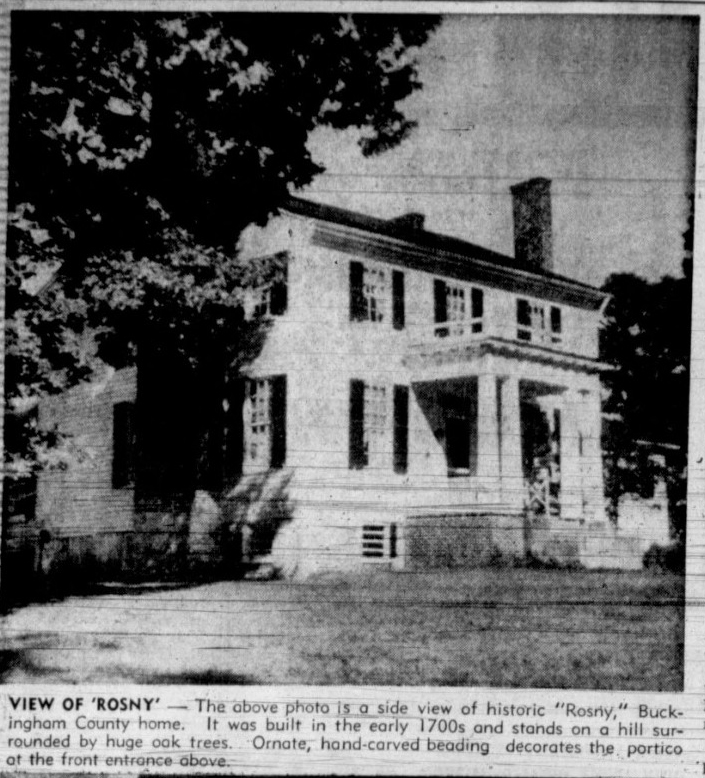
Rosny, 1959. Photo by Wojnicki. Courtesy Daily Progress.
In 1959, Charlottesville’s Daily Progress published the article “Historic ‘Rosny’ Built as Result of Family Spat” written by Mrs. R. J. Wojnicki, who begins by describing the “lovely home” which sits on a hill overlooking Rosny Road in Buckingham County. The house was surrounded by four acres of lawn and stood among huge oak trees. Cattle and sheep grazed on the property. To one side is Rosny Creek and Whispering Creek runs below the lawn.
Mrs. Wojnicki wrote:
The house is mainly in its original state. Nothing had been added to the structure since 1835. “Rosny” was constructed of the very best materials — hand hewn logs and pegs with shop-made nails.
The four-story, framed dwelling house has walls 12 inches thick and a basement of brick which reaches several feet above the level of the ground. The home contains 13 large rooms, three of which are in the basement.
There are eight fireplaces with mantels of classic design. Some of them are trimmed in a distinctive notched pattern. Around the top of the portico at the front entrance is an ornate hand–carved beading. The doors are very wide with six or eight panels. The doors are fastened with large English locks, all in their original state. In most of the rooms there are chair rails, all hand–carved.
Unusual features on the first floor include a wide hall reaching through the main part of the house. This hall, about 12 feet in width, leads from the front entrance above which are panes of glass. Approximately 20 feet inward (beyond which the hall continues) there is a huge archway carved from heavy walnut 10 inches in width. This archway reaches upward about 11 feet. Hanging from a series of brass chains is an antique lamp of hand-painted glass ornamented with brass fittings.
Beyond the archway the hall continues on to the left, and at the end of it is a wide, winding stairway of walnut. Heavy dark wood paneling is beneath the stairs. Between the stairway and the paneling is a graceful curve design. What was at one time a room 15 feet wide and 36 feet long is now divided into two rooms of equal size, but the wooden arch from the walls to ceiling is still intact showing the original plan of what is said to have been a ballroom.
To learn more about Rosny click on the following link:
Coming next, Buckingham Houses: Rosny, 1959, Part II

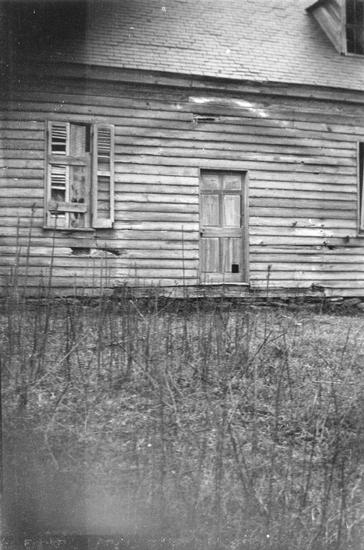
Courtesy Library of Virginia. Photos by Rosa G. Williams.
While searching for information about Dunn’s Chapel at the Library of Virginia, I found a Virginia Historical Survey entitled, “Parsonage (Methodist Church)” written by Rosa G Williams on April 27, 1937. The parsonage is not identified by name in the title, however, it was the parsonage for Brown’s Chapel situated near the Buckingham Female Collegiate Institute.
Mrs. Williams located the dilapidated building .3 miles south of Gravel Hill, Virginia, on Route #668; thence west ¼ mile on private road to the house.
She concluded that the structure was built about 1785, first occupied by Mr. Brown, followed by Garland Price (1835), established as a parsonage (1865), J. A. Chandler (1898), and James Lee Meadow (1910).
Her description reads as follows:
The old parsonage stands on a very high hill, overlooking the deserted village of Gravel Hill. It also overlooks the site of where the Old Buckingham Collegiate Institute once stood. No one has lived in this house for 27 years, but it has the appearance of having been a very attractive well-built home. It is now used as a storage house. This home is constructed of heart pine timbers, put together with wooden pegs and shop made nails. The rooms are in a bad condition; the plastering has fallen down, the roof leaks and the chimneys are falling due to severe wind storms. The porch has been removed or it has fallen down, since there are signs of one having been there.
The yard during the spring is very pretty, has many of the old-fashioned flowers, namely, buttercups, flag lilies, lilac bushes and many others may still be seen. No one [has] taken care of the yard; the rain washes all the rubbish downhill, causing the yard to be clean and the grass beautiful.
Mrs. Williams also noted, “This old place housed the first ministers that served this county after the discontinuation of the worship services at the Chapel of the Old Institute.”
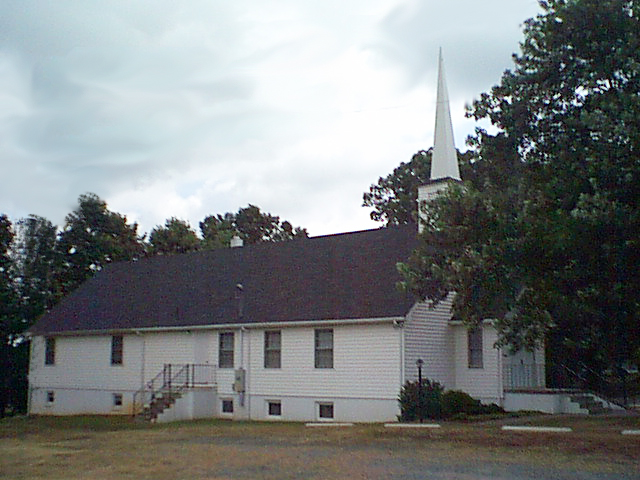
Brown’s Chapel, 2010. Photo by Joanne Yeck.
For much more about Buckingham Female Collegiate Institute, please search the archives at Slate River Ramblings and consult “A Noble Idea: Buckingham Female Collegiate Institute,” in my book, “At a Place Called Buckingham.”


 slate river ramblings . . . .