

Headstone Application for U. S. Military Veterans
Elisha Z. Robertson was a neighbor of my Woodson family on Muddy Creek, in the Slate River District of Buckingham County. He served as a private in D-56 Company, in the Virginia Infantry, during the War Between the States. Note that Robertson died in in 1910, however, because the application for his headstone was made in 1934, it is included in the searchable database available at ancestry.com.
Click here for more information: U.S., Headstone Applications for Military Veterans, 1925-1963
Many thanks to Jeremy Winfrey for this unusual document.
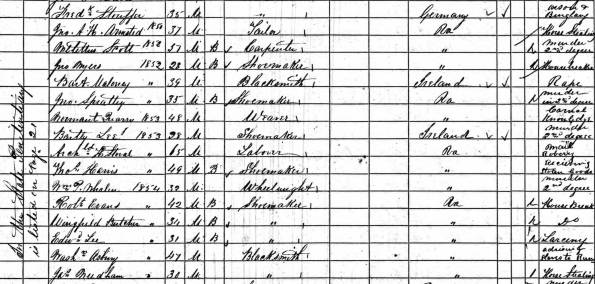
1860 Federal Census. State Penitentiary. Miletus Scott, carpenter. Click to enlarge.
In 1869, Richmond’s State Journal printed an unusual story about a Buckingham County resident named Miletus Scott:
A PRISON STORY. – Some time in September, 1852, seventeen years ago, Miletus Scott, a free man of color, was convicted before the county court of Buckingham county of murder in the second degree, and sentenced to 18 years in the Penitentiary. Thirteen of these years he served within the walls of the prison. On the morning of the memorable 3rd of April, 1865, while the fire was at its height, and one army left the city as another entered it, the inmates of the Penitentiary created a blaze of their own, and by its light liberated themselves. Amongst those who went forth was Miletus, who made his way to his old home in Buckingham. There for four years, he worked and supported himself. A few months ago, however, somebody related to Sheriff Davis, of that county, the tale of his conviction and escape. Acting on his sense of duty, the sheriff levied on Scott, and by the aid of a canal boat landed him in the city [Richmond]. The court house and clerk’s office of Buckingham County having been destroyed by fire during the war, the sheriff was unable to bring with the prisoner any documentary evidence of the conviction. Arriving here, he carried Scott to the State’s prison, but a search for the record of his entry into the prison disclose the fact that it had been burned up. The prison officials thereupon refused to receipt for him, and the sheriff informed Scott that he had no further claims upon him, whereupon he proceeded to make himself scarce. The sheriff has now pending before the Auditor of Public Accounts an unliquidated bill for expenses incurred in arresting Scott and bringing him hither. – –
Note: Buckingham County’s courthouse survived the war and was burned in early 1869. If Scott had been back in the county about four years, he must have been apprehended shortly after the courthouse burned.

Holy Cross Catholic Church, Lynchburg, Virginia.
Courtesy HABS, Library of Congress.
When James M. Logan of Algoma in Buckingham County married Miss Mary E. McDonald in Lynchburg, Virginia, the announcement was reproduced in the Richmond Times-Dispatch on May 3, 1915.
Logan—McDonald.
[Special to The Times-Dispatch.]
LYNCHBURG, VA., May 2. – James M. Logan, manager of the famous “Algoma farm,” in Buckingham County, and Miss Mary E. McDonald, were married yesterday, the ceremony being performed at the rectory of Holy Cross Catholic Church by the pastor, Rev. Edward M. Tearney. The witnesses to the ceremony were R. Colston Blackford and Colonel James A. Scott. The bride was formerly a resident of Chesterfield County, but for some time has been living in North Carolina. The groom is a son of General T. M. Logan, and has been living in Buckingham County for some time. After a brief stay here, Mr. and Mrs. Logan will go to Buckingham to reside.
To learn more about life at the “Famous Algoma,” type Algoma in the search box at Slate River Ramblings and enjoy the results!

Algoma. Courtesy Historic Buckingham.
In 1932, Lily Logan Morrill remembered her mother and life at Buckingham County’s Algoma in My Confederate Girlhood, The Memoirs of Kate Virginia Cox Logan:
… [H]ers was a life of work in the highest sense – work always for the happiness of those about her, for life meant to her one round of unselfish service. She was always packing baskets for the poor and sick. Her very worst cold was caught by giving all her warm clothes at once to an old colored woman whose house had been burned down. In the country in those days, that meant waiting several days for a new supply. She never let anybody leave our home, Algoma, hungry for either sympathy or food. No matter how much the cook might grumble, no matter what hour it was of the day or night, visitors of every class had to break their fast. How did she always remember?
And then there were the numberless cousins and friends to stay week after week, a lonely young Englishman – the proverbial younger son, who long afterwards gave his life nobly in the World War – came for a night and remained for three years.
Nor did mother ever forget to consider even the animals in her service. I remember her childish petulance when she made us curtail our trips because our horses might possibly be fatigued.
At Algoma, not only hospitality but everything else was freely dispensed. Watermelons grew easily in our low grounds, but refused to live on the higher rich lands behind our woods. Therefore, mother never considered it fair to sell melons, but divided her surplus among less fortunate neighbors. During August a daily procession came driving, riding or walking up to claim the dearest of dainties to a darkey’s pallet, while the white neighbors from the back country were never far behind.
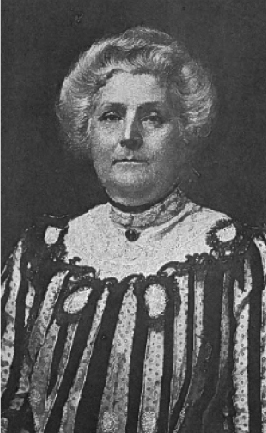
Kate Virginia (Cox) Logan
In the 1890s, Kate Virginia (Cox) Logan, wife of General Thomas M. Logan of Algoma in Buckingham County, wrote her memories of her youth, shaped by the American Civil War. In 1932, they were published as My Confederate Girlhood, The Memoirs of Kate Virginia Cox Logan. Her daughter, Lily Logan Morrill, added an epilogue, describing life at Algoma.
According to the review in the Richmond Times-Dispatch, the “little volume” (published by Garrett & Massie, Inc.), glorified Kate’s cousins, aunts, and uncles, accompanied by a few choice images. The review notes:
Even in 1890, when the war days were thirty years behind her, she could recall them so clearly that her book is like a glimpse into the mind of a Southern girl of the sixties. She has written, delightfully, of prewar gaieties, of the leisure and life at “Clover Hill,” of the stirring days when ladies spent their time in nursing wounded soldiers back to strength and health. The many Virginia people who knew her on General Logan will value her book for the very real glimpse it gives of herself.*
Charles W. Smith has done a striking and lovely jacket for this little picture of the Old South.
*Clover Hill was located in Chesterfield County, Virginia.
Click here for more about General Logan.
Coming Next: Lily Logan Remembers Her Mother

Chellow. Photo Courtesy Virginia Department of Historic Resources
In 1936, Rosa G. Williams surveyed Chellow for the Virginia Historical Inventory. At the time, the house stood empty. The caretaker was a son of a former slave owned by the Hubbard family. Mrs. Williams wrote:
Chellow Plantation is part of a grant of 6,740 acres, originally in Albemarle County, now Buckingham County, Virginia. Patented to Colonel John Bolling, July 20, 1748. Chellow was named for an old English Estate of the Bollings.
The home is a very imposing example of colonial architecture, consisting of ten rooms. You must enter the front by way of a “T” shape hall, to the right as you enter is a large bed room, to the left is a large library or living room, to the center of this hallway is a door leading to a lovely dining room, with French windows, lovely old doors with locks on them that were imported from England with brass keys. A side hall leads to the rear of this house. A lovely wide winding stairway leads to a large upstair hall. In this hall is a built in bookcase with many valuable books. In the center of this hall are double doors leading to an upper porch with French windows on either side of the door. The porch runs about three-fourths of the length of the house.…
The “old kitchen” still stands, but has been restored, it stands in the east corner of the yard. There was once a covered walk way leading from the kitchen to the main house, to protect the food from the weather. The yard is a thing of beauty, it contains two acres and is kept in perfect condition. Many of the old trees still stand, among them is a large oak, twenty odd feet in circumference, the sole survivor of the original trees that shaded the spacious lawn.
Aunt Mary Bolling’s garden at Chellow was known through the country as one of the most beautiful of its day, there are still signs of it, some of the old roses still bloom there.
The beautiful situation, the secluded location, the old house spring from which an abundance of crystal water flows, the tall trees, the extensive view, the gorgeous sunset beyond the mountain, the very atmosphere of the place, its history and its traditions, all combine to make Chellow a delightful and restful abode in these days of hurry, worry and painful uncertainty.
~
On Sunday, 23 April 2017, Historic Buckingham will hold its Spring Membership Meeting at Chellow, which remains a “restful abode in these days of hurry, worry and painful uncertainty.”
If you are in Buckingham County or environs, don’t miss the opportunity to visit the magnificent Chellow and support Historic Buckingham!
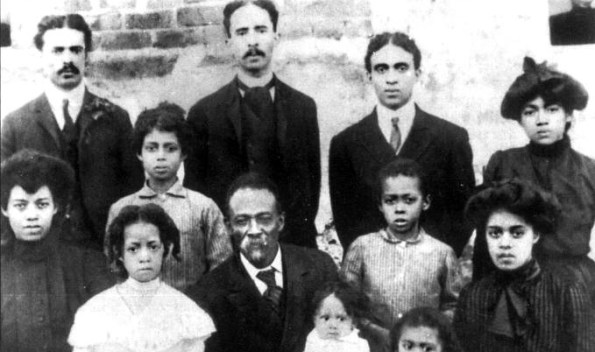
The Lomax Family, Courtesy Renée Ingram and Charles W. White Sr.
In the autumn of 1904, Buckingham County correspondent “Quoit” sent the following news to the Appomattox and Buckingham Times:
Published October 19th:
I have heretofore omitted, unintentionally, to mention the severe illness of Josephine Lomax, the teacher for many years of, the colored school at this place [Buckingham Court House]. She is extremely ill, and has the sympathy of the entire community. She is a colored woman who has the respect of the community. Her life is almost despaired of.
Quoit
Published October 26th:
We record with sincere sadness the death of the colored woman, Mrs. Josephine Lomax, of whom I wrote in the last issue of your paper. Yielding to the irrepressible attack of that terrible enemy of human life, consumption, she departed this life on Wednesday, October 19, and was buried on Friday, October 21, by the side of her mother, well known in this community, as “Aunt Lizzie Jones.” Quite a large crowd attended her burial. Having been a public school teacher in this county for a number of years, she was well known, and she was well thought of, both as a teacher and as a woman of exceptionally good reputation. She leaves a husband and twelve children.
Click here for the obituary for Josephine’s husband, Edmund S. Lomax.
Click for more about “Colored Schools” in Buckingham County.

Happy Birthday, Thomas Jefferson.
Born 13 April 1743. Shadwell, Albemarle, Virginia.
When I began work on a book about Randolph Jefferson and his Buckingham County plantation, Snowden, it was inevitable that Thomas Jefferson would play a big role in the story. And, he did!
The Jefferson Brothers provides an unusual, in depth, look at President Jefferson as a big brother, enough older than his only brother to assume (in a limited way) the role of surrogate father.
What to learn more about Thomas Jefferson, family man? Visit the Thomas Jefferson Encyclopedia. There you will find seventy-eight results for “Personal Life.”
The Jefferson Brothers is available online at Braughler Books.
#NationalThomasJeffersonDay

Rev. William H. Taylor. Courtesy George Cauble.
Sometimes, lost marriage records for Buckingham County can be found in the Richmond newspapers. This one, published in the Richmond Enquirer on April 15, 1845, took place at Mount Pleasant, shortly following the death of Mrs. Judith Patteson but prior to the death of Major David Patteson.
On Thursday, April 3rd, at Mount Pleasant, the residence of Mr. Henry Miles, by Rev. William Taylor, Mr. Felix Gibson, to Miss Mary F., second daughter of Mr. Henry Miles, all of Buckingham County.
Click here for much more about Rev. William H. Taylor.
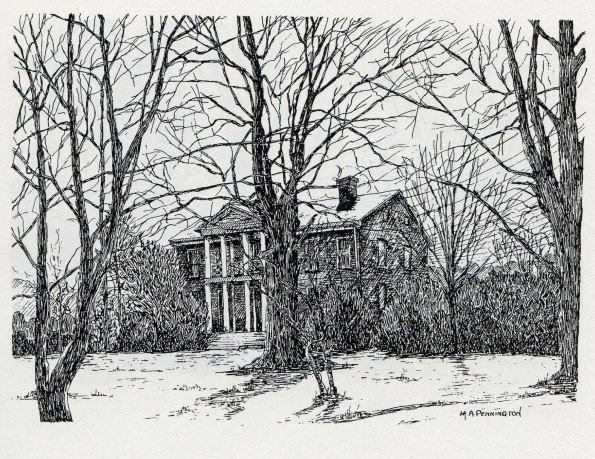
Mount Pleasant. Courtesy Historic Buckingham.
Mrs. David Patteson of Mount Pleasant, Buckingham County, proceeded her husband, dying in late 1844. An unusually lengthy obituary, particularly for a woman, ran in the December 17, 1844 issue of Richmond’s Whig & Public Advertiser.
Another has gone to her rest!
On Tuesday, 26th November, Mrs. JUDITH PATTESON, (consort of Maj. David Patteson, of Buckingham,) in the 84th year of her age, changed her state of mortality for one, we are assured, of immortal glory. Her deep-toned piety, her constant humility, her almost unequaled meekness, her long-tried patience, her becoming fortitude under the heavy bereavements which she had frequently to sustain, her love of virtue in others, her antipathy to all immorality, and her strong attachment to the Word of God, have made a deep and lasting impression upon the memory of her family and all who knew her, that their irreparable loss is her eternal gain! Her last illness, though severe, was short: her decision upon her own case was, perhaps, as correct as that of her attending physician: When she was taken sick, she told the family that “her time had come, and the Lord had sent for her, and she was willing to go.” The grim monster, Death, threw open his icy arms to receive his victim, but could produce no terror in the bosom of one who had put her house in order, and had patiently waited for many years for the coming of her Lord! It was her inestimable privilege to occupy the condition of St. Paul when he exclaimed, in the state of holy enthusiasm, “Oh, death! where is thy sting? oh, grave! where is thy glory? Thanks be to God which giveth us the victory through our Lord Jesus Christ!” The antagonist of vitality may triumph for the short time over the victory which he has won – the insatiable grave may have swallowed this victim – and her insatiable appetite may still cry “more, more!” Why should there be this shout of victory among the tombs? When the immortal spirit has gone to its home in the skies, there to remain in a separate state only till the morning of the Resurrection, and then it will return and be reunited to the body, and in that state of reunion enjoy the bliss of Heaven forever.
The subject of this obituary lived 67 years with her husband in the marriage union: during all that time she sustained, emphatically speaking, all the characteristics of a wife: To her husband she was entirely submissive – his will was always her pleasure; – she was obedient, attentive, kind and affectionate; nor did these traits of her character depreciate, with her physical powers, under the influence of age, but shown brilliantly to the last moments of her existence. In the death of Mrs. Patteson a great loss has been sustained: her aged husband (to whom the present generation are indebted, in part for their patriotic government and liberties as a nation) has lost the best of wives; her neighbors have lost the kindest of neighbors; the traveler will never forget the hospitality which he has so bountifully shared within her open doors, nor will the poor man’s wife and the needy orphan ever forget the supplies which they have so frequently received from her charitable hands; the servant has lost a mistress whose humility has always extended to them the best of treatment; – in conclusion, we have lost a friend whose example, if followed, will lead us to the Cross of Christ, and to the rest that remains for the people of God. After living at peace with all men, till she had received in her withered arms several of her fourth generation, this devoted Christian has fallen asleep in Christ, with the hope of seeing the face of God and righteousness, and of waking in his likeness.
T. N. J.
P.S. The Enquirer will please copy.
~
It is my belief that the author of this glowing obituary is Rev. Thomas Nicholas Johnson. Click here for more about him:
Buckingham Notables: Rev. Thomas Nicholas Johnson, Part I
Buckingham Notables: Rev. Thomas Nicholas Johnson, Part II
Buckingham Schools: Rev. Thomas N. Johnson
Click here for more about Major David Patteson.


 slate river ramblings . . . .