

Following the obituary of Major David Patteson, which was printed in the Richmond Whig & Public Advertiser on October 30, 1846, the newspaper ran a poem written by one of Patteson’s grandsons who signed with his initials, P. R. P.
Lines
To the Memory of my Grandfather.
Where art thou gone, my aged sire?
Thy home to me is lonely now!
Thy spirit tunes the Heavenly lyre,
While thoughts of sorrow dim my brow.
When first thou trod life’s early ways,
Hope winged life’s fleeting span,
‘Till you have numbered years and days
Allotted not to man.
Three score and ten upon this earth
But very few can date;
Yet onward, onward from thy birth
Hath made thee eighty-eight.
And now thy course on earth is run,
And death has brought by setting sun,
Yet may thy rising morning see
Thy soul in blest eternity.
And while we view thy moldering heap,
Thy children, scarce and few,
Can see where brothers, sisters, sleep,
While shedding tears for you.
My aged sire! fare thee well –
My father’s gone before thee;
And now from earth thou hence shall dwell,
Though fatherless I be!
And may thy good examples guide
Me through the path thou trod;
And when my works by death are tried,
May that will prove them, O my God!
It pains my soul to say farewell!
Yet trembling I address thee –
Such struggling thoughts my bosom swell,
That words I scarce can find to bless thee.
P. R. P.
Click here for Major David Patteson’s obituary: Buckingham Notables: David Patteson
Coming Next: Mrs. David Patteson

In the early 19th century, Mount Pleasant in Buckingham County was the home of Major David Patterson and family. According to Rosa Garnett Williams’ survey for the Virginia Historical Inventory, the brick house was built in 1758. Major. Patterson died, at his residence, in his 89th year, and was buried in the cemetery at Mount Pleasant: Major David Patteson (15 August 1758–22 October 1846).
His obituary in the Richmond Whig & Public Advertiser was exceptionally long, saluting one of the last of his generation:
OBITUARY.
Another Patriot and Soldier of the Revolution is gone! While but few remain to drop a tear of sympathy for the departed, or to bear the tidings of our Revolutionary struggles to later and succeeding generations.
Died, at his residence, Mount Pleasant, in the county of Buckingham, on 22d October, 1846, at 12 o’clock, Major DAVID PATTESON, in the 89th year of his age. And to mourn their great and irreparable loss, he left only an aged brother and an extensive line of family descent to the fourth generation. In all the relations which man sustains to his fellow beings through life, he has been one who had but few equals, perhaps no superiors. As a husband, he was constant, kind, affable and indulgent. As a father, he was strict, persuasive, affectionate and instructive. As a brother, he cherished those fond of affections which grew close around the heart, and are ever nourished by its warmest current. As a son, he was reared in that golden age which knew no other than honor and obedience to parental injunctions. As a neighbor, his door was ever unlocked, his purse strings untied, to administer with a lavish hand and an open heart to the alleviation of the suffering and destitute widow and the orphaned babe. And as a kind and provident master, he was ever vigilant in those things which made the comfort of those under his control; while at the same time he strove to keep them within the pale of that discipline which was their good, his comfort, and the public safety. In the early years of his age, he was called to the defense of his country against the hostile invasions of a foreign foe. Into that service he carried with him a heart burning with consummate love and patriotic zeal for the welfare of his country – with an arm nerved for the conflict of battle – with a spirit and courage as illimitable as that cause of freedom was just; and it was in that cause that he had enlisted to stem the iron storms of battle, and to roll back its devastating tide ragged and broken to its native atmosphere – and in this service he continued until his most earnest wishes and sanguine expectations were made delightful realities, when called to witness the surrender of Lord Cornwallis at York Town. The subject of this obituary was the member of the Court of his county from early life to the period of his death. He was called by his countrymen to serve them in the Legislature of his native State, which he did for several years, with the firmness and fidelity worthy of his charge. He was also acting Sheriff of his county for a number of years; in all relations to his county and his fellowmen, he acted as became a true, faithful, brave and honest man, – thereby fully satisfying every demand and duty of his earthly station: and now that his fleshy tabernacle has been consigned to the cold gloom of the grave, his immortal and deathless spirit has flown, as on angels’ wings, and has soared aloft to meet the Heaven-born spirit of his faithful, constant, and earthly companion – who but a short time since was called to give an account of her stewardship – and with that spirit of hers, united by angels and the spirits of just men made perfect, to shout the triumphs of redeeming love around the throne of a Just, Holy, and Eternal God. The writer of this tribute of respect for the memory of the deceased, is one who has known him long, has known him well, and known him intimately.
Click here for more about Mount Pleasant.
Coming next: “An Ode to David Patteson”

In the early summer of 1845, John Bland offered his Buckingham County tavern for sale in the Richmond Enquirer:
TAVERN AT BUCKINGHAM COURT HOUSE FOR SALE.
IN MY own right, as agent for John Bland, I shall on August 11, 1845, offer for sale, at public auction, on a credit of one, two and three years, the Tavern, Stables, &c., at Buckingham Court House, heretofore in the possession of E. L. Scruggs; the purchaser giving bonds with approved security; and a deed of trust on the property. Possession will be given immediately after the sale. If a sale cannot be made, it will be rented out from that time until the 1stday of January, 1847. At the same time will be sold fifty acres of forest land, about five miles from the Court House, on the New Canton Road.
Wm. G. OVERTON.
Does a Slate River Ramblings reader know who else owned this tavern or who the purchaser was c. 1845. If so, please comment.
Speaking of Taverns, if you are interesting in Prohibition in Virginia, visit the new exhibit at the Library of Virginia: “Teetotalers and Moonshiners: Virginia’s Prohibition Experiment” — opening April 3, 2017.
In 1840, when Mr. Rives was fêted at Buckingham Courthouse after a long absence, Buckingham County’s Whigs were enthralled. The letter to the Richmond Whig continued:

William Cabell Rives. Courtesy Small Special Collections, University of Virginia.
Mr. Rives proceeded, after dinner, in the most masterly and splendid effort of his life. He triumphantly vindicated himself from the imputations of treason and apostasy. He arraigned the Administration at the bar of the country, reviewed its policy, and, with a mighty and unsparing hand, unveiled its corruptions. It was the spear of Ithuriel disclosing the naked deformity of a fiend. He then reviewed the military and civic character of General Harrison (Martin Van Buren’s opposition), and hurled back, with indignant eloquence, the foul slanders and false charges which the minions of power had heaped upon his head. He fortified his position from the records of his country’s history – the testimony of Shelby and Perry, of Richard M. Johnson and Thomas Ritchie. It would be idle to attempt to give an outline of this admirable speech, the delivery of which enchained the unfaltering attention of nearly one thousand people for the space of five hours. After Mr. Rives had concluded, amid thunders of applause, Colo. Edmund W. Hubard, (the Democrat candidate for Congress against Mr. Hill,) who was an attentive listener, and stood close by, as if with the design to reply, arose for that purpose. . . .
If a five-hour speech was not enough, the correspondent from Buckingham County went on and on, praising the day’s worthy host, N. H. Thorton. Many toasts were drunk by Col. Thomas M. Bondurant presiding, assisted by Col. Reuben B. Patteson, George H. Matthews, Esq. and Col. Thomas H. Flood, who were the Vice Presidents of the Committee.
After rapturous applause with which one toast was received, Mr. Rives rose and offer the following sentiment:
The People of Buckingham: Republican by nature, Republican by tradition – They will prove their continuing Republicanism by voting, in November next, for the Republican candidate for presidency, William H. Harrison.
For more about Edmund W. Hubard, a frequent subject at Slate River Ramblings click here:
Buckingham Notables: Edmund Wilcox Hubard.
For part one of this letter, click here: Festival at Buckingham Court House: Part I
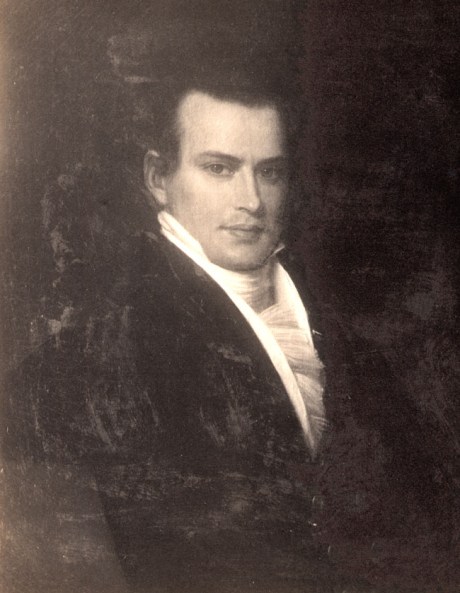
William Cabell Rives. Courtesy Small Special Collections, University of Virginia.
On July 11, 1840, Richmond’s The Whig printed special correspondence from Buckingham County describing a festival held in honor of Mr. Rives. It is a reminder of the fact that Administrations in Washington, D.C. can be “mentally agitating.” Nothing is new.
FOR THE WHIG.
FESTIVAL AT BUCKINGHAM COURT HOUSE,
IN HONOR OF MR. RIVES.
Pursuant an invitation tendered to Mr. Rives by the opponents of the present administration in this country (Martin Van Buren), to accept of a Public Dinner, and address them on those great political questions which are now agitating the minds of the whole People, that distinguished gentleman arrived here on the evening of the 12th instant. He was immediately waited upon by the Committee, and many others, who are desirous of an introduction. The 13th being Court day was the day appointed for the festival. Upwards of twenty years had elapsed since he had been permitted to mingle with his fellow citizens in this County, and great eagerness was manifested by all parties to see and hear one whose name was so widely extended, and whose political independence has rendered him the object of such unsparing and malignant persecution.
The Court House being thought insufficient to hold the assemblage who were expected to be present on the occasion, a spacious awning was erected in the public square. At an early hour in the morning, crowds of people from all parts of the county, and numbers from distant and adjoining counties, began to pour into the village and by 11 o’clock, the concourse was swelled to one thousand or fifteen hundred anxious and excited expectants. The signs of the morning promised an unfavorable day – the sky being covered with clouds, and the air being oppressive and sultry. At the hour of eleven, Mr. Reeves was accompanied to the stand by the Committee, and commenced his remarks in a beautiful and feeling manner, to an attentive and breathless audience. He had not spoken long, before a violent storm rendered farther (sic) speaking under the awning impracticable, and the crowd rushed into the Court House to hear the conclusion of his address. It was quite insufficient, however, to contain the audience, and when the rain had ceased, the people were again invited to the awning. After having spoken on for some time, the ringing of the bells announced that dinner was ready – and a proposition was made and acceded to for postponing further discussion until the dinner was over. Notwithstanding these embarrassing and successive interruptions, so well calculated to confuse the mind and damp the ardor of the speaker, Mr. Reeves seem to redouble his exertions, and rise higher and higher at each succeeding struggle of his genius. All sympathized with the situation of the speaker, but all admired the increasing energy with which he met and conquered all these obstacles – which, to say the truth, were by far the most serious he met with during the day.
Correction: When I first posted this story from The Whig, I mistakenly thought the Mr. Rives was Judge Alexander Rives. However, Mr. William Cabell Rives was the honored guest.
Coming Next: Festival at Buckingham Court House: Part II

Library of Virginia. Photo by Joanne L. Yeck. Slate Floor by Buckingham County.
If you are in the Richmond area on March 30th, I encourage you to attend this year’s celebration of Virginia Women in History. Buckingham County’s own Louise Harrison McCraw (1893–1975) will be one of the honorees.
The author of a dozen inspirational novels and co-founder of Richmond’s Braille Circulating Library, Louise’s work touched thousands, inspiring the blind and the sighted alike.
You can read more about Louise and her work in this month’s Buckingham Beacon. If you aren’t able to pick up a copy, you can download a PDF at Fluvanna Review.
The award ceremony and reception will take place on Thursday evening, March 30th, at the Library of Virginia, 800 East Broad Street, Richmond. There is no charge for the event. Visit the Library’s website for detailed information: Virginia Women in History.
For more about Louise Harrison McCraw at Slate River Ramblings:
Buckingham Notables: Louise Harrison McCraw (includes a list of her novels)
You can also learn much more about Louise Harrison McCraw and her “Life of Service” in my book, “At a Place Called Buckingham,” Volume Two (Slate River Press, 2015).
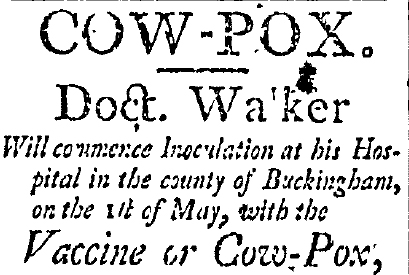
In 1801, a Dr. Walker of Buckingham County advertised in the Virginia Argus alerting the citizens of Buckingham County that he was ready to inoculate with cow-pox:
COW-POX.
Doct. Walker
Will commence inoculation at his Hospital in the county of Buckingham, on the 1st May, with the
Vaccine or Cow-Pox,
a disease that is so very slight, that it has caused many to doubt whether it is an antidote to the small-pox or not – the testimony from Europe in its favor has caused it to be adopted in many parts of America, and where its power has been put to the test by experiments, it has been found sufficient to prevent the body from smallpox, but to remove all doubt, sufficient trials will be made at the hospital before 1st May, for the purpose of giving– demonstration to the skeptical.
April 9, 1801.
It is quite probable that this Dr. Walker is the same physician who treated Randolph Jefferson at Snowden when he suffered from kidney stones. On August 18, 1801, Randolph Jefferson’s daughter, Nancy, was among the family members inoculated against small pox at Monticello. That day, her little cousins, Ellen and Cornelia Randolph were also treated. Former Snowden slaves, Ben and Cary, were inoculated as well, along with several members of the Hemings family.
For more about Randolph Jefferson, his family, and the lives of his slaves: The Jefferson Brothers.
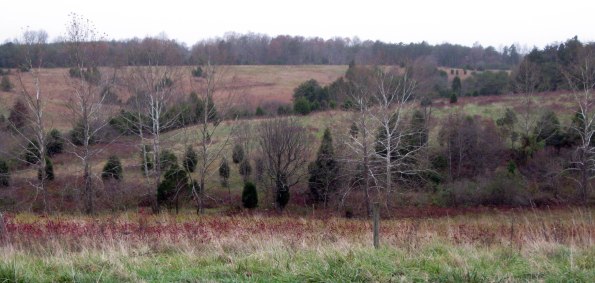
Lands of John M. Harris. Photo by Joanne L. Yeck
Many nuggets of Buckingham County gold can be unearthed if you dig deep enough.
After the courthouse burned in 1869, many wills and deeds were re-recorded, including a deed originally made in 1856 by my ancestor, Col. John M. Harris, in the new Deed Book #1.
THIS DEED made and entered into this 13th day of November in the year eighteen hundred and fifty-six between Jno M. Harris and Harriet C. his wife of the county of Buckingham of the one part and Henry St. Geo. Harris of the County of Albemarle of the other part, all of the state of Virginia, Witness: that for and in consideration of the sum of sixteen thousand dollars, payable as follows . . . do grant unto that said Harris, all their rights, title, interest and claim, in and to a certain tract of land in the county, adjoining the lands of Ro. Bolling, his old place, Skyler Thomas, Geo. A. Scruggs, Est., E. G. Jefferson, James Harris and Dr. L. Bolling, containing nine hundred acres. . . .
For me, this deed re-recorded on September 13, 1869, is priceless Buckingham gold.
If you are looking for information about Buckingham County families prior to the courthouse fire in 1869, be sure to look for re-recorded deeds and wills in Deed Book 1, available on microfilm at The Library of Virginia.
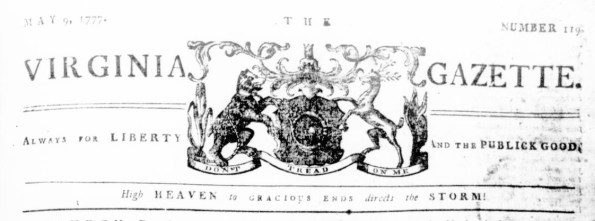
In May 1771, a “Great Fresh” swept through Virginia. The flooding throughout the colony was devastating; however, the damage was highly selective. On June 6, 1771, the Virginia Gazette reported:
. . . From the Mountains, to the Falls, the low Grounds have been swept of almost every Thing valuable; and the Soil is so much injured that it is thought not to be of Half its former Value, and a great Part is entirely ruined. . . . Appomattox has been little or Nothing affected, which proves that the Rains must have fallen high up the Country. . . . The Devastation on Roanoke is, if possible, still greater; in the Ruin of valuable Lands, Lots of Negroes, Stocks, Houses, &c.
The farms located at Buckingham County’s Horseshoe Bend, including Randolph Jefferson’s Snowden, did not escape the devastation. Today, in Scottsville’s canal basin museum, a monument stands to the town’s flood history, noting that at the Horseshoe Bend the river’s normal level is 4.6 feet. Dramatically etched at the bottom of the brick and slate tower is the following inscription:
“THE GREAT FRESH OF 1771”
ESTIMATED 40 – 45 FEET
APPROXIMATELY 10 FEET ABOVE THE TOP OF THIS PYLON
Not long after the flood, Snowden’s immediate neighbor, Thomas Ballow, advertised the sale of his 1,000-acre farm on the James River in the September 12, 1771 issue of the Virginia Gazette, in which Ballow noted that the “Land [was] but little hurt by the late fresh.” Did Ballow downplay the damage done or was his side of the river “little hurt”?
To be Sold by the Subscriber, in Buckingham County:
ONE THOUSAND ACRES OF LAND Lying on James River, and joining the Lands of Colonel Robert Bolling, at the Seven Islands. There is a Plantation in the low Ground that will work about eight Hands, with a very fine Apple Orchard, and the Land but little hurt by the late Fresh. About the same Quantity of Woodland on the River, not cleared. For Terms apply to the Subscriber, living on the Premises, who will show the Land to any Person desirous of purchasing the same.
THOMAS BALLOW
Ultimately, Thomas Ballow did not leave the Horseshoe Bend, remaining until his death on April 2, 1784.
The following year, Anthony Murray, Ballow’s neighbor at Buckingham County’s Horsebend, sold 60 barren acres of land to neighbor, Hardin Perkins. The property contained a demolished mill. While it is unknown whether or not the Fresh of 1771 destroyed the mill, the coincidence of the date of sale suggests rising waters that year were the cause. Mills were particularly vulnerable to flooding. On May 26, 1771, the rushing waters of the Rivanna destroyed the Peter Jefferson-built mill at Shadwell. Thomas Jefferson called it, “the greatest flood ever known in Virginia.” That spring, the future squire of Snowden, fifteen-year-old Randolph Jefferson, was likely at Shadwell, helping with damage there. Any loss and resultant mess at Snowden, in Buckingham County, was probably the headache of the overseer.
For much more about life at Snowden, consult The Jefferson Brothers.

On March 5, 1874, The Farmville Mercury, printed the following essay concerning the attractions and bounty of Buckingham County. Following the Civil War, many young men (and women) of intelligence and strength were leaving Buckingham County, looking elsewhere for their futures. Promoting the county’s riches was never more necessary, although, the hoped-for, east-west railroad would not become one of its assets.
Colonization in Buckingham.
The following report was read before the “Southside Virginia Board of Settlers,” at its meeting held in Chase City, on 2nd inst:
We, the undersigned, members of the Buckingham County Standing Committee of the Southside Board of Settlers, offer the following account of this county, and the multitudinous inducements it possesses to intending settlers to locate here:
The county has bounded on the north by Jas. River, (having a frontage 70 miles long on the canal running parallel with this river,) on the south by the Appomattox River, on the east by the county of Cumberland.
It is for the most part a rolling country, was almost all varieties of soil – deep red Clay, Sandy and chocolate loams, and in the neighborhood of the Court House, and north of it and almost black soil, which is considered inexhaustible, the soft hornblende rocks becoming disintegrated by the action of the frost, adds new life to the soil annually. The valley of the James River is considered second to no land in this country in richness and in productiveness.
The Willis River, a tributary of the James, runs through the county, and on this stream will be found lands of first-rate quality. No portion of the world can be found more uniformly supplied with the natural advantages than this county. Minerals of all classes abound in large quantities. – Before the war several gold mines were in operation here, paying extremely well; also copper and Slate mines, the latter beating the world at the Paris Exhibition of 1867. Iron and coal predominate as minerals, and are found in profuse abundance here.
Charters for two railroads through the county have been granted, and are expected to be put under contract speedily. One will be a continuation of the greatest of Virginia’s (or America’s should we say,) commercial arteries, “Chesapeake & Ohio,” running from west to east through the center of the county. The other, the Farmville & Charlottesville Road, running due north and south, so that very few portions of the county can be far removed from railway communications.
This is a par excellance clover and grass region. An English settler asserts that he has grown larger crops here than he ever saw in England, where the land he is to farm their cost £4 sterling rental per annum.
Heavy dark shipping tobacco is our staple crop. Wheat pays well for growing, if properly manured and cultivated. The soil is favorable to its growth. Maysville, our county town, has a population of 400 – in color about equally divided.
In conclusion, we, as settlers, are pleased with the county and people and can recommend old Buckingham strongly to industrious and enterprising immigrants. Men of large capital would find very mines of wealth here, while the sturdy yeoman can get enough and to spare.
(Signed) J.W. HEBDITCH;
Eng. Chairman of Committee.


 slate river ramblings . . . .