


Baber’s Mill, c. 1965, Courtesy Bernard Baber
Mills are always a favorite subject at Slate River Ramblings. And, like so many in Buckingham County, Baber Mill is no longer standing.
Thanks to Bernard Baber, great-grandson of C.S.A. veteran and mill owner Robert Lindsay Baber, here is a look at the ruins and site of Baber’s Mill as it existed c. 1965.
This map shows the approximate location of the once productive mill.

For more on the mill and the Baber family, enter Baber in the search box to the right and enjoy the results!
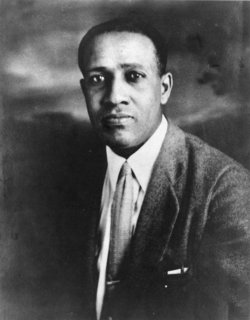 King Daniel Ganaway, Courtesy Brenda Fredericks
King Daniel Ganaway, a successful African-American photographer of the early 20th century, was not born in Buckingham County; however, his family roots were there, going back to at least the 18th century.
King Daniel Ganaway’s great grandparents, Sigh and Patsy, were born in Virginia, Sigh in 1797 and Patsy in 1801. They were owned by the Gannaway family, who had property in New Kent County, Nelson County, and owned Gravel Hill in Buckingham County. The Gannaways hired out some of their slaves and records housed at the Library of Virginia and Small Special Collections at the University of Virginia indicate some of them worked at the old mill near Curdsville and some for the Gannaway & Parrish Company. The Gannaways were cousins to the Curds, hence the connection to Curdsville.
In about 1800, John & Martha “Patsy” (Woodson) Gannaway’s son, Burrell, left Gravel Hill to settle in Murfreesboro, Tennessee, taking slaves with him. In 1853, when Burrell died in Murfreesboro, Patsy and her son, Daniel, were among thirty slaves mentioned in Burrell’s estate inventory. Daniel would become the father of King Daniel Ganaway – spelled with one “n.”
Back in Buckingham, Burrell’s brother, Theodorick Gannaway, was instrumental in the founding of the Buckingham Female Collegiate Institute. Interestingly, while the Female Collegiate Institute was ultimately bankrupt, Burrell successfully established two schools in Murfreesboro.
After emancipation, the Tennessee branch of the freed Gannaway slaves remained in Murfreesboro. In 1872, King Daniel Ganaway’s father established a store on the town’s public square. He and his family were the only African Americans to own land and a home in close proximity to the square. The Ganaway family was also among the founding members of Murfreesboro’s First Baptist Church.
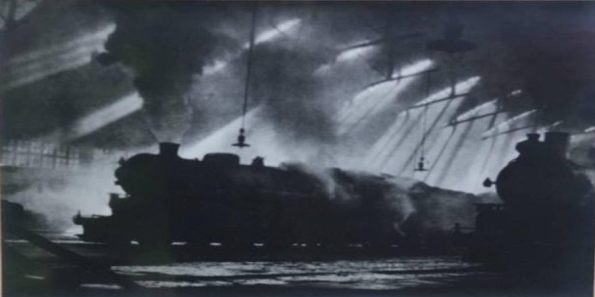
“The Spirit of Transportation” by King Daniel Ganaway, Courtesy Brenda Fredericks
According to Brenda Fredericks:
In 1903, King Daniel Ganaway left Tennessee, making his way to Zion, Illinois to live in a religious colony founded by famous evangelist and faith healer, John Alexander Dowie. He lived and worked as a waiter in Zion for 9 months but decided he was ready to take on the big city life in Chicago. He was spotted by socialite Mrs. E. F. Lawrence when standing on a train platform. She interviewed him and hired him on the spot to train as her butler.
Although he had enjoyed drawing as a child, his hands were too tired from working all day to keep up with the hobby so he taught himself photography, mastering the art. In 1921 he became famous when his photograph, “The Spirit of Transportation,” won the first place prize [in a contest sponsored by Philadelphia, Pennsylvania Department Store Owner John Wanamaker]. It was chosen over approximately 900 entries, besting famous and experienced artists of the day. He sold photographs to Chicago newspapers, National Geographic Magazine, and The America-Today combined with Fort Dearborn Magazine. His photographs were also seen in African American publications The Chicago Defender, The Crisis and The Messenger. In 1926, he became the staff photographer for the Chicago Bee. Ganaway won the praise of art critics for his creative interpretation of simple, everyday images that most artists would not use as subjects.
In Chicago, Illinois, he married Pauline Boren, a Swedish immigrant. They had one child, and were separated by 1922. Pauline raised their daughter and subsequent generations lost their connection to K. D. Ganaway, his ancestry, and his accomplishments as a photographer. In recent years, members of the family have been reunited and now celebrate their ancestor’s talent and achievements.
Want to learn more about King Daniel Ganaway and his descendants? Click here to read “King Daniel Ganaway – More discovery as his racial history comes into focus,” by Brenda Fredericks.
Also, put Curdsville Mill in the search box and learn more about the Gannaway family in Buckingham County.
This post concerning King Daniel Ganaway was made possible with the generous help of Brenda Fredericks. Many thanks Brenda!

Buckingham Courthouse, Photo by Joanne L. Yeck
The expulsion of “The Buckingham Outlaws” from the county did not curtail the sale of illegal whiskey.
On November 20, 1908, Richmond’s The Times-Dispatch reported that I. M. Moss, of Dillwyn, was tried for selling whiskey without a license. He was fined $50 in costs and put under a bond of $500 for twelve months.
Was this Isaac Moss, who was about eighteen years old? If so, his father, attorney John R. Moss, was likely displeased with his son.
Unsurprisingly, the illicit trade of whiskey did not cease. On September 4, 1910, The Times-Dispatch reported another raid near Dillwyn.
Raid Blind Tigers.
Dillwyn, Va., September 3. — The most important raid made in recent years on the violators of the revenue laws in Buckingham county was accomplished here on Wednesday, when, by the energy of the officers, six alleged offenders were hauled into the courts of Justices Taylor and Kenney.
For years violators of the law have been selling whiskey in this community.
When court was called this morning there were twenty-seven witnesses to testify to the fact that they had purchased liquor. Those who were convicted were Henry Taylor, Jim Worsham, Nannie Newton, Rosa Jemerson, Robert Taylor and Martha A. Oliver.
Each was fined for the first offense in the sum of $50 and put under a $500 in bonds to keep the peace for twelve months.
It was going to be a long “war on liquor” until 1933, when national prohibition was repealed.
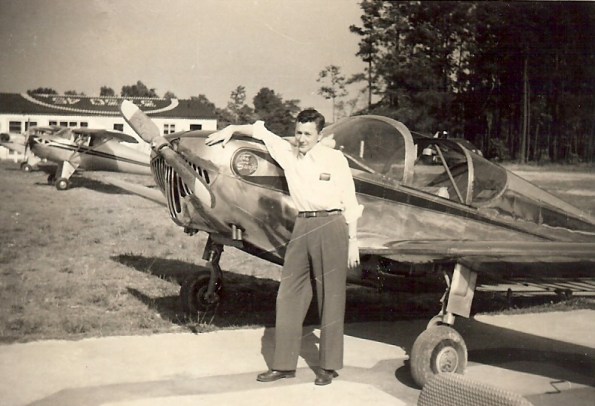
James M. Zimmerman with his Swift (1950)
Courtesy Keith Zimmerman
Don’t Lie. Don’t Cheat. Don’t Steal.
After only a few installments of “The Buckingham Outlaws” were posted at Slate River Ramblings, I was contacted by Keith Zimmerman. Realizing that he was related to two of the Buckingham County criminals, Keith was shocked at the gang’s behavior which certainly didn’t fit his family’s code of honor. His Zimmerman kin may have been fun-loving, but they were far from outlaws. Keith had been taught three rules to live by his father, James Maynard Zimmerman: Don’t Lie. Don’t Cheat. Don’t Steal.
Keith and outlaws Benjamin and Arthur Zimmerman share a common ancestor – Samuel Zimmerman. Samuel, the father of Benjamin and Arthur, was born in Maryland in 1813, came to Buckingham sometime before 1850, and settled in Buckingham County on Joshua’s Creek.
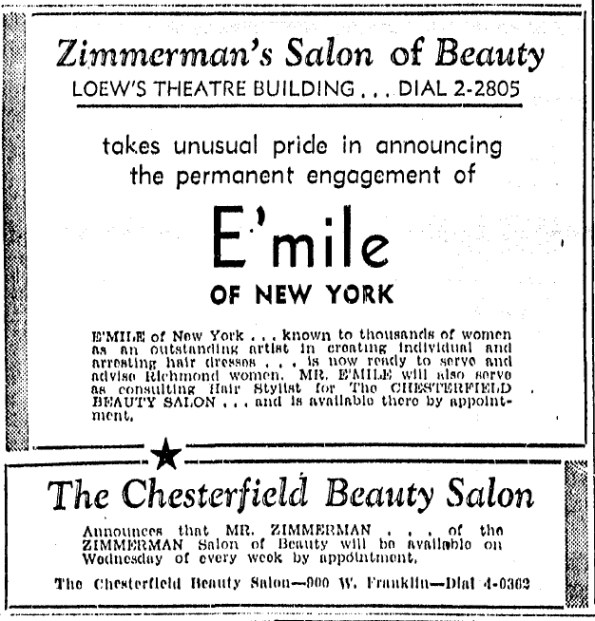
Keith’s father, James M. Zimmerman (1921–2010) served as a Marine in the South Pacific during World War II. After the war, on the G.I. Bill, he learned to fly a plane and, eventually, went into business with his older brother, William “Bill” Zimmerman. Together they operated the very successful Chesterfield Beauty Salon in Richmond. See advertisements below.
Keith, like his father, served his country as a Marine and his community as a professional firefighter for thirty-one years in the Henrico Co. Fire Dept. He is an avid reader of history and especially enjoys memoirs written by Civil War soldiers.
It is very good to know that Keith’s Zimmerman line – Samuel, William, William, James – took their Buckingham County roots in a positive direction. Thanks, Keith, for sharing your family’s stories and rounding out an exciting (if shocking) story for Slate River Ramblings readers.

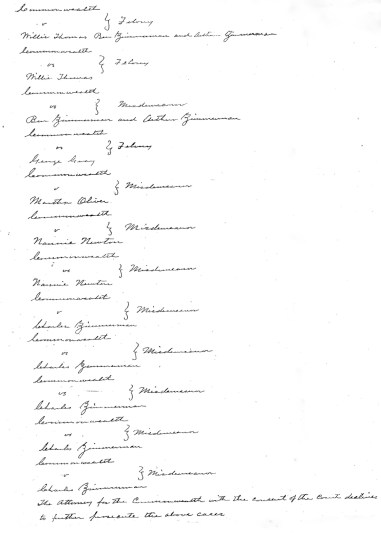
Buckingham County Common Law Book Vol. 4
(Click on the image to enlarge)
Justice for Arvonia
With the incarceration of Charles Thomas in March of 1909, reports concerning the Zimmerman-Thomas Gang disappeared from the newspapers. Many years passed and, in March of 1916, Commonwealth’s Attorney Edmund Hubard declined to further prosecute multiple charges for felonies and misdemeanors against Ben Zimmerman, Arthur Zimmerman, and Willie Thomas.
Many questions remain.
Did the prohibition of alcohol in Arvonia and Marshall District in 1903 create the breeding ground for wide-spread resentment among the newly disenfranchised lower classes and for the inevitable establishment of the gang’s “blind tiger” and other illegal means of selling liquor?
What actually happened between Ben Zimmerman and his brother-in-law, Charles Newton?
Did Charles Thomas “take the fall” for the whole gang?
Was William Thomas ever apprehended for the shooting of Matt Gregory and other crimes?
What about the Zimmerman brothers? Did they flee Buckingham County, never to return?
What role did Sheriff Williams have in all of this? If he was the bondsman for Will Thomas, did he set up the possibility of the jail break by letting Thomas go free?
~
The arrest and sentencing of Charles Thomas was not the end of Buckingham County’s troubles. As it turned out, peace was short-lived.
During the winter months of 1908-1909, life in Buckingham County settled down. Edmund W. Hubard continued to serve as Commonwealth’s Attorney. Lewis W. Williams carried on as Sheriff. Then, in mid-April of 1909, the Stewart brothers were brutally murdered in another corner of the county.
On April 22, 1909, Roanoke’s The Evening Press reported that Edmund Hubard had visited the governor and requested a reward for the capture of the murderers of the Stewart brothers. The obvious question was raised. Was this crime committed by members of the Zimmerman-Thomas Gang? The article concluded:
Mr. Hubard intimated to the governor that he had no reason to suspect that the murder of the two brothers was committed by any of the desperadoes who figured some months ago in the Arvonia neighborhood and who are popularly known as the “Buckingham outlaws.”
This gang was broken up sometime ago, and several of the offenders have since been imprisoned. The section in which the Stewarts [lived] is at least twenty-five miles distant from the former region in which the desperadoes used to commit their infractions of the law.
If Mr. Hubard communicated to the governor any of his suspicions as to who killed the Stewarts and burned their cabin, the executive was put under a pledge of secrecy, for he declines to venture any surmises as to the guilty parties.
Within two months, Sheriff Williams arrested Dallas Wright, Edward Jones, and Richard Perkins for the murders of the Stewart brothers. Could the many irregularities which followed in their treatment and trials relate back to the pressures put on Williams and Hubard over the failure to capture “The Buckingham Outlaws”? Did officials manipulate proceedings to demonstrate that law and order operated successfully in the county? If so, they failed.
Buckingham County’s reputation had been seriously damaged during the summer and autumn of 1908 while the Zimmerman-Thomas Gang terrorized Arvonia. Ultimately, the events surrounding the murder of the Stewart brothers did not help restore the county’s peaceful image. By 1911, when Dallas Wright, Edward Jones, and Richard Perkins were all acquitted, newspaper editors may still have been scratching their heads and asking . . .
“What’s the matter in Buckingham County, anyway?”
Once again, special thanks goes to Mary Carolyn Minton for introducing me to the Zimmerman-Thomas Gang. Virginia Chronicle, created at the Library of Virginia, provided most of the newspaper articles, including Roanoke’s sensational The Evening News.
Coming Next: Epilogue
Need to catch up? Click here: The Buckingham Outlaws: Part I
Click here for the story of the Stewart brothers: The 1909 Buckingham Murders? Part I

“Matt Gregory and Chesapeake and Ohio Bridge at Arvonia”
Wilkes-Barre Times (Wilkes-Barre, Pennsylvania)
The Thomas Brothers
On November 14, 1908, Roanoke’s The Evening News announced:
ONE BUCKINGHAM
OUTLAW CONVICTED
Charles Thomas Found Guilty of Jail Breaking and Brother Indicted.
Charles Thomas was tried in the Buckingham County Circuit Court for jail breaking and given four months in prison. The charge against him for housebreaking, the September incident at Seven Islands when the outlaws broke into Mrs. Ambler’s smokehouse, was continued until the next term.
William Thomas was indicted by the grand jury, charged with shooting N. M. Gregory on the “Swan Island” farm. Known as Matt, N. M. Gregory’s farm was on the Seven Islands in the James River. He was well enough to attend court and admitted that he feared being shot again.
The following March, a very small announcement ran in Richmond’s The Times-Dispatch stating that Charlie Thomas was tried for breaking into the smokehouse, found guilty, and sentenced to serve three years in the state penitentiary. Interestingly, it was described as “the meat house of N. M. Gregory” rather than Mrs. Ambler’s smokehouse.
Could this be the end of the story?
Coming Next: Justice for Arvonia
Need to catch up? Click here: The Buckingham Outlaws: Part I
Arrest!
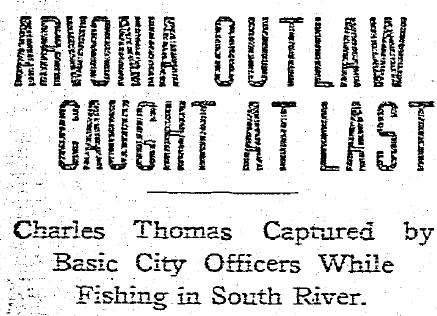
On October 22, 1908, The Times-Dispatch reported that Charles Thomas, one of the four leaders of the Zimmerman-Thomas gang, had been arrested by Sergeant S. T. Rodgers of Basic City, Augusta County, Virginia. Thomas was discovered fishing in the South River.
During the heat of Arvonia’s panic, reporters from The Times-Dispatch had interviewed Mrs. Thomas, the mother of outlaws Charles and William Thomas. According to the newspaper, “She was a respectable-looking woman, quiet and reserved.” The paper did not print her thoughts concerning her lawless boys.
On October 23rd, Sheriff Williams identified Thomas, who confessed his identity but denied that he shot N. M. Gregory. That day, Williams transported Charles Thomas to the Buckingham County jail. There he would be held in a steel cage until he could be arraigned in the Circuit Court’s November term. His brother, Will Thomas, who remained out on bail, would also be arraigned.
An article printed in the October 26th issue of The Times-Dispatch said that the Zimmerman brothers had an uncle living at Basic City and they might be hiding near that place. Sergeant Rodgers was expected to receive at least some of the $450 reward offered by the Buckingham County Board of Supervisors and Governor Swanson for the capture of the leaders of the Buckingham outlaws. Indeed in December, the officer received a check from the governor for $50. This was in addition to $100 he received from Buckingham County for apprehending Charles Thomas.
Coming Next: The Thomas Brothers
Need to catch up? Click here: The Buckingham Outlaws: Part I

A False Trail
The story of the Zimmerman-Thomas Gang fell from the headlines for several days. Then, on October 14, 1908, Roanoke’s The Evening News ran a provocative article, introducing a new piece of back story. If true, the officials of Buckingham County may have been embarrassed and suppressed this detail. On the other hand, it may have been a rumor or even fabricated, creating an excuse for a sensational headline.
SAW OUTLAW GANG
IN WOMEN’S CLOTHES
Report to Effect Officers Were Led Off on False Trail
Buckingham Va., Oct. 14.
. . . a certain young man told the officers if they would pay him $100 he would take them to the place where these men were hiding and show them to the officers, stating that they had been working in the woods while dressed in women’s clothes, and the officers led off on this false trail went to Arvonia. Then followed the sensational reports of the shooting of N. M. Gregory and the organized efforts of the people of Arvonia to locate these men.
It is a subject of great regret to Buckingham people that the idea should have gone abroad that lawlessness and riot were so rampant in this county.
There was moonshine whiskey sold and it is reported that it is sold now.
Coming Next: Arrest!
Need to catch up? Click here: The Buckingham Outlaws: Part I
An Appeal for Help
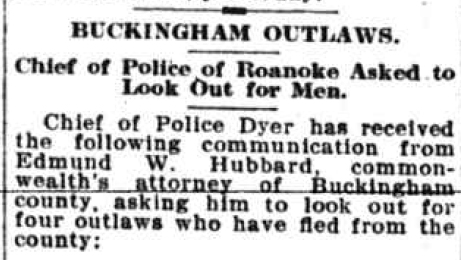
In an early 20th century equivalent to an “all-points bulletin,” Commonwealth’s Attorney Edmund W. Hubard sent the following letter to Chief of Police Dyer in Roanoke. The description of the leaders of the Buckingham outlaws differs significantly from the one printed in The Farmville Herald, especially the details concerning Benjamin Zimmerman’s appearance. Likely, the same letter circulated to other sheriffs and police officers. On October 9th, it was printed in The Evening News, keeping all of Roanoke alert to the flight of the Buckingham outlaws.
Arvonia, Va. Oct. 8. 1908.
To the Chief of Police.
Dear Sir: Four desperate outlaws who have been committing many crimes in and about this place for some time, are at large. They have been in hiding near this place since their escape from jail – from the best evidence obtainable – but it is feared now that they may have escaped or that they will make an attempt to escape when renewed efforts are made to capture them.
You are urged to look out for four men, all white, bearing the following names: Benjamin Zimmerman, Arthur Zimmerman, Charles Thomas and William Thomas.
They are typical backwoodsmen in appearance, unkempt and poorly dressed, and with an unprepossessing appearance.
Benjamin Zimmerman, aged between 35 and 40, black hair, generally long and uneven and a black mustache. About six feet tall, very straight, weight 160 pounds; right eye almost closed or deformed; several missing fingers on one hand.
Arthur Zimmerman, aged 25, brown hair, long and shaggy, generally without mustache or whiskers; hair hangs over forehead and curls; weight 140 or 145; height about 5 feet 8 inches.
Charles Thomas, aged about 30, very tall and thin, with short shaggy sandy whiskers and sandy hair. Weight about 175, height about 6 feet 3 inches.
William Thomas, rather stout and with large frame, aged about 40, height about 6 feet, usually wears long sweeping mustache sandy like hair though hair may be darker than mustache; weight about 185 pounds.
Look for these men along the railway lines and remember that a reward of $450 is offered for the former three.
Coming Next: A False Trail
Need to catch up? Click here: The Buckingham Outlaws: Part I

Quiet Reigns Again
By October 3, 1908, reporters were grasping at rumors, keeping alive the story of Arvonia’s plight at the hands of these violent criminals as there seemed to be no new facts to report.
There was brief excitement when it was believed that one outlaw had been captured; however, this was unfounded. In fact, no arrests had been made.
More importantly, the news of Charles Newton’s death seemed to be untrue. He was seen at his home and could not account for the report of his death. Whose funeral was confused with one for Newton?
According to the Alexandria Gazette:
The other sensational report which gained credence yesterday to the effect that Mr. Charley Newton had been killed by the men has been utterly disproved. Mr. B. Johnson, of Arvonia, visited Mr. Newton in his home, near Payne’s Landing, yesterday afternoon, and found that he had not seen any member of the Zimmerman-Thomas party. He was at a loss to understand how such a report could have gotten out.
Weeks later, this apparent rumor of Newton’s death was still being repeated in out-of-state newspapers. Who would have started such a rumor and why?
The Alexandria Gazette also noted:
The people of Arvonia are greatly distressed that such a great sensation should have developed there. Arvonia is a thoroughly civilized place, with cultured and intelligent people.
~
As the days went by, the newspaper coverage of Arvonia and the outlaws grew shorter and further apart.
October 5th: The Alexandria Gazette admitted that the excitement had all but “died away in Arvonia.” The men had not been caught, though the newspaper suggested that secret work towards their apprehension continued.
October 7th: Sheriff Williams returned to his home at Diana Mills, stating that he believed the men were no longer in the county.
October 9th: N. M. Gregory was still alive, slowly recovering from his gunshot wound.
Coming Next: An Appeal for Help
Need to catch up? Click here: The Buckingham Outlaws: Part I


 slate river ramblings . . . .