

Mildred M. Ellis, Passport Application, Click to Enlarge Image
In 1908, Mildred M. Ellis, commonly known as Minnie, married Judge Alexander S. Hall, both of Buckingham County. Click here to read the details: Judge Hall Marries.
Born in Buckingham County, on September 9, 1855, Minnie’s heritage represented the intermarrying of prominent Buckingham families. As was the case with many other Virginia families, her ancestors married cousins, creating a tangled web of tight interconnections. Her great grandparents were Prettyman Merry and Catherine Suggett, William Harden Perkins and Elizabeth Lee Fearn. Her grandparents were William Harding Perkins and Mildred Walker Merry. Her parents were Richard Shelton Ellis and Anne Fearn Perkins.
When she was forty-four years old, Minnie applied for a passport on May 17, 1900. In those days, passports still had physical descriptions rather than photos. Her description reads: stature 5 feet 6 ½ inches, medium forehead, blue eyes, prominent nose, medium mouth, pointed chin, light hair, fair complexion, and long face.
Minnie applied for her passport in May of 1900, planned to go abroad, and return by August. Not many women from Buckingham County traveled abroad in 1900, especially for such a short time. This was not long enough for a Grand Tour of Europe. Where did she go?
Though Minnie married late in life, she spent twenty-four years with Judge Hall. At Maysville Presbyterian Church, she happily taught Sunday School to the budding young ladies of Buckingham County. She died on February 8, 1936.
Thanks to Minnie’s distant cousin, Mary Carolyn Mitton, for providing this glimpse at a Virginia gem!
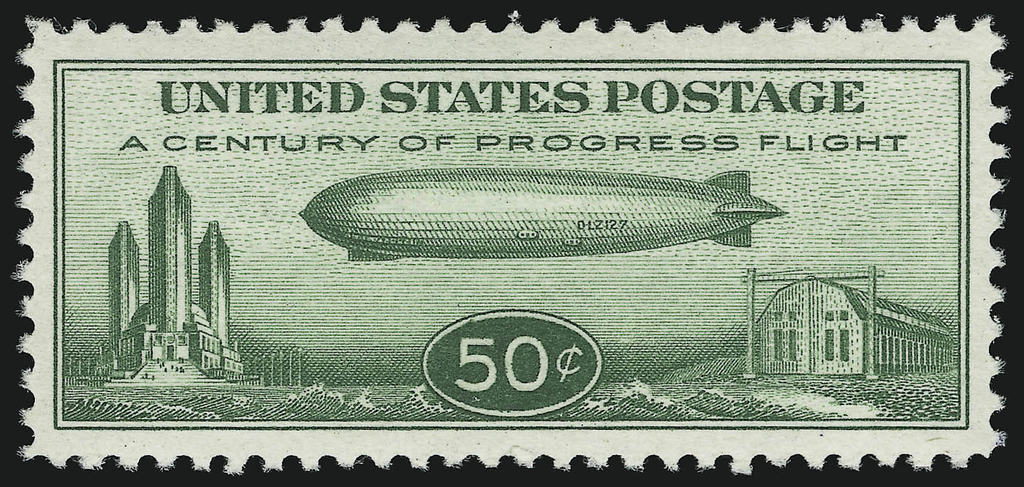
In December of 1914, as trenches were being dug in Europe and fears of a German invasion of North America began to grow, the Richmond Times-Dispatch ran this “special” news from Buckingham County:
GHOST OF AEROPLANE DESTROYED IN EUROPE?
That, or German Machine Reconnoitering –
Anyway, Some Kind of Aerial Visitor Has Excited Buckingham.
ARVONIA, VA. December 19. All the northeastern end of Buckingham County is excited over a most remarkable aerial visitation of some kind, which occurred on Thursday night about 10 o’clock and created such a noise that whole countrysides were aroused and alarmed. Many stoutly contend that it was an aeroplane or Zeppelin, as lights fore and aft were observed, and the chug of engines could be heard. Why they were sailing at night and in such cold is a mystery. Others say they heard vast volleying of shooting in the heavens, like a company of fifty men firing simultaneously. Others say the noise was that of thunder. Several say they saw at least three distinct lights pass in the heavens.
Three men, who were passing in the road at a late hour, say they saw the air craft, and that it fell with a loud noise in a field between Arvonia and New Canton. They did not investigate the matter, but instead went to the other direction rapidly.
The phenomena could not have been a hoax or anything like an aerial toy, as it was seen and observed over a wide extent of territory, and everywhere it created intense excitement.
Some think it was an aeroplane, others say it was a Zeppelin airship. Many who know little of geographical conditions say they are certain it was a German aircraft reconnoitering. Still others, who are superstitiously inclined, say it was a phantom airship, perhaps the ghost of one of those destroyed in the European war. The best informed think it was a most remarkable aerolite or meteor accompanied by noise like that of shooting.
The United States Weather Bureau had been asked to investigate the matter and determine, if possible, just what the strange occurrence could have been.
Nobody mentioned visitors from outer space?
Thanks to Mary Carolyn Mitton for discovering this Buckingham County mystery!
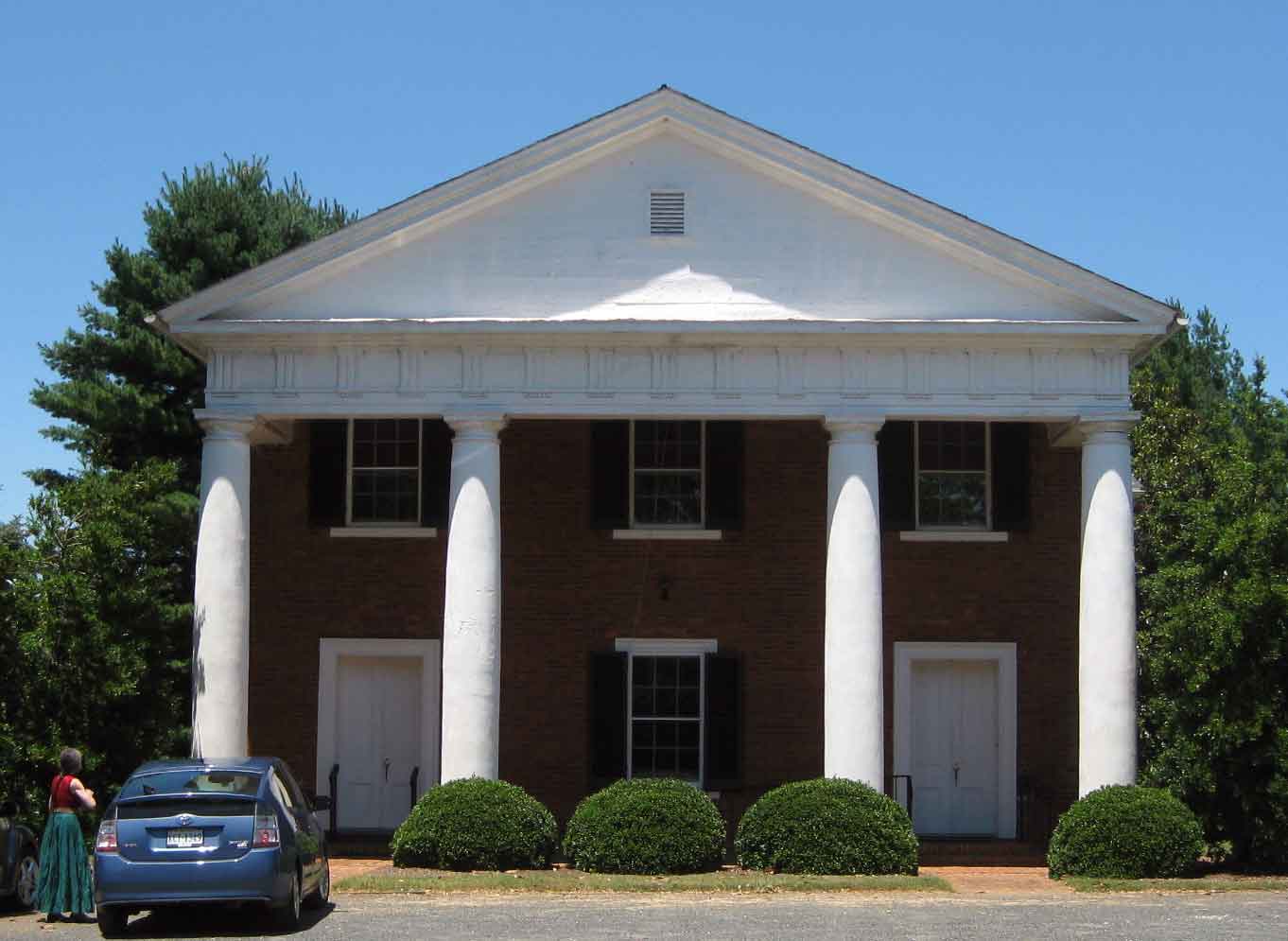 Maysville Presbyterian Church, photo by Joanne Yeck
On February 19, 1908, Judge Alexander Stuart Hall married for a second time. The bride was Miss Minnie M. Ellis of Afton and their wedding was announced in Richmond’s The Times-Dispatch:
The wedding was a quiet one. The ceremony was performed by Rev. Charles Martin Barrell, pastor of the Presbyterian Church, to which both bride and groom belong.
No marriage has taken place in Buckingham in many years in which more interest was manifested by the friends of the contracting parties. Judge Hall was for a long time judge of the County Court of this county is a man of sterling worth, of strict integrity, and at present represents Buckingham and Cumberland in the Legislature. The bride is one of the most popular ladies in Virginia, is related to many of the very best families in Richmond, and besides having a host of friends and admirers in her native county and State, has many relatives and friends in the South. She is the only daughter of the late R. S. and N.F. Ellis, and owns the beautiful Homestead, “Afton,” which is known far and wide as one of the most hospitable homes in Virginia.
Rev. Charles Martin Barrell, who performed the ceremony, was the pastor at Maysville Presbyterian from 1903—1940 and was married to Judge Hall’s daughter, Frances Stuart Hall.
Minnie Hall was an active member of Maysville Presbyterian Church. Carl Coleman Rosen, Sr. wrote in his history of the church that she taught Sunday School to the teenaged girls: “[H]er class was so popular that about all the village girls attended. She gave them house parties and various other kinds of entertainment.”
Minnie M. (Ellis) Hall was clearly a Virginia gem. If a Slate River Ramblings reader knows more about Minnie or has a photo of her, please contact me.
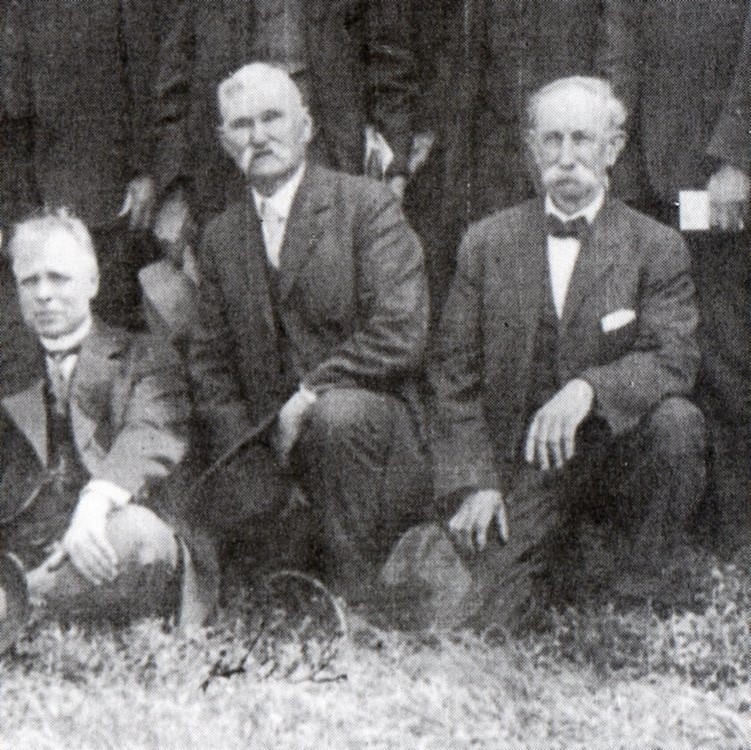
Judge Alexander Stuart Hall, center
Courtesy Stuart Hall Barrell and Carl Coleman Rosen, Sr.
During 1909-1911, Judge A.S. Hall was one of a team of attorneys who defended Dallas Wright, Edward Jones, and Richard Perkins in the sensational murder case of the Stewart brothers.
Alexander Stuart Hall was born on July 26, 1852, probably in Buckingham County, and lived at Perry Hill. He earned his law degree at the University of Virginia, practiced law in Buckingham County, eventually becoming a Judge in the county. He also served in the State Legislature. Hall became an elder of Maysville Presbyterian Church on June 6, 1880 and taught adult Bible classes for over forty years. He married Fannie Anderson of Prince Edward County, who died early in their marriage, and their three children were raised by their grandmother, Mrs. William P. Hall.
Judge Hall died on February 13, 1932 and is buried in the family graveyard at Solitude, Buckingham County. His obituary, printed in the Richmond Times-Dispatch on February 16th, stated that his funeral was “attended by a large assemblage of relatives and friends. Services were conducted by the Rev. George E. Henderlite of Farmville, his former pastor.”
Coming Next: Judge Hall Marries
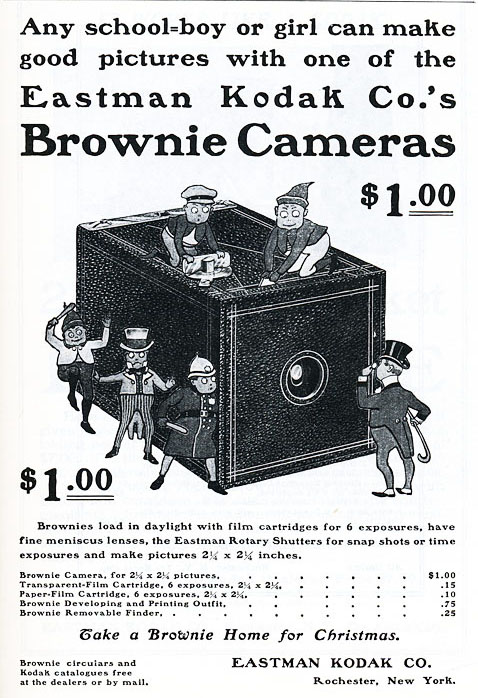 Eastman Kodak’s Brownie Camera
In May of 1908, photographer W.E. Burgess, who owned Idylwood Studio in Scottsville, Virginia, hosted a “Kodak party” for a number of his friends. According to the “Scottsville Social News” published in Richmond’s The Times-Dispatch: “Many pictures were taken, refreshments served and the occasion was a most enjoyable one.”
Eastman Kodak introduced the Brownie camera in February of 1900 and, within a decade, the country was full of happy “snapshot”-taking Americans. Some of them were having fun (and possibly a little instruction) in Scottsville, just a ferry ride away from Buckingham County. By the time Mr. Burgess held his “Kodak party,” the new bridge was in place connecting the lowlands of Snowden in Buckingham to the town of Scottsville in Albemarle County.
Over the decades, W. E. Burgess photographed many people and places in Buckingham and its environs. Many were sold as postcards and are now collectibles.
Read more about W. E. Burgess and Idylwood at Scottsville Museum, “William Edward Burgess, Scottsville’s Photographer” and at “William Edward Burgess, 1871-1935.”
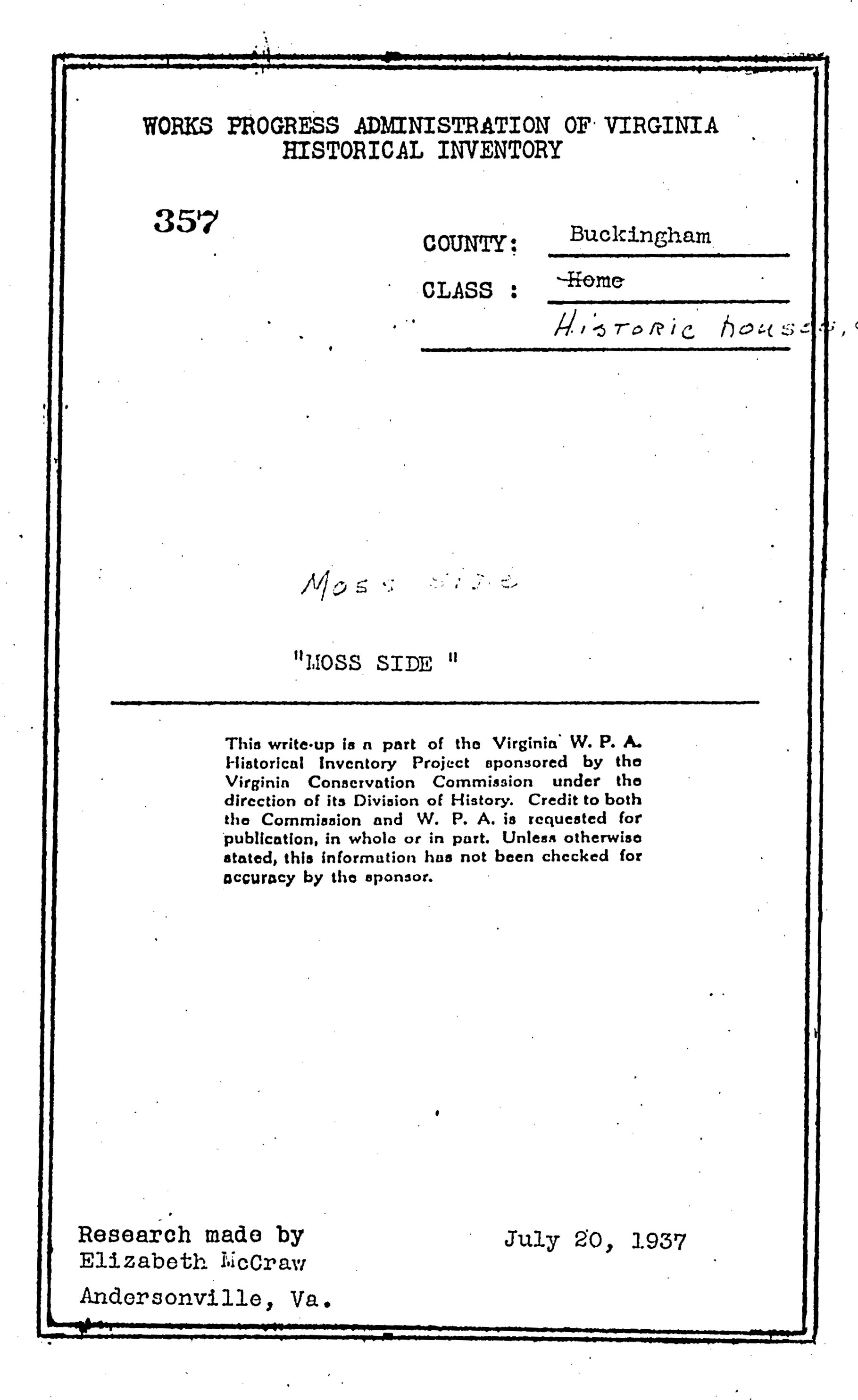
Virginia Historical Inventory, Courtesy Library of Virginia
Posts concerning houses in Buckingham County are always popular with the readers of Slate River Ramblings. According to Elizabeth McCraw’s 1937 report for the Virginia Historical Inventory, Moss Side was always known by that name and had been owned by the Ranson, Moss, Pollard, and Lewis families.
Mrs. McCraw located the house 1.3 miles south of Sheppards on Route 15, thence .1 mile west on a private rode. She described its unusual side entry through a one story porch. She noted that four rooms were added to the front in 1885 and that, with the exception of the original porch, it was “all in very good condition.” She went on to detail its historical significance at follows:
On the original chimney to the old house is the date 1808, and from dates in the family Bible one would conclude that the house was built at this time. Major Steven Moss came home from the War of 1812 and on Nov. 5, 1818, married Miss Lizabeth Ranson. They were given the Ranson home place and here Mr. and Mrs. Moss established their home and called it “Moss Side” which name it has always retained. Mr. Moss seems to have conducted a school here, and wrote some of the books used. There is an old Arithmetic here written entirely by hand and dated 1813 – 1817. By Steven Moss.
The old family burying ground is here too, but there are no markers prior to 1865,
Do any Slate River Ramblings readers know more about the school at Moss Side? If so, please comment.

Courtesy Historic Buckingham
The files at Historic Buckingham’s Housewright Museum include a broadside written by Edmund Wilcox Hubard. It not only captures his personality but also reveals the commanding position he held in Buckingham County politics for most of his long career as an attorney and politician:
NOTICE
TO THE DEMOCRATIC VOTERS
OF
BUCKINGHAM COUNTY
Fellow Democrats:
I hereby announce myself as a candidate of the nomination to the position of Commonwealth’s Attorney at the Democratic Primary Election on August 4, 1931.
While I was prostrate in a hospital as a result of an operation, I was urged to become a candidate for Commonwealth’s Attorney at our last County Democratic Primary and was finally assured if I would simply allow the use of my name that my friends would do the rest, but realizing that a Public Office is a Public Trust, and not feeling satisfied at that time that I would be able to discharge the duties of that responsible position, I declined to become a candidate after expressing my deep sense of gratitude at the confidence and devotion thus manifested. But now I have fully regained my health and strength, and should it be your pleasure to nominate me, I solemnly obligate myself to discharge all of the duties of office to the best of my ability and you will receive the benefit of my long experience as a prosecutor.
Six times I had opposition for the position of Commonwealth’s Attorney, and you endorsed my record by re-electing me each time by large majorities and elected me six times without opposition, and with a deep sense of appreciation and gratitude for those endorsements I am basing my claim of support in this canvass, as in all of my other contests, solely upon my record in office, for I have never assailed any candidate against me and will not do so in this canvass.
Again assuring you of my deep gratitude in soliciting a continuance of your endorsement and support, I am
Gratefully your friend,
Edmund W. Hubard
In 1931, Hubard was about seventy-eight years old.
Click here to read more about Edmund W. Hubard.

Buckingham Courthouse, Photo by Joanne Yeck
Commonwealth’s Attorney Edmund Wilcox Hubard, who headed the prosecution in the 1909 murder of the Stewart brothers, held that office in Buckingham County for over forty years.
Hubard was eighty-three years old at the time of his death in July of 1936 and was living in Richmond at 1602 Grove Avenue. He is buried in Hollywood Cemetery.
Hubard, a native of Buckingham, spent most of his life in the county. According to his obituary in the Richmond Times-Dispatch:
He was active in State and county politics and served a number of years as a State senator and as member of the House of Delegates. He was a member of the Constitutional Convention of 1902 and for more than 40 years was Commonwealth’s Attorney in Buckingham County. Mr. Hubard and his wife moved to Richmond in recent years.
According to the Library of Virginia, Edmund Wilcox Hubard was born on August 6, 1853 in Buckingham County, Virginia. His parents, Edmund Wilcox Hubard (1806–1878) and Sarah A. (Eppes) Hubard, sent him to public and private schools. He graduated from the University of Virginia in 1876. On January 27, 1897, Hubard married Mary E. May (1866–1910) of Buckingham County. They had one son.
The 1910 census, indicates that Edmund and Mary Hubard may have separated before her death. That year, he was living at Spencer’s boarding house in Maysville, Buckingham County, without his son. He is enumerated as divorced. His second wife, Margaret Leake Hubard (1873–1937), was over twenty years his junior. According to the 1930 census, they were married in about 1921.
Coming next: Edmund Wilcox Hubard, Democrat

Front Page Story, 24 November 1911, Staunton Spectator and Vindicator
Justice and the Stewart Brothers
The story of the murders of Thomas and William Stewart as it unfolded during 1909 – 1911, leaves many unanswered questions.
Based on census data, the Stewart brothers had no other siblings and likely had no close kinfolk living in Buckingham County. Their cabin was burned with its contents, however, they owned their farm. What happened to their property?
The coroner’s conclusion that the brothers were indeed murdered and not accidently burned in their cabin seems sound. If justice was served and Dallas Wright, Edward Jones, and Richard Perkins were innocent, then who killed the Stewart brothers?
Were Wright, Jones, and Perkins framed? Were Buckingham County officials and some of the county’s prominent citizens responsible for bribes and intimidation? Was there an organized cover up protecting the actual criminals?
Was Deputy Sheriff J. E. Carter’s death really an accident? Or was he silenced so he could never divulge the men involved in the intimidation of Richard Perkins? Did he know who actually killed the Stewarts and why?
What was the real motive for killing the apparently harmless Stewarts? Were the Stewarts killed for another reason, completely unrelated to the rumor of their hidden riches or “difficulty” with Dallas Wright?
Where there is money there are often also fights and grudges. Could there have been a multi-generational grievance between the Stewarts, the Wrights, and possibly others?
In 1871, an ultimately undetermined Buckingham County chancery case, Booker vs. Whitehead, involved many familiar and affluent Buckingham families including James A. Wright, Administrator bonis non of George Booker; Powhatan Jones, Executor for Mary Whitehead; James Stewart, Administrator of Thomas Jones, Jr.; James Stewart in his own right along with his wife Lucinda Stewart; Thomas Bondurant, Executor for Thomas M. Bondurant.
How did James Stewart, father of Thomas and William Stewart, come to be the administrator of Thomas Jones, Jr.’s estate and what claim did he and his wife, Lucinda, have against the Whitehead estate in this chancery case?
An association between James Stewart and Powhatan Jones (1792-1880) might explain the rumor of riches and slave trading. Jones was a wealthy and influential man in Buckingham County, as well as a politically prominent Whig. In 1850, Jones’ plantation was valued at $14,000. His son, Thomas Jones, acted as his overseer. By 1860, Jones’ real estate — 1,300 improved acres, plus 400 unimproved acres — was valued at $20,000. His personal property, including twenty-seven slaves, was valued at $35,000. His fortunes survived the Civil War remarkably intact. In 1870, Jones’ real estate was still valued at an impressive $12,000 and his personal property at $1,000.
~
Following the freeing of Dallas Wright, Edward Jones, and Richard Perkins the story of the murder of the Stewart brothers disappears from the headlines. Was anyone else ever charged with the murders? After such a lengthy, convoluted, and, perhaps, incriminating process, were Buckingham County officials content to let the crime vanish into obscurity?
If a Slate River Ramblings reader knows more about the case or the lives of the Stewart brothers, please comment or send an email using the contact box.
Many thanks to Mary Carolyn Mitton for finding much of the newspaper coverage and encouraging me to flesh out the story of the Stewart brothers. Also, a special nod to the Virginia Newspaper Project and the Library of Virginia for digitizing Virginia’s historic newspapers. Visit Virginia Chronicle and do some searching of your own!
Need to catch up on The 1909 Buckingham Murders? Part I: June 1, 2015
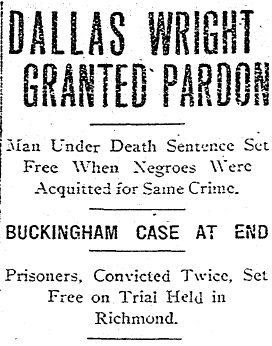
Acquittal and Pardon
On November 24, 1911, over two and a half years following the murders of the Stewart brothers, Edward Jones was acquitted by a jury in Richmond’s Hustings Court.
The Commonwealth chose not to prosecute Richard Perkins based on the decision in Jones’ case, the evidence against both being identical and Perkins was released.
Governor William Hodges Mann gave W. Dallas Wright an absolute pardon.
The Times-Dispatch reported Wright’s response to gaining his freedom:
When informed that he was a free man, Wright wept. He declared that he knew nothing of the murder of the two Buckingham brothers, who were killed and their bodies burned when their home was set a fire.
The white man, who is about forty years old, said that he had no idea what he will do. He said he would not return to Buckingham, and was anxious to get as far away from Virginia as possible.
With all three cases overturned by the Richmond jury and judge, the change of venue saved three lives.
How did Judge Hundley, “the ablest circuit judge in the State,” respond to the reversal of his decisions?
Was the complex, and now very contradictory, evidence too much and too incredible for the Richmond jury?
Where did the citizens of Buckingham County stand on the reversal of the Buckingham-based jury?
Coming next: Justice and the Stewart Brothers
Need to catch up on The 1909 Buckingham Murders? Part I: June 1, 2015


 slate river ramblings . . . .