
Dallas Wright on Trial
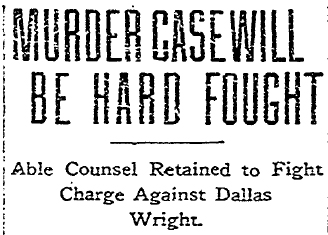
Former Buckingham County Judge Alexander S. Hall with Aubrey E. Strode and John L. Lee of Lynchburg were chosen to represent Dallas Wright. The prosecution was headed by Commonweath’s Attorney Edmund W. Hubard, assisted by Frank C. Moon of Snowden (Buckingham County) and Lynchburg. In addition to his law practice, Moon was a former State Senator. According to The Times-Dispatch, Senator Sands Gayle was “retained by citizens to aid the prosecution” and Congressman H.D. Flood and his law firm were also employed by the State Bureau of Insurance to further assist the prosecution.
In anticipation of Wright’s trial, it was reported that his brother, Clifford, asserted that he slept in the same bed with Dallas on the night of the crime. Their mother was also in the house that night and could have provided her son with an alibi; however, Mrs. Wright had died in May, leaving Clifford the only living witness to Dallas’ whereabouts.
On August 28th, The Times-Dispatch reported that Wright was still in jail in Buckingham County and was charged with “complicity” in the murder of Thomas and William Stewart:
. . . [Wright] lived near the log cabin home of the Stewarts and had known them perhaps all his life, and he stoutly maintains that he was in no way connected with the triple crime of murder, robbery and arson with which he is charged, and his relatives have made sacrifices to secure counsel for his defense.
The counsel for the defense fought an uphill battle. So much time had passed since the murder of the Stewarts, public opinion had been shaped both by potentially biased journalism and by the testimony given at the trial of Edward Jones. In July, Jones had been found guilty of “complicity” in the murder and burning of the Stewart brothers and witnesses testified that Dallas Wright was with him. The Times-Dispatch also noted that despite the fact that the Stewarts were not “generally known by the county people . . . the mere fact that such an atrocious crime has been committed has caused people to take unusual interest in the case.”
Could an unbiased jury be found in Buckingham County? Could Dallas Wright receive a fair trial without a change of venue? Attorneys Hall, Strode, and Lee had their doubts.
Coming Next: A Fair Trial
Need to catch up on The 1909 Buckingham Murders? Part I: June 1, 2015

Willie Jackson: Under Surveillance
The suspicious behavior of Willie Jackson may have led to the capture of Dallas Wright, Edward Jones, and Richard Perkins who were arrested in June of 1909 for the murders of the Stewart brothers. According to the June 22, 1909 edition of Richmond’s Times-Dispatch:
The boy, Willie Jackson, who is the star witness, was an employee on the farm of Superintendent of Schools John A. Twyman at the time of the murder, which took place two months ago. It was the actions of this boy which first directed attention to him as probably being connected in some way with the crime. He was seen running through a piece of pines with another negro and on being hailed and asked why he was running, he said he thought the man who was passing was the sheriff. When asked why he wanted to avoid meeting that officer, he said he had been killing fish with dynamite in the stream near by and had been told this was a violation of law. This, however, was not a satisfactory explanation of his action, and he had been under surveillance ever since. It is probable that he gave the first clue which led to the arrests.
Willie Jackson was about nineteen years old when the murders took place. John A. Twyman, born in 1856, lived with two sisters and a brother in the James River District of Buckingham County. His sister, Augusta, and his brother, Samuel, taught in the public schools.
Who was the man who questioned Willie Jackson and reported him to officials?
Need to catch up on The 1909 Buckingham Murders? Part I: June 1, 2015
The Trials Begin
In July of 1909, the trials began in Buckingham County for the murders of Thomas and William Stewart. One of the black men, Edward Jones, was the first to be tried. Former Buckingham County Judge Alexander S. Hall and Aubrey E. Strode of Lynchburg were appointed to defend Jones.
One witness in particular, George E. Bolton, a merchant who lived near the Stewart brothers, gave testimony that would have a profound effect on the case. Bolton told the court of a “remarkable” dream he had the night of the double murder. In it, he saw the crime committed and claimed to recognize Dallas Wright, Edward Jones, and Richard Perkins as the perpetrators. Bolton also described a “stout negro boy” whose name he did not know but who was an accessory to the killing. William “Willie” Jackson, who was being held as a witness, fit Bolton’s description.
According to the July 7, 1909 edition of the Alexandria Gazette and Virginia Advertiser:
Bolton says the dream was so vivid that he was awakened and went out into his yard, from which he could see the Stewart cabin ablaze. Jackson and Bolton both give the same time of the night when the fire occurred, although they never have seen each other. Bolton will be given an opportunity of identifying the negro.
Incredible as it may seem today, Bolton’s dream was accepted as evidence and became increasingly influential as the trials preceded.
Edward Jones was found guilty of “complicity” in the murder and burning of the Stewart brothers, he was “principally” convicted on evidence presented by Willie Jackson and Aylett Johnson, witnesses who confessed their involvement in the crime. Jackson and Johnson asserted that they were “coerced” and “compelled” to stand sentinel while the crimes were committed. Their testimony implicated Dallas Wright, Edward Jones, and Richard Perkins.
Jackson and Johnson were held in the Buckingham County jail along with Wright, Jones, and Perkins. All five men were guarded night and day. Wright was held in a steel cage on the second floor.
The trial of Dallas Wright was set for August 30, 1909.
Coming Next: Dallas Wright on Trial
Need to catch up on The 1909 Buckingham Murders? Part I: June 1, 2015
Arrests Made
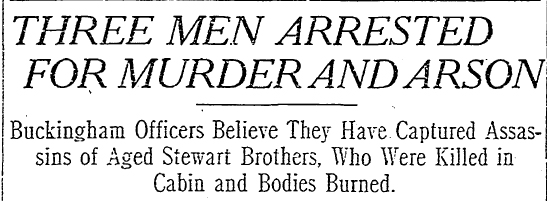
Two months passed following the murders of Thomas and William Stewart and no arrests had yet been made. Then, in June of 1909, The Times-Dispatch reported that one white man, W. Dallas Wright, and three black men, Richard Perkins, Ed Jones, and Aylett Johnson had been arrested for the murders of Thomas and William Stewart. They were also charged with arson. The Times-Dispatch may have been in error about the charge against Johnson or, later, the charges were dropped. Ultimately, Johnson was held as a witness but not charged with any crimes. Witness Willie Jackson, another black man, was also jailed. Sheriff Lewis Williams and Deputy Sheriff E. J. Carter, who lived in the same district in which the crime was committed, were credited with “working up” the case. The newspaper noted that Willie Jackson had been under surveillance for suspicious behavior and that it was “probable that he gave the first clue which led to the arrests.”
In June, Buckingham County’s Commonwealth’s Attorney Edmund W. Hubard held a preliminary trial, during which he obtained valuable evidence. Local Justice of the Peace F. W. Swan presided over the proceedings. Judge A. S. Hall represented the accused and all of the prisoners were refused bail.
The Times-Dispatch did not reveal the sources; however, on June 22, 1909, the newspaper summarized some of the details collected by Hubard:
It is alleged that the principals in this crime met at a colored woman’s house in the early part of the night of the double murder and planned the crime, which was committed later in the night. After having what they term a “little frolic” at the house of Charity Perkins, they placed two of the negroes as sentinels on the road leading to the little log cabin which sheltered the two old men, Thomas and William Stewart. One of these was the boy Willie Jackson, and he tells of having heard the two gunshots fired which ended the existence of the two aged brothers. Then he saw the fire and smoke from the burning building. Next, the three men, so the witness alleges, joined the sentinels and told them they had “fixed the Stewarts.”
The newspaper also noted that Dallas Wright was from a “very good family, but is said to have associated with bad companions.” Presumably, these “bad companions” were Richard Perkins and Edward Jones.
In a later report, Charity Perkins will be identified as Charity Johnston, the mother of Aylett Johnston, and the story of what happened on the night of April 17, 1909 will grow increasingly complex and contradictory in detail.
Coming Next: The Trials Begin
Need to catch up on The 1909 Buckingham Murders? Part I: June 1, 2015
“Governor Offers Reward”
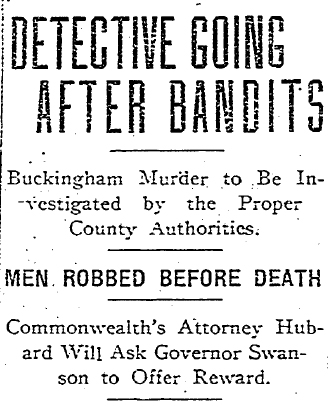
On April 21, 1909, The Times-Dispatch printed a lengthy report about the murder of the Stewart brothers. Buckingham County’s Commonwealth’s Attorney, Edmund W. Hubard, announced that he would approach the Governor, asking him to offer a reward for the capture of the criminals. The newspaper published the attorney’s statement as follows:
“In addition to the efforts that I will make personally with the aid of the county officers,” said Mr. Hubard last night, “I will see the Governor before leaving [Richmond] and get him to offer a reward for the apprehension of the criminals. As soon as I reach Buckingham county I will call a special meeting of the Board of Supervisors for the same purpose. I feel certain that all of the other county officers will do all in their power by way of cooperating with me to bring the perpetrators of the deed to justice.”
Buckingham’s coroner was convinced that the men were murdered. Yet, at the inquest, according to The Times-Dispatch, some persons present “were inclined to push the theory that their death was accidental.” Dr. Lightfoot Morris, however, satisfied the jury that the Stewart brothers were murdered. The presence of “shot” in the skull of each man determined the cause of their death. While the fire had charred the bodies beyond recognition, a discharged shotgun and a pistol were found in the remains of the cabin.
The Times-Dispatch also printed a firsthand account of the event which, interestingly, is never reported again:
The nearest thing to an authentic account of the affair comes from Mrs. Thomas Wright and her daughter, Mrs. Lithgoe of Henrico county, who was spending some time with her. Mrs. Lithgoe stated that at 2 o’clock Sunday night she got up for the purpose of giving medicine to her mother and looked out of the window. Again, between the hours of 3 and 4 o’clock, she got up. This time she saw a bright light in the direction of the Stewart cabin. She immediately aroused her brothers, who ran to the cabin. When they reached the place the house had fallen in, though the figures of the men were seen crouched up in the flames.
“No arrests have been made,” the article continued, “though there is strong suspicion that the perpetrator of the crime is a white man. Contrary to reports, there is little excitement in any part of the county except in the neighborhood in which the murder occurred.”
Apparently, the citizens of Buckingham County did not feel this was the beginning of a crime spree. From today’s perspective it’s hard to imagine precisely what about the nature of the crime led citizens and/or officials to suspect a white man was the murderer.
Governor Swanson responded immediately to Attorney Hubbard’s request, authorizing a reward of $500 for information leading to the arrest of the murderers. The equivalent of over $13,000 in today’s dollars, this was an impressive sum.
Coming Next: Arrests Made
Need to catch up on The 1909 Buckingham Murders? Part I: June 1, 2015

Antioch Baptist Church, Courtesy Historic Buckingham
The Stewarts and Antioch Baptist Church
The Stewart land was located on Tower Hill Road, near Antioch Baptist Church. Were the Stewarts church-going men? How were they perceived by their neighbors?
Currently, no church affiliation is known for the Stewarts; however, according to The Courthouse Burned – Book II, in about 1893, Thomas “Stuart” sold some of his land for the building of Antioch Baptist Church, charging $3.40 per acre.
Within three days of the brothers’ death, the Alexandria Gazette and Virginia Advertiser reported on April 20, 1909, “Both men were prominent in the community, and were bachelors.” The coverage of the murders concluded, “If the murderers are caught trouble is expected as the dead brothers were much respected.”
Conversely, Richmond’s The Times-Dispatch stated that while the Stewart brothers didn’t cause trouble and were considered harmless, they were not “desirable citizens.” Over the coming months, the newspaper would call their cabin “dilapidated,” describing their home as situated in a “thinly settled” and “secluded part of the county.” The newspaper repeatedly identified the Stewarts as “miserly” and claimed that the men were not “generally known by the county people.”
Which to believe? If the Alexandria Gazette was correct, The Times-Dispatch failed to draw positive portraits of the brothers and report on community support for them personally. The focus, instead, would remain on the brutality of the crime.
Coming Next: “Governor Offers Reward”
Need to catch up on The 1909 Buckingham Murders? Part I: June 1, 2015

1900 Census Buckingham County — The “Stuart” Brothers
The Stewarts of Buckingham County
Virginians Thomas and William Stewart had likely lived in Buckingham County most of their lives. In 1900, nine years before their murder, they were enumerated as Thomas and William “Stuart.” Thomas, born in August of 1847, was the head of the household and gave his occupation as a farmer. William, his elder brother, born in November of 1845, gave his occupation as a farm hand. They owned their farm. Living with them were two black boys, born in April of 1888 and in July of 1891. According to the enumerator the boys used the last name “Stuart”; their first names are illegible. They are both identified as “farm hands.”
What would have incited the murder of these two men in their sixties?
The brothers had a reputation as misers. On April 21, 1909, Richmond’s The Times-Dispatch printed the rumor that the Stewart brothers were believed to be hording riches and stated that their father, James W. Stewart, had been a slave trader.
According to census data, James W. Stewart was born in Campbell County, Virginia in about 1813. Land tax records indicate that he bought two parcels, 15 + 216 acres, in southeastern Buckingham County in 1836, selling the land by 1838. In 1844, he and Daniel Brown bought 50 acres on Buck and Doe Creek, nine miles west of the courthouse, from Zedekiah Brown. In 1851 and 1858, Stewart acquired more acres on Doe Creek from Zedekiah Brown’s estate, including Mrs. Judy Brown’s dower interest. The place was identified as “Mountain Home.” The Stewarts’ immediate neighbors are familiar Buckingham surnames – Scott, Jones, Kitchen, Ragland, and McCraw, among others.
In 1850, James W. Stewart and his wife, Lucinda, lived with their sons, William (5) and Thomas (2). By 1860, Stewart (enumerated as “Steward”) owned only $500 worth of real estate; however, he reported $15,000 worth of personal property, most of which could be accounted for in the value of eleven male and six female slaves, aged two to forty, living in three houses. That year, he produced 5,000 lbs. of tobacco and other crops. The farm produced 100 lbs. of butter from milk cows. Based on the agricultural census, James Stewart appears to be a modest but successful farmer. Currently, it is unclear why Stewart owned so many slaves to work a relatively small farm.
In 1870, at the age of fifty-seven, Stewart’s real estate was valued at a mere $196 and his personal property at only $160. His wealth, apparently based almost entirely in human property, had been lost with emancipation.
By 1880, James W. Stewart tilled only 15 acres of his roughly 150 acre farm, valued at $300. In these diminished circumstances, his sons may have begun cutting wood and selling ties to the railroad across the James River.
Coming Next: The Stewarts and Antioch Baptist Church
Need to catch up on The 1909 Buckingham Murders? Part I: June 1, 2015
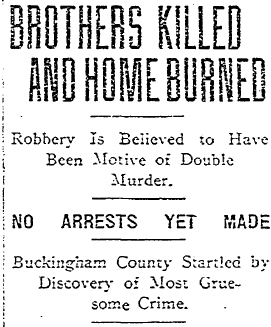
The Slate River Ramblings post concerning the brutal murder of Curtis Nunley Branch, night watchman at the Mateo Post Office, mentioned the murder of the Stewart brothers several years earlier.
Undoubtedly, the murder of the Stewarts was one of the most sensational in the history of Buckingham County. The twists and turns of the resulting trials held the public’s attention for over two and a half years. The Richmond newspapers closely followed the developments and coverage extended throughout Virginia at least as far as Alexandria, to Washington DC, and to Baltimore.
In the coming weeks, highlights of this complicated and sometimes shocking story will be serialized at Slate River Ramblings. Feel free to comment as the tale unfolds. If you recognize the Stewart brothers, please contact me. Their mother may have been a Jones or a Brown. At the time of their death, however, apparently no kinfolk were involved in the search for their murderers.
~
On April 17, 1909, Thomas and William Stewart were brutally murdered in their home, which was burned to the ground with their bodies inside. The brothers lived in southwestern Buckingham County near the Appomattox County line. Three men, one white and two black, were eventually charged with the crimes of murder, robbery, and arson in connection with the death of the Stewart brothers.
From the outset, newspaper coverage was lively. On April 20, 1909, Richmond’s The Times-Dispatch broke the story, reporting that the Stewart brothers were burned “to an unrecognizable mass of flesh and charred bones.” The following day, the newspaper printed informative background about the two men:
Among the ignorant people of the county it has been supposed that the Stewarts had a large amount of money in their cabin, though they never gave any evidence of being hardly more than paupers, so low was their scale of living. It is thought that the motive of the killing was the hope of finding the hoarded treasure.
The men lived in a cabin on the Tower Hill Road, near Antioch Baptist Church, not far from the Appomattox line, in one of the most respectable sections of the county. They made their money by cutting [railroad] ties and dealing in a small way in lumber. Their father in the old days was a slave trader and is reputed to have left them a large amount of money, to which they have added from their earnings in the woods. They had never been in any trouble and were considered harmless though not desirable citizens.
In the weeks and months following their murders, the Stewart brothers were described primarily as solitary bachelors, uninvolved in the community around them. Whose wrath did they invoke and why? Was robbery really the motive? Why destroy their home and their meager possessions? Was it, as the newspaper suggested, to cover traces of the crime and make the deaths appear accidental?
Coming Next: The Stewarts of Buckingham
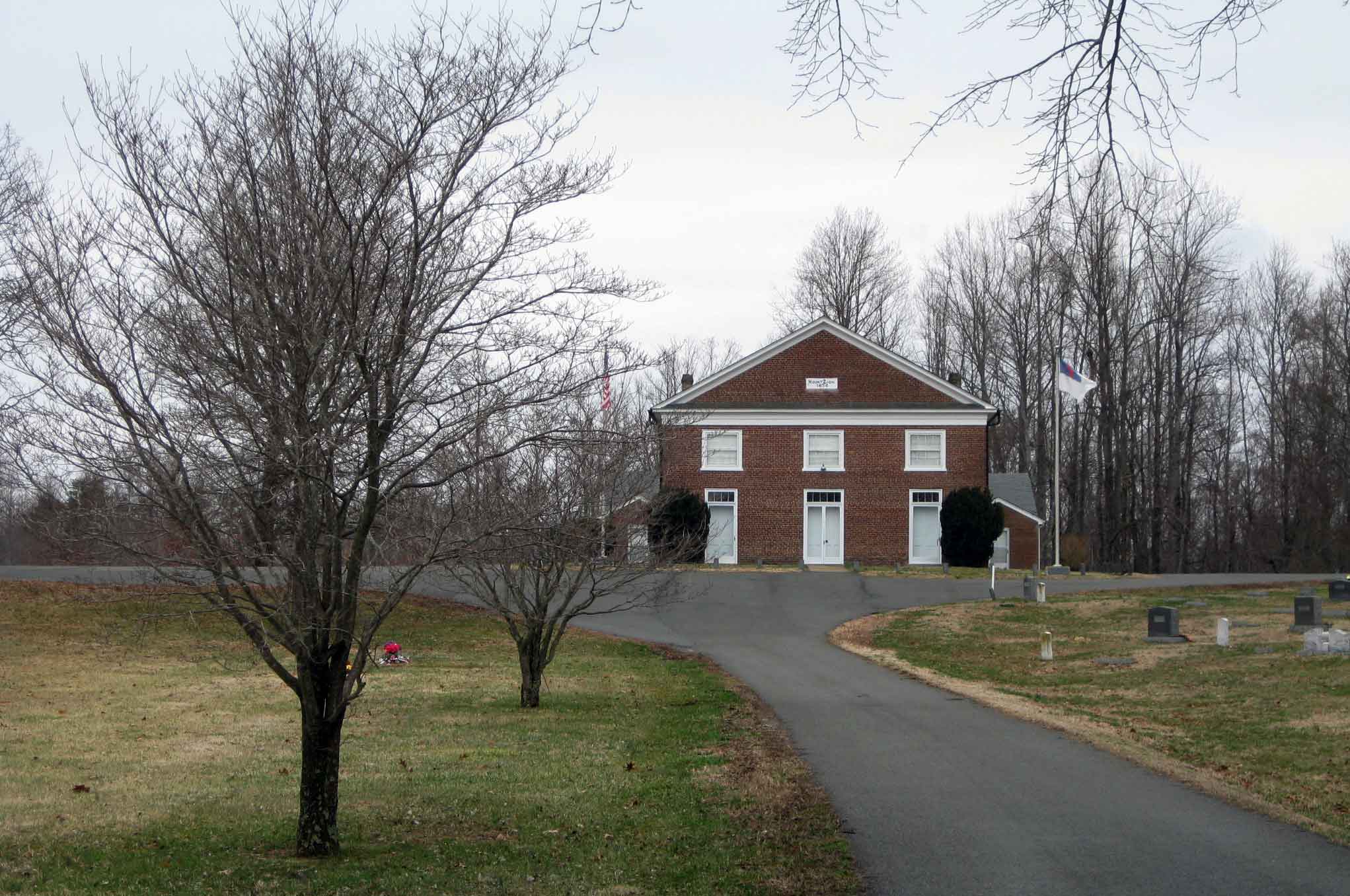
Mt. Zion Baptist Church, Photo by Joanne Yeck
Beginning in 2013, I attempted to identify nineteen Buckingham County churches referred to (but not named) in Thomas Baldwin’s Gazetteer of the United States (1854). My final post, Buckingham Mystery: The 19th Church, contains links to the eighteen of the churches.
Less than ten years later, by 1863, there were at least two dozen churches and chapels identified on the map created by Charles E. Cassell. Lebanon Chapel is gone and Hanes Chapel has replaced its nearby predecessor, Stony Point. The map is incomplete. There are no churches, for example, identified at the Court House; yet, Maysville Presbyterian was constructed in 1838, making it one of the nineteen churches in Buckingham in 1854.
The list below, gleaned from the 1863 map, was contributed by Slate River Ramblings follower and Buckingham native, Ed Ayres, who has questioned a couple of hard-to-read names.
Bagby Church
Bethel Church
Buckingham Church
Cedar Church
Centenary Church
Chestnut Grove Church
Concord Church
Goosberry Church
Hanes Chapel
Jones Chapel
Liberty Church
Maple Church
Mountain Church
Mt. Zion Church
Mulberry Grove Church
[New Canton] Church
Presbyterian Church
Rocky Mt. Church
St. Peters Church
Saints All Chapel [?]
Salem Church
Sharon Church
Smyrna Church
Union [?] Church
Wesley Chapel

John C. Calhoun by George Peter Alexander Healy
Historic newspapers frequently contain peculiar tidbits and attitudes of the past, including this unusual declaration made at Buckingham Court in 1847:
“Honor to whom honor.”
Dr. C.R. Fontaine, of Buckingham, puts in his claim for the somewhat doubtful honor of having been the first to suggest the annexation of Texas: and, it will be seen, by the annexed certificate, that his claim is supported by strong testimony:
We hereby certify that Dr. C.R. Fontaine was the first person we ever heard speak or write of the propriety of annexing Texas to this Union – let him have been in public or private life. This was many years ago, and we thought strange of the position he took in public or private conversation on the subject.
Yet it appears to be about to be falsified by the destiny of the nation, strange as we then thought it.
(A Copy,) signed,
JAMES W. BROWN, THOS. H. WORD, B.L. WORD, E.G. JEFFERSON, ADAM LONG, JAS. DYSART, A.G. WORD, JOHN HILL, WM. H. TAPSCOTT, JOHN JONES.
June Buckingham Court, 1847.
P.S. – So you see Mr. Calhoun or no other person can claim credit of the above origin. C.R.F.
The press of Richmond, the Union in Washington, and other papers will please copy through the U. States. C.R.F.
E.G. Jefferson was Rev. Elbridge Gerry Jefferson, grandson of Randolph Jefferson.
Recognize any other of Dr. Fontaine’s friends and neighbors? If so, please comment.


 slate river ramblings . . . .