

John M. Harris Farm (2009), Photo by Joanne Yeck
During the 19th century, private schools for young ladies and gentlemen came and went in Buckingham County. Previous posts at Slate River Ramblings highlighted Rock Mill Academy, Homer Male Seminary, Oak Grove Academy, and others. Many are yet to be discovered.
In 1840, my ancestor, Col. John M. Harris, operated a school on his Sharps Creek plantation in the northeastern part of the county. The name of the school remains unknown, though the 1840 census offers statistical details. That year, thirteen students were enrolled and an unidentified mature man (age sixty–seventy) was living with the Harris family. He may have been the school master.
The Harris family’s oldest children were likely taught there, in addition to the youth of the neighborhood and, possibly, boarders. While the specifics of Col. Harris’ own schooling are unknown, he was a well-educated member of Trinity Presbyterian Church, a Justice of the Peace, and a Colonel in the Buckingham County Militia. He and the older gentleman were identified on the census as “learned professionals.”
It is not known how long this school operated; however, by 1845, it was reconceived and advertised in the Richmond newspapers as East Farm Female Seminary.
Next: East Farm Female Seminary
Mark Your Calendar!
15 March: Presentation, Book Signing, and Reception
Place: Maysville Presbyterian Church
12945 West James Anderson Highway
Buckingham Court House
Time: 2:00 PM
17 March: “The Joys and Challenges of Historical Research”
Panel Discussion with Shelley Murphy
Place: Library of Virginia, Conference Room
800 East Broad Street, Richmond
Time: Noon – 1:00 PM
20 March: Book Signing at Baine’s Scottsville & Appomattox
Place: Baine’s Scottsville, 485 Valley St., Scottsville
Time: Noon – 1:00 PM
Place: Baine’s Books & Coffee, 205 Main Street, Appomattox
Time: 3:00 – 4:00 PM
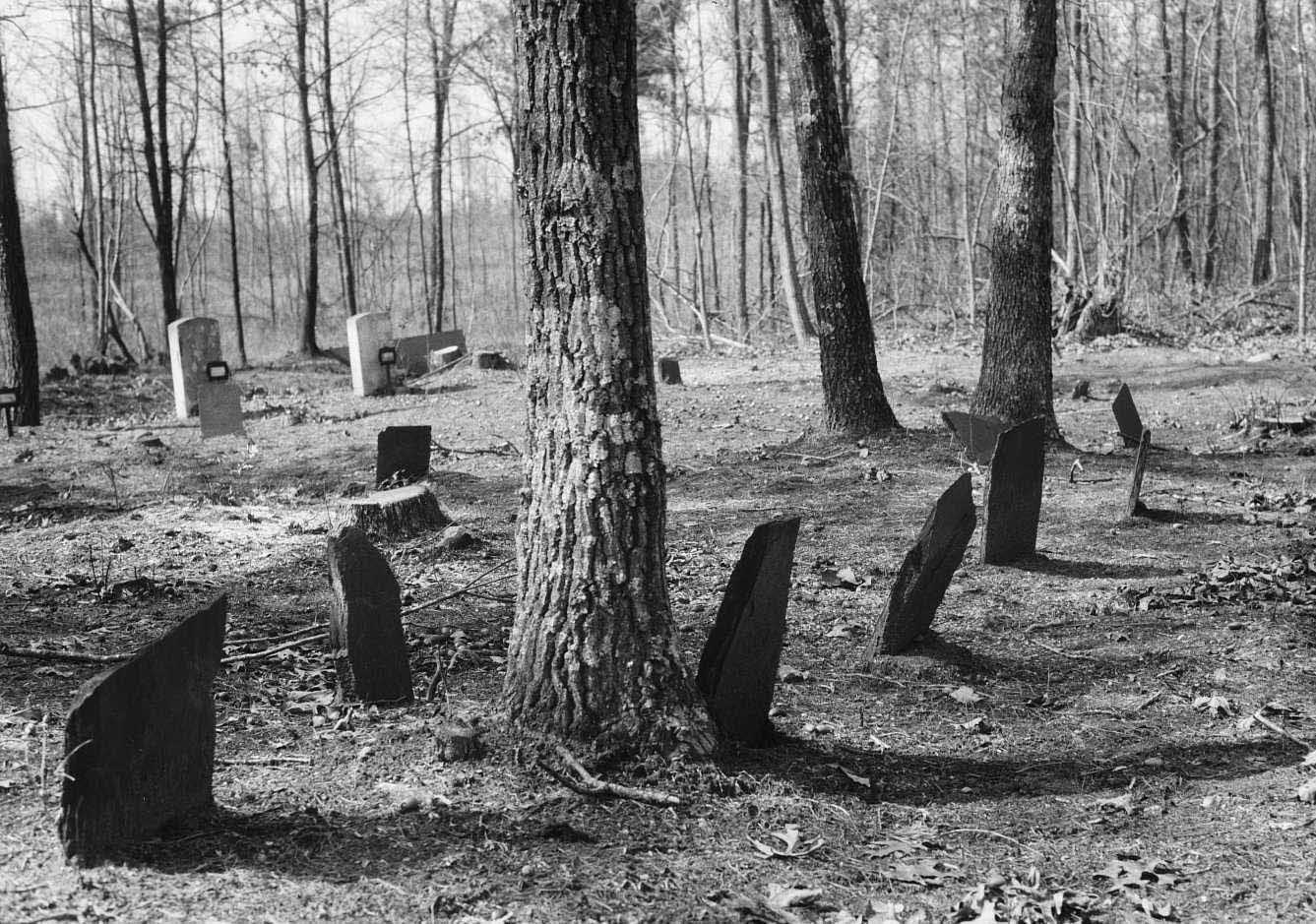
Stanton Family Cemetery, Courtesy Virginia Department of Historic Resources
In 1993, the Stanton Family Cemetery in Buckingham County was added to the Virginia Landmarks Register and the National Register of Historic Places. The cemetery was established by an Antebellum Free Black family and is located in the northeastern section of the county, about five miles south of the James River on the east side of Route 677.
According to the Nomination form for the National Register:
The Stanton Family Cemetery, approximately sixty-eight by sixty-five feet, contains at least thirty-six burials and is large for a rural African-American family cemetery. Its layout features six rows spaced from one to five feet apart and varying in size from two to nine irregularly spaced graves. Most graves have both head and footstones and two children’s graves are identified by their small size. All are oriented on an east-west axis — an old tradition particularly pervasive in African-American cemeteries. The cemetery was overgrown with vegetation for many years and some markers have become partially dislodged or are leaning, but there has been little disturbance of the cemetery.
The Stanton family has traced its roots in Virginia back to 1820. In 1853, Daniel and Nancy Stanton purchased 46.5 acres of land in northern Buckingham County from H. C. Hill. Nancy Stanton is the first known internment in the cemetery. Daniel Stanton farmed this land. According to the 1850 census, two of his sons were boatman.
In addition to farming and working the river, the Stanton men worked as blacksmiths, carpenters, soldiers, and quarrymen.
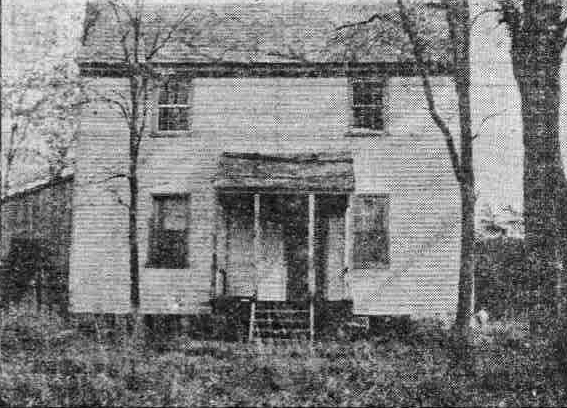
Old Castle, Arvonia, 1936
The 1936 story in the Richmond Times-Dispatch continued, describing “The Old Castle,” home to many Welsh immigrants.
“Old Castle” Stands Alone in Barren Quarry
In the midst of the quarries today stands a lonely, shabby old building that through all the years has been “The Old Castle.” There M. E. Jones lived. Here 40 Welsh quarrymen were boarded for a long time.
Here was held the first Sunday School, the first prayer meeting service for the Welsh people are devoted to their religion. They are fond of singing hymns, and reciting poetry, and have meetings called “Eisteddfods,” where they enjoy competing in these two activities.
When the services grew too large for the Old Castle to hold the attendance, loyal hearts solicited funds to build the first church, a little chapel that held 300 persons, strangely, yet appropriately called “Bethel.”
As the years passed, old age came on the most robust, as well as the frailer flesh, and so they began to lay these “strangers within a strange land” within the shadow of the little chapel. There must have been many a pang of longing for the hills of the Landberis (sic), Wales, from which many had come as these sojourners felt the end drawing near.
Walking in the silent rooms of the “Old Castle,” one thinks of the many reunions that took place there, as kindred and friends came over to join their loved ones. What eager inquiries, what tender reminiscence, what sacred confidences exchanged. But its walls are as quiet as the grave, so far as any revelation of those days long past are concerned.
Recognize “Old Castle”? If so, please comment.
Note: The article is unsigned; however, it is reminiscent of the prose of Buckingham County historian Lulie Patteson.
On March 29, 1936, the Richmond Times-Dispatch ran a full-page story in the paper’s Sunday Supplement section about the history of Arvonia, Buckingham County. It began with a brief description of the discovery of the slate in the region:
Arvonia Slate Quarries in Buckingham County
Produce Finest Type of Rock Known
Sprawled over the rough, wooded hills on both sides of Hunt Creek in the eastern part of Buckingham County, down in Old Virginia, is the slate quarry “settlement” of Arvonia, the site of what is said to be the finest slate region in America.
Far back in the early days of Buckingham history, two Englishmen, Edmond Sims and Robert Chatman, first noticed the slate formation of the ridges and bluffs around them. They put their slaves to work digging deep pits in the slaty rocks, (for that was long before the War Between the States), and they took from the sides of the pits great blocks of the stone. Then they used “Niggerhead” rocks to break the blocks to a size small enough to be carried on the shoulder.
But there was no large quarry opened until M. E. Jones and Hugh Hughes of Carnavonshire, North Wales, came to Virginia. These men opened the first quarry of any size. Many Welshmen from the Northern States, then came to Buckingham to work in this quarry, and the one opened by two other Welshmen, John J. Roberts and J. E. Edwards. Quarrymen from Wales then began to come over to share in the enterprise.
Soon the settlement grew to a size where a name was necessary, and these Welsh emigrants, homesick no doubt for the slaty hills of their own homeland, called it “Arvon” after Carnavonshire in Wales. Later the place was called Arvonia, but the railroad station is still “Arvon.”
To be continued . . . .
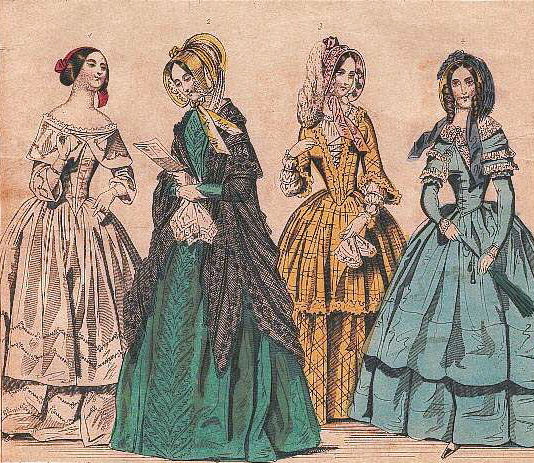
Fashion Plate, August 1844
The Buckingham High School for Young Ladies operated at Buckingham Court House for at least a decade. During the 1830s, the founders and Principles, John and Laura P. Fairchild, ran advertisements for the High School in the Richmond newspapers.
Sometime before 1844, the Fairchilds apparently discontinued their school and made their buildings available to Mr. and Mrs. Meany, formerly of the “Lynchburg Institute for Young Ladies.” On November 5, 1844, the Meanys ran this advertisement in the Richmond Whig. Given the date, they still had places to fill!
BOARDING AND DAY SCHOOL
FOR YOUNG LADIES,
At Buckingham Court House, Va.
Mr. & Mrs. Meany, who formerly conducted the “Lynchburg Institute for Young Ladies,” propose to open a Boarding and Day School for Young Ladies on Monday, November 4th, 1844, at this place.
The instruction will be explanatory in a high degree, and adapted in all cases to the comprehension and proficiency of the pupil; and the understanding of the young ladies will be exercised, and their judgment matured, by a well-selected a rigorous course of Mathematical and Natural Sciences, calculated to secure a habit of close attention and accurate reasoning.
The School will be supplied with the instruments necessary for the proper illustration of the subjects requiring such aid, and every facility will be offered to acquire a liberal and thorough education. The buildings are suitable and commodious, being those formerly occupied, and build expressly for a Female School, by the Rev. J.P. Fairchild.
According to tradition, the academic buildings burned about two years later. It is currently unknown if the Meanys were conducting school there at that time.
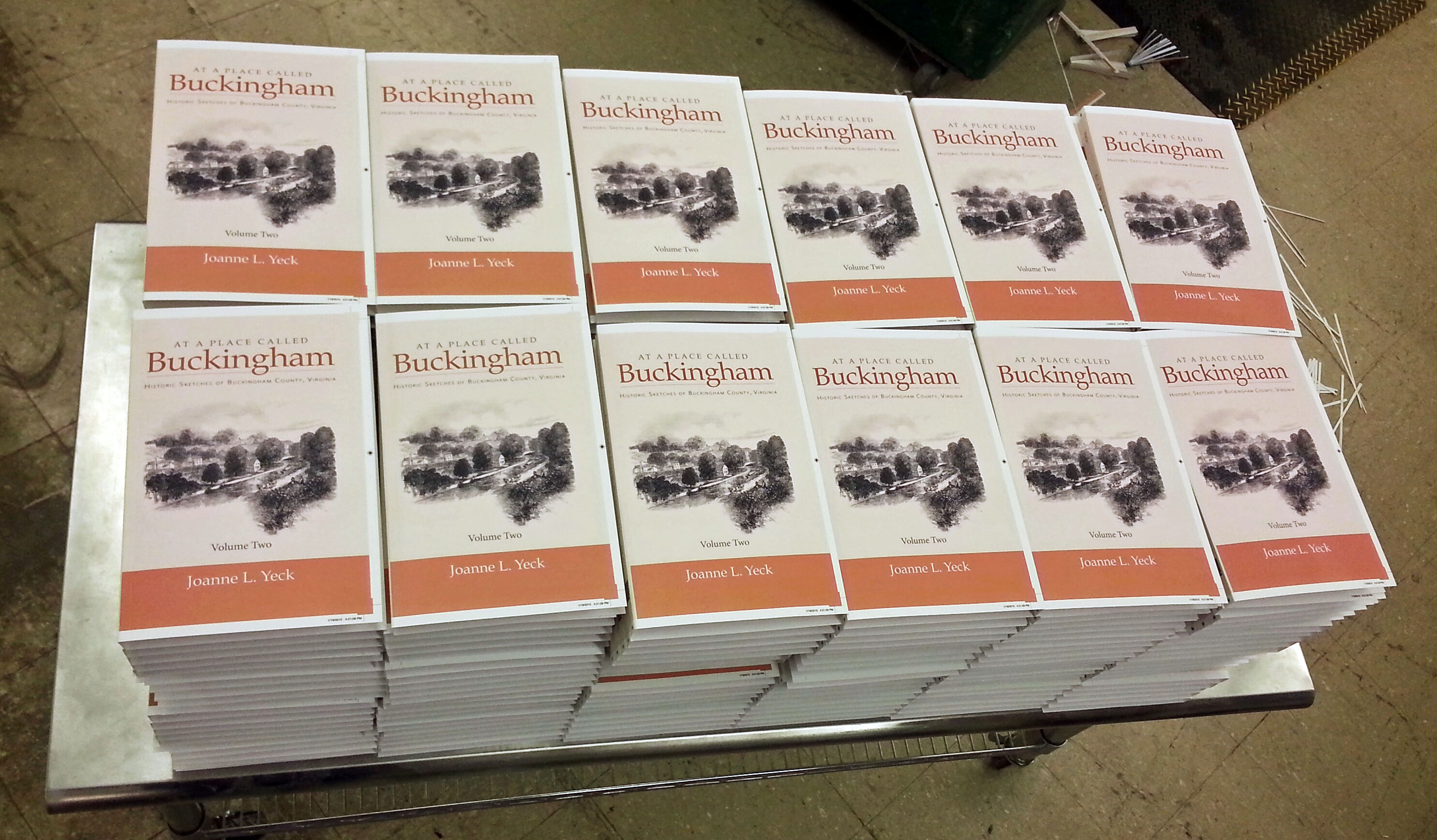
Photo by David Braughler @ Greyden Press
“At a Place Called Buckingham” – Volume Two
Bound and ready to box!
Available March 15, 2015 from Slate River Press.
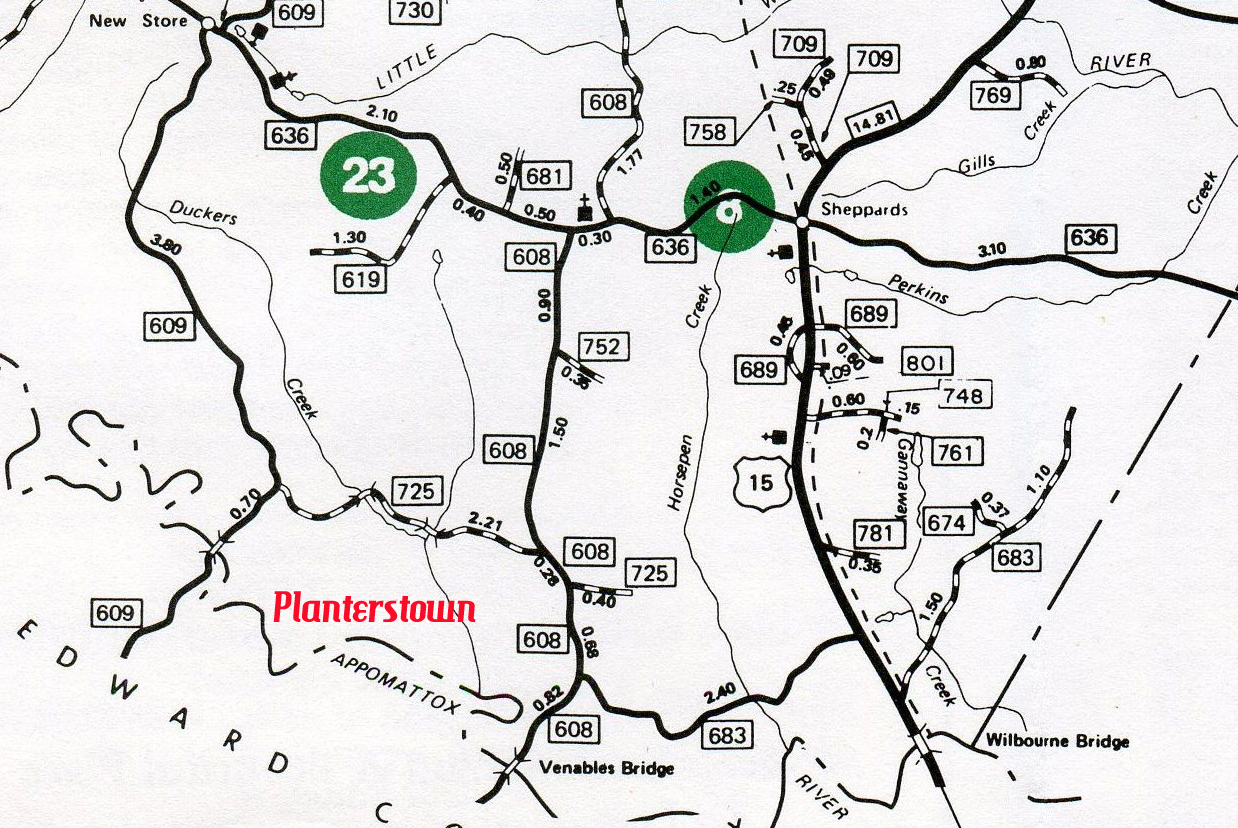
In Genealogical Records of Buckingham County, Virginia, Edythe Rucker Whitley published a lengthy transcription of John Epperson’s Day Book, which she saw in 1930.
She also related the story of his death: “Epperson was killed in a stage coach accident about 1806. The widow [Elizabeth Ann “Betty” Woodson] married Claiborne West and they removed to near Hopkinsville, Kentucky.”
Epperson’s years of commerce at Plantersville resulted in a wide and honorable reputation; his obituary ran in the Richmond newspapers:
Departed this life at Planter’s Town (Buckingham county) on Tuesday the 20th ult. JOHN EPPERSON, Esq. late a merchant of that place.
In his death his much afflicted family has sustained an irreparable loss, and society also hath lost a truly valuable member. For industry and integrity he was exemplary; his uniform good moral conduct produced a calmness and serenity in his last short, but painful illness, peculiar to conscious rectitude.
Although he filled no high office under government and claimed not the reputation of being either learned or witty; all who had the pleasure of his acquaintance acknowledged him an honest and most respectable man; such a man as probably occurred to the celebrated poet, who so elegantly expressed this important truth: that
“A wit’s a feather–and a chief’s a rod.
“An honest man’s the noblest work of God”
Enquirer, 8 July 1806
To read more about Buckingham County’s town on the Appomattox River, type Planterstown in the search box to the right and enjoy the results!
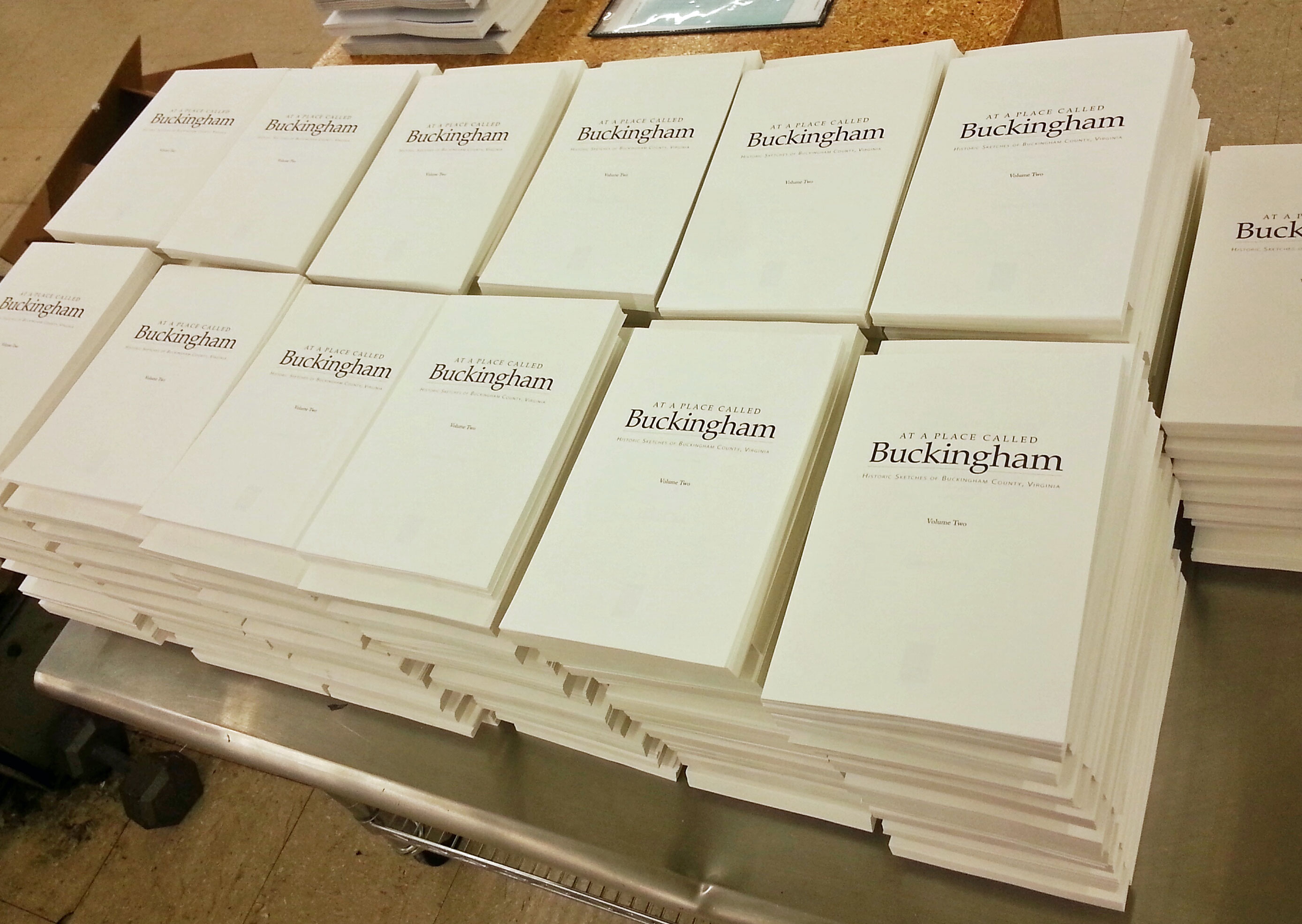
Photo by David Braughler @ Greyden Press
The presses are rolling! “At a Place Called Buckingham” – Volume Two is in production.
Available March 15, 2015 from Slate River Press.
Coming soon: The 2015 Virginia Book Tour.

Elizabeth McCraw, in her 1937 survey of Planterstown, described a bustling river town at the turn of the 19th century. She quoted a mutilated, surviving Day Book kept by John Epperson who ran a tobacco warehouse and a general store. It was filled with the names firms and individuals who conducted business at Planterstown.
Firms included: Brown Reives & Co., Dunlop Pollok & Co., Farrar & Lackland, John Johns & Co., Willis Wills & Co., Sharks & McRae, W. Irvin & Co., and Hughes Allen & Co.
Tobacco Warehouses: Dean’s, Epperson’s, and Johnson’s
The accounts are peppered with the oldest names in Buckingham County, including: Anderson, Bell, Cox, Curd, Childress, Coleman, Eldridge, Flood, Gannaway, Gilliam, Guerrant, Harrison, Hooper, Johns, Moseley, Saunders, Seay, Tapscott, and Watkins.
Next: John Epperson of Planterstown


 slate river ramblings . . . .