

Rolfeton (2013), Courtesy Longwood University, Archeology
Recently, Lynn Henshaw shared some very good news about the future of the dwelling house at Rolfeton, once one of Buckingham County’s finest homes. She, Dr. Brian Bates (Longwood University, Archeology), and Historic Buckingham are developing plans to move Rolfeton to Buckingham Court House village. Rolfeton would be relocated behind Housewright House Museum, owned and operated by Historic Buckingham. After “a thorough cleaning and a coat of paint,” Rolfeton would house Historic Buckingham’s research collection.
Visit Longwood Archeology’s Facebook page and learn more: Longwood Archeology
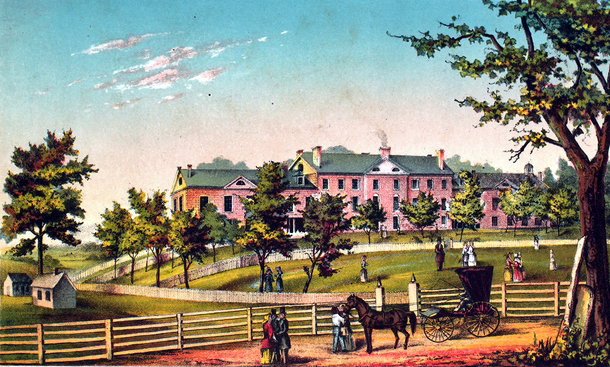
Buckingham Female Collegiate Institute
Those of you who follow Slate River Ramblings via the Slate River Press Facebook page will recognize the image above of the Buckingham Female Collegiate Institute. Used to illustrate “The Buckingham Polka” composed by the Institute’s music teacher, Arnaud Préot, this image also appeared with the chapter “A Noble Idea: Buckingham Female Collegiate Institute,” in “At a Place Called Buckingham.”
The drawing was executed by Rev. Henry James Brown (1811-1854), a Methodist minister and fellow instructor at the Institute. He also served as vice-president of its board. Born in Cumberland County, Brown began painting when he was about sixteen years old, eventually studying with the renowned artist Thomas Sully. In 1833, Brown married Susan Ann Hobson and together they had eight children. In 1850, they were living in Buckingham County adjacent Dr. John C. Blackwell, President of the Institute. In 1854, Brown died at the Institute at that age of forty-two.
To learn more about the college, type Buckingham Female Collegiate Institute in the search box.
Special thanks to John Ayres Greenlee for adding to my knowledge of Rev. Brown.

Celebrate Independence Day!
. . . by learning more about Thomas Jefferson and his lesser known brother, Randolph, Squire of Snowden and Citizen of Buckingham County.
The Jefferson Brothers introduces Randolph Jefferson, bringing him out from the shadow of his famous sibling, focusing on the years during which their paths crossed. Over twelve years Randolph’s senior, Thomas Jefferson stood in for the father his brother never knew, guiding his education and helping the younger man establish himself as a successful planter in central Virginia. Randolph’s life at Snowden, during and after the American Revolution, illuminates everyday world of planters in central Virginia. Additionally, The Jefferson Brothers introduces a new Thomas Jefferson, not the great statesman of monumental intellect, but the thoughtful brother and dedicated farmer.
For Sale:
Buckingham: Housewright Museum (U.S. Route 60, in the village of Buckingham)
Scottsville: Baine’s Books and Coffee (485 Valley Street)
Charlottesville: Albemarle Charlottesville Historical Society (200 Second Street, NE)
Appomattox: Baine’s Books and Coffee (205 Main Street)
Not in Virginia?
Order online from Braughler Books.
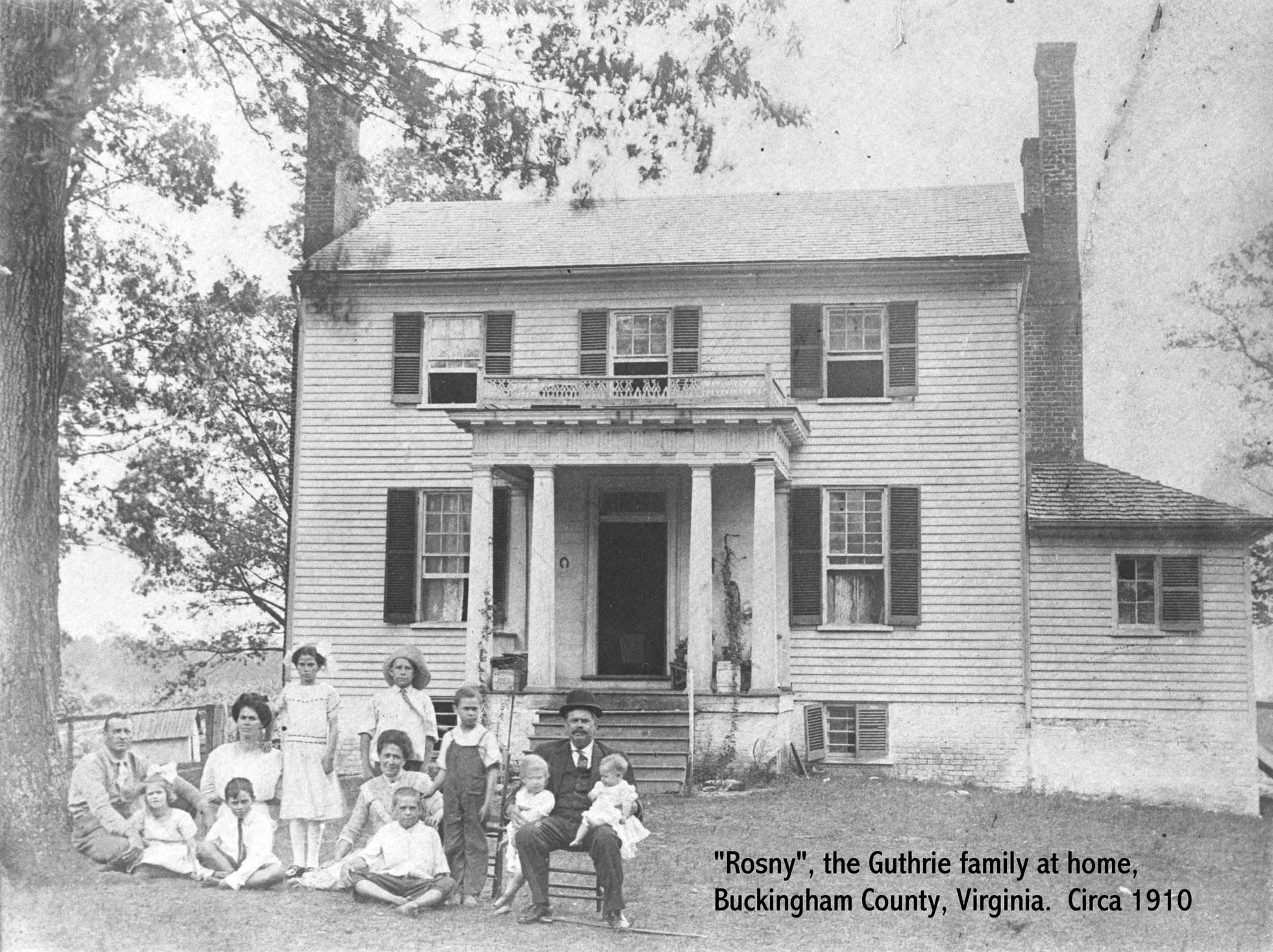
Courtesy Forrest Guthrie Family and Mary Carolyn Mitton.
According to Mary Lou Guthrie: Forrest Guthrie is seated next to the tree. Louzanie is seated next to him. Forrest Jr. is seated next to Louzanie, in front of his mother Mary Frances. Next to Mary Frances is Mary Eliza, her first born. John Yancey Spencer is seated in the chair.
~
When this photo was copied in the 1990s, it was the property of Forrest Guthrie, III and persons in the photo were identified as follows by Forrest “Monk” Guthrie (1924-2011) and Elizabeth Jane “Tizzie” (Dunkum) Charlton Guthrie (d. 2013):
Forrest Guthrie; Louzanie Guthrie; Mary Frances “Dixie” (Spencer) Guthrie; Mary Eliza Guthrie; Mary Frances (Spencer) Guthrie’s brother, John Yancey Spencer; and Mildred “Minnie” Walker Spencer.
The Guthries, however, were not specific as to which name went with which individual.
Mary Carolyn Mitton believes that the man in the chair is Forrest Guthrie (1899-1936) and that the woman seated closest to him is likely Mary Frances “Dixie” Spencer Guthrie (1875-1946). The man seated by the tree is probably John Yancey Spencer (1866-1917).
Can a Slate River Ramblings reader identify precisely who’s who?
Corrected: 12/9/2019
Powhatan Bolling’s mother lived at Chellowe, one of Buckingham County’s finest homes. According to Garnett Williams’ 1937 survey of “Rosney,” mother and son had their differences:

Chellowe, 1936
As both he and his mother were very peculiar and could not agree on anything she decided to build this place (Rosny) for him on the extreme end of her plantation, so there would be some distance between them, it is said they quarreled more about ministers spending the night in the home than any other one thing, so he asked, that she put the house as far away from a public road as possible.
It is told that a Colporteur once rode up to Powhatan Bolling’s place, not knowing where he was, Powhatan went out and spoke to him.
Having heard the hatred that Powhatan had for anyone connected with religious work, he asked, “Do you know where Mr. Powhatan Bolling lives?”
He said, “Yes, why do you ask?”
The man hesitated and said, “Well, I do not care to go to his home as I have been told he was the meanest man in this country.”
Bolling replied, “I am Powhatan Bolling, and there is the road.” It is said he did not have to speak the second time.
Some colporteurs were peddlers of books or newspapers; others were employed by religious societies to distribute Bibles or other religious tracts. This particular fellow was likely the later.
Does a Slate River Ramblings reader have a kinder story to tell about Powhatan Bolling? If so, please leave a comment.
Coming Next: Rosny: The Guthrie Family

Courtesy Library of Congress
In 1937, Garnett Williams surveyed Rosny (a.k.a. Rosney) for the Virginia Historical Inventory, writing:
Rosney is a lovely old estate, it is one of the better types of homes. It is splendidly built and of the very best material. It stands among very large oaks, the yard consist(s) of four acres of ground. The wood work in this house is very pretty, and [has] a lovely wide winding stairway. Nothing added since 1835.
Mrs. Williams goes on the say that the house was built for Powhatan Bolling by his mother. Bolling occupied the home in the late 18th century, followed by members of the Bolling-Hubbard family.
The drawing above is part of the marvelous Historic American Buildings Survey (HABS) collection at the Library of Congress.
Coming Next: Powhatan Bolling

Caroline Baker (Ellett) Littlepage with Lucy Littlepage, by John Toole (1815-1860)
Courtesy Louise Eichhorn Schroede and Virginia Historical Society
Slate River Ramblings usually focuses on Buckingham County and its immediate surroundings; however, a new blog, “Caroline’s Journal,” may be of interest to many readers.
This month, Bibb Edwards began posting the journal of Caroline Baker (Ellett) Littlepage of King William County, Virginia. The family’s plantation was Woodbury on the Mattaponi River.
Over the next three years, the blog posts will follow day-by-day, Caroline’s journal entries, offering many insights to everyday life during and immediately following the Civil War. Bibb Edwards writes in his introduction to Caroline’s journal:
Mrs. Caroline Baker [Ellett] Littlepage, born 1810, of Woodbury in King William County, Virginia, kept a journal for many years in the mid-1800s. Her most complete known volume – 1 June 1864 to 22 June 1867 – and a wonderful transcription, were generously donated in 2003 to the Virginia Historical Society (Mss5:1 L7332:1) by Louise Eichhorn Schroeder and Dudley M. Eichhorn in memory of their mother, Ruth Littlepage Barnett Eichhorn. In order for Caroline’s voice to reach a wider audience, each of her entries will be posted here on the 150th anniversary of the day they were recorded, beginning 1 June, 2014.
Just as with Slate River Ramblings, you can subscribe to the blog and have posts delivered to your email inbox.

Tucker School (c. 1890), Revis Leigh (Baber) Eckler Collection, Courtesy Carole Jenson
Pictured:
Back Row: Second from left, Hay Norvell; third from right, Fanny Norvell.
Center Row: Third from left, Julia A. (Tapscott) Moseley, teacher; fourth from left, Gracie Norvell; fifth from left, Julia B. Tapscott; sixth from left, Allan Walker Tapscott; far right, Lily Leigh Norvell.
Front Row: Far left, Bernard Miller Norvell; second from left John Hal Norvell.
Today’s post doesn’t merely provide Slate River Ramblings readers with a superior image of the class at Tucker School, c. 1890, it also demonstrates the important results of sharing personal collections. Buckingham County researchers Jeremy Winfrey and Carole Jensen continue to pool and compare their resources concerning families living near Diana Mills and Sharps Creek in northeastern Buckingham County. Both families saved this particular photo. As it turned out, Carole’s was in much better condition. Click here to compare it to the Winfrey family copy: Tucker School.
Not only is the Winfrey photo significantly more deteriorated, but the owner, Julia B. Tapscott, had scratched out her own face, presumably displeased with her photo.

Courtesy Library of Virginia
Above is the 1894-1895 “Census of Colored Teachers,” listing the African-American teachers in Buckingham County. Note that there were considerably fewer African-American teachers (24) than there were White teachers (62) working in the county.
Members of the Lomax family of Buckingham Court House were leaders in Buckingham County’s education of African Americans. In 1894-1895, three of them were teaching at the county seat: Mr. Edward S. Lomax, Mr. E.W. Lomax, and Mrs. Josephine Lomax. Edward S. and Josephine Lomax were married. E.W. Lomax was their son, Eugene. By 1900, their son, Clarence, was also teaching school in Buckingham.
Mr. James B. Riddle of New Canton also appears on the census. He was the uncle of Dr. Carter G. Woodson and, in 1926, helped establish Liberty School. The two-room schoolhouse was located near Third Liberty Baptist Church in New Canton and was built at a cost of $2,400.
Click on the image to enlarge it.
If you recognize a teacher, please leave a comment!
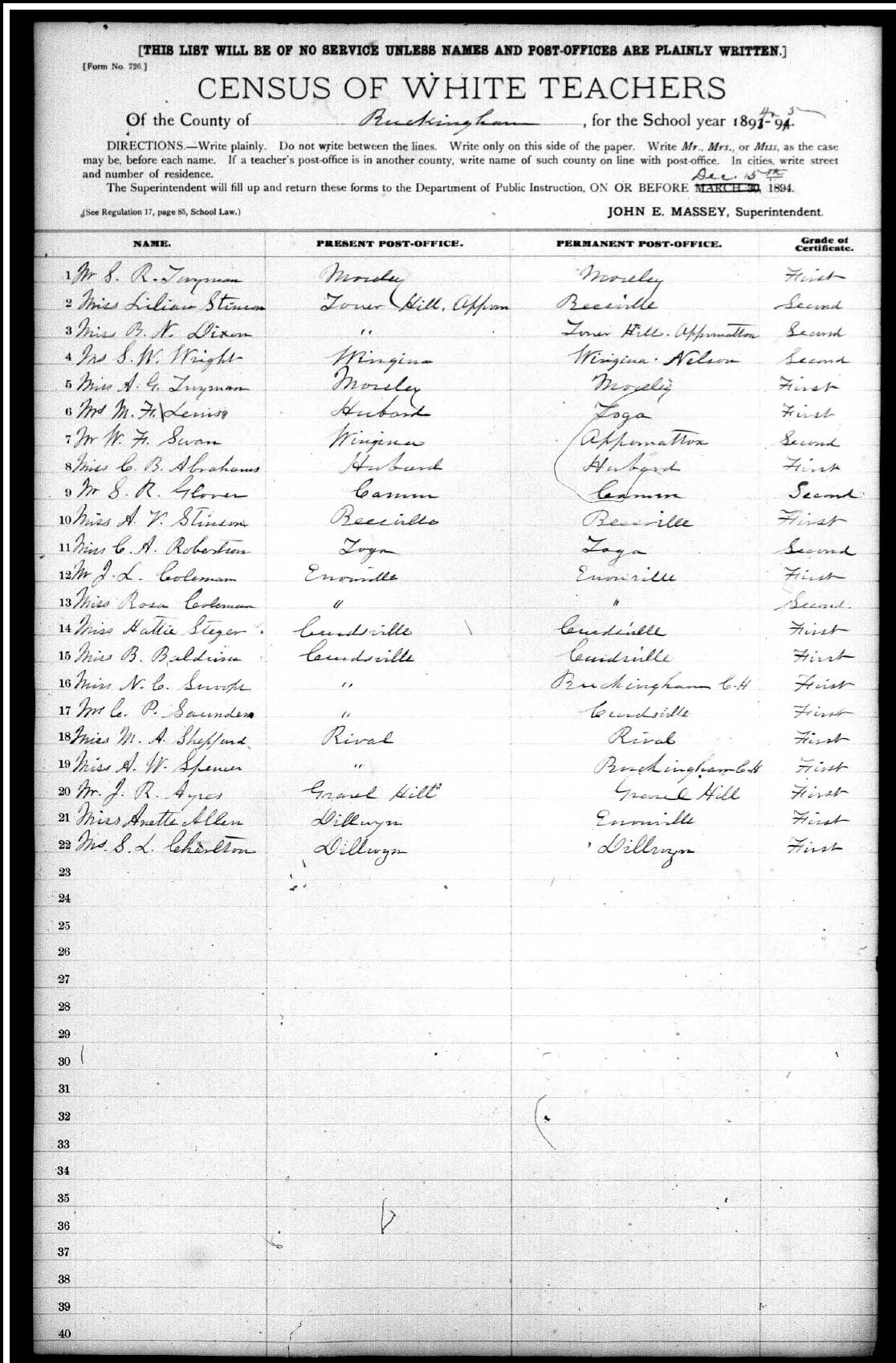
Courtesy Library of Virginia
Following an enthusiastic response to yesterday’s initial list of White Teachers in Buckingham in 1894-1895, here is page two of the “Census of White Teachers.”
If you recognize a teacher, please leave a comment. . . .


 slate river ramblings . . . .