
Courtesy Library of Virginia
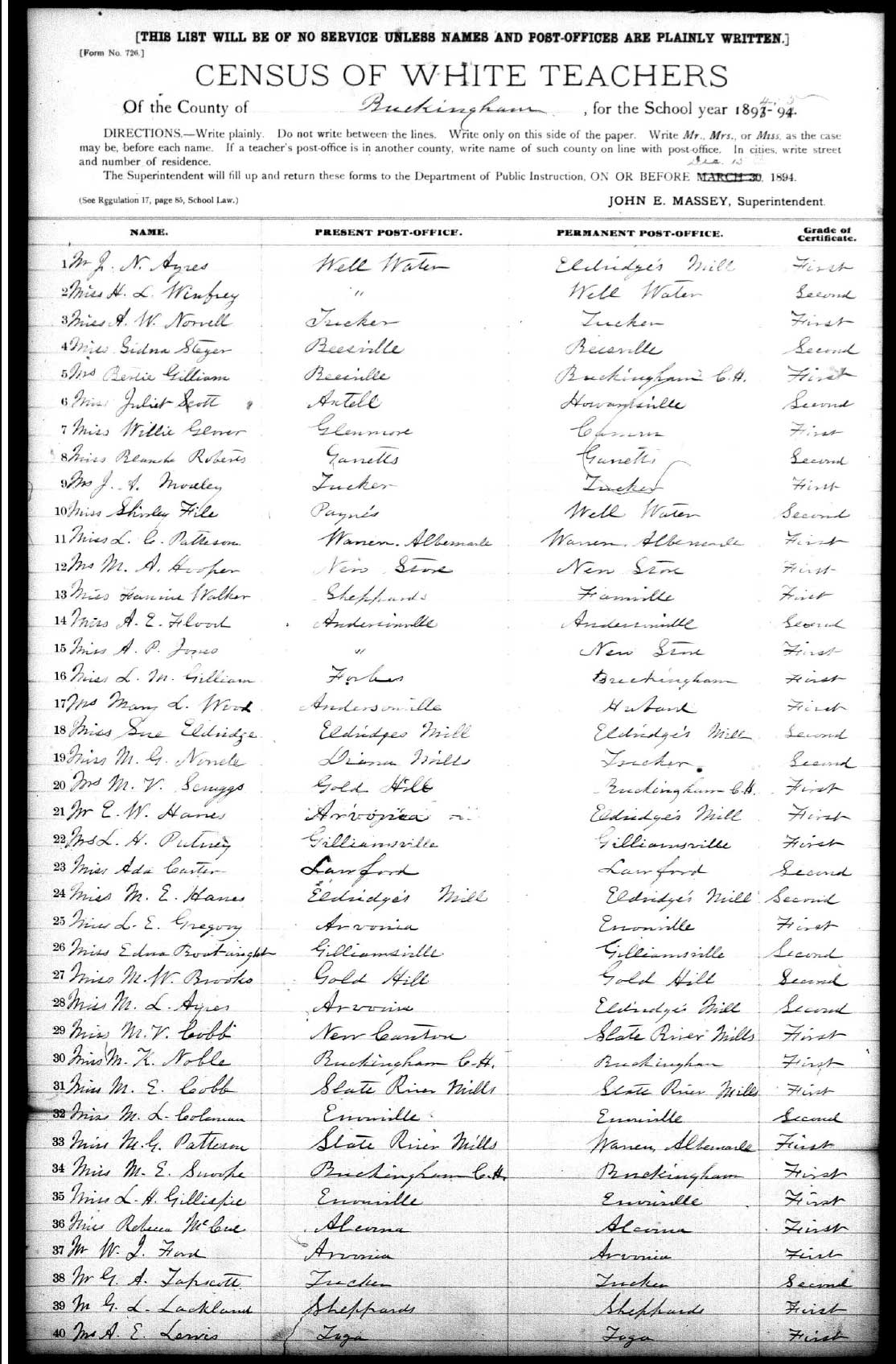
Above is an example of the annual “census” taken of teachers working throughout Virginia in the late 19th century. This one enumerates White teachers in Buckingham County during 1894-1895. The “First Grade” Certificate (far right) was Virginia’s highest classification for a teacher. This Certificate was valid for teaching in any county or city in the state when endorsed by the superintendent of that place. A teacher had to be over 21 to hold one and had to have taught successfully for ten months
Less experienced and/or younger teachers held “Second Grade” Certificates.
Note that Mrs. Julia Moseley’s brother, George Allen Tapscott (1850-1935), was also a school teacher. At one time, Tapscott lived at and helped operate Hatton Ferry. When his first wife died, his daughters, Annie and Julia, went to live with Matt and Julia Moseley.
Click on the image to enlarge it.
If you recognize a teacher, please leave a comment!
Coming next: “Census of Colored Teachers”

Tucker School (c. 1890), Courtesy Jeremy Winfrey
For many years, Julia A. (Tapscott) Moseley was the school teacher at Tucker School in northeastern Buckingham County. Above is the class picture taken circa 1890. Can a Slate River Rambling reader identify any of the students?
In 1877, Julia married M.L. A. “Matt” Moseley. They lived on the farm once owned by Randolph Jefferson’s son, Robert “Lewis” Jefferson, and later by his son, Elbridge G. Jefferson. The Moseleys had no children of their own and raised Julia’s nieces, Annie (Tapscott) Winfrey and Julia (Tapscott) Baber.
Coming Next: Teaching School in Buckingham County

Happy 300th Post Slate River Ramblings!
The archive at Slate River Ramblings is chock-full of Buckingham County history. Notable personalities, houses, mysteries, and more!
Searching can be fun! Explore Slate River Ramblings by keyword or by category. Just enter a word in the box in the panel on the right-hand side.
Try “Civil War” or “houses” or a surname that interests you. You’ll get a page of search results like this sample for mysteries:
- 05.29.14Buckingham County Mystery: Naming Allendale
- 05.12.14Buckingham Mystery: Dunn’s Chapel
- 05.5.14Buckingham Mystery: Beesville
- 53.14.14Buckingham Mystery: Dunn’s Chapel
- 83.6.14Buckingham Mystery: The Enigmatic W.B.M.
- 42.18.14Buckingham Mystery: New Store Academy
- 72.12.14Buckingham Mystery: Farm For Sale
- 01.25.14Buckingham Mystery: Riverside Library
- 512.6.13Buckingham Mystery: Mrs. Cabell’s Library and Axtell Academy
- 512.2.13Buckingham Mystery: Mrs. Cabell’s Library

Buckingham County Postal Routes, 1896
Virginia in Maps – Four Centuries of Settlement, Growth, and Development
By Richard W. Stephenson and Marianne M. McKee, eds. (The Library of Virginia, 2000).
Slate River Ramblings reader Brian Tapscott responded to a recent post about Dunn’s Chapel, locating it near the Post Office at Tucker in northeastern Buckingham County.
The post office at Tucker was active for about twenty years. On June 7, 1890, Ida M. Baber was named postmistress. Years later, on June 16, 1919, Addie Baber failed to qualify for the job and, after December 31, 1919, the mail that had once gone to Tucker’s was sent to Diana Mills.
Click on the map above to enlarge the image. Notice Tucker just north of Diana Mills.
Did the Baber family operate a store at Tucker?
Coming next: Tucker School
Reports vary as to the naming of Allendale. According to Elizabeth McCraw’s survey for the Virginia Historical Inventory, “Dr. Swoope and his second wife, who was Elizabeth McCraw, were of Scotch descent and the home was named ‘Allandale’ a name familiar in song and story.”
Indeed the popular song, “The Rose of Allendale,” dates to the 1840s and has been attributed to the English, the Scots, and the Irish.
Others have suggested the farm named for a Mr. Allen or for one-time-owner Allen Jones.
Can a Slate River Ramblings reader shed more light on the naming of Allendale?

(Courtesy Library of Congress)
In 1937, Elizabeth McCraw surveyed “Allandale” for the Virginia Historical Inventory. The proprietors she listed included Allen Jones, owner 1832–1857, and Dr. William McDowell Swoope. Lost Buckingham County deeds forced Mrs. McCraw to rely on oral history to establish the owners of Allendale. Today, Roger G. Ward’s collected and published Buckingham land and tax summaries offer significant clues to the chain of deeds.
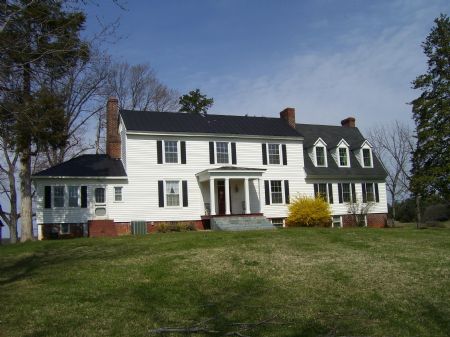
Allendale
In 1847, Allen Jones purchased 175 acres on the Slate River from Charles Christian and, in 1854, sold the land to W. H. Word. This tract was identified as two miles north of Buckingham Courthouse.
In 1856, Charles L. Christian bought 200 acres from William H. Word located five miles north of Buckingham Courthouse. Christian owned numerous tracts in this section of Buckingham County some of which were purchased directly from the extended Jones family.
In 1858, Dr. William M. Swoope purchased 225 acres on the North River, described as five miles north of Buckingham Courthouse, from Charles L. Christian and others.
Are these tracts actually overlapping? Were the locations “2” and ”5” miles north of the courthouse misread or misrecorded over the years?
According to Mrs. McCraw, the house at Allendale was built in 1832, its construction possibly pre-dating Allen Jones’ ownership of the land in the area. Who built the house?
Today, the dwelling house at Allendale survives and sits on 54 acres, on the North Fork of the Slate River, near Buckingham Court House. For a gallery of image of the house, follow this link: Allendale
Coming next: Buckingham County Mystery: Naming Allendale

The Battle of Fredericksburg
In Frank O. McCraw’s letter home from the front, written in the summer of 1861, he mentioned Dr. Swoope who resided in Buckingham County. In 1937, Elizabeth McCraw surveyed the Swoope home, “Allandale,” for the Virginia Historical Inventory. In the mid-19th century Dr. Swoope lived there with his second wife, Elizabeth (née McCraw), and his large family. Mrs. McCraw noted:
Dr. Swoope was married twice and reared seventeen children. One son, George Washington Swoope, was killed in the battle of Fredericksburg, 1862.
In 1937, Mrs. McCraw also surveyed the Swoope cemetery:
The graveyard is fenced in, and is clean and well kept. There are a number of unmarked graves.
This cemetery was opened about 1830 or 1832 by Allen Jones. The first owner of the estate. None of the Jones graves are marked.
A family burying ground of a well known and honorable Buckingham family, the Swoopes. The first member of the Swoope family to be buried here was a son of Dr. William M. Swoope, father of Frank Swoope, who was killed in the battle of Fredericksburg, in 1862, and was buried here.
The following names and dates are copied from headstones found here:
G. Washington Swoope: 1842 – 1862
Eliza S. Swoope: 1822 – 1864
E. Mildred Swoope: 1847 – 1865
Dr. W.M. Swoope: 1819 – 1895
Informants: Dr. W.M. Swoope’s family and Mr. Albert Rush, Katrina, Virginia
Coming Next: Allendale

Courtesy University of Virginia
In 1860, Montevideo, the former Cabell family show place on the James River, was put up for sale. Offered privately by Richmond agent Charles Y. Morriss, slaves and livestock were auctioned with the plantation. Previously known as Repton, in the 1810s, Judge William H. Cabell and Attorney General William Wirt dubbed it Montevideo for the wondrous view. Judge Cabell, who owned the plantation until in 1822, died at his residence in Richmond on January 12, 1853. The advertisement read as follows:
JAMES RIVER ESTATE, NEGROES, STOCK &C. &C.,
FOR SALE PRIVATELY.
I OFFER for sale the Valuable Estate, in the County of Buckingham, known by the name of “MONTEVIDEO.” (formerly the residence of Judge Cabell) also the Negroes, Stock, &c., of every description. The Estate contains 2,280 Acres, of which 200 Acres are James River low-grounds of the best quality. Large crops of Corn, Wheat and Tobacco are annually made upon this Estate. It has all the necessary improvements. The Negro Quarters are all new, with brick chimneys and plank floors. The tobacco houses are built of chestnut logs and covered with chestnut shingles. It has an Orchard containing upwards of 2,000 trees of the most choice fruit, apples, pears, peaches, cherries, &c. It is well watered and healthy, and has a magnificent view of James River, mountain scenery, &c. This Estate is on the South-side of James River, having a covered bridge across the River to the James River and Kanawha Canal, about a quarter of a mile from the Estate. . . .
Can a Slate River Ramblings reader identify the owner of Montevideo in 1860?
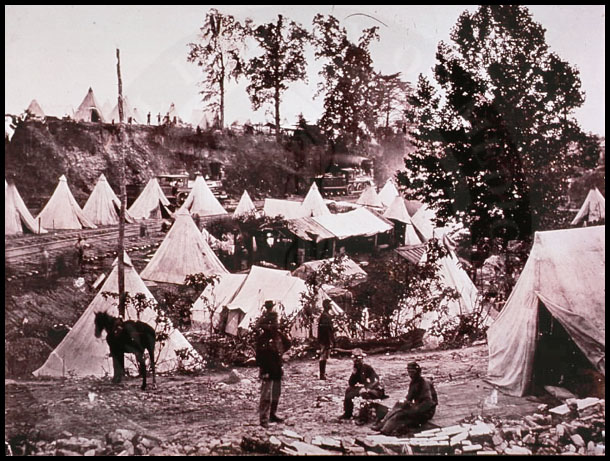
Civil War Field Hospital
In 1937, Louise Harrison McCraw participated in the Virginia Historical Inventory, serving as an “informant” for her sister-in-law, Elizabeth B. (Watts) McCraw, and helped preserve a Civil War-era letter written from Valley Mountain on August 28, 1861 by her cousin, Frank O. McCraw. He was one of seven sons of Thomas McCraw, survived the war, and lived to be an old man.
It read in part:
I am unfit for any service and have been for the last three weeks. I never suffered so much in my life with the bowel complaint as I have done in that length of time, but I have enough strength to walk and write. A soldier has not as much attention here as a sick cow would have in Buckingham. Dr. Swoope has been here and he says he had not the least idea how we were treated, and the people who were in Buckingham know nothing of the sufferings of soldiers. I weigh about one hundred and twenty-five pounds. A volunteer has all the hardships to undergo that any other class of soldier does and is thought as little of; the treatment is equally as rough, and it is a standing rule here for the volunteers to relieve the Regulars (the lowest Irish) in all their labor. As for the men being drafted in Buckingham I know that will not take place this year, and if I had the money I would bet ten to one it will not be. If one company were in Buckingham I do not believe five out of Eighty would ever join, but wait for a draft. John D. Saunders leaves here with his brother for Buckingham, he has been very sick for the last five weeks with measles, and the Drs. have given him a discharge, which I think very proper.
We have no fighting and I do not expect we will in several weeks. Genls. Lee and Loving are here….

Sharp’s Creek, Photo by Joanne Yeck
Dunn’s Chapel was a Methodist Episcopal church located in the northeastern section of Buckingham County. Class Lists survive for 1869-1870 and for 1881.
In 1869, Walter A. Ford acted as Steward. The Guerrant family was well represented. Other surnames in the congregation included Snoddy, Norvell, Oslin, Woodfin, and Brown.
In 1880, Dunn’s Chapel was still viable. It was one of six Methodist Episcopal churches in Buckingham County, all under the direction of Rev. J.W. Howard. He is likely John Wesley Howard (16 January 1816 – 12 March 1887), buried in Longwood Cemetery in Bedford County, Virginia.
By 1881, the congregation had dwindled to thirty-eight members. Peter B. Guerrant acted as Steward. At that time, the post office for the church was Virginia Mills, near New Canton.
Can a Slate River Ramblings reader tell us more about this church, particularly the location?
For more about Dunn’s Chapel:


 slate river ramblings . . . .