

Dixie, Courtesy Historic Buckingham
In 1937, Rosa G. Williams described “Dixie Hill” (a.k.a. Dixie) for the Virginia Historical Inventory. Once owned by Jack Jones, it was purchased in 1872 by Rev. John Spencer, who is buried on the place.
Mrs. Williams located the house 2.8 miles south of Buckingham Court House, on Route 638, thence 0.8 miles on private road to the house. Her description reads in part:
The old house is in very good condition. There are nine rooms, and it is thought that six were built originally, and that three were added later. There is a little enclosed porch or hallway between these rooms. There are four large closets; some have said that one of the largest closets was used by Mr. Jones, as a wine closet, as he was said to have been a very heavy drinker. There are three very large fireplaces. The rooms are all plastered, and have wainscoting about twenty two inches wide. The house was constructed of heart pine, and put together with wooden pegs and shop-made nails. The roof was originally shingled, and the shingles were put on with wooden pegs. In 1892 the shingles were taken off, and slate put on. That is the only repair work that has been done to this house since it has been in the Spencer Family.
The old kitchen was torn down about 1920. It is said that the fireplace in the old kitchen was long enough to use a six foot log.

Philip W. McKinney
In 1899, Hampden-Sydney College’s student publication, Kaleidoscope, printed a tribute to the distinguished alumnus, Philip W. McKinney (1832-1899). Born in Buckingham County, McKinney served as Governor of Virginia from 1890-1894.
The memorial article was written by Thomas J. Garden who had known McKinney since college days. To Garden, McKinney was “Phil,” a humble, diffident, and refined boy from Buckingham County. Garden wrote:
To say that he was born May 1st, 1832, and died March 1st, 1899, is all that he would wish to be said about him. Such was his aversion to praise, and so retiring was he in the sweetness of his nature that he shrank from any demonstrations of display made in his honor….
Educated at an old-field school at New Store, his home and native place in Buckingham County, Virginia, by good instructors he early was prepared for college and it was at Hampden-Sydney that the writer had the privilege and the honor of first knowing his classmate Phil W. McKinney,—a diffident blushing youth of seventeen, gentle in manner, courteous to all, fluent and attractive in conversation, a good speaker and such were his oratorical gifts that he easily carried off the prize as best speaker in our graduating class of 1851. While at college, I had the best of opportunities to know Phil McKinney. We often prepared our recitations together, took long walks in the groves and around the campus grounds, and after we left college he induced me to take a school at New Store and I lived in the same room with him for years and I can say neither at college nor during all these fifty years that have passed in which we have been thrown frequently together I have never known him to take even a drink of ardent spirits or utter an oath, or bet at a game of chance, and his language has been always chaste and refined. Of how many public men of these days can this truthfully be said?

Ruins of Shepherd’s Tavern (2010), Photo by Darlene Farmer
The February 10th post concerning Gen. Robert E. Lee’s camp in Buckingham County, located on the land of William Shepherd (Sheppard), generated some interesting discussion among readers of Slate River Ramblings.
Readers wondered if the oak tree described by Camm Patteson still standing at Lee Wayside. There is no historic marker identify such a tree. Today, the spot has a dozen or so thriving oaks. Any one of them might be Gen. Lee’s oak tree or its descendant.
Not far from the Lee Wayside, the chimneys of Shepherd’s Tavern still stand.
For more about Gen. Lee’s camp in Buckingham County see Rose Cottage.

Shaft mining in central Virginia, c. 1865 (Harper’s New Monthly Magazine)
On July 14, 1838, a letter to the Editor ran in the Washington D.C. newspaper, Madisonian, for the Country. It was in response to “extracts from the New York Gazette, on the subject of Gold Mines in Virginia.” The letter discusses several Buckingham County gold mines which were active in 1838 and was signed, simply, BUCKINGHAM.
Here’s what the correspondent had to say about the Morton mine:
The Morton mine has been opened by shafts . . . about one hundred feet deep – several veins cut – and the ores have been worked on a small scale, but with profit, for some three years. The motive power used in propelling the machinery is the water derived from a small creek, which was entirely insufficient, during most of last summer, to do anything. The veins are not very large, so far as opened, but they are sufficiently numerous and productive to justify the application of a considerable capital, and steam power, which is in contemplation by the proprietor. The present machinery consists of a Chilean mill, and stamps for crushing the rock, with the ordinary washers for separating the gold from the sands. This mine promises well, by good working, with proper machinery; but too little is done at present.
Want to learn more about Buckingham gold mines?
Put “gold” in the search box at Slate River Ramblings and enjoy the results!
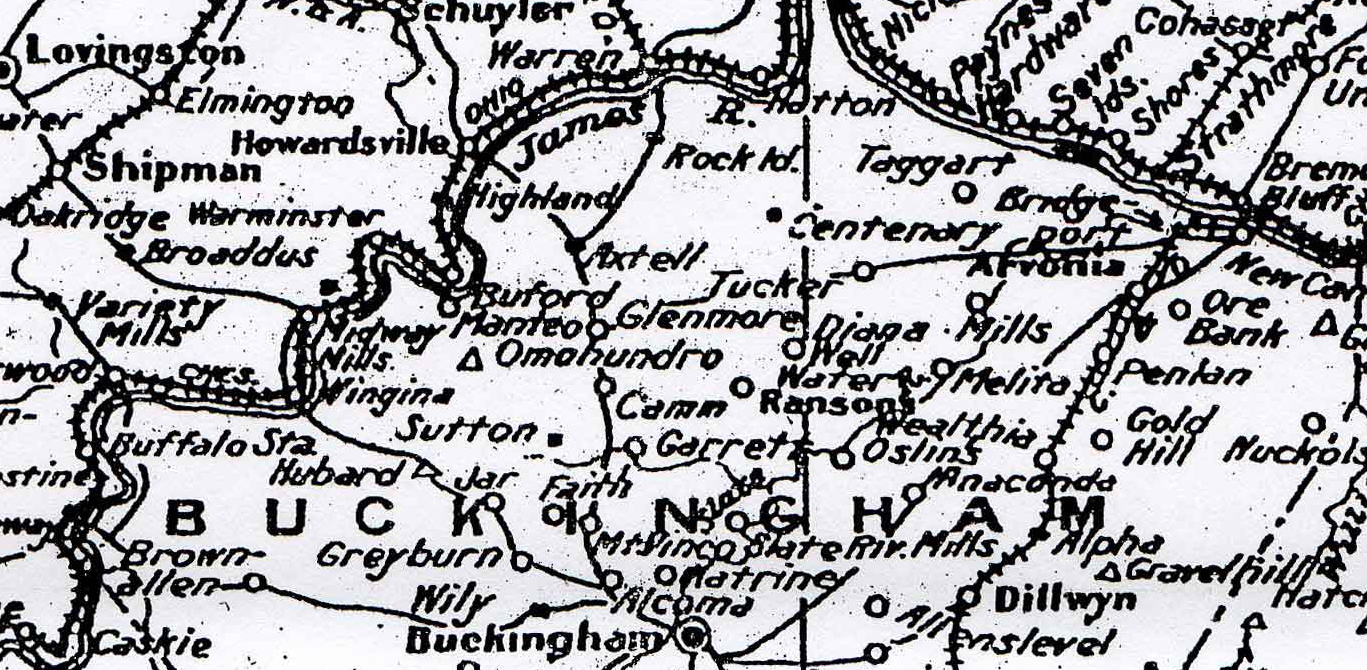
Buckingham County Post Office Map, 1916
Several Slate River Ramblings readers inquired about the location of Diana Mills. The post office map above, created in 1916, includes Diana Mills.
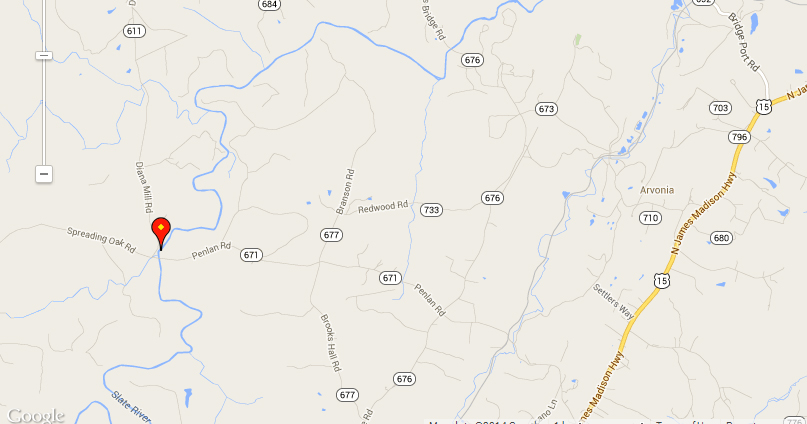
Its ruins can still be found in Buckingham County on the Slate River, west and a bit south of Arvonia, near the crossroads of today’s Diana Mills Road and Spreading Oaks Road. The red pin on the map below marks the spot.
Click on the detail from Google maps to enlarge it.
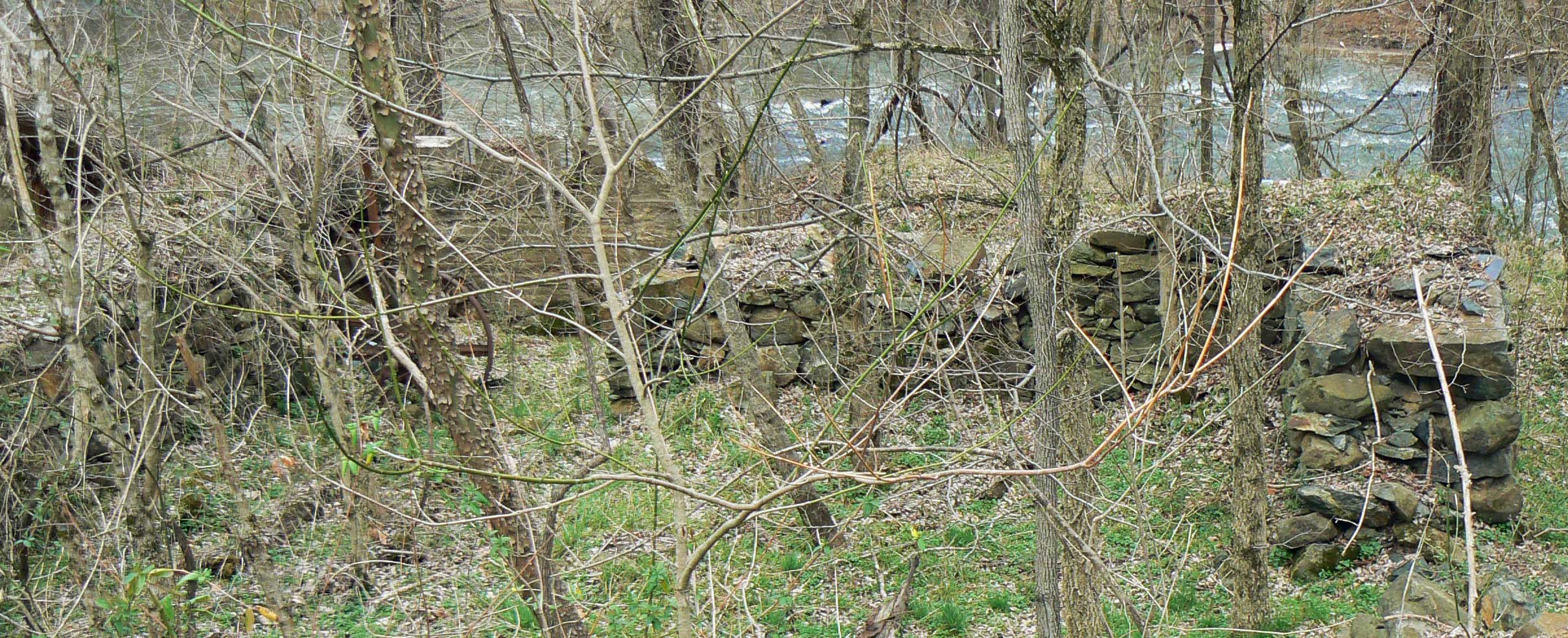 Ruins at Diana Mills, Photo by Jeremy Winfrey
Mills in Buckingham County typically carried the name of the landowner or their locale.
Chambers Mills. Baber’s Mill. Curdsville Mill. Slate River Mills.
Who was the Diana of Diana Mills? The name apparently goes back to the early 19th century.
By 1827, there was a post office at Diana Mills. The first recorded postmaster was Clement R. Fontaine, who owned the property. In 1835, there was one dwelling, three stores, and twelve inhabitants living at the mill.
Just before the Civil War, Diana Mills was still owned by the Fontaine family. On January 17, 1860, this advertisement ran in the Staunton Spectator:
AN EXPERIENCED MILLER WANTED – Who can come well recommended for honesty, industry and sobriety. Liberal wages will be given. A single man is wanted. Apply immediately to
WM. J. FONTAINE,
Diana Mills, January 17, 1860. Buckingham, Va.
That year, Fontaine owned real estate valued at $9,000. The mill couldn’t be entrusted to just anyone. Did the previous miller have a drinking problem?
Apparently nobody fit for the job answered the advertisement. In July of 1860, William J. Fontaine, age 26 and married, was enumerated on the Federal Census as a miller, with no assistant.
Special thanks to Jeremy Winfrey for his ongoing investigations of Diana Mills.

Perry Hill
(Courtesy Virginia Department of Historic Resources)
Perry Hill was built by Col. Thomas Moseley Bondurant (1797-1862) for his daughter, Angelina, who married Dr. William Paxton Hall, c. 1851. Col. Bondurant was a wealthy and prominent Buckingham County politician, member of the board of trustees of Hampden-Sydney College, and a founder of the Richmond Whig.
According to Perry Hill’s nomination for the National Register of Historic Places:
Constructed of brick, Perry Hill is distinguished by a Gothic facade that consists of a pointed-arch entry and windows and pointed gables embellished by fancy verge boards. The design may have been determined by Dr. Hall, a physician whose position in the community demanded a residence in a fashionable architectural style. While spacious, the house does retain a conventional center-hall plan with fairly restrained woodwork.
In 1863 the property appears in the county land tax book in trust to William P. Hall, “812 acres Perry Hill”, “From estate of T.M. Bondurant,” apparently who died the year before. At Hall’s death, ca. 1900, his son Alexander Stuart Hall inherited the house and part of the Perry Hill tract.
Buckingham County tax records locate Perry Hill at five miles northwest of Buckingham Courthouse.
Could Perry Hill be the solution to Buckingham Mystery: Farm For Sale?
If it is, in 1868, the property did not sell and stayed in the Hall family.
Special thanks to Slate River Ramblings reader Hal Coleman for investigating Perry Hill.
The plot thickens.
In December of 1858, a Buckingham County correspondent from New Store sent news of “Affairs in Buckingham” to Richmond’s The Daily Dispatch. He mentioned at attempted break in at the store of Messrs. C. D. McKinney & Brother, the burning of “The Old Academy” (owned by W.D. Jones), and the attempted arson of other property near it. For more details see: Buckingham County: Crime Report
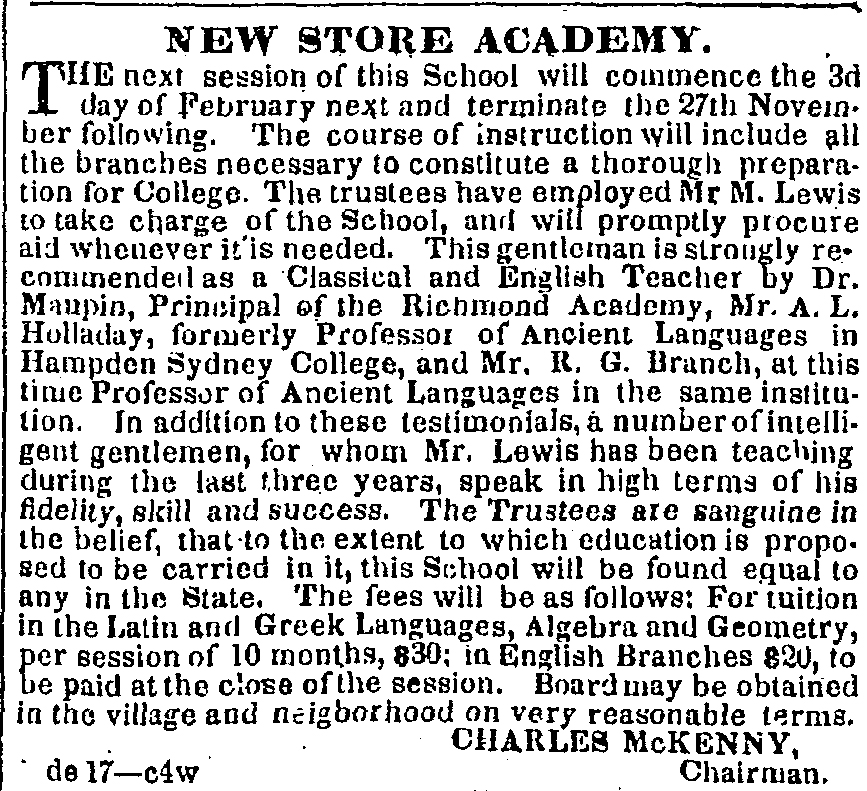
“The Old Academy” was New Store Academy, incorporated in 1839. An advertisement in the Richmond Whig reveals it to be a classical preparatory school. C.D. McKinney submitted the advertisement as “Chairman,” presumably Chairman of the school’s Trustees. The announcement in the Whig was placed on January 14, 1840:
NEW STORE ACADEMY.
The next session of this School will commence on the 3rd day of February next and terminate the 27th November following. The course of instruction will include all the branches necessary to constitute a thorough preparation for College. The trustees have employed Mr. M. Lewis to take charge of the School, and will promptly procure aid whenever it is needed. This gentleman is strongly recommended as a Classical and English Teacher by Dr. Maupin, Principal of the Richmond Academy, Mr. A.L. Holladay, formerly Professor of Ancient Languages in Hampden Sydney College, and Mr. R.G. Branch, at this time Professor of Ancient Languages in the same institution….
The village of New Store and planters in the neighborhood were prepared to take in boarders.
Was Charles McKinney’s son Philip, b. 1832, first educated at New Store Academy? In 1850, the McKinney family was living in New Store and Charles was a merchant. Living with the family was William Dinwiddie, teacher, age 21, from Campbell County, Virginia. Did Mr. Dinwiddie teach at the Academy?
The question remains. . . .
Who were these enemies of Messrs. McKinney and Jones? And what did they have against the New Store Academy?
Special thanks to sleuths Fran Harris-Hill and Hal Coleman who helped discover New Store Academy.

In the early part of the 19th century, W.D. Jones ran a store in the southern part of Buckingham County. According to tradition, New Store was named for Jones’ establishment.
Surviving accounts reveal that he had a famous customer — Revolutionary hero, Peter Francisco. In 1821, Francisco paid $.75 for a gallon of molasses, $.06 for a silk handkerchief, $3.48 for 20 ½ lbs of brown sugar. That’s a lot of brown sugar!
Was he brewing hard apple cider for his tavern?
In 1938, Jones’ store was still standing when Elizabeth McCraw wrote her survey for the Virginia Historical Inventory.
To locate New Store, click here:
In December of 1858, a Buckingham County correspondent to Richmond’s The Daily Dispatch, reported the following shocking news:
AFFAIRS IN BUCKINGHAM.
New Store, Buckingham County
December 4th, 1858
This village has two stores, a church, some half dozen private dwelling houses, &c. Last Thursday night an attempt was made to break in the store of Messrs. C. D. McKinney & Bro. Two holes were bored through the door, with the intention, doubtless, of raising a bar, which was placed across the door, to keep it shut. But for some cause, the person or persons, desisted from their undertaking.
Charles D. McKinney was also the postmaster at New Store and the father of future Virginia Governor, Philip Watkins McKinney (1832-1899).
The church mentioned is likely New Store Presbyterian Church.

New Store Presbyterian Church
Courtesy Historic Buckingham
The Buckingham County Correspondent went on to tell news of possible arson:
A few days ago, “the old Academy” owned by Mr. W.D. Jones, was destroyed by fire; and another house, standing near was also set on fire, but it was discovered in time to be saves—evidently the work of an incendiary, as it could be seen were straw was brought from a stack to the houses.
Was the old Academy at New Store? Can a Slate River Ramblings reader identify it and its Principal?
Coming Next: New Store and W.D. Jones


 slate river ramblings . . . .