
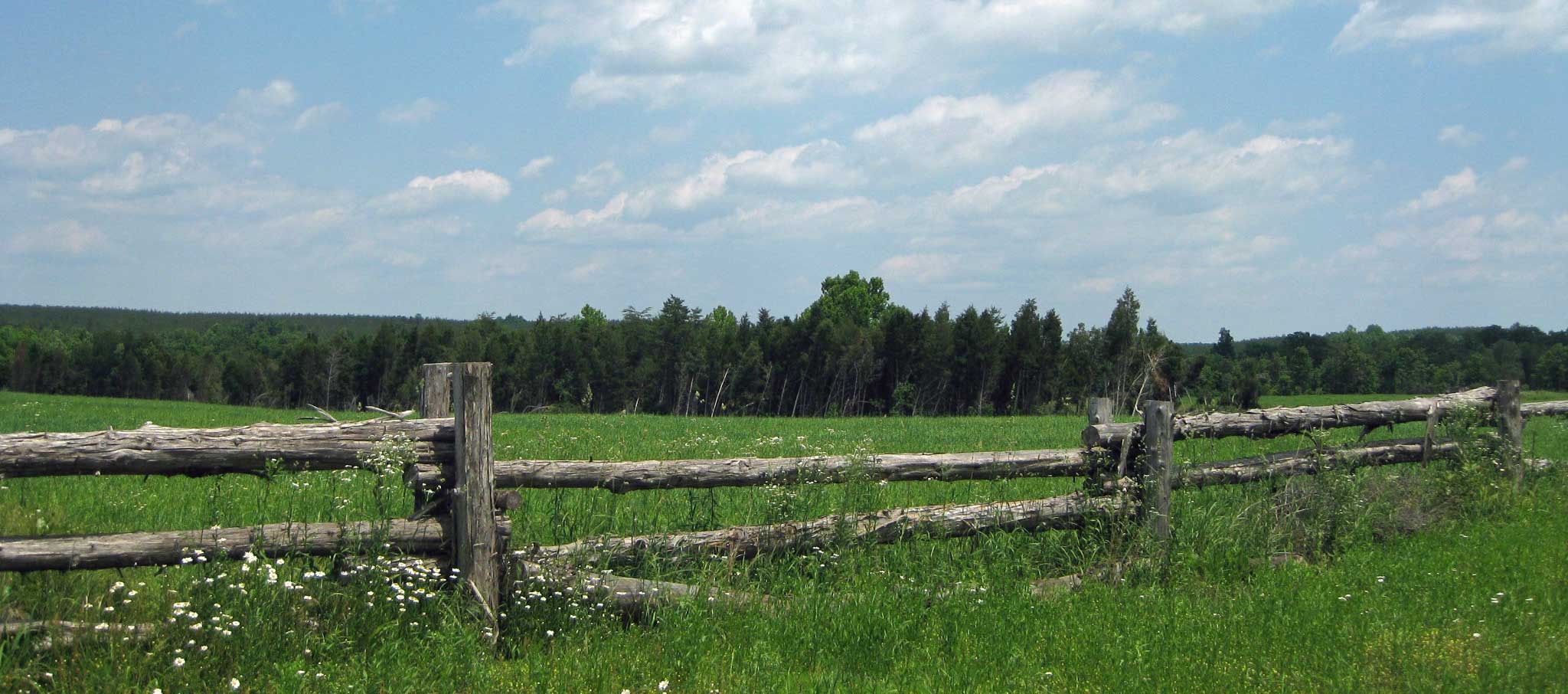
Buckingham County (2009), Photo by Joanne Yeck
Following the Civil War, many Virginians fell on hard times and citizens of Buckingham County were no exception. In 1868, an advertisement for a Buckingham farm ran in a Richmond newspaper. The contact for the sale was J.D. Imboden, Office Virginia Lands. The owner of the farm is unnamed; however, the description of the farm and of Buckingham County creates an extremely desirable picture of rural life.
In Buckingham County. – A Farm, containing six hundred and fifteen acres, in the county of Buckingham, five miles from the county seat, six miles from James river and Kanawha canal, and near the chartered line of railroad from Richmond to Lynchburg. Four hundred acres cleared and well enclosed, remainder in original growth of Hickory, White Oak, Chestnut, Poplar and Heart Pine. Forty acres of meadow land well taken in Timothy, Herds Grass and Clover. Is well watered with streams through each field. Produces well all the cereals, shipping tobacco of the finest quality, and all the crops usually found in Eastern Virginia. The neighborhood excellent, convenient to schools and churches of the Presbyterian, Episcopalian, Methodist and Baptist denominations. The blue grass is of spontaneous growth, an excellent opportunity offered for making a Dairy farm. Improvements consist of a NEW MANSION containing twelve room(s), Tobacco and Grain Barns, Stables, Servants’ Houses, and all improvements generally found on a Virginia farm.
TERMS — For the whole, including improvements, $18,000, one half cash, or all if desired by purchaser, the remainder on satisfactory terms. Would exchange for property in the city of Richmond.
If a Slate River Ramblings reader recognizes the property, please comment.
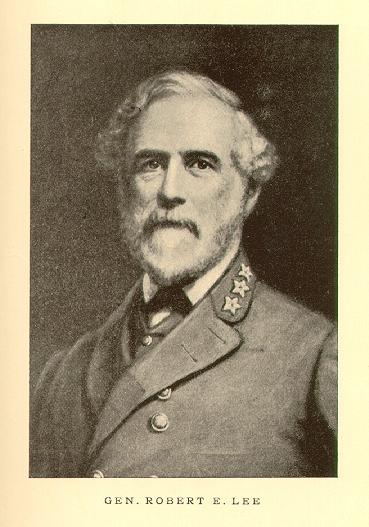
In 1906, attorney and politician Camm Patteson wrote a warm and lengthy tribute to General Robert E. Lee. Printed in The Times-Dispatch, it began at an old white oak, just east of Buckingham Courthouse:
Less than two miles from Buckingham Courthouse, there stands a white oak tree, even now not more than a foot in diameter, under which General Robert E. Lee camped the night after his famous battle at Appomattox. The second night he stopped at the house of his brother, Mr. Charles Carter Lee. When he left the tree near Buckingham Courthouse, he left it never to camp again. It stands about one hundred yards from the house of the late William Shepherd, a good old Virginian, who then owned the land. Mr. Shepherd, with true hospitality, invited General Lee to spend the night at his house. The General thanked him but stated that he believed he would camp with the boys; his staff accompanied him. The weather was comparatively warm and pleasant. As he composed himself to rest upon this, his last camping ground, who can fathom his thoughts? . . .
Patteson’s reverie covered most of four columns and, in the end, he came back to the oak.
The tree in Buckingham to which I have adverted, was called to my attention by my friend and old comrade, Judge George J. Hundley, as gallant a Confederate soldier as ever drew a blade in defense of constitutional liberty.
We went into the army at the same time; we are about the same age, and belong to the same profession. He knows the tree well which I have described, and it was mainly at his request that I have written this paper. Old Confederates like us must be allowed the “garrulity” of age. All that we can do, like that old veteran described in that famous work, “Old Mortality” written by Sir Walter Scott, is to re-write the inscriptions upon the tombstones of the past, and try to keep green and fresh the memory of the cause we loved so well.
CAMM PATTESON
Buckingham County, Va., April 13, 1906
250 Posts? That’s a lot of Buckingham County history!
Invite a friend or cousin to join the fun!

Courtesy Library of Virginia
Over the last few days, Slate River Ramblings has attracted visitors searching for information about Dr. Carter G. Woodson – Father of Black History.
If you missed previous posts about Dr. Woodson, please follow these links:
Buckingham Notables: Dr. Carter G. Woodson
From “At a Place Called Buckingham” — “Carter G. Woodson: Deep Roots in Buckingham County”
The great achievements of Dr. Carter Godwin Woodson (1875-1950) are widely known. His rise from the humblest of beginnings near New Canton, Buckingham County was fueled by an insatiable thirst for knowledge, which culminated in his Ph.D. from Harvard University. Woodson’s life and work as teacher, historian, author, and founder of The Journal of Negro History have made him a hero in many circles. His books discussed African-American contributions in American religion, labor, education, even the economics of the Free Black ownership of slaves – earning him the title “Father of Black History.” His concept of a “Negro History Week,” celebrated to include the birthdays of Abraham Lincoln and Frederick Douglass, eventually blossomed into “Black History Month.”

Godey’s Lady’s Book, July, 1850
In 1850, Baptist minister, Rev. Thomas N. Johnson, advertised in the Richmond newspapers:
WANTED. – A young lady qualified to take charge of a school of 10 or 12 children, in a healthy neighborhood. For particulars address the Rev. Thomas Johnson, Mount Vinco, Buckingham.
Was Rev. Johnson in search of teacher for his own children a few others from the neighborhood? Did he have plans to start a school of his own? In 1850, there were many thriving schools in Buckingham County including John Claiborne’s Oak Grove Academy, Elijah G. Hanes’ Humanity Hall Academy, and Homer Male Seminary at Physic Springs.
In 1850, Rev. Johnson lived modestly, with his four young children, ages 11–5. His immediate neighbor was the wealthy and prominent Thomas M. Bondurant. That year Johnson’s property was valued at $1,800; Bondurant’s was valued at $77,400.

View from Humanity Hall, photo by Joanne Yeck
In 1856, something was stirring in Buckingham County.
A significant number of valuable Buckingham farms and other businesses were advertised for sale in the Richmond newspapers. Did sellers attempt to take advantage of a strong market? Did they anticipate a dip? Was the climate in Buckingham shifting towards increasing industry, making those properties more valuable? Did the political battles over the Kansas Territory concern Buckingham County slaveholders? Was it just coincidental?
Among the properties for sale was Apple Hill, nestled in the neighborhood of Chambers Mills. The proprietor, Selah Holbrook, lived adjacent Humanity Hall Academy, where he farmed and worked as a carriage maker. His advertisement in the Richmond newspaper succinctly describes this pleasant area of Buckingham County.
APPLE HILL FOR SALE. – The subscriber offers for sale his Farm in Buckingham county, containing 318 Acres, about one half in original Timber of superior quality for building purposes, adapted to the culture of tobacco, a healthy location and near the Slate River Navigation, and adjoining Col. Hanes’ Acadamy (sic), having the advantage of taking boarders for the same and a good location for a Physician. The improvements are a new Two Story Dwelling house, large and well finished, with all other necessary out houses, an office in the yard, a superior Apple Orchard and first rate Spring of excellent water. The price and terms of payment will be accommodating. For further particulars address,
SELAH HOLBROOK
Chamber’s Mills, Buckingham County, Va.
The farm with its sweet water and superior apples did not sell in 1856. In 1860, Selah Holbrook and his growing family still lived on Slate River.
If you know how Selah Holbrook came to settle in Buckingham County, please comment.
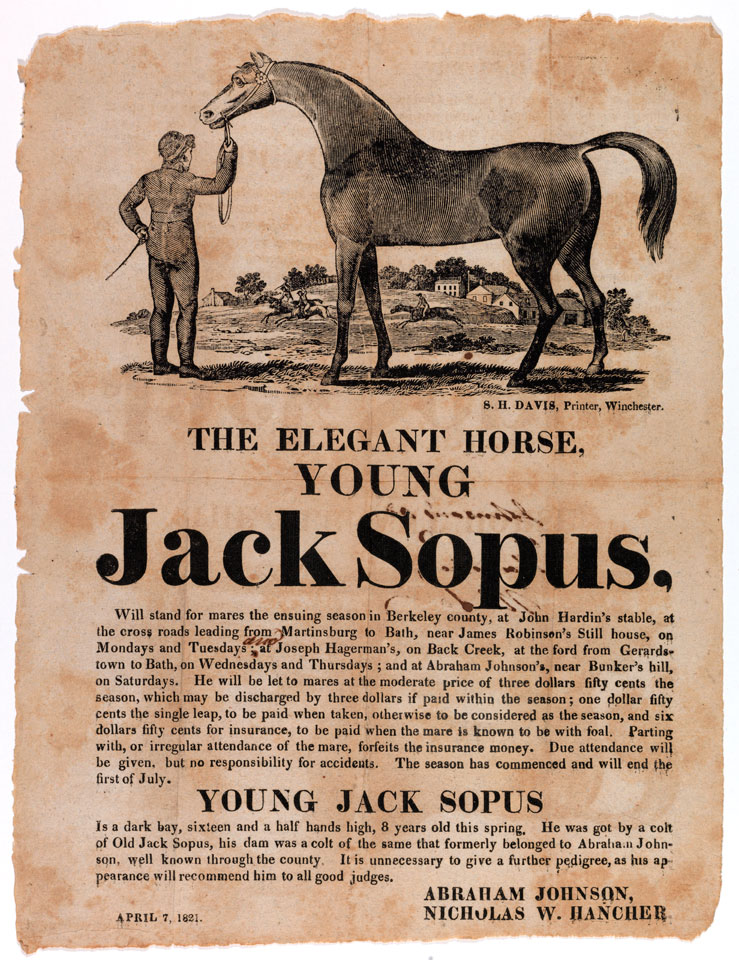
Broadside, Courtesy Library of Virginia
In central Virginia, offering stud services was a common source of extra income. Even this short-term business required a license. In 1797, for example, Randolph Jefferson paid 15 shillings to the Buckingham County taxman for keeping a stud horse at his farm, Snowden.
On May 30, 1854, A.W. and W.J. Fontaine ran the following advertisement in the Richmond Whig & Public Advertiser. Broadsides (like the one above) were likely posted throughout the county, announcing the many virtues of the breeding stallion — Star of the East.
STAR OF THE EAST. – This well known Stallion will stand the present season at Diana Mills, at Buckingham Court House, Virginia. These two stands are as many as we wish him to attend. He has seen much service, and has acquired a reputation for Blood, Action and Beauty, that should prompt any man, who really wants a colt worth having to obtain his services. We will not impose on his good nature, nor to disparagement to his celebrity by peddling him about. Persons sending a distance will send to Diana Mills, Buckingham as we have excellent pasturage, and will furnish grain, if desired, at a small extra charge. No responsibility for accidents; but the utmost pains taken to prevent their occurrence.
TERMS: Insurance $30 [$38?]; season $15; and single leap, $10. One dollar to groom, except the mare be from a distance.
A.W. & W.J. Fontaine.
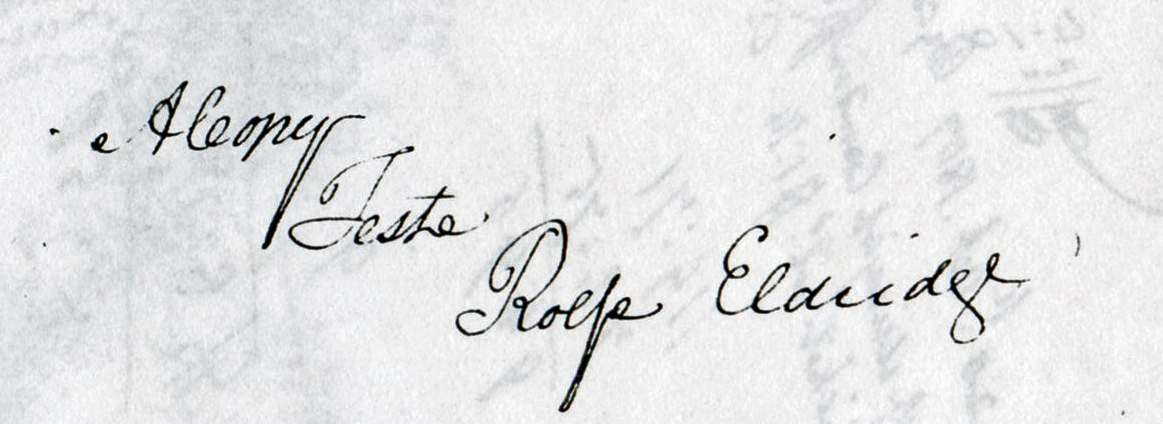
Rolfe Eldridge, Sr., Buckingham County Clerk
In “A State of the Commission of the Peace for Buckingham County” recorded on July 8, 1793 in the Virginia State Papers, Buckingham County Clerk Rolfe Eldridge summarized the current list of acting Justices and the men recommended for new commissions.
Behind these lists are Buckingham’s leaders posed to serve the county as its citizens prepare for the 19th century. These men will care for the poor, design education, and keep the peace.
A List of the acting Justices for the county of Buckingham, to-wit:
John Bernard, Flamstead Ransom (sic), John Cabell, John Moseley, James Dillard, Wm. Cannon, Thomas Anderson, Anthony Winston, Jr., Henry Bell, William Perkins, Jr., Benjamin Morris, David Coupland, David Bell, Joseph Cabell, Jr., Josias Jones, Samuel Allen, Peter Guerrant, Joel Watkins, William Allen, Boaz Ford, Charles Moseley.
ROLFE ELDRIDGE, c. B. court.
At a court held for Buckingham county the 8th day of July, 1793:
Present — Henry Bell, Samuel Allen, Boaz Ford, Peter Guerrant, John Moseley, Charles Moseley, David Coupland, & Josias Jones, Gentlemen Justices.
Thomas Moseley, John Pittman, Robert Kincaid, Clough Shelton, Charles Yancey, William Evans, Robert Nicholas, Henry Flood, Philip Duval, and Mathew Branch, are recommended to his Excellency the Governor and Council as proper persons to be added to the commission of the peace for this county.
A Copy — Teste:
ROLFE ELRIDGE, Cl. Court.
~
According to Edyth Whitley’s Genealogical Records of Buckingham County, Virginia, Rolfe Eldridge, Sr. was Clerk of Buckingham County from 1770 to 1806. Rolfe Eldridge, Jr. (1780-1861) succeeded his father in the job. At age fifteen, he entered his father’s office and, in 1797, qualified as Deputy Clerk. Rolfe Eldridge, Jr. then served as County Clerk from 1806 to 1859, dying in the spring of 1861. In 1858, Edridge, Jr. had declined reelection and was succeeded by his son-in-law, Robert K. Irving.

Buckingham Courthouse, Photo by Joanne Yeck
Many of Buckingham County’s planters were asked to serve as Gentleman Justices or Magistrates. Interestingly, as this record covering 1777- 1793 indicates, many declined or never qualified. This list is practically a “who’s who” of Buckingham County’s earliest families. Some, however, such as Randolph Jefferson, are conspicuous by their absence.
The list below, recapitulating Buckingham County commissions, was recorded in the Virginia State Papers on July 8, 1793.
In the New Republic, how did a Justice “qualify”? What was meant by: “don’t act.”
My ancestor, Robert Moseley, is mentioned here. If you recognize one of yours or can correct a name, please comment.
The first commission of the Peace for the county of Buckingham, since the late Revolution, dated the 20th Day of December, 1777, directed to the following Justices, to-wit:
John Nicholas, resigned.
George Hooper, resigned.
John Cabell, 1789, Aug. court, took the oath agreeable to Act of Congress.
Jeremiah Whitney, Dead.
Charles Patteson, qualified, but not taken the oath agreable (sic) to act of congress, but don’t act.
William Cannon, Do.
Charles May, Do.
John Johns, Do.
Henry Bell, 1789, August court, took the oath agreeable to act of congress.
John Bernard, Do.
Dolphin Dren (Drew), dead.
Robert Cary, never qualified.
Hardin Perkins, never qualified.
Thomas Read, Removed to Prince Edward.
John Benning, never qualified.
Hickerson Barksdale, qualified, tho’ not taken the oath agreeable to Act of Congress, but don’t act.
John Moseley, Sheriff, took the oath agreeable to act of congress.
William Dinguid (Diuguid) , resigned.
Thomas Anderson, Qualified, tho’ not taken the oath agreeable to act of congress, but don’t act.
William Perkins, Jr., took the oath agreeable to act of congress, 1789, Aug. court.
Flamstead Ransom (Ranson), Gent, qualified, tho’ not taken the oath agreeable to act of Congress, but don’t act.
2d Commissions issued 27th March, 1781, adding the following Justices, to- wit:
Joseph Cabell, Sen’r, never qualified.
Anthony Winston, Sen’r, never qualified & since dead.
John Crouch, never qualified.
3d Commissions issued 17th June, 1783, adding the following Justices, to-wit:
James Dillard, qualified, tho’ not taken the oath agreeable to Act of Congress, but don’t act.
William Watt, Do., resigned.
Anthony Murray, never qualified.
4th Commissions issued the 15th April, 1784, adding the following Justices, to-wit:
Edmund Wilcox, never qualified & since dead.
John Nicholas. Jr., never qualified — removed. Benjamin Mosely, Jr., never qualified — refused.
Benjamin Mosely, Jr., never qualified — refused.
Robert Mosely, never qualified — refused.
David Parrish, resigned.
Anthony Winston, Jr., 1789, Aug. Court, took oath agreeable to Act of congress.
Benjamin Morris, Do.
5th Commissions issued the 23d day of June, 1788, adding the following Justices, to-wit:
David Coupland, qualified, tho’ never took the oath agreeable to Act of congress — Don’t act.
Joseph Cabell, Jr., 1789, Aug. Court, took the oath agreeable to Act of congress.
Samuel Allen, 1789, Aug. Court, took oath agreeable to Act of congress.
Joel Watkins, ” ” ” ”
Boaz Ford, 1789, Aug. Court, took oath agreeable to Act of congress.
Thomas Blakey, never qualified— refused.
6th & Last commissions issued the first of March, 1790, adding the following Justices, to-wit:
David Bell, qualified & took agreeable to Act of congress.
Josias Jones, Do.
Peter Guerrant, Do.
William Allen, Do.
Charles Moseley, Do.
Edmund Glover, & Do.
George Duiguid (Diuguid), refused to qualify.
Teste: ROLFE ELDRIDGE, CI. B. court.
Coming Next: Clerk of Court, Rolfe Eldridge, lists Buckingham County Justices in 1793
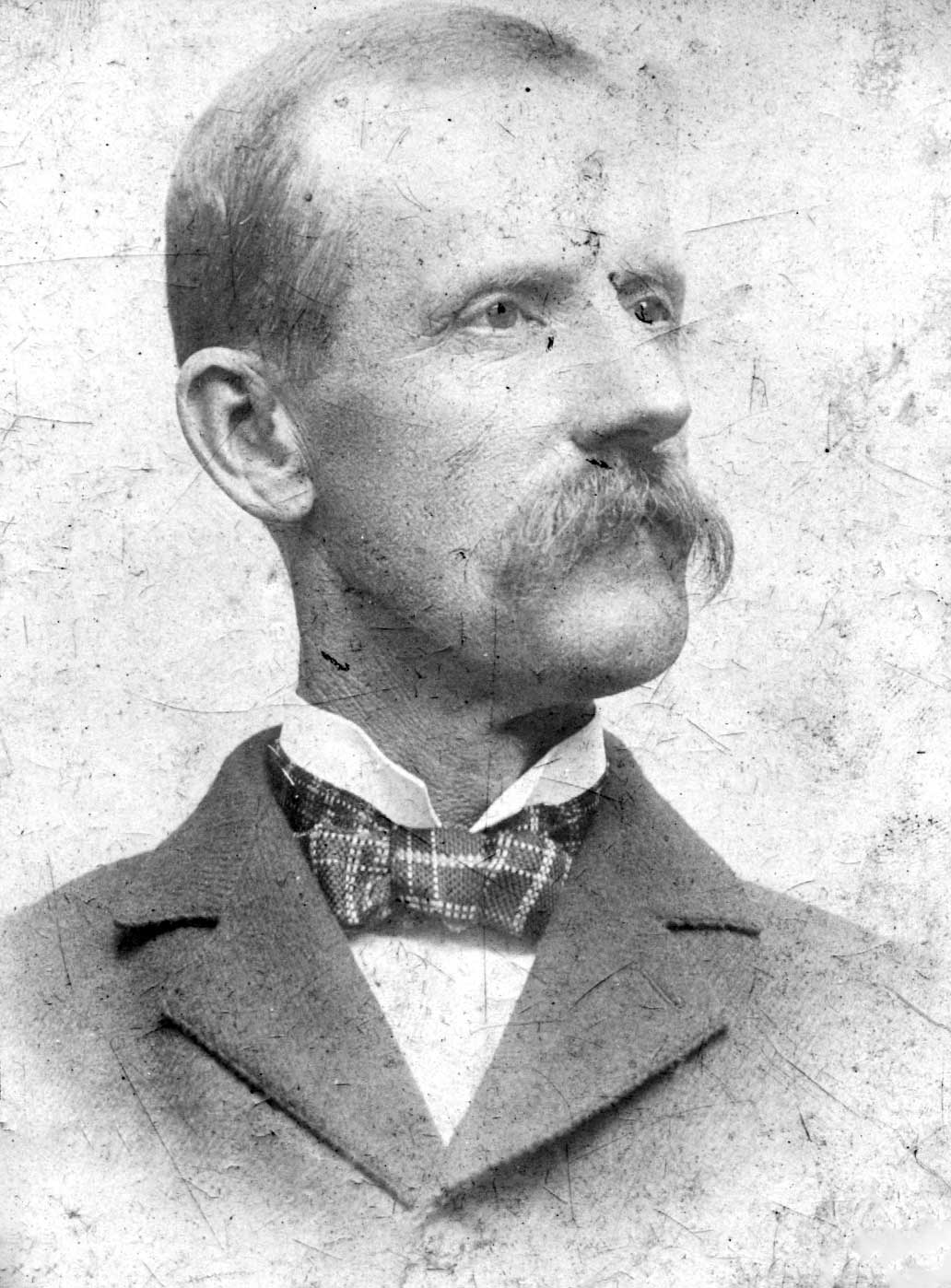
Dr. W. E. Pratt, Courtesy of Mary Carolyn Mitton
In May of 1901, Dr. Whitcomb Eliphalet Pratt was buried in Buckingham County. He died in Richmond, after a lingering illness. His impressive obituary appeared in the Richmond Dispatch on May 17th and in other papers across Virginia. It described his important career and the tragedy of his death at the comparatively young age of 52.
“DR. PRATT’S ILLNESS”
Dr. Pratt had not been well for many months, though he continued in active practice up to within the last two months. His trouble was valvular heart disease, complicated with enlargement of the liver. Just one month ago yesterday Dr. Pratt, accompanied by Mrs. Pratt, came to Richmond for medical treatment and remained here, under the care of Dr. Stuart McGuire for two weeks, when he returned to Buckingham. He remained at Buckingham Courthouse, trying to recuperate, until Wednesday, when, on account of developments of alarming symptoms, he determined to return to Richmond and again seek the treatment of Dr. McGuire. With his wife he arrived in the city over the Chesapeake and Ohio railroad at 6:20 o’clock Wednesday, and immediately went to the Alhambra Hotel, where he engaged a room. He was quite ill at the time of his arrival at the hotel, and Dr. McGuire was immediately summoned.
The physician pronounced his case hopeless, and told Mrs. Pratt that he could not live longer than a few days. He promised to return to his patient early in the morning, and bring with him Dr. Gordon, to consult with him about the case. The patient, however, got worse as the night wore away, and he died at 6:40 o’clock in the morning, no one being present except his wife, who was devoted to him.”
For more about Dr. Pratt, see Martha Louis’ article, “An appreciation of the beloved Dr. Pratt” (Buckingham Beacon, January 2013).


 slate river ramblings . . . .