
TIMES-DISPATCH, 29 July 1906
According to a brief mention in the Howardsville news, printed in the Times-Dispatch on July 29, 1906: “The Riverside Library has recently had 1,500 volumes of books sent it by a library in Cincinnati. Some of these will be given to the library at Buckingham Courthouse.”
No donor was named in the Times-Dispatch; however, at the time, Mrs. Hartley Cabell (born Margaret “Meta” Polk Logan) and her husband lived in Cincinnati, Ohio. Is this a subsequent donation by Mrs. Cabell, following her initial gift, in the spring of 1901, of several thousand volumes to Buckingham County?
Can a Slate River Rambling reader confirm that Riverside Library was across the James River in Howardsville, Albemarle County?
We are still hoping to discover the location of the Buckingham County library c. 1901 – 1906. Any leads would be appreciated.
For earlier posts concerning Mrs. Cabell’s Library see:
Buckingham Mysteries: Mrs. Cabell’s Library
Buckingham Mysteries: Mrs. Cabell’s Library and Axtell Academy
Special thanks to Coz. Mary Carolyn for the new clue in this on-going mystery.

Shaft mining in central Virginia, c. 1865 (Harper’s New Monthly Magazine)
On July 14, 1838, a letter to the Editor ran in the Washington D.C. newspaper, Madisonian, for the Country. It was in response to “extracts from the New York Gazette, on the subject of Gold Mines in Virginia.” The letter discusses several Buckingham County gold mines which were active in 1838 and was signed, simply, BUCKINGHAM.
Here’s what the correspondent had to say about the “Ayres” mine:
The Ayres mine has been opened some thirty or forty feet deep, and a well defined vein, recently found, containing good ore. Some parts of it are said to be uncommonly rich. But the magnitude of this vein has not been so fully ascertained, as those of the mines above mentioned (Morton, Booker, Alcinda, Ford and Nicholas). The proprietor has put in operation a few stamps and workers, on a small stream of water near the vein, which serve rather to test the ore, than to work the mine. A fair return might well be expected, from the expenditure of capital, to operate on this mine in a proper manner.
In 1865, The Ayres Mine was still operating when Harper’s Magazine reviewed Virginia’s gold mines.
Can a Slate River Ramblings reader identify which branch of the Ayres family operated the mine?
Courtesy Library of Virginia
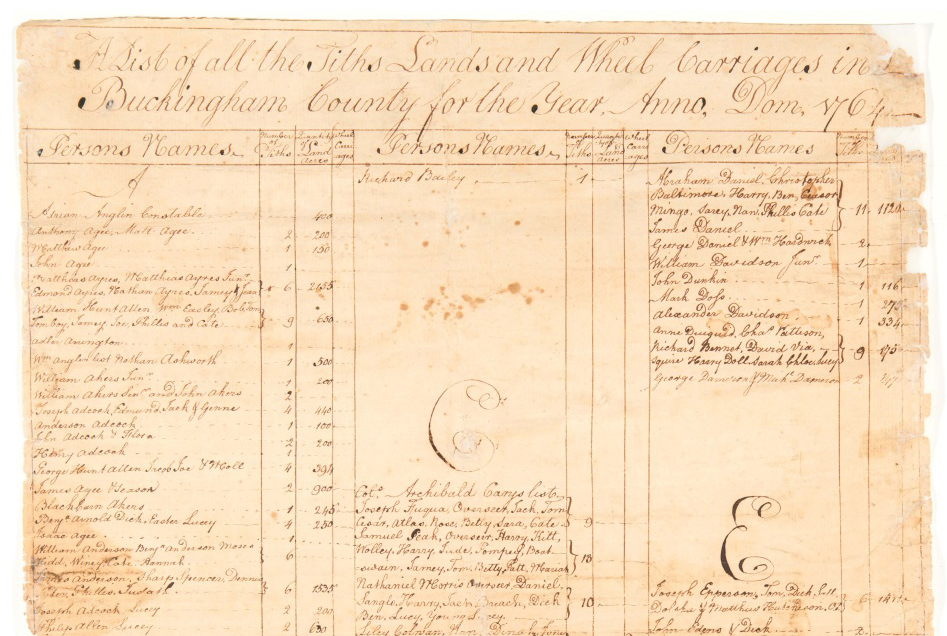
On December 11, 2013, the Library of Virginia featured a rare Buckingham County document on their blog, Out of the Box: NEW IMAGES ADDED TO LOST RECORDS DIGITAL COLLECTION
Now, in addition to finding various Buckingham County wills digitalized at the Library of Virginia’s “Lost Records Localities Digital Collection,” anyone can access images of the original Buckingham County Tithable List, A-G, 1764.
How did the fragment of Buckingham’s 1764 tithable list happen to survive?
In 1869, these two precious pages were not in the Buckingham Courthouse when it burned to the ground and were discovered in the Prince Edward County Courthouse. From 1789 to 1809, Prince Edward County served as the district court for several counties including Buckingham. There both civil and criminal suits originating in Buckingham County were appealed. The tithable may have been an exhibit in a Buckingham County suit, though according to Library of Virginia archivists, “no style of suit or exhibit number is found on the document.”
If you are fortunate to have a Buckingham County ancestor whose surname begins with A-G, you just might find him listed in 1764. Among these founding families of Buckingham are Agee, Allen, Bell, Bondurant, Chambers, Cabell, Daniel, Davidson, Epperson, Easley, Ford, Flood, Guerrant, and “Garrot.” The names of tithable slaves are also included.

In 1856, something was stirring in Buckingham County.
A significant number of valuable Buckingham farms and other businesses were advertised for sale in the Richmond newspapers. Did sellers attempt to take advantage of a strong market? Did they anticipate a dip? Was the climate in Buckingham shifting towards increasing industry, making those properties more valuable? Did the political battles over the Kansas Territory concern Buckingham County slaveholders? Was it just coincidental?
Among the properties for sale were Physic Springs Farm and its Grist Mill. Owner Martha G. Spencer advertised in the Richmond newspapers:
The Undersigned wishing to dispose of her PHYSIC SPRING property, takes this method of offering it at private sale. The tract contains by survey 473 ACRES of land of a fair quality, and in good condition, with timber and water well distributed. The improvements consist of a good Dwelling House, with all the usual farm houses; and a very good Grist Mill, in good repair, which will be sold with, or without, the tract, as purchasers may prefer.
Martha Spencer added that the farm was located in an “agreeable community,” convenient to the well-known Buckingham Female Collegiate Institute and other good schools.
In 1860, Martha G. Spencer and three of her unmarried children were living with her son-in-law, Dr. A.W. Fontaine, and his wife, Mildred. Also in 1860, William J. Fontaine (age 26) was employed as a Miller. His water-powered mill, grinding corn and wheat, is among those listed on the 1860 Industrial Census producing over $500 in business per year. Was he operating the Physic Springs Grist Mill? Or, perhaps, Diana Mills, which was given as the address of Dr. A.W. Fontaine?

For many decades, Physic Springs in Buckingham County, near Gravel Hill, was a busy place. It was home to a health resort, a farm and mill, an Academy for boys, and a Seminary providing the equivalent of a junior college education.
According to Garnett Williams’ survey for the Virginia Historical Inventory, “Physic Springs was a well known health resort, people came for miles around that were afflicted with any form of skin diseases, they drank the water, and used it for bathing purposes. Dr. (Edward) Snead conducted an Academy for boys there for about ten years.”
In 1850, Homer Male Seminary operated at Physic Springs and advertised in the Richmond papers. One ad began, “The next session of this Institution will commence the 1st of Jan., and close the 30th of Nov’r following, giving a vacation of one month. The object of the School is to educate youth thoroughly, prepare them for the Junior and Senior Classes in College, or the active duties in life. “
Instruction in Languages and Science was thorough. Boys did not advance who did not fully comprehend their course of study. Board for ten months was $80.00. Importantly, the institution was located just two miles from the Buckingham Female Collegiate Institute, facilitating fraternization between the young scholars and the girls of The Institute.
Coming next: Physic Springs Farm & Mill
In the 1950s, a former German soldier named Dominik Stillfried settled in central Virginia and developed a successful dairy farm at Snowden, once the home of Randolph Jefferson. In 1964, Stillfried was ready to sell his 600 acres and placed an advertisement in the Richmond Times-Dispatch on August 23, 1964. Though the farm was labeled, “historic,” no mention was made of the Jefferson family connection.

HISTORIC SNOWDEN FARM – Located on James River, Scottsville, Va.; prosperous dairy farm is being offered as an operating unit, has nice dwelling, beautiful shrubbery and trees. 2 tenant houses, all necessary buildings and silos for operation of efficient dairy. Approximately 600 acres of land, 150 acres of river bottom corn land, 70 acres of alfalfa upland, 50 acres of pasture land. This farm has been maintained in top condition and soil brought up to proper balance each year. 225 head of top quality Guernsey cattle producing golden Guernsey milk at this farm each year. Excellent financing.
Apparently, the dairy did not attract a buyer and, one year later, the Richmond Times-Dispatch advertised the dispersal of Snowden Farm. 200 cows and heifers, as well as the dairy and farm equipment, were auctioned. Today, ruins of the silos can still be seen on the lowlands at Snowden.
For more about life at Snowden in the 18th and early 19th century, see The Jefferson Brothers.

Alexander Hill Church, Courtesy Historic Buckingham
On January 1, 1867, Buckingham-born Alexander Moseley, Editor of the Richmond Whig, granted a tract of land consisting of 346 acres of land to his former servants. The tract was located at the headwaters of Ryan’s Creek just west of Glenmore.
The deed transferred the property to nine “men of color,” including Gabriel Palmer, who would become the pastor of Alexander Hill Baptist Church, the first African-American Baptist Church in Buckingham County. The others were Emanuel Wayne, Emanuel Moseley, Cornelius Palmer, Winston Palmer, Peter Scott, Jesse Moseley, Sr., John Harris, Sr., and Samuel Braxton. On the deed, a church was noted at the tip of Emanuel Wayne’s land on Nicholas Cabell’s Ferry Road. In the center of the property, on Emanuel Moseley’s lot, there was a saw mill.
The community became known as Alexander Hill and provided homes and livelihoods not only for these nine men, but also for their rapidly expanding families.
For more about Alexander Hill, please see my article in this month’s Buckingham Beacon: “The Man Behind Buckingham County’s Alexander Hill Community: Will the Real Alexander Moseley Please Stand Up?”
Currently, I’m expanding this article and am interested in the long-lasting legacy of Alexander Hill. If you have stories or photos to share about the community, please contact me at jlyeck@gmail.com.

Photo by Joanne Yeck
On January 7th, Slate River Ramblings had a whopping 255 visitors. What a great way to spend a snow day. Many thanks to all of you who took time to investigate a little Buckingham County history!
Buckingham and its citizens have a long tradition of managing well in the dead of winter. On February 19, 1914, The Farmville Herald noted that Buckingham “folks are taking the bad weather quietly. Just sitting around and talking over things in general.”
If you run out of conversation, don’t wait for more extreme weather to explore Buckingham’s past. Try putting Ghosts or Mysteries in the search box at Slate River Ramblings. You might bump into something intriguing to talk about!

Buckingham County history is scattered everywhere, much of it held in various collections of private and business papers. One such collection is the LeSueur–Richmond Slate Corporation Records, 1834–1998, housed at the Virginia Historical Society.
The LeSueur–Richmond Slate Corporation evolved from numerous other slate companies, many located in Buckingham County, including: Williams Slate Corporation, Buckingham Slate Quarries, Arvonia–Buckingham Slate Corporation, and Buckingham–Virginia Slate Corporation.
To learn more about the collection and some very interesting Buckingham history in the process, consult the finding aid for LeSueur–Richmond Slate Corporation Records, 1834–1998.

John R. Williams (1843-1901)
Courtesy Virginia Cavalcade and John D. Williams
On March 22, 1901, The Richmond Dispatch announced the “untimely death” of John R. Williams who, though in apparently fine health, expired very suddenly. His obituary began:
Mr. John R. Williams, one of the most prominent and successful businessmen of Richmond, died suddenly yesterday afternoon at his home, on Park avenue. The cause of his untimely death was apoplexy.
Mr. Williams was a native of Wales, having been born at Carnarvon, on March 28, 1843. Had he lived seven days longer he would have been 58 years old. He emigrated to America in 1868, and was one of three brothers who came to Richmond about that time and opened a stone-yard on Dock street, near the foot of Twenty-eighth street….
Some years after coming to Richmond Mr. Williams became interested in the Buckingham slate quarry. It was through his energy that this well-known quarry has been developed and made a great thing for the entire State of Virginia. The output has been shipped to all parts of the United States, and not a little to England.
Besides being the head of the quarry, Mr. Williams was president of the Southern Trust Company, of this city; a director of the State Bank, largely interested in the Virginia Casket Company, and a member of the company recently formed to develop the Natural Bridge property, and to make it one of the greatest of all southern resorts. His office was located in his building, at the northwest corner of Ninth and Cary streets.
SUCCESSFUL IN BUSINESS
Mr. Williams was pre-eminently a level-headed, self-reliant, and well-poised man. He was a superbly equipped businessman, and had always been successful in his business ventures. He was widely known, especially among architects and builders….
The obituary went on to name members of the Williams family, including Evan R. Williams, his brother and partner in Williams Slate Company as well as his brother, Hugh, and sisters, Mrs. Jeffries, Mrs. McLavis, Mrs. Ellis Jones, and Mrs. William Jones – all of Arvonia, where the quarry was situated.


 slate river ramblings . . . .