
Buckingham County’s Poor, 1805-1820: Part IV
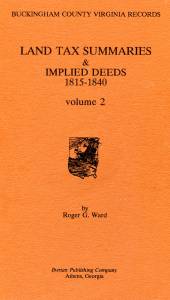
Volume Two in Roger G. Ward’s indispensable series, ” Buckingham County, Virginia: Land Tax Summaries and Implied Deeds, 1815-1840.”
Roger G. Ward has abstracted images from the Buckingham County Virginia Loose Papers housed in San Marino, California at the Huntington Library. At the end of this series, there will be a link to a PDF containing his complete document.
Click here to catch up: Buckingham County’s Poor, 1805-1820: Part I
~
Physicians living in Buckingham County were frequently reimbursed by the Overseers of the Poor. Grimly, others provided coffins. The loose papers at the Huntington Library include the names of the following doctors:
Dr. Reubin D. Palmer treated Catharine Whorley.
Dr. Mace C. Spencer treated Eveline Haskins.
Dr. John S. Mills and Dr. Charles Mills were reimbursed. Were they related?
Dr. C. C. Allen, Dr. Southal, Dr. Fontain, and Dr. N. C. Spencer received funds. Is this actually Mace C. Spencer mentioned above?
~
In affidavits of Virginia Soldiers of 1776, Mace Clements Spencer, of “Oakville” in Buckingham County, is identified as the son of Gideon Spencer, of Charlotte County. In 1835, Spencer became one of the trustees for Buckingham’s Oak Grove Academy. Mary/Maria Elizabeth Walker (c.1785-1857) married Dr. Mace C. Spencer. She is believed to be his third wife. They were enumerated together on the 1850 census: Mace C. Spencer, physician, age 61; Mary, his wife, age 55; and three probable sons: Benjamin, Charles, and Samuel Spencer.
If a Slate River Ramblings reader recognizes any of these early nineteenth century physicians living in Buckingham County, please comment.
To learn more about the fascinating history of Buckingham County’s poorhouses, see my essay “Stewards of the Poor: Buckingham County’s Poorhouses” in “At a Place Called Buckingham” Volume Two.
Coming next: Buckingham County’s Poor, 1805-1820: Part V


 slate river ramblings . . . .
Many thanks for sharing your findings!
Joanne
Been a while since this was posted but I recently made kind of a small weekend project of Dr. Mace Clement Spencer and what happened to him. He is listed in the will records of Campbell county VA as a creditor for medical services on the estate of Philadelphia Johnson (nee Jones) on 31 Jan 1825.
From 1829 through 1837, as reported by another researcher, Spencer was advertising to sell around 620 acres of land so he could move west, but remained near Oakville Virginia as late as 1839, where he served on a Committee of Vigilance.
In the US General Land Office Records, Mace C. Spencer patented, all together, around 1100 acres of land in Chariton County Missouri in township 54, Range 20, the earliest of which was dated in 1840. Generally the person applying for the patent had prove they had lived on the land for 3 years prior to making the application, so it seems reasonable to figure he went to Chariton Missouri around 1837 and took out substantial land holdings near the Missouri River (the highest concentration of enslaved persons were in plantations along the Missouri River). Maybe he made several trips to Missouri or left some of his slaves and an overseer to handle the required improvements to the land.
He was listed in the 1850 US Census of Chariton County Missouri and the slave schedules showed him owning 18 slaves ranging from 1 year to 65 years in age, 10 females, 8 males.
Various deeds, court records, marriages etc record some of the events in the lives of his children.
On May 10, 1850, Dr. Mace Spencer made an 18 page will with 32 separate bequests, each individual bequest signed by him. The will concluded with a hand-drawn detailed plat map of his land holdings and the initials of each heir shown by the parcel they got.
He also willed $50 in cash and some household belongings to John E. Cannon that were originally the property of his (John E. Cannon’s) mother, “my wife Jane Spencer”, along with several books that had his (Cannon’s) father’s name inscribed in them, but the father’s name is not given. He also mentions silver spoons and a ladle owned by John E. Cannon’s sister Caroline that were to go to John when he came of age.
Spencer’s will mentioned two and possibly three wives: Jane, who seems to have been dead by 1850, Mary “if she survive me” and later in the same document Mary, who seems to be a different person, but that will take further research to determine.
Spencer said he was in good health, no particular reason he should make the will except the usual recognition that life is short etc…he did not know how right he was.
By early September 1850, his will was proven by oaths of witnesses and admitted to probate court in both Chariton and Platte counties in Missouri. Dr. Spencer, it seems, was dead.
A search of newspaper databases turned up a few grim articles, the gist of which was that Dr. Mace C. Spencer, while returning to his home in Brunswick Missouri “with his lady” from a visit to Virginia, he took his breakfast on the Ohio river on the deck of the steamboat Visitor on Sunday morning (28 Jul 1850) and “by night time was a corpse”, dead from cholera, which was raging along the rivers.
Other newspaper articles added minor details: ”the Visitor was between Cincinnati and St. Louis” when Dr. Spencer took ill and he was buried “at the head of Treadwater Bar” or “the head of Treadwater Island”
A little bit more research showed that place to be a variant, perhaps a dark pun on the confluence of Tradewater River with the Ohio River about two miles below Caseyville Kentucky and the problematic nature of that section of river for snagging or grounding boats.
While an 1857 map of Crittenden county Kentucky indeed does show a fairly large sand bar island about 2.5 miles ‘below’ (downriver toward Cairo IL) Caseyville KY, Google Maps shows no trace of it existing today.
It’s very likely that the mortal remains of Dr. Mace Clement Spencer were claimed by the Ohio River, either due to natural erosion, flooding or dredging activities undertaken to widen and the channel and improve navigation along that part of the Ohio.
His body does not seem to have been returned to be buried alongside his wife and two young children at Elliot Grove cemetery near Brunswick. There’s no stone and a man of his means would almost certainly have had or ordered one. It’s also extremely unlikely the family would have disinterred the decomposing remains of a body that was riddled with cholera, so he was left on Tradewater Island and was reclaimed, along with the island, by the Ohio River.
There is a memorial to him at FindAGrave but it specifically states that it is a memorial and he is not buried there.