
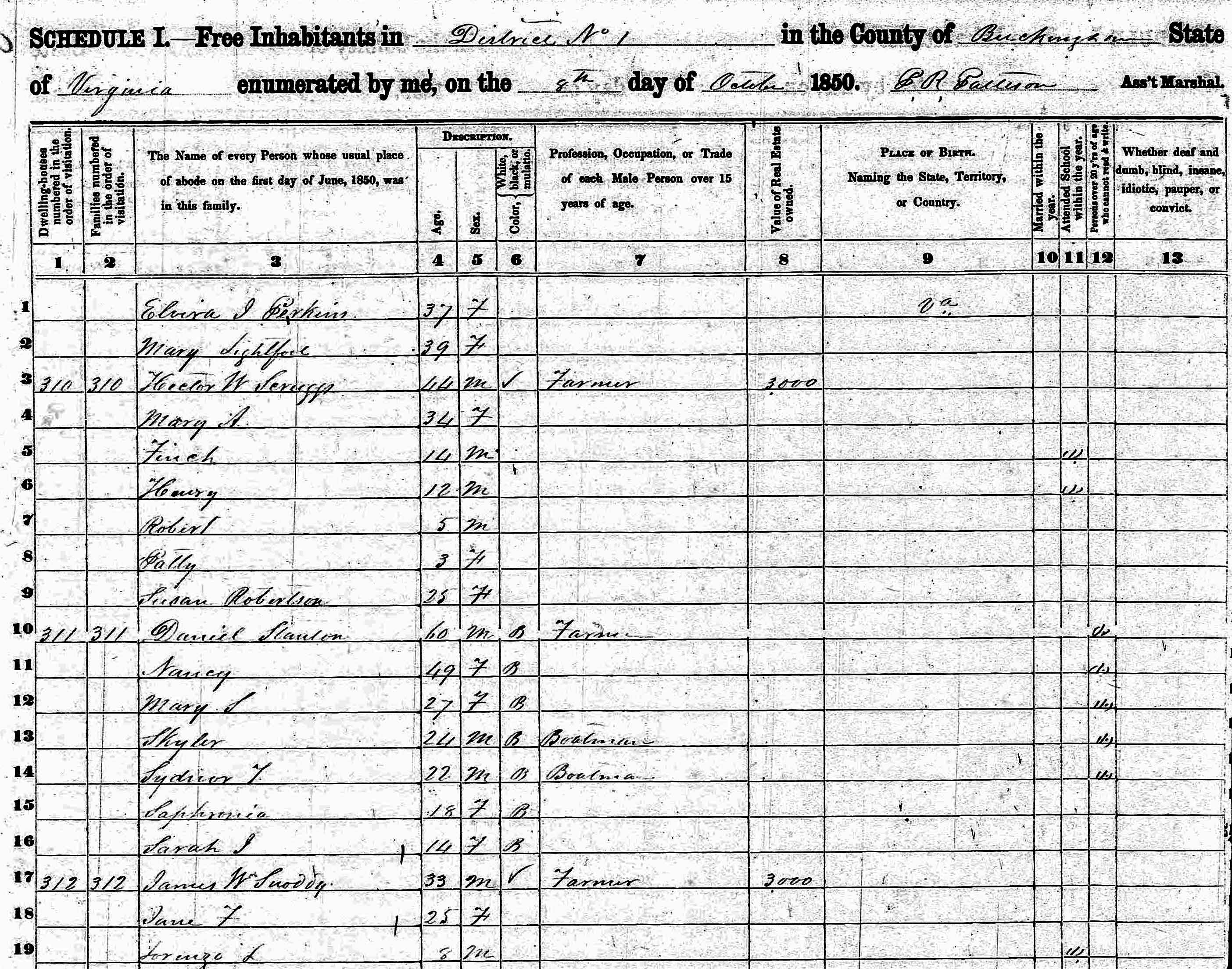
In the Gazetteer of the United States (1854), Thomas Baldwin very simply states the population of Buckingham County that year: “Population, 13,837, of whom 5676 were free, and 8161, slaves.”
At first glance, the degree to which slaves outnumber free men, women, and children is impressive. The numbers, however, do not represent a simple dividing line between the races. In 1854, here were a number of free blacks living in Buckingham, including the well-known Daniel Stanton family, whose sons were boatmen on the James River.
Among the slaves were Blacks, “Mulattos” (mixed race or light skinned individuals), and possibly some people with Native American ancestors. Some of these slaves were highly skilled, working as blacksmiths or millers. Most, of course, labored on Buckingham’s farm land.
The 1850 Federal population census includes a separate slave census which gives the age, gender, and “color” of each slave. While the assignment of Black vs. Mulatto varies from enumerator to enumerator, it can be an informative detail. The slave census also notes if the person is “Deaf & dumb, blind, insane or idiotic.” From these few facts a rough idea of the slave population in a household, on a farm, or on a larger plantation emerges.
One of my current projects is collecting stories of Buckingham’s enslaved population and information about the early days following emancipation and Lee’s surrender in April of 1865. If you have any family stories you would be willing to share, please let me know.
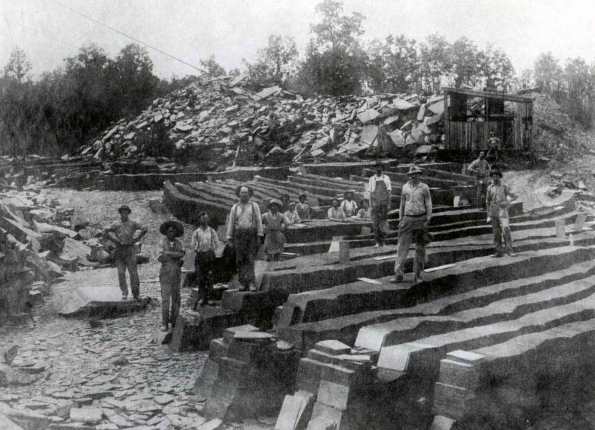 Courtesy Historic Buckingham

In my 1/5/13 post I mentioned the ubiquitous Buckingham slate. In the Gazetteer of the United States (1854), Thomas Baldwin reminds the reader that, “Valuable slate quarries have been opened on the bank of Slate River, and iron is found in the county.” Indeed 1854, was just the beginning of Buckingham County’s reign as the King of Slate.
Unlike Buckingham’s “gold rush,” slate quarrying in the county has been a steady industry for more than 150 years. Buckingham’s slate belt is one of only six in North America with commercial value and runs for approximately five miles along Hunt’s Creek, a tributary of the aptly named Slate River. Beginning in the early 19th century and continuing today, the unfading, blue-black slate, glistening with mica, remains of “the very best quality.” Abundant and practical, in areas of Buckingham close to the quarries, slate was used to roof even the hen houses and the outhouses.
In the 1820s, the Thomas Jefferson-designed Buckingham Courthouse was crowned with it. In the 1830s, the tin-roofed buildings at the University of Virginia (the tin lasted only ten years) were re-roofed with Buckingham slate. In 1851, Edward Sims sent a sample of his quarry’s slate to the London World’s Fair, where it won at least honorable mention. Later, Buckingham slate took first prize at the nation’s Centennial in Philadelphia in 1876, was awarded first prize and a gold medal at the Chicago’s World’s Fair in 1893, and again won the gold at the St. Louis’ Universal Exposition in 1904.
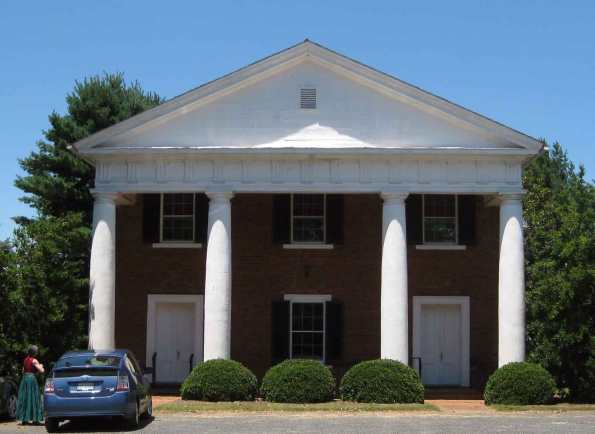 Photo by Joanne Yeck
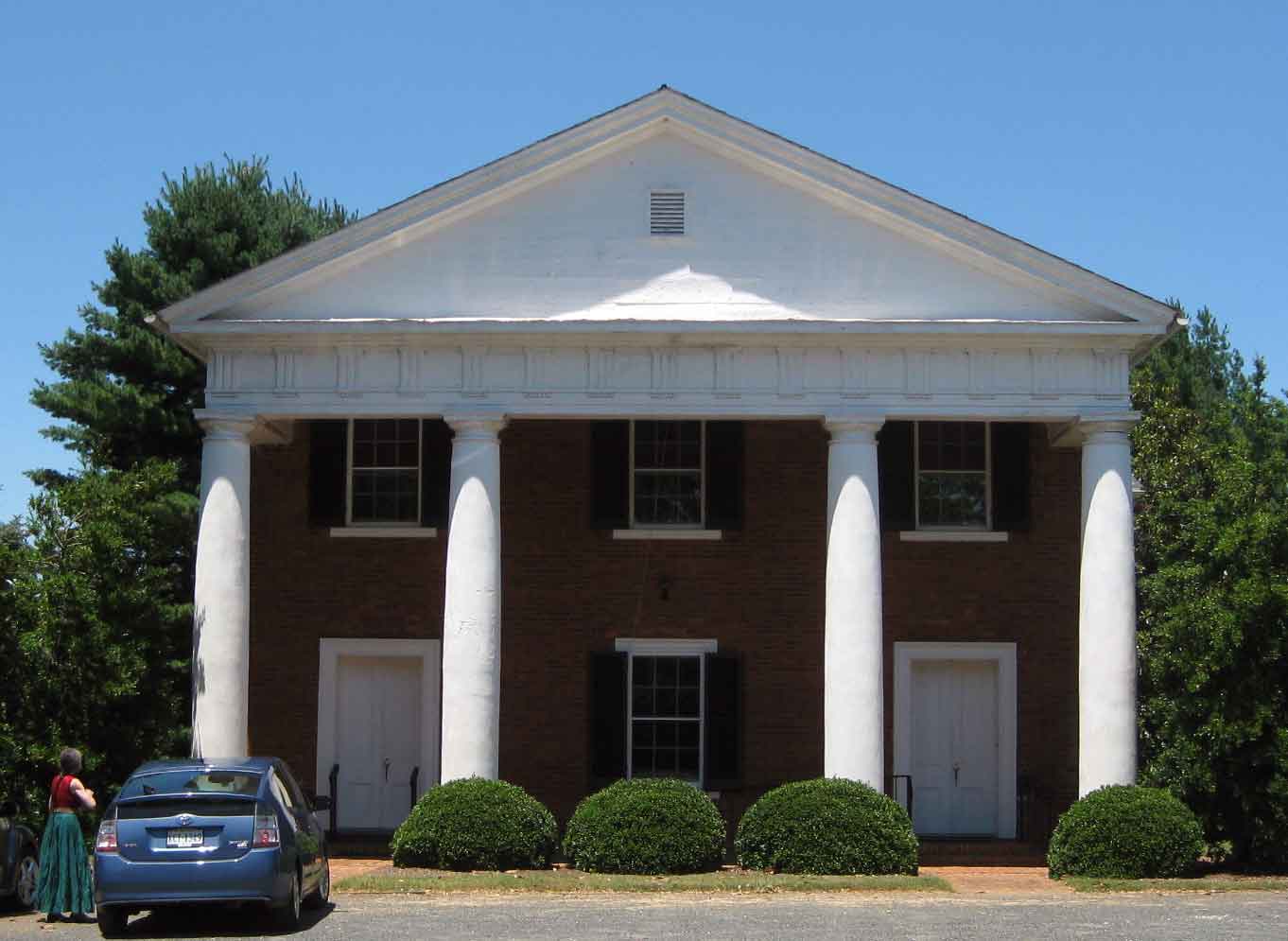
Yet another of the nineteen churches in Buckingham enumerated in Thomas Baldwin’s Gazetteer of the United States (1854) is Maysville Presbyterian Church. In 1822, Rev. John W. Fulton, licensed by Hanover Presbytery, was sent to Buckingham County to establish a church. Two years later, Rev. John Holt Rice, D.D. organized the new church with nine members. By 1830, the congregation had grown to thirty-nine. The church building pictured here was completed in 1838 and is beautifully maintained today. Closely resembling the Buckingham Courthouse, it is located in the town’s Historic District. As would be expected in Buckingham, its roof is made of slate.
In 1997, Carl Coleman Rosen, Sr. wrote the comprehensive History of Maysville Presbyterian Church Buckingham Court House, Virginia, 1824-1996. In it, Rosen quotes from History of Maysville Church: 1824-1888, written in May of 1888, by Rev. Thomas D. Bell: “Being at the county seat, this church has exerted some influence over a considerable part of the county. It has always been predominant in the village of Maysville and its influence there for good has been very decided. The list of elders, numbering twenty-eight shows that more prominent men in the county have been in its connection than is usual in a church of this size.”

Shaft mining in central Virginia, c. 1865 (Harper’s New Monthly Magazine)
Thomas Baldwin’s Gazetteer of the United States (1854) noted that in Buckingham County, “Gold mines are worked in the vicinity of Willis Mountain, and yield large profits.”
When the Gazetteer was published, it had only been six years since the frenzy of the California Gold Rush. Prior to 1848, the gold vein that runs through Buckingham County and environs was one of the richest in the nation. In 1832, the first commercial gold mine in Buckingham was established at Bernard Gaines Booker’s plantation, located about three miles from Sprouse’s Corner. It is remembered by the Booker family that Capt. Booker sported his wealth by adorning his carriage driver’s jacket with large buttons made of Buckingham gold. The Bondurant “strike” was not far behind. Soon the Buckingham “gold rush” was on, with many of Buckingham’s industrious men forming gold mining companies. By 1837, at least nine were incorporated.
In December of 1865, just after the Civil War had ended, a journalist for Harper’s New Monthly Magazine visited some of Buckingham’s still active mining enterprises owned by Buckingham families Lightfoot, Bumpus, Ford, Hobson, Ayres, and Duncan’s mine (also operated by Apperson and LeSueur). The writer traveled from Fluvanna County, across the James River and the Canal, journeying to “the renowned County of Buckingham,” stating, “I apply that epithet to it, because it has always borne the character of being the richest mineral county in the State of Virginia.”
Folks still pan for gold in Buckingham County. Central Virginia Gold Prospectors maintain a website: http://www.cvgp.net

In my 12/24/12 post, I referred to so called “burned counties.” Virginia is plagued with them. Most record loss is due to the activities of war. For example, when Banastre Tarleton burned the Albemarle County records during his famous raid in 1781, much of Buckingham’s history prior to its inception in 1761 was lost. During the Civil War, Federal forces were responsible for some burning as well. Sometimes early frame courthouses just simply caught on fire, one of the reasons Thomas Jefferson advocated brick structures. His designs for Virginia courthouses reflected this prejudice.
The Library of Virginia has created three basic categories for research in counties with burned records: Hopeless, Almost Hopeless, and Difficult. You guessed it, Buckingham is labeled “hopeless.” But I’m here to say that unearthing Buckingham’s history is far from hopeless. If you are looking for a specific birth, marriage, or death record, it’s true you may be out of luck. On the other hand, if you are willing to open up your research and apply a lot of persistence and patience, you will be rewarded. I certainly have been and I’ve met a lot of terrific cousins in the process. One thing I’ve learned about people working on burned counties . . . they tend to be generous. Every nugget of information becomes surprisingly precious.
In the weeks to come, I’ll offer some suggestions as to where to look when the records you so desperately want are burned. The hunt is, at least, half the fun!
 photo by Jeremy Winfrey
In all my travels in Buckingham County, I have not collected ghost stories. In fact, I’m not sure I’ve heard a single one. I know quite a bit about the Moon family ghost who wreaked havoc just across the James River in Scottsville, Albemarle County. But what about Buckingham? With all the decaying and demolished structures, not to mention the lonesome graveyards lost to the woods, there must be some stubborn and vocal Buckingham ghosts!
Does your Buckingham family have any hauntings? If so, please let me know and be sure to say if it is okay to share your story on Slate River Ramblings. Thanks!
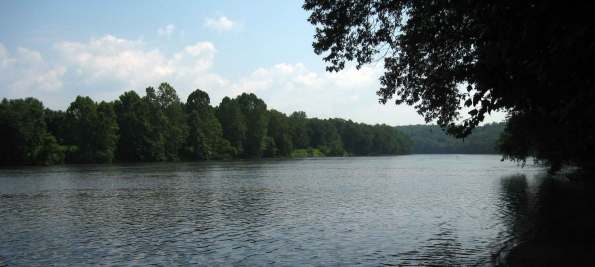
James River at Hatton Ferry Crossing, Photo Joanne L. Yeck
With Buckingham’s long exposure to the James River, ferries have long been an important aspect of the county’s culture. As the 18th century progressed and Buckingham’s population steadily grew, public and private ferries (built and abandoned at the planters’ convenience) appeared connecting Buckingham to Fluvanna, Albemarle, and, later, Nelson County. In the 1790s when new river towns like New Canton and Wilson Cary Nicholas’ Warren (Albemarle) were incorporated, they included ferry landings. In 1791, John Horseley’s ferry was established in conjunction with the founding of Dieuguidsville at Bent Creek.
In 1819, the revised Virginia Code mentioned several ferries operating with landings in Buckingham. They included one from John Scott’s to the lands of Randolph Jefferson at Snowden (the original Scott’s ferry), one from Thomas Anderson’s landing to Howard’s landing, one from the land of John Cabell (Buckingham) to his own land on the opposite shore, one from the land of Joseph Cabell Megginson (Buckingham), who was Joseph Cabell’s grandson, to his own land on the opposite shore. Additionally, John Nicholas operated a ferry across the Slate River, not far from where it entered the James River.
For more about ferries in Buckingham County see the December 2012 issue of the Buckingham Beacon or follow this link to a PDF of my article:
 Photo by Joanne Yeck
Mt. Zion Baptist Church was founded in 1838 and is one of nineteen churches in Buckingham alluded to in Thomas Baldwin’s Gazetteer of the United States (1854). According Rosa G. Williams’ 1937 entry in the Virginia Historical Survey, “Mt. Zion is said to be the second oldest Baptist organization in the country. . . . Funds were raised and the new church was erected and dedicated in the year 1856, a much larger and better church than the first. The pews are said to have been brought from the old church, and are of the old box type. The present pastor says they are the most uncomfortable seat he had ever tried to sit on. . . .
“The first pastor that served at this church (the new building) was known through the country as ‘Parson Taylor.’ He served there for forty years, and requested that he be buried in front of the church he had served so faithfully. His request was granted and one may see his grave today, marked with a plain slate marker, directly in front of “Mt. Zion Church” and only a few feet from the door. In the church is an enlarged picture of “Parson Taylor.”
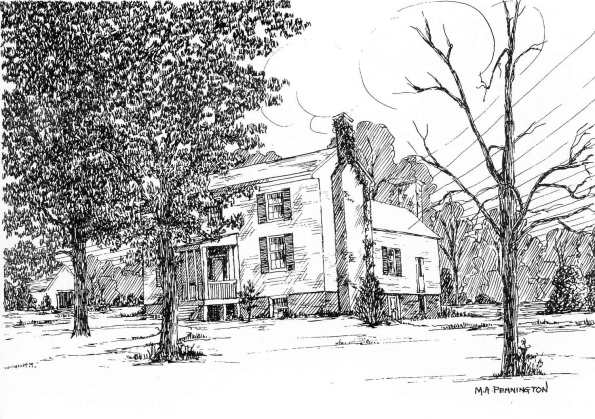 Humanity Hall (Courtesy Historic Buckingham)
According to Thomas Baldwin’s Gazetteer of the United States (1854), that year 194 pupils attended public schools and 96 attended academies or other schools. One of those academies was Humanity Hall. Founded by Elijah Garland Hanes, the original location for Humanity Hall Academy was not far from the Buckingham-Cumberland County line, near Nuckols. The school’s unusual name may have remembered another Humanity Hall Academy in Hanover County.
In 1848, Elijah Hanes purchased 1050 acres on Joshuas and Turpins Creek, about ten miles north of Buckingham Courthouse. He paid $10,000 for the farm, which was previously owned and developed by the Holman family, who left behind a handsome manor house. There he relocated his family and his school. It continued to thrive through the 1850s, eventually under the direction of his son, Garland B. Hanes. Closed during the Civil War, Humanity Hall never reopened.


Photos by National Park Service: Washington Monument
George Chambers’ grave marker (posted 12/26/12) was cut by J.T. Rogers of Richmond. In 1846, importing a marker from Richmond to Buckingham was a pretty big deal and it’s a reminder that many Buckingham planters had influence and contacts beyond the confines of the county. J. T. Rogers was a prominent “marble dealer” in Richmond, located at Main and 8th.
In the mid-1850s, Rogers contributed not one but two Masonic stones to the Washington Monument.
From “Masonic Stones of the Washington Monument:”
At the 200-foot level, eighteenth landing, Virginia presented two Masonic stones. The first is presented by St. John’s Lodge No. 36, F. & A.M., Richmond. The stone is granite with a raised marble Bible carved with a compass and square. The stone is signed J.T. Rogers, Richmond. The stone from the Grand Lodge of Virginia is granite with a raised border and also contains a carved Bible with compass and square. It bears the inscription: “By the Grand Lodge of Accepted, Ancient and Free Masons of Virginia. Lo’ She gave to this Republic, the Chief Corner Stone. Aug. 4 A.L. 5854.” J.T. Rodgers, Richmond, has signed the lower border.


 slate river ramblings . . . .