
Take a trip to Peter Jefferson’s Snowdon and the Horseshoe Bend in the James River courtesy of Chase Richards.
You can learn more about the origins of the plantation in my newest book, Peter Jefferson’s Snowden: A History of Settlement at the Horseshoe Bend.
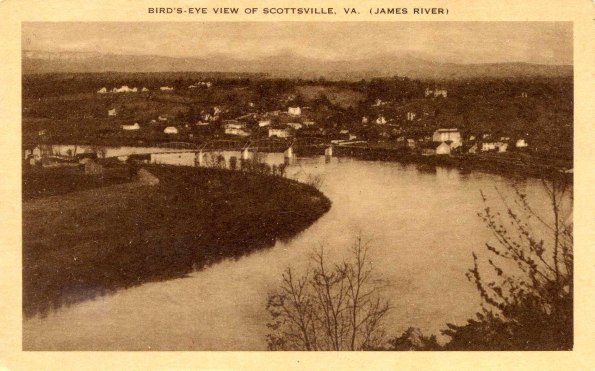
Bird’s-Eye View of Scottsville, VA (James River). Courtesy Raymon Thacker.
In 1901, the building of a bridge was proposed from Buckingham County across the James River to Scottsville. The March 20, 1901 issue of the Appomattox and Buckingham Times ran an article entitled “Progressive Old Buckingham,” describing the plans.
Last winter Senator Flood and Delegate Hubard secured the passage of the bill allowing the people of Slate River District to vote upon the question of issuing bonds for $2000 for the purpose of constructing an iron bridge over James River at Scottsville. The requisite number of signers having been secured, the position was presented to Judge Moss of the county court, at the last term, and his Honor has ordered an election to be held at Slate River District on April 16th next. If we are correctly informed about this bridge matter, the citizens of Buckingham generally are very much interested in its completion, or should be. The bridge at Scottsville is estimated to cost when completed between $12,000 and $15,000; the bridge Bremo, which has been a source of annoyance in the way of extorting toll, will become at the same time a free bridge. We do not know the value of the structure of Bremo, but it is certain that the C. & O. is anxious about the completion of the Scottsville bridge, for the Company has contributed liberally and also proposes to make the Bremo bridge free. These two magnificent and expensive structures are to be dedicated to the service of the people of Buckingham for the sum of $4000, $2000 of which sum is given by the county at large and $2000 by the taxpayers of Slate River District. If the election on 16thof April fails to vote the $2000, the county’s subscription will not be binding.
With the above facts before us, it would seem the part of wisdom for our people to extend the welcome hand to the developers and accept the bridges especially so since the cost is not made a factor of the problem. Good roads and free bridges increase the value of land, and invite home-seekers⸻toll bridges and bad roads retard progress and keep out settlers.
Finally, in 1907, a steel-girdered bridge from Buckingham County to Scottsville was completed. How it was financed is currently unknown.

Virginia Historical Inventory. Courtesy Library of Virginia.
Identified as “Travelers Rest No. 2” on the Virginia Historical Inventory, Rosa G. Williams described the house as follows:
This old English type mansion is in bad condition and is at present used as a barn. The yard has grown up in brambles and briars and some of the trees in the yard have blown down. The porch has been torn down. A large 4-panel, double door opens into a very large hall; to the right of this hall is an unusually large room with beautiful panel wainscoting about two feet high and plastered walls, although most of the plastering has fallen. To the left of the hall is a room similar to the one on the right, but not so large. Both have beautifully carved mantles and panel wainscoting. In the rear of this room is a very small room. A lovely winding staircase leads from the hall to the second floor; the baluster and hand-rail are beautifully carved.
There are five small rooms on the second floor, each plastered and with panel wainscoting and beautifully carved mantles. There are three large basement rooms. The house was built of heart pine, and shop-made nails and wooden pegs were used it its construction. The original flooring is in all the rooms. Wide, hand-sawed, tongue-and-groove boards were used.
The old kitchen still stands a short distance from the dwelling.
Do the five small rooms on the second floor indicate that the house was used as an inn?
For more about this question, see Buckingham Houses: Travelers Rest #4, Part I

I am delighted to announce my newest publication, Peter Jefferson’s Snowdon: A History of Settlement at the Horseshoe Bend, published by the Central Virginia Genealogical Association. It provides an informative companion to my previous books, The Jefferson Brothers and Peter Field Jefferson: Dark Prince of Scottsville & Lost Jeffersons.
This volume tells the story of settlement on the south side of the James River and the development of the plantation Peter Jefferson would call Snowdon, a very valuable farm with a complex history.
Beginning in the 1720s, a small group of men based in Goochland County, Virginia began to migrate west, along the James River, settling the frontier which lay at the foot of the Blue Ridge Mountains. A few stopped at what is known as the Horseshoe Bend, a particularly beautiful and fertile spot in the river. Today, the modern counties of Albemarle, Buckingham, and Fluvanna, converge there at the village of Scottsville.
In the early 1740s, President Thomas Jefferson’s father, Peter, already a successful surveyor and land speculator, was quick to realize the commercial value of the spot when the newly formed Albemarle County located its seat at the Horseshoe Bend and set about acquiring land by purchase and patent, creating a plantation which would enrich the family for decades to come.
You can purchase the book at Amazon. Just follow this link: Peter Jefferson’s Snowdon

Thomas Jefferson.
In 1937, Rosa G. Williams surveyed yet another Buckingham County house named Travelers Rest. In the Virginia Historical Inventory it is identified as “Travelers Rest No. 2.” This house, belonging to the Johnson family, was located “2.9 miles southeast of New Canton, on Route #670, thence west .2 mile on private road.”
Mrs. Williams identified the first owner as Robert Hill (1798), who was followed by several generations of the Johnson family including J. R. Johnson (about 1860), Nannine (1896), and Nannine Johnson’s heirs, who were the present owners in 1937.
Mrs. Williams’ informants included: Goode Johnson, heir of Nannie Johnson; Peyton Moss, a descendant of Robert Hill; and Rev. Plummer Jones, an old resident. She also consulted the old records of Mr. W. H. Bumpus, deceased, who was a grandson of Robert Hill.
The survey claims that many distinguished men were often guests at this Travelers Rest, including Thomas Jefferson, John Marshall, and Henry Clay.
Was this house a public inn? If so, who was the innkeeper a member of the Hill family or of the Johnson family?
Thomas Jefferson listed dozens and dozens of taverns, hotels, and ordinaries in his memorandum books. A Travelers Rest in Buckingham County is not mentioned.
In the late eighteenth and early nineteenth century did the property perhaps go by another name?
Can a Slate River Ramblings reader help solve this mystery? Please comment below.
Coming next, Buckingham Houses: Travelers Rest #4, Part II
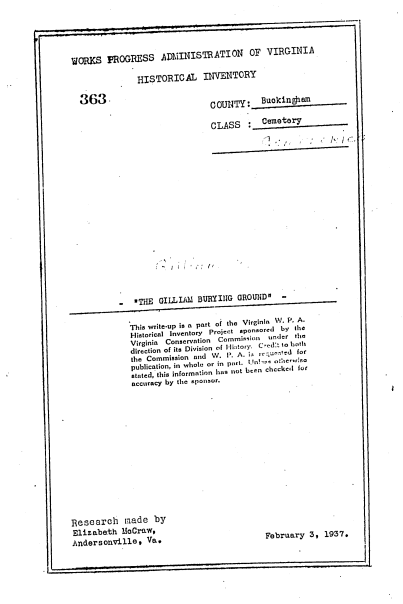
Virginia Historical Inventory. Courtesy Library of Virginia.
It appears that the name Travelers Rest was almost as popular in Buckingham County as Locust Grove.
In 1937, Elizabeth McCraw wrote this for the Virginia Historical Inventory:
On the old Gilliam estate, known as “Travellers Rest,” three-fourths of a mile west of New Store, is the family burying ground. Here are overshadowed by large trees, and the grades and surrounding ground overgrown with lovely periwinkle are three large upright “period” tombstones of marble. These several broken stones and several unmarked graves. Following are copies of the inscriptions on the head stones.
Sacred
To the Memory of
Sarah E. GILLIAM
Born March 24, 1822
Died December 8, 1848
“The Cage was broke, to let us fly,
To build our happy, Nests on high”
Joham [?] Gilliam
Died November 10, 1859,
Aged 86 years.
He died in the hope of a blissful immortality.
Erected as a tribute of filial affection by his children.
Sacred
To the Memory of
Caroline S. Gilliam
Born June 9, 1817 Died May 8, 1853
“Her soul has taken its flight,
To Mansions of Glory Above,
To mingle with the Angels of Light,
And dwell in the Kingdom of Love.”
Erected as a Tribute of filial affection by her husband.
Chas. W. Gilliam

New Store Historic Marker. Photo by Joanne Yeck.
Need to catch up? Click here: Buckingham Houses: William D. Jones, Part I
In her 1937 survey of the William D. Jones house for the Virginia Historical Inventory, Mrs. Elizabeth McCraw included a short biography of William Dibrell Jones. It reads as follows:
William Dibrell Jones married in 1818 and it is believed that he came to this house to live about that time. Whether he built the house is not definitely known. He lived here from 1818 until his death in 1875.
He was an extensive land and slave owner. It is said that he owned 10,000 acres of land and 100 slaves. He conducted a mercantile business before he was married, at New Store, Virginia, one of the oldest settlements in Buckingham County. He dealt extensively in the fur trade in those days. He sold furs to the Astors and to the Larillards in New York. He also sent great wagons to New York with country produce for sale. He is known to have had as many as 3000 hogs at one time to sell. Merchants of this type in those days were called peddlers.
During the War Between the States this home was visited by both armies. Some plundering was done by the Union soldiers, such as pouring out molasses and ripping open the feather ticks and mixing them together in the yard.
Mrs. Jones asked the Union officer to give her a guard for protection against straggling soldiers. This was done and the guard protected her home during the closing days of the war.
This house was on a road traveled by both armies to and from Appomattox, and about two hundred yards from “Keswick”, the Jones home where General Lee staid the night before “Appomattox”.
~
Learn more about the Jones store here: Buckingham County: Jones Store: Part I
Click here to learn more about Keswick: Buckingham County Houses: Keswick, Part I

“William D. Jones House.” Virginia Historical Inventory. Courtesy Library of Virginia.
In 1937, Elizabeth McCraw surveyed the former home of William Dibrell Jones for the Virginia Historical Inventory. Located at New Store in Buckingham County, William Dibrell Jones owned this property from 1818 to 1875, which was then passed to his son, L. D. Jones, and then to his heirs.
Mrs. McCraw described the house as follows:
This house close to the highway has the marks of the fine old house that it once was. The yard, while neglected, shows some of the old trees and the marks of the old flower beds.
This old house with its main part two and a half stories and the wings only one and a half stories each, is framed with beautiful beaded weatherboarding, smooth and well finished. On approaching one notices the different size windows on the front, the upper sash having only six panes of glass while the lower has nine. There is no porch. Two unusually large stones for steps are in front of the entrance. Double doors with transom, lead into the hallway, from which a two flight stairway leads to the second floor. The small square newels and balusters to the stairway and the paneled wainscoting are noticeable in the hall. The rooms are all large and beautifully finished with wainscoting and picture molding on the plaster walls. The six panel doors with large iron locks and small brass knobs are noticeable. All of the old mantles except one, have been removed; this is a very plain type. There are large closets and fireplaces in each room.
Coming next: Buckingham Houses: William D. Jones, Part II
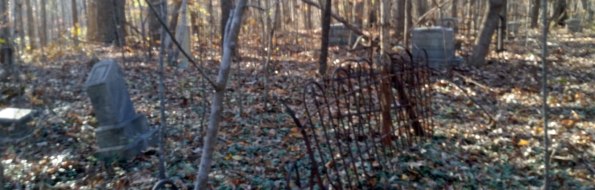
Jones Cemetery at New Store. Photo by L. D. Phaup.
While conducting research concerning the Jones Family of New Store, Slate River Ramblings follower L. D. Phaup shared the following about his visit to the Jones Family Cemetery located on Rt. 636, near the intersection with Rt. 609 in the village of New Store. The Jones house sat nearby and was removed about forty or fifty years ago. The cemetery is across Rt. 636 from the former location of the house. Mr. Phaup wrote:
I visited the family cemetery on Sunday 11-11-2018 and did not have difficulty in locating it. My greatest surprise is the discovery of William D. Jones and the inscription on his tombstone. According to his stone it shows Virginia— PVT. Moseleys Co —1 Va Cav. —-War of 1812.
During the visit, he documented the following markers:
Louis Dibrell Jones 1837-1911
Orra Louisa Jones 1916–1917
Infant Sons 1921
Clinton H. Jones 1869–1947 and Lucy McFarland Jones 1880
Louisa T. Jones 1840–1915, wife of Louis Dibrell Jones
William D. Jones, died June 30, 1874
Louis Dibrell Jones D.D.S 1864–1930
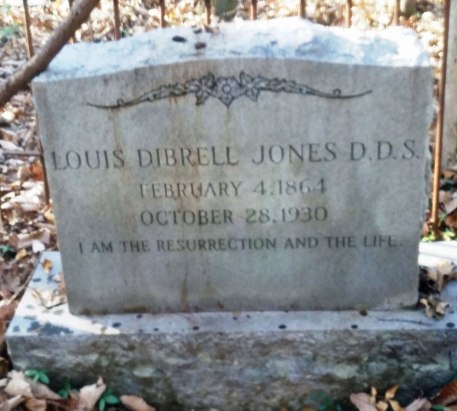
Louis Dibrell Jones D.D.S., Jones Cemetery at New Store. Photo by L. D. Phaup.
L. D. Phaup added that there are additional burials in the cemetery, however, he is unclear about their relationship to the Jones family. There are also several graves marked only by field stones.
Some members of this family are buried at Trinity Presbyterian Church, including Rev. Plummer Flippen Jones.
More about these burials can be found at Find A Grave: Trinity Presbyterian Church, Plummer Flippen Jones.
~
For a survey of the cemetery consult Buckingham Burials, Vol 1, available online at Historic Buckingham.
For more about much Louis Dibrell Jones and his family, click here:
Buckingham Notables: The Jones Family of New Store, Part I
Coming Next: Buckingham County Houses: William D. Jones, Part I
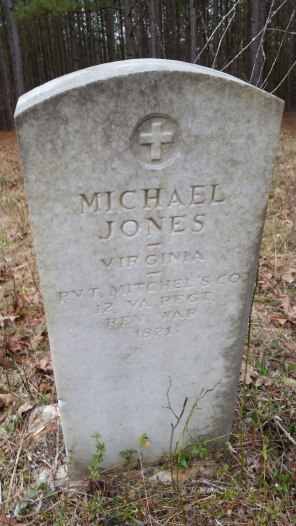
Photo by L. D. Phaup.
Slate River Ramblings follower, L. D. Phaup kindly shared this photo of Michael Jones’ elegant gravestone.
For more details, see: Jones Graveyard at Travelers Rest (Toga), Part II
Coming next: Jones Cemetery at New Store


 slate river ramblings . . . .