
Buckingham Burials, Volume IV
Need to catch up? Click here: Jones Graveyard at Travelers Rest, Part I
In 1937, when Elizabeth McCraw surveyed this Jones graveyard, she described it as follows:
In what was once an orchard, a few trees remain, in this family graveyard. A cool shady spot covered with periwinkle, and nature has been kind for after years and years of neglect this spot is easily found and identified. There are many graves marked only by rocks, but only one tombstone in the graveyard.
The oldest grave was dated 1821 and the only marker that Mrs. McCraw found. It read:
Michael Jones
Virginia
P. D. T. Mitchel’s Co.
12 Va. Regt.
Rev. War.
1821
~
According to Buckingham Burials, Vol IV there were at least two other unmarked graves: Kitty Jones and Leanna D. Jones.
The complete set of Buckingham Burials is available online at Historic Buckingham.
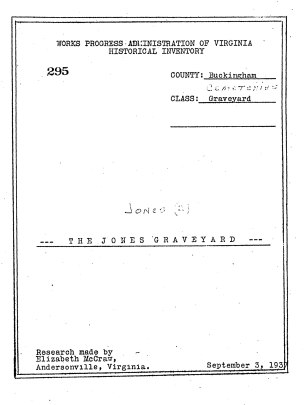
“The Jones Graveyard.” Virginia Historical Inventory. Courtesy Library of Virginia.
As is often the case with the naming of Virginia plantations and farms, there was more than one Travelers Rest in Buckingham County.
In 1937, Elizabeth McCraw of Andersonville surveyed “The Jones Graveyard” for the Virginia Historical Inventory. This spot was located 2.6 miles south of Toga on Rt. 24, then 1.4 miles east on a private road.
Mrs. McCraw noted, “This graveyard is on an estate known as ‘Travelers Rest’ and from data secured this place antidates the other ‘Travelers Rest’ near Warminster, in Buckingham County.” The dwelling house on the place was long gone and, in 1937, the land and hunting rights were owned by the Blue Ridge Hunt Club. The timber was the property of the “Lumber Company.” The graveyard remained in the family and J. L. Jones was in charge.
The property may have been owned by Michael Jones as early as 1776. Because Jones served in the Revolutionary War, Mrs. McCraw concluded that “he certainly must’ve resided here as early as 1775 or before.” She found no evidence concerning his arrival in Buckingham County.
Today, genealogists refer to him as Michael Jones, Jr., son of Michael and Ann Jones. He was born in Bedford County (now Campbell County) on July 5, 1750 and married Leanna (Dibrell). He was the father of William Dibrell Jones and the grandfather of Louis Dibrell Jones (1837-1911).
For much more about this family, click here: Buckingham Notables: The Jones Family of New Store, Part I
Coming next: Jones Graveyard at Travelers Rest, Part II

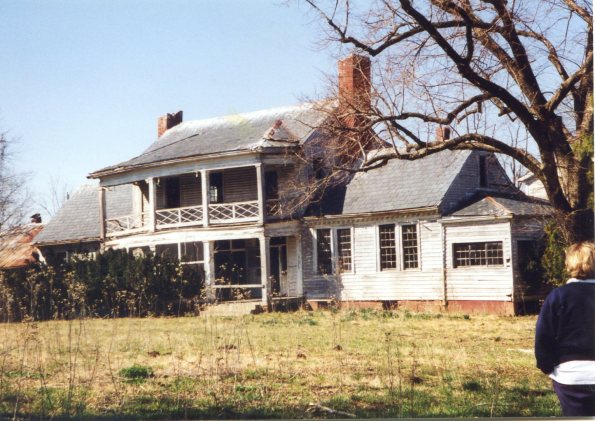
Travelers Rest, 2015. Photo by Vanessa Crews.
Slate River Ramblings follower Vanessa Crews shared this photo and some information about Travelers Rest. Thanks Vanessa!
“Following the Civil War, on 5 May 1876, James A. Crews purchased 25 acres, part of the tract of land lying in James River in Buckingham County known as ‘Travelers Rest.’ It was previously conveyed to John Horsley by Mary C. Horsley. Crews was a carpenter. This was his only land transaction, certainly a milestone in his life. The Civil War forced some large landowners, like Horsley, to break up the great estates and sell small parcels to individuals for whom property ownership had previously been only a dream.
“I visited Travelers Rest in September 2015. This stately home still displays signs of past grandeur. Ancient trees shelter the house. Autumn crocus and lilies bloomed in the overgrown lawn. I’m still searching for the exact location of the Crews home. There was no one at Travelers Rest that September Day. Perhaps one of your readers can offer a lead to the property location.”

Charles Yancey.
Need to catch up? Click here: Buckingham County Houses: Travelers Rest, Part I
~
There are at least three cemeteries at Travelers Rest — a large Horsley-Yancey graveyard, a Horsley-Moon graveyard, and a slave cemetery. Burials include Buckingham County Notable Charles Yancey who died on November 9, 1857. His marker reads:
In this dark world of Sin and Pain
We only need to part again
But when we reach the heavenly shores
We then shall need to part no more
Other graves in this cemetery are documented at Find A Grave: Maj Charles Yancey
For a complete survey of the Horsley-Yancey cemetery, consult Buckingham Burials, Vol 1, available online at Historic Buckingham.
~
The Horsley-Moon Cemetery at Travelers Rest contains the following graves:
Channing Horsley Moon, son of Frank Russell Moon and Annie Horsley Moon (30 June 1902 – 2 October 1970)
Ida Yancey Horsley (7 April 1871 – 17 August 1937)
Annie Horsley Moon, Jr. (8 January 1910 – 6 April 1922)
Annie D. Horsley, wife of Frank Russell Moon (29 January 1875 – 15 June 1949)
Louise Brady Horsley (9 March 1869 – 2 March 1968)
Frank Russell Moon (2 February 1875 – 2 February 1955)
Rose Turner, “Our Faithful Servant,” (d. 22 October 1935)
~
In an Internet post concerning the Horsley-Moon cemetery, Barbara Daniel Pickett shared this:
An anchor fence was put around this cemetery by Ethel Daniel Moon, wife of Channing Horsley Moon in the 1970s. It is located to the left of “Traveler’s Rest” Residence. On a hill to the far left is another cemetery where slaves were buried. Traveler’s Rest was a James River Plantation in Buckingham County, Virginia which had been in the family since the 1600s. At the death of Channing Moon, the last of the Horsley blood line to live there, the home passed to his two nieces who sold it.
Learn more about this cemetery at Find A Grave: Horsley Cemetery
Travelers Rest. Courtesy Richard Nicholas.
Need to catch up? Click here: Buckingham County Houses: Travelers Rest, Part I
~
In 1937, when Garnett Williams surveyed Travelers Rest for the Virginia Historical Inventory, she had little to say about its historic significance, writing:
William Horsley, the first settler at “Travelers Rest”, came over from Warminster Wilshire, England.
Nancy Spencer, a granddaughter of William Horsley, married Charles Yancey. Charles Yancey fought in the War of 1812 and was a Major. He was called the “wheel horse” of the Democracy, and serve to stay in the Legislature for 32 years. He was also Grand Master of the Grand Lodge of Masons in Virginia.
The architectural description in the survey indicated the house was in good condition, including the preservation of its wide original floors with handmade nails. The mantels were high and simply carved. Mrs. Williams noted both old-fashioned brass and iron locks were still on the doors. The stairway was “very simple.”
The overall impression was that the dwelling house at Travelers Rest was designed to be comfortable rather than a showplace.
~
According to the “Yancey Family Genealogy” website:
“Travelers Rest” was owned by Major Charles Yancey during the early 1800’s. Major Yancey was one of the most prominent citizens of Buckingham County in the early 1800’s. Travelers Rest was called such, because it was located on the James River — the rivers being the main transportation highways of the time, with ferries bringing travelers that would stay at the place over-night or until they continued on their journey. Major Yancey and his wife are buried in the Yancey/Holman (sic) cemetery on the premises.
~
To learn more about Charles Yancey, click here: Buckingham Notables: Charles Yancey
Coming Next: Buckingham County Houses: Travelers Rest, Part III
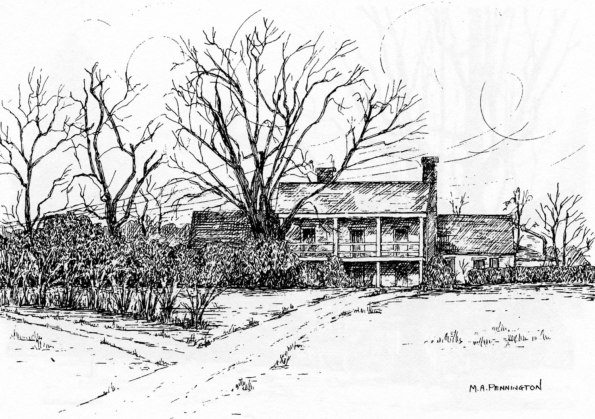
Travelers Rest. Courtesy Historic Buckingham.
In 1937, Garnett Agee Williams surveyed Travelers Rest for the Virginia Historical Inventory. Mrs. Williams located the property 1.2 miles west of Buckingham Court House on Hwy 60, and 8.5 miles northwest on Route 604, then north 5.8 miles on Route 604. Simply put, Travelers Rest is located near the James River between Wingina and Howardsville.
Mrs. Williams believed the house was built in about 1724. The property owner at that time was William Gilmer Horsley. Without the ability to search for deeds due to Buckingham County’s burned courthouse, she identified the following owners: Mary Horsley Spencer (1760); Nancy Spencer Yancey (1800); John Horsley, Jr. (1861); Annie Horsley Moon, Louise Horsley and Ida Horsley (1901).
The house was described as follows:
“Travelers Rest” was built with hand-wrought nails, and the brick was made on the place. There were only four rooms in the original house with a very wide hallway. The original house was of brick, but about 1850 it was weatherboarded over and more rooms added. The sills of the house are of hardwood and are very large. It seems when they added rooms they also added porches. The front porch is in three sections, where it has been added to from time to time.
There is a very large lawn and it is beautifully kept. Many of the old flowers are still there, and some of the original locust trees are still standing.
Coming next: Buckingham County Houses: Travelers Rest, Part II
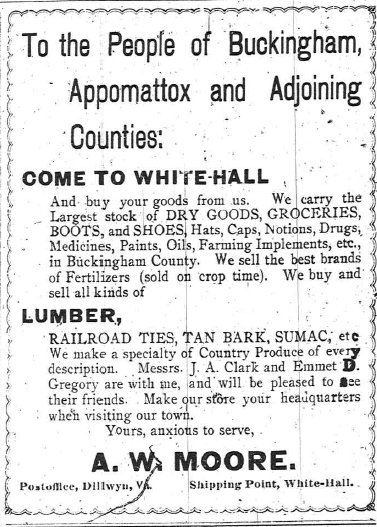
Appomattox and Buckingham Times. Courtesy Library of Virginia.
During 1899, the town of White Hall in Buckingham County underwent significant financial upheaval on its way to becoming Dillwyn. In 1901, as this advertisement suggests, locals still called the town White Hall although the post office was now named Dillwyn.
The above ad appeared in a February, 1901 issue of the Appomattox and Buckingham Times and was designed to encourage customers of all kinds to visit White Hall. Addressed to the people of Appomattox, Buckingham, and adjoining counties, the copy indicates that businesses in White Hall were plentiful and friendly. In addition to meeting everyday needs such as groceries and dry goods, merchants in the town welcomed a variety of lumber products. Businessmen J. A. Clark and Emmet D. Gregory were mentioned by name, as well as the advertiser, A. W. Moore — all eager to serve their customers!
~
Learn more about Emmet D. Gregory here: Buckingham Notables: Emmet D. Gregory
Click on these links for more about White Hall:

Buckingham County Postal Map, 1896.
Need to catch up? Click here: 1901: Letter From Glenmore, Part I
~
In 1901, the Glenmore section of Buckingham County still contained large forested areas. In his first letter to the Appomattox and Buckingham Times, “Observer” noted that merchants in the neighborhood faced difficulty shipping railroad ties to Richmond:
The large timber trade of this section has been of immense benefit to our merchants, and now that Spanish oak railroad ties are being used the trade is likely to increase. And in this connection, I will state that there is a just and proper complaint of the timber owners and the men who cut the ties, of the excessive freight charged by the railroad company on railroad ties. It can only be characterized as a cruel and onerous and unjust monopoly absolutely incapable of being justified by any principle of law, morality or justice. It has enriched many people at the cost of others. To show its baneful effect I will state that prior to the existence of the railroad about 650,000 railroad ties were carried from Buckingham County alone to Richmond and an average cost of eight cents a tie. The cost to now is and has been for many years about double this amount and in many instances the railroad refused to ship the ties at any price.
How much better and wiser on the subject are the laws of Massachusetts. Our people are by no means unfriendly to the railroad company or railroads, for the Buckingham branch of the Chesapeake & Ohio, it is admitted, has been of immense value to the county; all we want is a fair living freight charge, and this we can never obtain until the waterworks dam is taken out above Richmond and the way opened for a free navigation of James river by small steamers. The New York Central & Hudson River railroad with its four parallel tracks does not do away with the necessity for the Erie Canal. . . .
~
For more about railroads in Buckingham County, especially the Buckingham Branch, search the archives at Slate River Ramblings and enjoy the results!

Grace Episcopal. Courtesy Historic Buckingham.
Need to catch up? Click here: 1901: Letter From Glenmore, Part I
~
In 1901, correspondent “Observer,” wrote to the Appomattox and Buckingham Times concerning religion in Glenmore.
Our people are especially blessed in having for their minister the Rev. T. Hugo Lacey whom we consider to be one of the best all-around preachers in Virginia; he not only preaches well but goes among the poor and the lowly and tells them of the estimable [?] blessings of the holy gospel; if any are sick and in need he does not rest until their wants are attended to; no work is too hard or no sacrifice is too great for him to make. He has a warm place in the hearts of our people and is rapidly building up the Episcopal Church all three of the churches — Emmanuel, Grace and St. Andrew; for him to go to another section would be a real calamity to this neighborhood. Mr. Coons and Rev. E. C. Trevilian are most worthy an excellent men. The recent Methodist minister Mr. Banks, was by many greatly admired and is much missed in this section. Not only does a great good feeling exist specially between the Episcopalian and Methodist churches; it finds action in a generous rivalry as to which church shall be the most forbearing.
~
By 1903, the citizens of Glenmore was enjoying a new Methodist church.
Click here to learn more: Buckingham Churches: Glenmore Methodist Church
Coming next: 1901: Letter From Glenmore, Part IV

Need to catch up? Click here: 1901: Letter From Glenmore, Part I
~
In 1901, Virginia’s newspapers were filled with discussions about the creation of a new state constitution. Correspondent “Observer,” whose lengthy letter was published in the Appomattox and Buckingham Times, represented the opinion of at least some citizens in Buckingham County concerning the need for the white population to secure control of the government. He wrote:
Our people, like all Virginians, or politicians in a mild way. The new constitution is much discussed, and all the white people want white supremacy insured by a proper and constitutional elimination of the ignorant Negro vote which can readily and easily be done by both property and educational qualification, which will not apply to include Confederate soldiers. With practical unanimity are people demand this property and educational qualification — that is to let every man vote who pays taxes on $200 with the property of any kind, real, personal or mixed, or who can read and write the English language. The Constitution must be submitted to the people for their ratification. The solemn pledge of the Norfolk Democrat Convention to this effect must be carried out in good faith.
On a less controversial note, Observer moved on to discuss land values in the Glenmore neighborhood:
Our land is slowly rising in value and tracts can now be sold it is true at a low price but the same places have hitherto for many years been unmarketable. Our detractors state that our land is peculiarly well adapted to the use of fertilizers. This is a slander for we have some of the very best land in Virginia. One of our largest farmers having made some time since by actual weight slightly over a million of pounds of excellent hey, mainly timothy. What farm in Virginia is there that can beat this? Our highland under proper cultivation produces remarkably well; clover is easily raised and there are few better sections for fruit to be found anywhere.
~
For much more about Virginia’s revised constitution, visit the Encyclopedia Virginia:
“Virginia Constitutional Convention (1901–1902)”
Coming next: 1901: Letter From Glenmore, Part III


 slate river ramblings . . . .