
I’m delighted to announce that the current issue of Central Virginia Heritage (v.36, no.1), published by the Central Virginia Genealogical Association, contains my article, “No Stone Left Unturned: The Papers of Walter Lloyd Fontaine,” which discusses the surprising information I learned about two of my Buckingham County ancestors hiding in W. L. Fontaine’s papers.
You’ll also find my review of Randy F. McNew Crouse’s new volume, The Freshest Advices; Buckingham County, Virginia, Genealogical Records from Newspapers, 1736-1850.
Other articles include: “Life In 1940s Earlysville, Virginia”; “Marriage Announcements in the Daily Progress (Charlottesville, VA) February 1895”; “The Jouett Family in Central Virginia”; “A Review of Charles Wesley Lusk, Jr. (1914-2005)”; and “Settlement of the Estate of Samuel Griffin of Bedford County, VA,, died 1812.”
Many thanks to Editor Jean L. Cooper for another engaging and informative issue!
Click here for details at Amazon: Central Virginia Heritage, Spring 2020

Glenmore Methodist Church. Photo by Jeremy Winfrey.
In February of 1901, the Appomattox and Buckingham Times featured a new correspondent from Buckingham County. Signing his lengthy letter “Observer,” he covered a wide range of topics, from lumber to politics. It began:
Glenmore.
INTERESTING LETTER BY A NEW CORRESPONDENT.
About 42 years since I moved to this neighborhood; by Glenmore I did not mean the little village only but the neighborhood for fully five miles around it, including the James river people. It has occurred to me that a letter from this locality might not be without interest. The neighborhood includes three classes — the rich, the middle class and the poor. It is one of the most quiet, most intelligent and among the very best neighborhoods in Virginia. Crime of any kind, even among the colored people, is very rare; indeed, it is so rare that it excites unusual comment when it occurs.
Recently we have had a great deal of sickness which is very unusual, as the health of our people generally speaking is phenomenally good. Mr. J. Bryant, commonly styled “Boss Bryant,” is getting well from a very serious attack of blood poisoning caused by an accidental cut of his foot by an ax. He lingered for weeks on the very eve, it seemed, passing away, and was saved only by the heroic remedies of his physician, Dr. H. A. Nash, who has become a permanent resident of this neighborhood, having bought the former home of Mrs. Ellen Goolsby, where he now resides.
Another very ill man is young Mr. Beazley, the son of the plasterer, Mr. Richard Beazley, whose condition is extremely unfavorable from erysipelas. Captain Camm Patteson, who has the friendship, the respect, and the good will of the entire community, those something better than he has been, is still an invalid.
Coming next: 1901: Letter From Glenmore, Part II
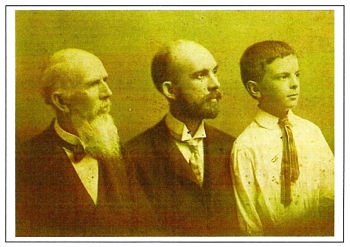
Three generations of Boatwrights.
Courtesy Boatwright Family Genealogy in America.
Need to catchup? Click here: Buckingham County Notables: Rev. Reuben Baker Boatwright, Part I
~
Rev. Boatwright’s impact on both churches and colleges was surprisingly widespread, yet author George Braxton Taylor felt his simple, local contributions would be longest remembered, writing:
Mr. Boatwright will be remembered as a country and village preacher, and his college and seminary friend, Dr. Charles H. Ryland, whose friendship ran out through sixty years, thinks that the following lines of Goldsmith well described his character and career: “Remote from towns he ran his godly race, Nor e’er had changed, nor wished to change, his place; Unpracticed he to fawn, or seek for power, By doctrines fashioned to the varying hour; Far other aims his heart had learned to prize, More bent to raise the wretched than to rise.”
No less important was the fact that Rev. Boatwright reared a son whose career continued his own dedication to higher education. Relying on an article in the Religious Herald (8 February 1906), Taylor concluded:
This article expressed the opinion that perhaps the best service he had rendered was the giving of his son, Dr. F. W. Boatwright, to Richmond College and to the world, and closed with these words: “His life has been a benediction, and I trust he may yet be spared for years to the hundreds and thousands who know and love him.” It was in the same year that Mr. Boatwright sent a brief letter to the Herald pleading for more “spiritual uplift” in its columns for the old men and women, declaring that it is “highly necessary to keep the fires burning on the altars of our hearts.” Mr. Boatwright had known Mr. Sands, the first editor of the Herald, and had paid $4 a year subscription for the paper.
~
For more about Dr. F. W. Boatwright (1868-1951), click here: Frederic W. Boatwright
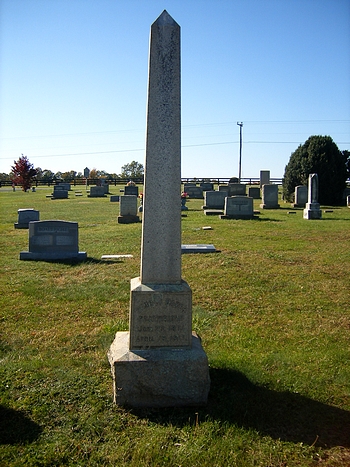
R. B. Boatwright grave. Courtesy Boatwright Family Genealogy in America.
Need to catchup? Click here: Buckingham County Notables: Rev. Reuben Baker Boatwright, Part I
~
In 1915, George Braxton Taylor published Virginia Baptist Ministers: 5th Series, 1902-1914, with Supplement which includes an especially lengthy biography of Rev. R. B. Boatwright. Information about his family and his various accomplishments are sprinkled with personal stories, such as this amusing one:
It was while he lived in Southwest Virginia that once at a meeting of the New River Association, in company with Hon. J. Taylor Ellyson and Dr. W. R. L. Smith, the following incident occurred. At the home to which the trio went to spend the night there were not less than thirty or forty guests. After a long trip of a score and a half miles over the mountains they were very tired, and so no little interested as to where they were to sleep. About ten o’clock their host led them to a large room furnished with two good beds. There was a fire burning on the hearth, but, much to the dismay of the trio, before the fire there sat two women wearing long-eared bonnets and busy cooking. The women looked neither to the right nor to the left, and were silent. It was evident that they were going to stay until the victuals were cooked, no matter how long that took. After much hesitation Mr. Boatwright, feeling that the long-eared bonnets gave him a large degree of protection from observation, undressed and got into bed. His companions after a season left the room, but finally returned, when the women, seeing that they were “uncommonly modest young men,” gathered up the next day’s dinner and departed.
After leaving Marion the last time, and before his active work as a pastor ceased, Mr. Boatwright served the following churches, all of them in that general section of Eastern Virginia of which Buckingham forms a part: Peterville and Fine Creek (Middle District Association); Lyles (Albemarle Association); Cartersville, Enon, Cedar, Buckingham, Cumberland (James River Association); Mt. Hermon, Big Spring, Ivey Chapel, Morgan’s, Diamond Hill, Flint Hill (Strawberry Association). Before this he had been pastor for a year at the First Church, Bristol.
During the closing years of his life he was an invalid, and at times a great sufferer. When the end came, April 19, 1913, his wife and five children were with him, and there was peace. On a bright Sunday afternoon his body was laid to rest under the old oaks in the Buckingham churchyard, the funeral being conducted by Rev. R. W. Bagwell, who was assisted in the services by Rev. W. H. Street and Rev. C. H. Ryland.
Coming Next: Buckingham County Notables: Rev. Reuben Baker Boatwright, Part IV

Enon Baptist Church. Courtesy Historic Buckingham.
Need to catch up? Click here: Buckingham County Notables: Rev. Reuben Baker Boatwright, Part I
~
George Braxton Taylor’s collected biographies of Virginia Baptist Ministers is a marvelous resource and some editions can be found at Google Books. According to his obituary in Fincastle Herald (12 March 1942), Taylor was born in Staunton, Virginia and spent his boyhood in Rome with his missionary parents. He received his B. A. from Richmond College (1881), graduated from Southern Baptist Seminary (1886), and received his D. D. degree from Mercer University (1894).
Taylor’s biography of Rev. Boatwright continues:
Before the War he was pastor of Enon and Brown’s, in the James River Association, and Scottsville, in the Albemarle, and, having been married on September 5, 1865, in Cumberland County, to Miss Maria Elizabeth Woodruff, Rev. Wm. H. Taylor performing the ceremony, in 1866 he took charge of Lewisburg and other churches in Greenbrier County, West Virginia. The children of this union were F. W., Martha Susan (now Mrs. A. Clark), Mary Elizabeth (now Mrs. R. M. Booth), Sarah Look (now Mrs. Sands Gayle), and John B. During his pastorate of some three years there he completed the repairs on the Lewisburg Meeting-House and “secured a deed of gift to the house of worship at the Sweet Springs.”
Rev. Boatwright’s influence reached far beyond Central Virginia, including many years spent in Marion in Smyth County, Virginia where he increasingly participated in higher education. Taylor continues:
Marion, in the Lebanon Association, was Mr. Boatwright’s next field of labor. Here was his home and his church for three different pastorates, and, all told, for seventeen years, a longer period than he spent as pastor anywhere else. While at Marion he also preached, during his first pastorate, for the South Fork, Chatham Hill: and Sugar Grove Churches, and during his second term for Friendship and Greenfield Churches. Mr. Boatwright always retained “the impress of his alma mater,” was ever interested in education, and while at Marion taught in the Marion Academy and the Marion Female College. He was one of the first trustees of the Southwest Virginia Institute (now Intermont College), and later of the Jeter Female Institute, Bedford City. In writing once for the Herald on the question of ordination, he said, referring to the Marion period of his life, that he had had “some bitter experience in trying, as one of a presbytery, to keep out men whom I thought unqualified for the ministry.” Dr. Ryland is doubtless right when he says: “At this place the best work of his life was done. He not only built up the Marion Church but strengthened other churches in Smyth and Washington Counties.”
~
For more about Enon, click here: Buckingham Churches: Enon Baptist Church
Coming Next: Buckingham County Notables: Rev. Reuben Baker Boatwright, Part III

Mt. Zion Baptist Church. Photo by Joanne Yeck.
George Braxton Taylor wrote extensively about Baptist ministers preaching in Virginia during the 19th and early 20th centuries. His volume, Virginia Baptist Ministers: 5th Series, 1902–1914, with Supplement, includes an impressive biography of Buckingham County-born Reuben Baker Boatwright (1831–1913). Taylor describes the Boatwright family’s arrival in Buckingham:
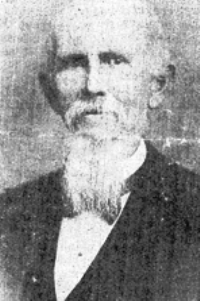
Rev. R. B. Boatwright. Courtesy Boatwright Family Genealogy in America.
Buckingham County, where he spent much of his life, and beneath whose sod his ashes rest, gave him birth. Near Mt. Zion Church, January 23, 1831, he first saw the light, his parents being Reuben Boatwright and Mary Bryant. His grandfather, Reuben Boatwright, a soldier of the Revolution, coming from Prince Edward County to Buckingham County in 1788, had built his home, “Travelers’ Rest,” near Mt. Zion Church. The son of this Revolutionary soldier and the father of Reuben Baker Boatwright was an ordained minister, but he declined calls from Mt. Zion and other churches, choosing rather to look after his farm and to preach as occasion invited. The other children of the family were two daughters, who died when young, and two brothers, Charles P. and Thomas Frederick, and three half-sisters and one half-brother, P. P. Boatwright, offspring of the father’s second marriage. In 1847, when sixteen years old, he made a profession of religion and was baptized, near Mt. Zion and into her fellowship, by Rev. Wm. H. Taylor.
After having begun his education at Berryman’s Academy he entered Richmond College in the fall of 1856, Charles H. Ryland being one of his fellow students. Before his course of two years at the college was over he was licensed by his mother church to preach, and before he became a student at the Southern Baptist Theological Seminary at Greenville, S. C., he did some preaching and was ordained at Mt. Zion, Rev. P. S. Henson and Rev. W. H. Taylor forming the presbytery. His year at Greenville was the first in the history of the Seminary, and he was one of the ten Virginia sent that session. His fellow-student, Charles H. Ryland, says that he was “the best theologian of his class.” From the Seminary it was not long before he took his place in the army, becoming chaplain of the 46th Virginia Regiment.
~
For more about Mt. Zion, click here: Buckingham Churches: Mt. Zion Baptist
Coming Next: Buckingham County Notables: Rev. Reuben Baker Boatwright, Part II

Those of us who have done extensive genealogy concerning our Buckingham County families know that marriage between first cousins was a common occurrence, especially during the nineteenth century. By the turn of the twentieth century, however, not everyone supported the practice as is revealed in this story that ran in the Appomattox and Buckingham Times and August 1901.
Young Couple in Buckingham Foiled.
A highly interesting incident occurred yesterday at the Tabernacle at Dillwyn, Buckingham county, at which there were 4,000 persons in attendance. James Benninghove and Mary Meadows, first cousins, were present, and expected to be married.
They had contemplated matrimony for some months, but had deferred the ceremony. About a month ago the young couple went to Norfolk on an excursion, and while there, it is stated, obtained a license to marry. They presented themselves to a local minister to perform the ceremony. While waiting for the divine to come into the parlor the couple concluded that they would wait until they returned home. When the parents of the young lady heard of this Norfolk episode they were very much offended.
The young man obtained a second license in Buckingham, but the girl’s brother balked the wedding. Young Benninghove, not to be outdone, a day or two ago secured another license, and by the aid of a young doctor hoped to have the ceremony performed yesterday during the services at the Tabernacle at Dillwyn. At one time they were nearly successful. Miss Meadows slipped out from the Tabernacle, where she was attending service, and joined the young doctor. The doctor summoned the expectant groom, who entered the Tabernacle and beckoned to the minister. He was discovered by her brother however, who went out, found his sister and led her back to the building. The young woman’s parents say that their only objection is the near relationship of their daughter and the young man.
— Special to the Baltimore Sun.
~
Evidence from the 1910 census indicates that the couple was successfully wed in 1901. A James and Mary Benninghove were enumerated in Marshall District, Buckingham County, married nine years, with four living children. James’ occupation is given as blacksmith.

Grace Episcopal Church. Courtesy Historic Buckingham.
According to Margaret A. Pennington and Lorna S. Scott, authors of “The Courthouse Burned —“, John Horsley gave the land for Grace Episcopal Church in the autumn of 1871. Logs from nearby woods were used for the framing and were hewn on the grounds. Jim Crews and his sons were responsible for much of the construction. More lumber was hauled from Payne’s sawmill by J. B. Horsley and H. D. Omohundro. The sand for the plastering came from an island in the James River. The two front doors arrived by packet boat and were carried by ox team to the site. The Bradys of West Virginia donated a memorial window in memory of Louise Brady Horsley.
In 1901, Grace Protestant Episcopal Church was the site of the wedding of Annie Dunscomb Horsley and Frank Russell Moon.
Click here for details: 1901: Moon-Horsley Wedding.
The July 3, 1901 edition of the Appomattox and Buckingham Times reported the union of two familiar Buckingham County families, Moon and Horsley. The lengthy description of the wedding read as follows:
On Wednesday, June 26, at 10:30 A.M., Miss Anne Dunscomb Horsley, daughter of the late John Horsley, and granddaughter of Hon. Sobieski Brady, of Wheeling, W. Va., was married to Mr. Frank Russell Moon, at Grace Protestant Episcopal Church, Buckingham County, Va.
The edifice was beautifully decorated for the occasion, ferns and daisies predominating in the floral decorations, and a large congregation was assembled to witness the ceremony. Mrs. Jno. B. Horsley played the wedding march from Lohengrin for the entry of the bridal cortege. Mr. Henry Burton Taylor, brother-in-law of the bride and Mr. John Sydnor [?] Horsley, brother of the bride, followed by the bridesmaids, Misses Moylan [?] Moon, Fannie, Jeanette, Mildred, Louise, and Ida Horsley, attired in organdie, and caring ferns and daisies, entered the church first. Then came the matron of honor, Mrs. Henry Burton Taylor, eldest sister of the bride, who wore her own wedding dress of white satin and carried ferns and daisies. The bride came next, accompanied by her brother, Mr. Alexander Caldwell Horsley. She wore white muslin trimmed with lace, and carried a posy of sweet peas. Mr. Cary Nelson Moon, a brother of the bridegroom, was his best man. Rev. T. H. Lacy, D. D., was the officiating minister.
After an elegant luncheon at the home of the bride, the couple left to spend the honeymoon at New York, Buffalo, and Niagara Falls. Returning they will be at home in Manteo, Virginia, where the bridegroom is engaged in business.
Many valuable gifts were received by Mr. and Mrs. Moon —
Warminster letter to Richmond Dispatch.
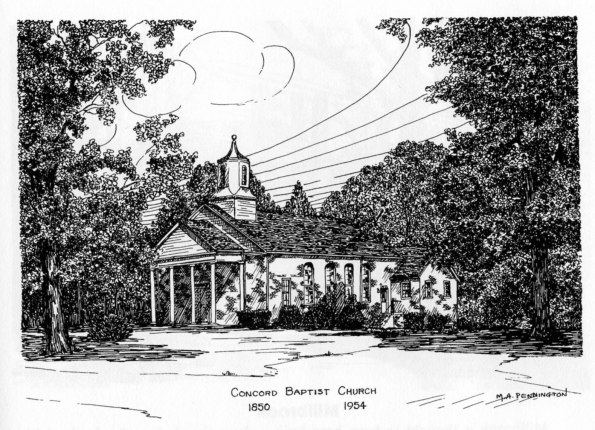
Concord Baptist Church. Courtesy Historic Buckingham.
According to Margaret A. Pennington and Lorna S. Scott, authors of “The Courthouse Burned —“, Concord Baptist Church was founded in 1850, established on land given by Hugh and Henry Gill’s grandfather, and served the community around Sheppards in Buckingham County. Much of the lumber was donated by members and prepared at local, pit sawmills. Pennington and Scott noted, “The first church was divided into two rooms. Blacks worshiped in the north room while whites worshiped in the South room. After the war, the partition was removed and the black people built the church of their own.”
In 1895, Rev. R. B. Boatwright served as pastor as well as at Buckingham, Cedar, and Enon Baptist churches. In 1953, the original building burned. It was replaced with the new brick church, which still serves the community.
In 1899, one member of Concord Baptist Church, George R. Davis, ran into trouble with the law. Click here for details: 1899: George R. Davis Arrested.
~
Learn more about the church today at their website: Concord Baptist Church.


 slate river ramblings . . . .