

In 1911, several farmers in the northeastern section of Buckingham County joined “alfalfa clubs,” created by the Chesapeake and Ohio Railway. Club members worked an area of ground in an experimental way, planting this “new hay crop.” A report was sent to Richmond’s The Times-Dispatch that the crops were looking good and showed every indication of success in Buckingham County soil.
The Arvonia club attracted between fifteen and eighteen members, all of whom had gone to considerable trouble and expense for this experiment. The article noted that there had been former experiments with alfalfa in the county, some more successful than others, however none had been made with such thorough and scientific preparation as the one conducted in 1911. The article concluded, “a full report from each member of the club will be made early in the spring and given to the public.”
A good reminder that something more than slate quarrying was going on in Arvonia!

Give the Gift of Local History
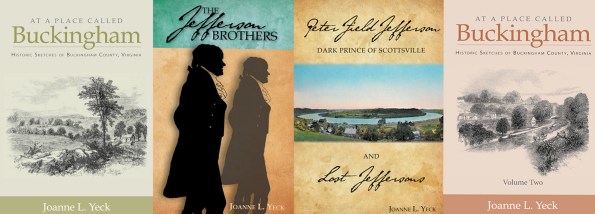
The Jefferson Brothers is more than a biography of Randolph Jefferson, it’s a new look at President Thomas Jefferson, who could be a somewhat daunting big brother!
For the entire month of December 2018, Braughler Books is offering $10.00 off The Jefferson Brothers. Use Code: JEFFERSON10
Please share the holiday discount code with your friends, family, and anyone interested in learning more about Buckingham County during 18th-19th centuries, as well as life among the planters in Central Virginia.

Quarrymen at “The Big Quarry,” beside Hunts Creek and next to the old railroad station.
Courtesy Robert Jeffery.
In December 1911, Richmond’s Times-Dispatch reported the conclusion of a lawsuit concerning a property line running through slate quarries located in Arvonia, Buckingham County. The announcement read as follows:
The case of Jones, Roberts, Evans et als. against A. L. Pitts, which occupied a special session of Buckingham court all last week, was brought to a conclusion on Friday night, when the jury brought in a verdict in favor of the claims of A. L. Pitts. The suit was brought to determine a property line between the two parties, and settled a matter of long contention. The line in question passes through a very valuable Slate field, and in one case cuts off the end of an actively worked slate quarry, now in the hands of Buckingham Slate Company a Richmond Corporation, which has been doing business in this field for seven or eight years. The slate lands of A. L. Pitts formally belonged to Col. Fontaine, who owned large properties here. These properties cross the Buckingham slate vein between Arvonia and Bridgeport station, 2 miles on the north. Attorney Frank C. Moon represented Jones, Evans et als., and Attorneys A. L. Pitts, Jr. and Edmund W. Hubard represented A. L. Pitts.
For much more about Edmund W. Hubard enter his name in the search box at Slate River Ramblings and enjoy the results.
Slate River Press
In need of a gift idea this holiday season? Give the gift of local history!
Here’s where you can purchase these books (and many others) about Buckingham County and Virginia:
In Virginia
Buckingham: Housewright Museum (U.S. Route 60, in the village of Buckingham)
Buckingham: Nancy’s Gift Shop (U.S. Route 60, in the village of Buckingham)
Scottsville: Baine’s Books and Coffee (485 Valley Street)
Monticello: Monticello’s Gift Shop [The Jefferson Brothers]
Appomattox: Baine’s Books and Coffee (205 Main Street)
Richmond: The Library of Virginia: The Virginia Shop (800 East Broad Street)
Not in Virginia? Shop online at:
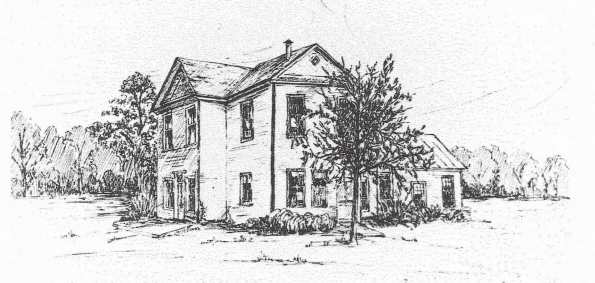
Buckingham High School. Courtesy Historic Buckingham.
Many years ago, the oldest records concerning Buckingham County schools were destroyed. Today, scattered records can be found in archives and, occasionally, we can learn something about schools and teachers in announcements printed in historic newspapers.
In December of 1911, Richmond’s The Times-Dispatch printed a congratulatory article, sent from Arvonia, listing prize-winning teachers and their schools—both white and African-American. The awards were given out on Patron’s Day, observed on October 27.
Here’s a list of the best of Buckingham’s educators in 1911 and their schools:
White teachers
First prize: Miss Agnes White, Gold Hill School, Marshall District. Miss White received a set of books.
Second prize: Miss Bessie Patteson, Cut Bank School, Maysville District. Miss Patterson won a set of books.
Third prize: Mrs. S. B. Bondurant, Buckingham High School, Maysville District. Mrs. Bondurant was given a book.
Colored teachers
First prize: Jennia A. Starr, Tongue Quarter School, Curdsville District. Miss Starr won “a handsome picture.”
Second prize: Mary Tharps, Cedar School, Curdsville District. Miss Tharps received a book.
Third prize: Annie Coleman, Red Bottom School, James River District. Miss Coleman also won a book.
Honorable mentions included: Miss May Woody (Andersonville), Miss Anita Hall (the Snoddy School), Miss Mollie Butcher (Mount Zion School), and Mamie Spencer (Well Water School, colored).
Patrons Day was enthusiastically celebrated, with about seventy schools involved. Roughly 700 patrons were present. Forty speeches were made by visitors and approximately $500 was collected for “general purposes”—presumably for supporting the Buckingham County school system. The article concluded, “The County school board appropriated a sum at its last meeting for the purpose of supplementing the sum given by the division superintendent for prizes to teachers.”
Do you have a Buckingham County school teacher in your family? Please comment below.
Click here for more about Buckingham High School.
A Jefferson Connection
Need to catch up? Click here: Buckingham Notables: John Horsley, Part One
When Slate River Ramblings reader Karen Lucas Williams wrote to me with more information about John Horsley of Elk Mills in Amherst County, she surprised me with a Jefferson connection. This John Horsley’s niece married Thomas Jefferson’s great-nephew.
According to Karen’s database, John Horsley’s parents, William Andrew and Martha (Megginson) Horsley, had the following children: William, Mary Cabell, Joseph, Judith, Robert, Martha, Samuel Cabell, Elizabeth, John, and Nicholas.
In 1808, John brother, William Horsley (1772–1865), married Sally Christian in Amherst County. They were the parents of Mary Cabell Horsley, who married Randolph Jefferson’s grandson, Elbridge Gerry “E. G.” Jefferson, on October 17, 1845 in Nelson County.
Interestingly, both William and Sally (Christian) outlived their daughter Mary Cabell (1822–1862). The Horsleys died within weeks of each other. Sally on March 24, 1865, followed by her husband William on April 21, 1865. They were living in Nelson County at the time of their deaths. E. G. Jefferson died shortly after his in-laws on September 10, 1865.
For the two living sons of E. G. and Mary Cabell (Horsley) Jefferson, Elbridge Gerry, Jr. and Lindsay “Bolling” Jefferson, 1865 was marked by one loss after another.
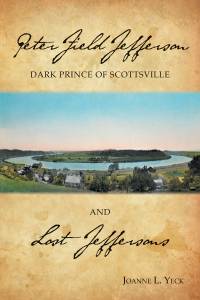
Learn much more about E. G. Jefferson and his family in my newest book, Peter Field Jefferson: Dark Prince of Scottsville & Lost Jeffersons.

This Horsley Family Cemetery sits close to the James River.
The Horsleys owned land on both sides of the river and in it!
Need to catch up? Click here: Buckingham Notables: John Horsley, Part One
I am always delighted when posts at Slate River Ramblings result in additional information from readers. Replying to “Buckingham Notables: John Horsley,” Karen Lucas Williams wrote that she had compiled information about this Horsley family who were neighbors and associates of her Spiller family, early settlers in Buckingham/Amherst/Nelson counties. Karen wrote:
John (ca 1787-1851) was the son of William Andrew Horsley (ca 1745-1791), of Horsley Island, and wife, Martha Megginson (ca 1747-1793). John was married in 1819 to Mary Mildred Cabell (1802-1880), daughter of Frederick Cabell and Alice Winston. John was also married, apparently first, to Philadelphia Hamilton Dunscombe, ca 1814.
In regards to his mother, Martha Megginson: Her father, Col. William Megginson (1715-ca 1762), purchased 580 ac. of land from Mrs. Elizabeth Cabell in 1739, on the south side of the James river at Greenway Station, to which he afterwards added over 2,000 ac., and called the estate “Clover Plains;” after the year 1761 his lands were in Buckingham Co.
Was “Horsley Island” the island still being worked by John Horsley’s slave Robin in the 1830s?
Coming next: A Jefferson Connection.

Need to catch up? Click here: Buckingham Notables: John Horsley, Part One
In the spring of 1836, John Horsley’s vast estate was held in trust by Frederick M Campbell and Horsley’s neighbor, Alexander Mundy, and put up for auction at Elk Mills in Amherst County. Among other things, they were responsible for auctioning his slaves. This list was provided in an advertisement in the Lynchburg Virginian:
Robin (who worked on the Island in the James River), Nancy, Big Robin, Anna, Frank, Sophia, Bob, Nelson, Wilson, Charles, Archey (a yellow boy,) Blada [sic], Sam, Albert, Robert, Henry, Sarah, Amanda, Rachel, Isabella, Haney and her youngest child. Mary, Emela, Brittain, and a girl named Judy, in whom Horsley owned a half interest.*
There were also horses for sale, a mule, and twenty head of cattle, as well as house furniture and farm implements.
Slaves were sold for cash. The other personal property could be sold on credit for six months.
Results of the auction are unknown, though, it seems likely that African-American families were separated when the slaves were sold. Except for Robin, who worked on one of the islands in the James River, the others probably lived on the plantation in Amherst County, since the Buckingham property was mostly timber.
*In 1830, John Horsley of Amherst County was taxed on eighteen slaves.
Coming Next: Buckingham Notables: John Horsley, Part Four
Need to catch up? Click here: Buckingham Notables: John Horsley, Part One
On March 13, 1836, the property of John Horsley was auctioned at Elk Mills in Amherst County, Virginia. Some of his land lay in Buckingham County and was described in the Lynchburg Virginian as follows:
On the Buckingham side, there are three very good dwelling houses — about 150 acres of this Land, including the Islands, is James River Bottom, of great fertility. The high Land is rolling, but most of it is very productive, well watered, and lies on a bed of Limestone. Immense water-power may be had at trifling expense. . . . This tract of Land runs down to the town of Bent Creek, on Buckingham side. . . .
A Lumber House at the mouth of Bent Creek, 26 feet square, first story stone, balance framed.
Another tract of land in Buckingham County, the joining Mrs. Perkins, Mr. F. Cabell and others, contained 1,100 acres. According to the advertisement, there were “too small settlements” on the property, one of them included a new dwelling house. This tract was heavily timbered, with a creek passing through it, large enough for either a saw or gristmill. Located ½ mile from the James River and not more than two miles from two public landings, one of which was opposite Greenway and the other within sight of the Tye River Warehouse.
There were two additional small pieces of land in Buckingham. One contained 100 acres and adjoined Mr. James Patteson. The other, located near Bent Creek, had been purchased from Hail T. Freeland.
Tax records reveal that one man named John Horsley, miller, paid taxes in Buckingham County from 1821-1840, and lived in Amherst County from 1831-1839. There are however, multiple John Horsleys owning property in Buckingham at the same time.
There were also 1,000 acres of land in Greenbrier County, miscellaneous tracks in Nelson and Amherst counties, and four lots in the city of Richmond. It is unknown how much of this sold the day of the auction.
Coming next: John Horsley’s Personal Property
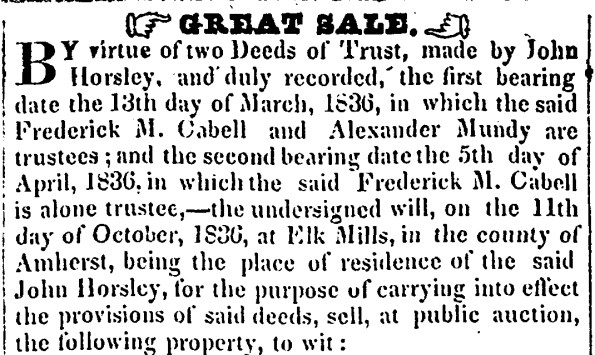
Courtesy Lynchburg Virginian
When doing research for families living in Buckingham County, especially prior to 1869 when the courthouse burned, it often pays to search surrounding counties for deeds and wills, even across the James River. Especially the affluent families often held property in multiple counties. Such was the case with the John Horsley estate. On March 13, 1836, a public auction was held at Elk Mills in Amherst County which included extensive property in Buckingham. An advertisement in the Lynchburg Virginian contained this information about his impressive holdings:
One tract or parcel of Land in the counties of Amherst, Nelson and Buckingham, containing between eleven and twelve hundred acres, being the tract on which said Horsley resides, and upon which is a good Stone Mill House, 50 by 40 feet, containing the Machinery common to a Flour Mill, two pair of 5 feet Burrs, one pair of 5 feet country Stones, very heavy, Rubbers, a Corn Crusher, & near the Mill a large Cooper’s Shop, part stone, and balance framed, a Black Smith Shop and a set of Black Smith’s Tools, a good Dwelling House, Ice House and all necessary out Houses, a new Store House, and a good Garden. The Tobacco Houses below the Creek and in the Islands have most of them shingled roof and are nearly new.
As was the case at many mill sites in Central Virginia, there was a small service center, equipped with a blacksmith and store, which often included a post office. At Elk Mills, it appears that John Horsley owned all the services.
In 1836, the James River Canal was under construction and, presumably, would increase the value of Horsley’s property once finished. The canal would eventually run within 180 yards of the Mill House.
Coming next: John Horsley’s property in Buckingham County.


 slate river ramblings . . . .