
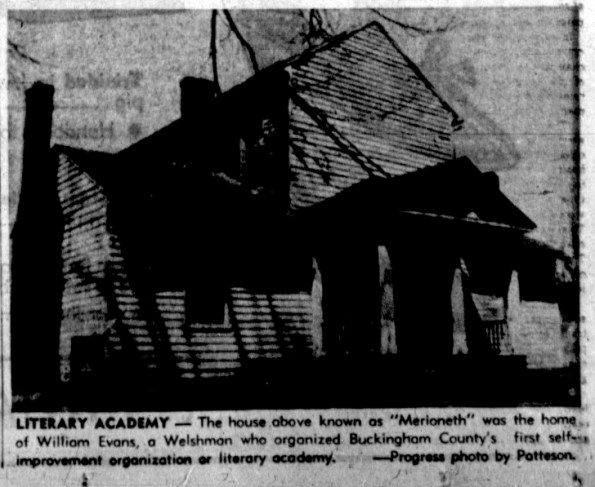
Photo by Lulie Patteson. Courtesy Daily Progress and University of Virginia
Stories about Arvonia and the Welsh settlement in Buckingham County are always popular at Slate River Ramblings. In 1960, Buckingham County historian Lulie Patteson shared some of that history with Charlottesville’s Daily Progress in an article entitled “Welshman Organized First Buckingham Cultural Group.” Miss Patteson opened in her typical evocative style:
Those who remember Richard Llewellyn’s book, “How Green Was My Valley,” will recall the passionate devotion of the Welsh people to singing and reciting poems.
Buckingham County has benefited from these gracious Welsh assets.
The first benefit was from the Buckingham Literary Academy, the first of the cultural organizations in the county, which was conceived and set in motion at Merioneth by William Evans, a Welshman.
Miss Patteson went on to explain that William Evans’ father settled in Pennsylvania before the Revolutionary War. William moved southward, lived in Augusta County, Virginia and, for his service during the war, received several thousand acres of land in Ohio and the land grant in Buckingham County at the southern end of Willis Mountain. There he built his home, which he called Merioneth, remembering his ancestral home in Wales. Patteson continued:
William Evans was a great reader. He constantly had the newest and best books sent to him from England. This passion for cultural reading was the genesis of the first self-improvement organization in Buckingham.
This club, or Academy as they designated it, seems to have had a small membership, if we are to depend on the scraps of minutes from their meetings.
Coming next: Buckingham Literary Academy: Part II
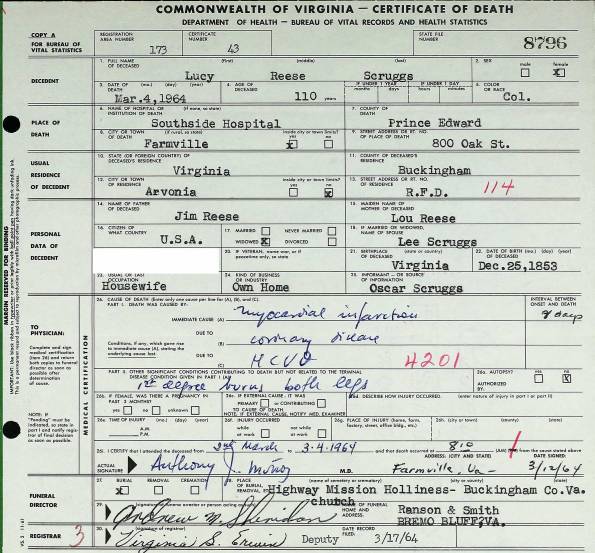
Lucy Scruggs, Death Record
Click here to catch up: Buckingham Notables: Lucy Scruggs, Part I
Slate River Ramblings’ readers have been charmed by Lucy Scruggs’ life story, including Tom Almquist, who quickly produced her death certificate after reading Part IV.
In it, we learn that Lucy lived to be 110, dying in Prince Edward County, Virginia on March 4, 1964. What a life she led! Humble as it was, the former slave ultimately owned her own home outside of Arvonia.
Prior to her death, she was taken from Buckingham County to Southside Hospital in Farmville, where she died of a heart attack. The doctor noted that she had 1st degree burns on both legs. Did she fall near the fireplace, precipitating her death?
Her parents were given as Lou and Jim Reese. Her deceased husband as Lee Scruggs. Her son, Oscar, provided the details for the death record and she was buried in Highway Mission Holiness Church cemetery in Buckingham County.
A long and thoughtful life was laid to rest. How fortunate that Boyce Loving and The Daily Progress preserved her story for us to discover nearly sixty years later.
Many thanks to Tom Almquist and to Phil James for sharing Lucy’s interview.

Lee Scruggs, Death Record
Click here to catch up: Buckingham Notables: Lucy Scruggs, Part I
~
In 1958, Lucy (Reese) Scruggs was the subject of a touching profile in Charlottesville’s Daily Progress. Boyce Loving honored the former slave who was soon to be 104 years old.
In the interview, Lucy Scruggs was quick to admit that her life had been hard and she would not like to live it over again. While her emancipation from slavery had improved things a little, she felt her life had not improved significantly. She had lived through the first and second World Wars, and hoped never to see another. During the Civil War she had struggled to “keep body and soul together,” food and clothing being scarce.
She did not care for modern times. Automobiles were “all right,” however, she showed no great enthusiasm for riding in them. She enjoyed church services and listening to hymns on the radio, though, regular radio programming was of no interest to her. She had never gone to a motion picture theater and had no plans to do so.
She recalled with amusement, her innocent youth:
She said a rainbow appeared in the sky and her mother told her that, if she went to the foot of the rainbow, she would find a pot of gold. She said she started out on a run and “I run till they had to come and hunt for me,” she concluded. At this, she threw back her head and laughed, “fit to kill.”
In recent years her white neighbors have been “mighty good” to her, Aunt Lucy said. She mentioned Mrs. Mildred Beazeley, at whose home this interview took place, and Mrs. Mamie Childress, of Bremo Bluff. She said they had given her food, brought her wood, sewed for her, and performed other acts of kindness.
Aunt Lucy has the gentility and good breeding of another age and is “quality.” It was a pleasant experience to chat with her and to hear her give a first-hand narration of conditions and incidents about one ordinarily only can read. The writer’s parting wish was that “the Lord’ll let” Aunt Lucy live till Christmas morning—and far beyond that date. She is a credit to her race (or any race, for that matter) and her community will suffer a real loss when “she joins the saints,” as she hopes to do. Aunt Lucy is one of the fast vanishing tribe, the more’s the pity. God bless her.
It is good to know that Lucy Scruggs had kind neighbors and devoted children. To date her death record remains elusive. There’s a good chance, though, that she lived until Christmas Day in 1958.

1920 census. Scruggs Family, Buckingham County, Virginia
Note: Based on the birth information of Lucy Scruggs’ sons, the family may have spent some time living in West Virginia. Other census data suggests that they were born in Virginia.
Click here to catch up: Buckingham Notables: Lucy Scruggs, Part I
~
Lucy Scruggs’ outlook on life certainly contributed to her longevity. Opinionated, a devout Christian, and a teetotaler, Lucy proved a colorful interviewee for Boyce Loving, offering the following under a subheading, “Don’t Know Hard Times:”
The former slave said she had seen hard times in her day. “People talk about hard times, but they don’t know what hard times is,” she added. Slavery was hard because of the long hours of work, she explained, and then came Civil War days and after that Reconstruction. She said she “worked, scuffled and did the best she could.”
Asked if she ever smoked a clay or corncob pipe, Aunt Lucy said she tried smoking a corncob pipe when she had a toothache, but it didn’t relieve her, so she threw away the pipe. Now she doesn’t have to worry about toothache. She said she never drank any “likker” or other alcoholic drinks.
Deeply religious, Aunt Lucy had firm ideas about integrated schools and told Loving:
“It’s all a lot of folly and is goin’ to cause lots of hard feelings. We was separated before the War (Civil) and let us stay separated. If I had any chilluns, I wouldn’t let ‘em go to school with white chilluns.” With explicit trust in the Lord, Aunt Lucy remarked, “If ‘twarn’t for the Lord, what would we do? If the Lord’ll let me, I’ll be 104 years old, come Christmas mawnin’.”
Coming next: Lucy Scruggs, Part IV

1940 census, Lucy and Lee Scruggs
Click here to catch up: Buckingham Notables: Lucy Scruggs, Part I
~
In 1958, when Lucy Scruggs was about to turn 104, she earned a lengthy salute in The Daily Progress.
Born into slavery, Lucy Scruggs originally came to Buckingham County with a white family whose name she no longer remembered. She was about fifteen years old at the time. When she was about eighteen or twenty, she married Lee Scruggs, of Buckingham. Lee lived to be over ninety years old and had been dead about fifteen years when the interview with Lucy took place. Lee had worked in the slate quarries at Arvonia and lived as a sharecropper. Boyce Loving continued his tribute:
The centenarian has outlived all but three of her 10 children. Her three sons, Benny, Oscar and William, live within sight of her house and William, the youngest, sometimes lives with her.… She has grandchildren and great-grandchildren too numerous to mention, 11 of the latter living in one house near her.
Aunt Lucy has a keen sense of humor and laughs heartily as she tell stories about herself. She said that soon after her husband’s death another man named Scruggs came to her and said, “You married one man named Scruggs and mine is the same.” She took this as a proposal and said she told the man, “If you was up a tree of gold, I wouldn’t shake you down.” She added that living with one man about 70 years was enough for her.
Coming next: Lucy Scruggs, Part III

Photo by Boyce Loving. Courtesy The Daily Progress and University of Virginia.
In December of 1958, Boyce Loving paid tribute to “Aunt” Lucy Scruggs in Charlottesville’s Daily Progress. Her life was, indeed, extraordinary. The article began:
This is one of the last stories of its kind that will ever be written from a real, live interview. Other persons will pass the century milestone, but they will not have been born in slavery in this country. Aunt Lucy Scruggs, who will be 104 Christmas Day, was.
Now living alone in a small tarpaper house near Arvonia in Buckingham County, Aunt Lucy is remarkable in more senses than one. Besides doing her own cooking and housework, she has excellent eyesight, hears as well as anyone half her age and is as spry and sprightly as a cricket.
Lucy Scruggs was not at home when Loving conducted the interview. She was visiting friends across the road from her house, her white neighbors, Mr. and Mrs. Clyde Beazeley.
Lucy was not a Buckingham County native. She was born in Roanoke, Virginia, in 1853, on Christmas morning. Her parents were Jim and Lou Reese, owned by a family named Hazeby, she recalled.
A search for a family named “Hazeby” has yet to be found living in Virginia in 1850 or 1860. Perhaps Mr. Loving’s hearing was not as good as Lucy’s. Perhaps Lucy misremembered the name, or, it was misprinted in the newspaper. In any case, if a Slate River Ramblings reader can decipher the name of Lucy (Reese) Scruggs’ former owners, please comment below.
Coming next: Lucy Scruggs, Part II

Alexander Cheatwood Smith. Courtesy Bell Family Collection.
Digital restoration by Robert Harris.
On July 5, 1774, my ancestor Alexander Smith received 390 acres in Buckingham County, Virginia from then Governor Dunmore. Price: Forty shillings of good and lawful money. Located on Walton’s Fork of the Slate River, his neighbors were among others, the Patteson family.
When I first learned I had a Smith line, my response was: “This is going to be a nightmare.” With some help from my cousins, my work turned out to be remarkably easy. If you are the only Smith in the neighborhood, tracing the family is not so hard.
Alexander Cheatwood Smith (1790–1839), above, was the grandson of Alexander Smith. Born in Buckingham County, he grew to be a very successful merchant in Cartersville, Cumberland County, Virginia.
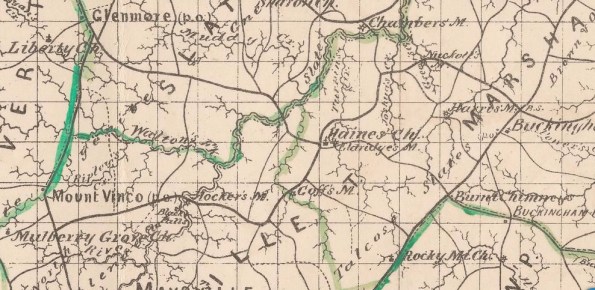
Walton’s Fork of Slate River. Courtesy University of Texas, Arlington Library
The Patteson family was an early entry in the history of Buckingham County and, in 1960, The Daily Progress ran an article summarizing its lineage and arrival. An unsigned article, entitled “Patteson Heirs Still Have Original Mt. Pleasant Grant” related the following:
The first Patteson of this family was Thomas Patteson, who came to Middlesex County from Norwich, England, about 1650. We later find his son, David Patteson, living at Roxboro in New Kent County. He was a vestry men in St. Peter’s Episcopal Church, where Washington is claimed to have married Mrs. Dandridge.
The family then moved up to a grant of land (1,570 acres) described as lying on Walton Fork of Slate River (Buckingham had not then been cut off from Albemarle) the grant vividly described in the patent is still treasured at Mt. Pleasant as some of the following extracts show:
“With all woods, under woods, swamps, marshes, low grounds, meadows and feedings,” the grantee is to have and do share of all veins, mines and quarries, as well discovered, as not discovered. All rivers, waters, and watercourses therein contained, together with the privileges of hunting, hawking, fishing and fouling and all of the profits, commodities and hereditaments.”
For right to the land, the grantee was ordered to pay a shilling each year on the feast of St. Michael, the Archangel for every 50 acres and was required to cultivate and improve three out of every 50 acres. Failure to do so meant the land would revert to The Crown.
It was here that Maj. David Patteson, descendent of the grantee, built the brick house at Mt. Pleasant and lived there with his wife Judith Dibrell and their twelve children.
Special thanks to Phil James for sharing this article from The Daily Progress.
Click here for more about the dwelling house at Mount Pleasant.
Coming Next: Buckingham Notable: Alexander Smith
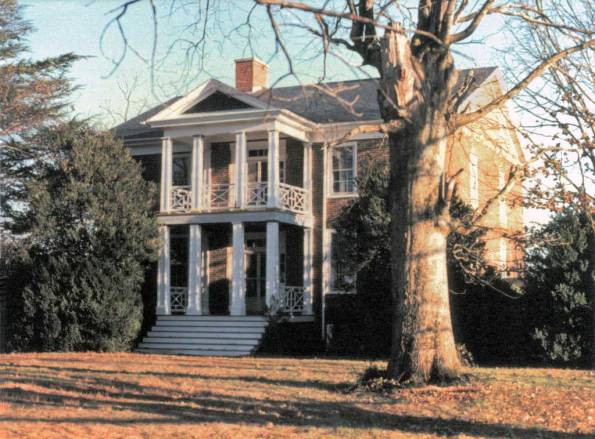
Photo courtesy Samuel P. Clarke
In 1960, Charlottesville’s Daily Progress ran an unsigned article about the history of Buckingham County’s Mount Pleasant entitled: “Patteson Heirs Still Have Original Mt. Pleasant Grant.” At the time, Miss Lulie Patteson was a regular correspondent for the newspaper and it seems likely that she either wrote the article or provided the information. Notably, Mount Pleasant, built in about 1796 by Maj. David Patteson, had remained in the family since the land was originally granted. In 1960, the home was owned by Mrs. O. P. Maxey.
The first dwelling houses on the land were wooden homes, followed by the large brick one built by Maj. Patteson. The article goes on to describe it:
Mt. Pleasant was made of brick molded on the place. It has a full basement, a double hall and four rooms on the first floor; a double hall and four rooms on the second floor. Two stairways lead from the first to the second floor; a single stairway takes one from the second floor to the two attic rooms. Modern conveniences, such as bathrooms, have been added in recent years.
The equally mature grounds included notable boxwood:
Priceless boxwood hedges enclose the great lawn and many old oaks shade its green expanse. To have remained in the possession of the same family for well over 200 years is indeed a unique distinction for any estate. It now belongs to the six children of the late George W. Patteson, who was a Confederate Veteran and one time treasurer of Buckingham County.

Photo courtesy Samuel P. Clarke
Additionally, the article speculates about the family graveyard:
It is not known how many of this family’s deceased members have been laid to their resting place in the cemetery here. But there are many, many graves as could be expected from the four or five generations since the first internments. And Maj. David and Judith had twelve children themselves.
Coming next: Buckingham Notables: The Patteson Family

Click image to enlarge.
In the spring of 1857, Edward A. Blanton of Cumberland County, Virginia advertised in Richmond’s Whig concerning the availability of his stud horse Young Red Eye:
THIS distinguished foul geiler and thorough-bred Horse, will stand at Brown’s Church, and Cumberland and at Farmville, and pass through several points in Buckingham county, where he will meet mares for the convenience of both parties. Gentlemen entering mares will please enter their TERMS in a book carried by the Groom, (Joe.)
TERMS. —$6 cash, single leap; $12 the season — discharged by $10 within the season; and $20 to insure. Mares parted with, forfeits the insurance. $1.00 to his faithful Groom. I have put the prices thus low because I wished the horse to further establish himself as a fine foal getter, notwithstanding his colts now rank higher and are valued at higher prices than those of any other horse within my acquaintance — for instance: one of his colts sold at the last Fair in Richmond for the sum of $410, and purchased by the French Counsel, and sent off to his Imperial Majesty in order to procure the stock.
Mr. Blanton went on to mention M. M. Johns, Esq., of Buckingham County who owned one of Young Red Eye’s colts, as well as N. H. Jackson, Esq. and B. W. Davidson, Esq. (both presumably of Buckingham County) who also owned colts by the stallion.
Young Red Eye’s lineage was impressive. He was sired by Star of the East, he by Telemachus, he by Dungannon, he by imported Bedford, out of Overton filly, she by Boxer and Star of the East, dam Penelope, she by the American Eagle, he by Imported Eagle, he by Vollnter [?], a son of Eclipse of England; Red Eye’s dam by Young Enquirer, and he by old Enquirer, of South Carolina, etc., etc.
For more pedigree information, Mr. Blanton referred readers to the Stud Book, “where they will find this horse to be crossed with the best stock of the most noted horses of England and America….”
Click here for more about Star of the East.


 slate river ramblings . . . .