
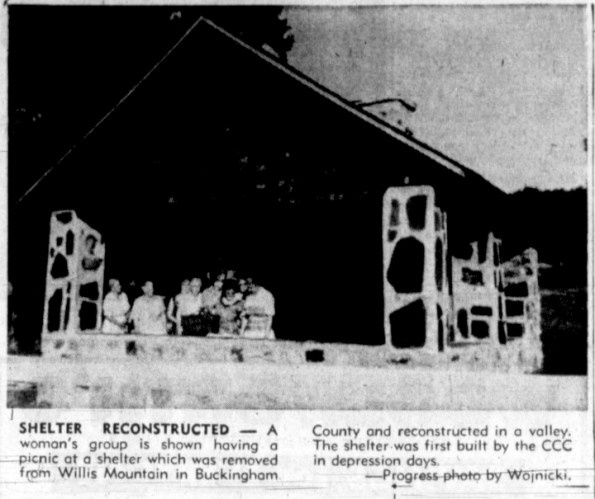
Courtesy University of Virginia and Daily Progress.
During the 1930s, members of the Civilian Conservation Corps (CCC) worked hard in Buckingham County, Virginia, improving roads and building bridges, as well as erecting a mountain shelter at the top of Willis Mountain. For many years, visitors from far and wide drove up the mountain to enjoy the view and benefit from the shelter.
In 1960, Mrs. R. J. Wojnicki, acting as a correspondent from Buckingham for Charlottesville’s Daily Progress, wrote about the shelter’s move from the top of Willis Mountain to Pleasant Valley:
DILLWYN—Many persons in Buckingham County and no doubt countless others as well will remember the rock shelter on top of Willis Mountain when the shelter was a haven for courting couples who enjoyed its romantic atmosphere some 30 years ago.
The shelter now has been relocated at “Pleasant Valley,” just off U.S. 15 seven miles south of here. The owners of Willis Mountain, Guy and Gene Dixon, transported the shelter and reconstructed it so that the county residents might share its usefulness for picnics or for recalling fond memories.
Due to the Dixons’ Kyanite mining operations, the road to the top of the mountain had been closed and the shelter, thankfully, was saved. According to Mrs. Wojnicki, the name “Peaceful Valley” was “imprinted” on the shelter’s floor. She continued, describing the shelter’s construction:
The shelter is made of six-inch blocks of slate set in cement. Carved in a slab of slate at the right side of the fireplace is a legend saying the shelter was erected by the CCC Camp P-56. H. P. Baker of Cumberland County, who died about eight years ago, was camp superintendent at the time.
The shelter was 16 x 16 feet, and open on three sides. The stone fireplace was 6 feet wide and 4 feet high. Unsurprisingly for structures built in Buckingham County, the roof was made of slate.
~
According to Barbara White, Francel J. Wojnicki and her husband, Rudy, purchased a home just outside of Dillwyn in 1949. During the 1930’s, Rudy Wojnicki had been a supervisor at Buckingham County’s CCC Camp and the couple retired in the county.
To read much more about the CCC activities in Buckingham County, consult: “Spirit and Industry: Buckingham County and the Civilian Conservation Corps,” in “At a Place Called Buckingham,” Volume Two.
Special thanks to Phil James for sharing this article, and to Margaret Thomas and Barbara White for the biographical information about Mrs. Wojnicki.

From time to time, stories concerning former slaves and the children of former slaves found their way into local newspapers. In 1958, at the age of eighty-three, the life of Josie Sire Rose of Buckingham County was celebrated in Charlottesville’s The Daily Progress. She was a native of Louisa County but had lived most of her adult life in Buckingham, where she was known as “Aunt” Josie.
Born on Valentine’s Day, February 14, 1875, her father was Joe Sire who had married in Halifax County and returned to Louisa after the Civil War. The article, entitled “‘Aunt’ Josie Looks Ahead,” was sent to the newspaper from Glenmore and is unsigned, though possibly was written by Mrs. E. W. Snoddy, a correspondent to The Daily Progress. It reads in part:
When Josie was 14 years old, she went to work for a “rich widow lady” by the name of Mrs. Anna Reynolds in Allegheny County. While there she married John Rose of Buckingham County in 1896 moved to the home where she still lives. That was in 1901. She was pleased to recall that she had a church wedding. She had four sons, all of which died at birth. Her husband died in 1950, four years after they had celebrated their golden wedding anniversary.
She has worked for a large number of white people in Buckingham and still bakes cakes and makes jelly and jam for them. Josie is a member of the Salem Baptist Church, which is located about a quarter-mile from her home.
Many of the people of Buckingham County remember “Aunt” Josie as a big entertainer. She has numerous visitors and cooks large meals for them.
Among the white folks who come to visit her are Dr. and Mrs. Hugh McCollough, Miss. Sallie Brady, Mrs. Kate Bruns and Mr. and Mrs. Charles Irving of Boyd Tavern, Fluvanna County.
Besides a love for people— young and old alike— “Aunt” Josie is also fond of her two pets— a dog and cat.
She has a clear mind and vividly remembers many dates in her life. As for making a living, she seems to get along fine selling eggs and selling the quilts she makes. She looks forward to another busy summer like last one when she works occasionally for the white folks who become her friends.
While a biography of Josie Sire Rose would be written differently today, this article is unusual for its biographical detail and its genuine affection for the gregarious local woman. In 1940, she was enumerated as Josephine Rose, living with her husband, John W. Rose, in the Slate River District of Buckingham County. The census enumerator noted that she had a third grade education.
If a Slate River Ramblings reader remembers Josie, please comment.
Many thanks to Phil James, author of Secrets of the Blue Ridge, for finding Josie’s story.

Courtesy Virginia Chronicle, Library of Virginia
During the Civil War, the personal notices that ran in Virginia’s newspapers were filled with heartbreaking requests. On July 3, 1862, Richmond’s The Daily Dispatch, ran the following query about a Buckingham County resident:
PERSONAL.
INFORMATION WANTED. — I will be thankful for any information in regard to HOUSTON BLACKWELL, of Buckingham county, a private in Capt. Fontaine’s company, 57th Regt. Va., Vols. He is represented to have been wounded Tuesday evening last in the thigh.
JOHN LETCHER.
~
Houston Letcher Blackwell, born on February 17, 1844 in Buckingham County, enlisted on August 22, 1861, survived his wound, and was mustered out on April 9, 1865 at Appomattox Court House. It was a long war for Mr. Blackwell and his family. The son of Mary (Letcher) and John C. Blackwell, President of the Buckingham Collegiate Female Institute, he was also the nephew of John Letcher, who in 1861, was Governor of Virginia.
Young Blackwell, who died in 1885, fought at Gettysburg and papers concerning his war record are included in the Paul R. White Collection (2003) at the Library of Virginia. The collection contains White’s submission to the Gettysburg Wall of Faces Project, National Park Service at Gettysburg, Pennsylvania and concerns men of Buckingham County who participated in the Battle of Gettysburg. Others included are John Garland Ayres (b. 1843), Samuel Bransford Ayres (1845-1879), Thomas E. Ayres (1847-1874), John Davidson Blackwell (b. 1838), and Garland Brown Hanes (1832-1879).
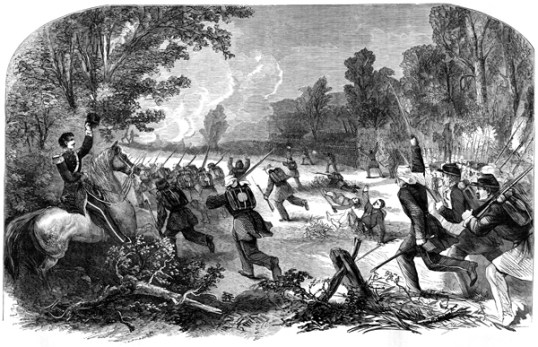
During the years of the American Civil War, daily newspapers were filled with sad and terrifying news. On August 1, 1861, Richmond’s The Daily Dispatch printed an article entitled “Care of Disabled Soldiers, Committee for Reception and Accommodation of Sick and Wounded Soldiers,” which included this news about the death of Buckingham County resident George H. Snoddy.
Died. —Three of the Southern volunteers recently arrived here died yesterday. Their names are given below. Dulce et decorum est pro patria mori, yet the loss of so many “good men” and true is not the least evil that human wickedness in high places has brought on our fatherland.
George H. Snoddy, a member of the 20th Regiment Virginia Volunteers, died in this city [Richmond] yesterday, at the house of Mr. Edward Wilson. Deceased was a native of Buckingham county, aged about 40 years. His death was caused by exposure at Rich Mountain.—The body was sent up the canal by packet last evening, to be interred in the family burying ground.
Many thanks to Mary Carolyn Mitton for finding this report.
For more about Buckingham County’s sacrifice at Rich Mountain, visit these posts at Slate River Rambling:
Buckingham County: The Battle of Rich Mountain
Battle of Rich Mountain: Part II
1908: Buckingham County’s Confederate Monument

Courtesy Virginia Chronicle, Library of Virginia
In 1911, very little was widely known about Thomas Jefferson’s only brother, Randolph, and what was printed was error-ridden. For example, this answer to a query to the Richmond Times Dispatch, published on August 13, 1911, must have disappointed Mrs. D. P. S. if she was looking for a connection to Randolph Jefferson in order to join the Daughters of the American Revolution:
Richmond, Va., October 21, 1910
Editor Genealogical Column:
Did Thomas Jefferson have more than one brother, Randolph? Did Randolph Jefferson aid, in any way, in the “Revolution”? To whom was Randolph Jefferson married and did he have any sons? If so, what were their names and what can you tell me of their descendants?
MRS. D.P.S.
~
Randolph Jefferson was the only brother to arrive at maturity. He was born in 1755. He had a twin sister, Hannah Scott Jefferson. The largest number of Jeffersons are descended from Field Jefferson, of Roanoke. I can find no record of the Revolutionary service of Randolph Jefferson. Randolph Jefferson married, but I find no record of the names of his wife or his children.
EDITOR
~
Can you spot the errors?

RJ’s sister was Anna Scott Jefferson.
RJ’s uncle, Field Jefferson, was of Mecklenburg/Lunenburg County.
RJ served the American Revolution several ways, including riding with Capt. Thomas Nelson.
RJ married his first cousin, Anne Lewis.
For much more about Randolph Jefferson and his family, consult: The Jefferson Brothers.
Happy Independence Day!
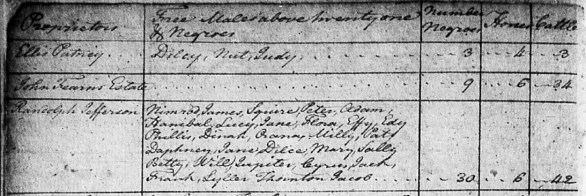
Randolph Jefferson, 1782, Personal Property Tax. Buckingham County, Virginia.
Courtesy Library of Virginia.
When a county courthouse burns, as was the case in Buckingham County, Virginia in early 1869, research concerning the county’s history can be very challenging. Despite the local loss, many county records during the 19th century were submitted to Richmond. Some have survived, including land and personal property taxes. Images of the original records, like the one above, are available to view at the Library of Virginia.
Years ago, Roger G. Ward created three indispensable volumes of “implied deeds” using land tax records for Buckingham County, which typically indicated both grantee and grantor when land was transferred. His books have been invaluable to Buckingham County researchers and remain in print. Click here to find them online at Iberian Publishing: BUCKINGHAM COUNTY, VIRGINIA LAND TAX SUMMARIES & IMPLIED DEEDS.
Following in Ward’s footsteps, Randy F. McNew Crouse has published an initial collection, transcribing (line for line) Buckingham County’s earliest personal property taxes, including the surviving fragment from 1764; 1773-4; and 1782-92. His book, Personal Property Tax Lists of Buckingham County, Virginia 1764-1792, contains a 160 page index of surnames and appendixes, including a brief biography of Buckingham County Clerks Rolfe Eldridge and Rolfe Eldridge, Jr. Crouse also offers helpful hints for alternate spellings of names.
Unsurprisingly, Crouse has roots in Buckingham, including patriarchs: Abraham Childress, Matthias Nichols, and Archelaus Reynolds. A curious man of many specialties, Crouse has long been interested in history and genealogy. He describes himself as a “husband, father and grandfather, scientist, botanist, astronomer, ornithologist, entomologist, naturalist, artist, musician, cook, backpacker, kayaker and author.” Having finished his first compilation of Buckingham records, he moved on to Volume 2, which will cover 1792-1802 and will be available later in 2017.
Click here to learn more or purchase a copy at Lulu:
Personal Property Tax Lists of Buckingham County, Virginia 1764-1792.

Sycamore Island. Buckingham County, Virginia.
On January 24, 1895, the “Well Water Notes,” printed in the Appomattox and Buckingham Times, included a description of the sad death of Jesse Moseley, a “highly respected colored man.” Moseley was one of the “nine men of color” who received land from Alexander Moseley in 1869 at what became known as “Alexander Hill.” According to the newspaper:
… at Manteo Station on the C. & O. R.R. on Friday the twelfth, instant. Jesse Moseley a highly respected colored man, who carries the mail from Manteo P.O. in Buckingham county across the river to the Station, with two section hands overtook to cross the river in the skiff. The river was very high, the current too strong for them. They were carried against the wire rope of the ferry which caught the boat and upset it, and the three men were thrown in the river. Moseley managed to catch hold of the wire rope and held onto it for over an hour, when he let go from exhaustion and being unable to swim he was drowned. The other two men swam to Sycamore Island and climbed a tree where they sat until a messenger could go to Wingina for a boat and help, when they were rescued from their fearful situation almost frozen. While Jesse Moseley was holding the rope Mr. Geo. W. Patterson, a Merchant at Manteo, offered $100 to any one who would rescue him, several attempts were made but each one failed the current being too strong.
During the great freshet of 1870 Jesse Moseley rescued the young lady a Mrs. Wright, from the same tree the two men climbed. She was in a house that floated down until it struck the island and dashed to pieces, when the young lady escaped drowning by climbing the tree.
Note on the map above:
Fish Pond Road: Fish Pond, in Nelson County, was home to Alexander Moseley.
Sycamore Island.
Ryan Creek, Buckingham County, ran through Alexander Moseley’s farm known as “Sycamore Island.”
Manteo Road.
Click here for more about Alexander Hill Baptist Church, now on a Virginia Historic Landmark.
Alexander Hill Baptist Church, Courtesy Historic Buckingham
Earlier this month, Alexander Hill Baptist Church joined other Buckingham County historic properties on the Virginia Landmarks Register. It was a long, tedious process. Congratulations to all who were involved!
The accepted application can be found here: Alexander Hill Baptist Church
Click here for photos of the property: Alexander Hill Baptist Church, Buckingham Co. #014-5054
~
As many readers of Slate River Ramblings already know, on January 1, 1867, Buckingham-born Alexander Moseley, Editor of the Richmond Whig, granted a tract of land consisting of 346 acres of land to his former servants. The community became known as Alexander Hill and provided homes and livelihoods not only for nine men grantees, but also for their rapidly expanding families. The tract sits at the headwaters of Ryan’s Creek, just west of Glenmore. The deed transferred the property to nine “men of color,” including Gabriel Palmer, who would become the pastor of Alexander Hill Baptist Church, the first African-American Baptist Church in Buckingham County.
For much more about Alexander Moseley and Alexander Hill, download this issue of the Buckingham Beacon, which contains my article: “The Man Behind Buckingham County’s Alexander Hill Community: Will the Real Alexander Moseley Please Stand Up?”

William Cabell Rives. Courtesy Small Special Collections, University of Virginia.
In March 2017, I misidentified the Mr. Rives who was fêted at Buckingham Courthouse and have now corrected those two posts. To find out more about the political festival and the true identity of Mr. Rives, click on the links below:
Festival at Buckingham Court House: Part I
Festival at Buckingham Court House: Part II
In July of 1840, it was indeed an enthusiastic gathering of Buckingham County’s devoted Whigs and Conservatives. Below I have added some of the “volunteer toasts,” saluting not only the honored guest but alsomany other politicians the men admired, while condemning some they detested. My ancestor, Col. John M. Harris, went even further, raising a glass to all noble, surviving men of the American Revolution. A very lengthy report was reprinted in The Lynchburg Virginian on July 27, 1840.
VOLUNTEER TOASTS
By Capt. Thos. Miller. The union of the Whigs and Conservatives for the sake of the Union.
By E. A. Cabell. The People of Buckingham: Famed not less for their hospitality and intelligence than for their devotion to the true principle of Republican liberty.
By R. Ivanhoe Cocke. The patriotism of the honest yeomanry will prove, in November next, the Mount Ararat on which are political arc may rest in safety.
E. H. Moseley. Thomas Jefferson: That great advocate of civil and religious freedom, and founder of the University of Virginia.
By Alexander Moseley of Buckingham. John Tyler: His opponents charge him with being a slaveholder, in order to secure the abolition vote to Mr. Van Buren, who can see nothing in the testimony of a free negro against a white man to call for his interference.
By F. B. Scruggs. Henry Clay: Guided by the integrity of his own bosom, sustained in his efforts alone by the mastery of his own intellectual greatness, he has risen superior to every obstacle, and will deserve, if he does not receive, in 1844, the highest office in the gift of a free people.
By R. E. Moseley. Our distinguished guest, W. C. Rives: The freemen of Old Dominion delight to honor, and will sustain him in his efforts to bridle Executive usurpations.
By J. K. Irving. Wm. C. Rives: The edict of power has gone forth for his destruction, but the People have recalled that edict, and will change the victim.
By N. B. Tapscott. Our guest, Wm. C. Rives. The brightest star in the political horizon.
By Col. John M. Harris. Virginia: She has nothing to fear whilst we have so many Revolutionary soldiers and officers alive to cheer us, and while aided by our highly distinguished guest, Wm. C. Rives. Hurrah for Harrison and Tyler!

Pleasant Grove, Courtesy Historic Buckingham.
In 1936, when Elizabeth McCraw surveyed Pleasant Grove for the Virginia Historical Inventory, she included a fairly lengthy comment concerning the property’s “historical significance.” According to Mrs. McCraw:
This house was built by Mr. Junius Clay, a brother to Oden Clay who was the first president of what is now the Norfolk and Western Railroad. It is generally supposed that the house was built in 1824 and that the Clays lived there about that time. This date is on the gutter, but the present owner says she often heard her grandparents say that the gutters were put on the house some years after it was built. The house may have been built prior to 1824.
The place was visited a number of times by both Union and Confederate Soldiers during the War Between the States. No damage was done to the house, but provisions were taken, and on one occasion simply destroyed. The family silver was also taken.
Mrs. McCraw’s informant was Mrs. Julia Smith Forbes of Farmville, Virginia. In 1936, Mrs. Forbes was the owner and represented the third generation of the Smith family at Pleasant Grove. Mrs. McCraw also gathered information from Mr. Emmett Gillespie of Enonville, a relative of the Clays.
In 1880, a Junius Clay (age 81) and his wife, Elizabeth (age 79) were living in the Francisco District in Buckingham County. Is he the Junius A. Clay who married Elizabeth Cobbs in Bedford County, Virginia on December 12, 1820 and the builder of Pleasant Grove?
Can a Slate River Ramblings’ reader add more about the Clay family? Please comment below.
For more about the dwelling house at Pleasant Grove, click here: Buckingham Houses: Pleasant Grove


 slate river ramblings . . . .