

A Surprise Ending
On June 21, 1905, Richmond’s The Times Dispatch printed this notice from Lynchburg, Virginia:
MISS FORBES A BRIDE.
Married the Sheriff Who Had the Custody of Her Brother.
Lynchburg, VA. June 20. – Miss Janie Forbes, daughter of the late John S. Forbes, is the bride of Mr. Lewis Williams, the sheriff of that county. The marriage took place some two weeks ago, but it was not made public until a day or two ago.
The bride is a sister of young Forbes, who figured in the Forbes-Wooldridge arson cases, which attracted so much attention in Buckingham county during the past year or more. She spent liberally of her means in the defense of her brother, and stuck by him through all of his troubles. During the trials she became acquainted with Sheriff Williams, who admired her devotion to her brother. From this began a courtship, which culminated in the marriage. Mr. and Mrs. Williams are now residing in a beautiful home on Slate River, Buckingham county.
While wedding bells did not exactly a ring out “all’s well that ends well,” at least, Janie Forbes, now Mrs. Lewis Williams, had a home of her own. Some years later, her husband, still Sheriff of Buckingham County, would find himself criticized by the same press that covered “The Famous Forbes Case.”
Click here for more about Sheriff Lewis Williams and his involvement with “The Outlaws of Buckingham County.”
Once again, Cousin Mary Carolyn Minton deserves many thanks for introducing me to the Forbes-Wooldridge case and I owe thanks to Margaret Thomas for her detective work searching Buckingham County’s Court Order Books. Virginia Chronicle, created at the Library of Virginia, provided most of the newspaper articles and continues to expand its wonderful collection which now includes the Appomattox and Buckingham Times.

The Long and Winding Road
On March 17, 1905, The Times-Dispatch prepared their readers for the next chapter in “The Famous Forbes Case,” reminding them that Charlie Forbes’ trial was to start on Monday in the Prince Edward County Court and recapping the case, in brief.
Then, on March 21, 1905, a headline in The Times-Dispatch announced:
CHARLIE FORBES IS A FREE MAN
Jailed since late May of 1904, having survived typhoid fever in the Buckingham County jail, Charlie Forbes’ case was swiftly concluded in the Prince Edward County Court. According to the newspaper:
Indictments No. 3 and 9 were nolle prosequied by the Commonwealth and on the other seven indictments against him he was tried and declared “not guilty” in each of them.
The same disposition was made of all the cases against E. C. Wooldridge.
In the two cases which were nolle prosequied the Commonwealth, of course, reserves the right of reindicting. It is understood that both Forbes and Wooldridge will leave the State, as their presence is not desired in the old neighborhood where they lived.
The crowd in attendance to-day was not large, and there was no excitement. A sense of general relief is experienced that these cases have been disposed of.
There may have been a general sense of relief among the public when the Commonwealth declined to further prosecute; however, could the Forbes family really forgive and forget the extensive damage done to John S. Forbes property? What about the indictments against Dan Wooldridge? The Forbes family and the public remained puzzled as to a motive behind the crimes.
Was the investigation of Elkin Agee and Tom Ferguson, two of the men previously accused of robbing the Forbes’ home, as the possible arsonists deep enough? Having spent time in the penitentiary, they had reasons to want revenge on John S. Forbes and his family. What happened to the projected testimony of Governor Montague, with whom Cliff Wooldridge appeared to be on friendly terms, and Officer Marshall, of the penitentiary?
~
Once Cliff Wooldridge was found not guilty and there was no new, direct evidence against Charlie Forbes, it is unsurprising that the cases were dropped. A jury was not going to hang two or three men on circumstantial evidence.
Charlie Forbes may or may not have left Buckingham County, as predicted by the newspaper. In 1910, E. Clifford Wooldridge was still living in Buckingham, adjacent R. D. Forbes, and raising his many children. It seemed, yet another Buckingham County crime just drifted away from the headlines.
Coming Next: A Surprise Ending
Need to catch up? Click here for The Famous Forbes Case of Buckingham County: Part I

Peter A. Forbes
News of the assault on R. D. Forbes was followed on March 7, 1905 by the obituary of Peter A. Forbes, brother of the wronged John S. Forbes. In January, Peter Forbes had attended the trial in Farmville. The weather was inclement and, when he returned home to Buckingham County, he fell ill and never recovered. The Times-Dispatch printed this tribute:
[He] was indeed a friend to all classes and conditions of people in this county, and there are few men here who have not experienced kindness at his hands. Mr. Forbes was in the seventy-fourth year of his age, and had been clerk of the Courts of Buckingham continuously for about thirty-five years. He was an astute and efficient officer, and conducted the office to the satisfaction of all concerned. Mr. Forbes began his public career as deputy sheriff under his uncle, Colonel W. W. Forbes, and succeeded the late R. K. Irving as clerk of the then County and Circuit Courts.
It is thought that the great worry incident to attending the two long and tedious trials of charges against E. C. Wooldridge, who was charged with Charles Forbes, with having burned the houses of the late John S. Forbes, had much to do with hastening Mr. P. A. Forbes’s death. . . .
Mr. Forbes married Miss Helen C. Oliver, of this county, who, with five sons and two daughters, survive him. Mrs. Forbes is in very precarious health and it is feared that the shock of her husband’s death may prove disastrous to her.
With this obituary, it becomes increasingly clear how far the influence of the Forbes family stretched in Buckingham County. One member or another had held offices of power and/or influence for decades. Certainly, long enough to accumulate some political enemies.
On March 12, 1905, The Times-Dispatch reported that W. J. Hubard, previously clerk of the Circuit Court in Buckingham County, was selected to replace Peter A. Forbes as Clerk of Buckingham Court.
Coming Next: The Long and Winding Road
Need to catch up? Click here for The Famous Forbes Case of Buckingham County: Part I
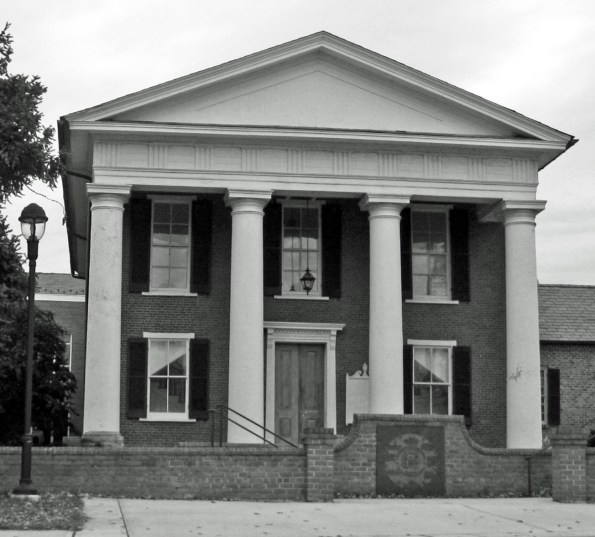
Buckingham Courthouse. Photo by Joanne L. Yeck
R.D. Forbes Assaulted
The story of “The Famous Forbes Case” did not miss a beat. On January 19, 1905, The Times-Dispatch reported that the prosecution had asked for a continuance in the case of Charlie Forbes, due to the absence of two material witnesses. A continuance was granted and the new date for the trial was set for the third Monday in March. Charlie Forbes, who had been in jail since May, looked remarkably well when he appeared in court. His attorney requested bail and Judge Hundley agreed to consider the motion during his vacation.
~
On February 18th, The Times Dispatch featured a shocking front-page headline:
E.C. Wooldridge Again In Court
Arrested with Dan Wooldridge on Charge of Attacking R. D. Forbes
Dan Wooldridge was accused of assaulting R. D. Forbes, with intent to kill, and Cliff Wooldridge was charged as an accessory. They were indicted by the grand jury and brought to Farmville where judge Hundley allowed bail with Mrs. Wooldridge as surety. Apparently, some of Wooldridge’s animals trespassed on Forbes’ land, the cause of the alleged altercation.
Quoit wrote his opinion of the Forbes – Wooldridge altercation, which appeared on the front page of the Appomattox and Buckingham Times on February 22, 1904:
Deputy Sheriff Chas. D. McCraw arrested E. C. Wooldridge and his son, Dan, who stand jointly indicted and charged with assault, (Dan with making the assault and his father as an accessory) upon R. D. Forbes and Judge Hundley granted both bail, Mrs. Wooldridge justifying for them in the sum of $1000 to appear in court on the first day of the next term. Hon. E. W. Hubard suggested the accused being put under peace bonds and Mr. Wooldridge stated he thought it a very good plan if both parties were made to give bond, but as Mr. R. D. Forbes was not present Judge Hundley said application could be made afterwards to a Justice of the Peace.
There seems to be a lot of bad blood between the Forbes and Wooldridge families and the end of trouble for them seems distant. If these people could only do as Abraham and Lot did and one go to the right and the other go to the left and avoid these clashes, they might be happier.
This twist in the story disappeared from the headlines. Perhaps, the charges were dropped.
Coming Next: Peter A. Forbes
Need to catch up? Click here for The Famous Forbes Case of Buckingham County: Part I
A Letter to the Editor
On January 18, 1905, The Times-Dispatch printed a letter to the editor signed by E. C. Wooldridge:
Editor of The Times-Dispatch:
Sir, – During my confinement in the Prince Edward county jail I had the opportunity of observing the conduct and management of said jail and, taking all the circumstances into consideration, I am satisfied that there is no neglect of duty as to the management, sanitary conditions, &c. At the time of my confinement there were thirteen prisoners in jail, and there is scarcely a day that there are not from one to four incarcerated for petty offenses, of all classes, from the hobo to the city vagrant, and it is utterly impossible to keep it at all times free from objectionable companions, but it is certainly not from a lack of consideration, care and effort on the part of the officials, as each one of them is diligent to duty, kind, courteous and considerate to the prisoners, and I cannot see of any improvement that could be made, unless they were given additional room, means, &c.
Respectfully,
E.C. Wooldridge
Forbes, Buckingham Co., Va.
January 16, 1905
~
Considering that the sanitation of the Farmville jail had been highly criticized, it was thoughtful of Cliff Wooldridge to write to the newspaper concerning his experience. His signature revealed that his mail was collected at the Forbes Post Office, reminding readers that he lived surrounded by the Forbes family and their many cousins.
Once married to a niece of John S. Forbes, Cliff Wooldridge bore the many burdens common to a self-made man. Resentment of his rise in power and wealth may have fueled the massive testimony against him.
Coming Next: R.D. Forbes Assaulted
Need to catch up? Click here for The Famous Forbes Case of Buckingham County: Part I
Murder Will Out
On January 11, 1905, an unsigned letter from Buckingham courthouse appeared on the front page of the Appomattox and Buckingham Times. Its opinion was fresh yet it lagged behind the news.
We missed the regular weekly letters from this place in the last weeks issue, guess your correspondent must be keeping company with the “cloud of witnesses” attending court at Farmville. If there is not another mistrial in the Wooldridge case we ought to know by your next issue if Wooldridge is ajudged guilty or set at liberty. I see, counsel for the defense are paving way for an appeal in case the verdict should be adverse to their client. How difficult it is to prove the crime of arson; somehow “murder will out,” but unless circumstantial evidence is taken the crime of burning is not often proved.
In fact on page four the newspaper’s readers learned:
WOOLRIDGE ACQUITTED.*
OUT ON $8,000 BAIL BOND.
The article that followed was a quick summation of the end of the trial in Farmville. Being late with breaking news is one of the disadvantages of a weekly paper.
On January 18th, the Appomattox and Buckingham Times published more about the trial, including a letter from Quoit, which read in part:
After an absence of 10 days from my home, as a comparative know-nothing witness for the Commonwealth in the now celebrated “Wooldridge arson case” which was so recently tried in the neighboring (?) town of Farmville I will endeavor “to take up the thread of my argument” and as best I can atone for my two week’s silence.
Well the trial for the burning of the smokehouse is now a thing of the past, so far as E. C. Wooldridge is concerned; and upon that charge he is now standing acquitted. The verdict was in no sense unexpected after the case took such an unlooked for turn. When those of whom the Commonwealth had every reason to expect the full force of the unbiased testimony in support of her contention, seemingly, to all intents and purposes, swayed by the hypnotic influence of the superior mind, gave their testimony in the interest really of the accused but intentionally in the interest of Charlie Forbes who was jointly indicted with Wooldridge, it began to dawn upon those who carefully weighed the effect of their testimony upon that undisputedly and queerly constituted jury, that no conviction would be had; and it was commonly remarked, long before the argument was ever made, that a hung jury or an acquittal would be the result. Some of the witnesses though are more to be pitied and censured. From the common and frequently expressed public opinion, this case is but another evidence that the verdict of juries does not establish the guilt or innocence of an accused further than the accused himself is concerned.
*The Appomattox and Buckingham Times consistently spelled Cliff Wooldridge’s name as “Woolridge.”
Coming Next: A Letter to the Editor
Need to catch up? Click here for The Famous Forbes Case of Buckingham County: Part I
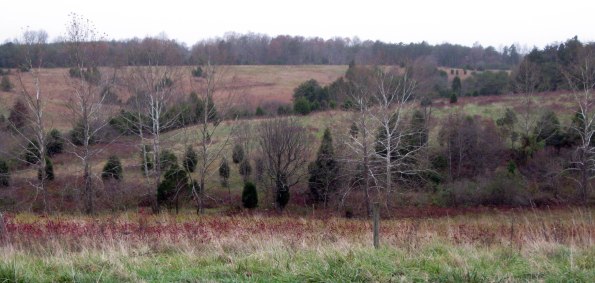
Site of John M. Harris Farm, Slate River District.
Photo by Joanne L. Yeck
Tomorrow, Slate River Ramblings celebrates its fourth anniversary and we just crested 600 followers!
Many thanks to all of you for making the blog a success and for caring about the people and places of Buckingham County, Virginia.
The content keeps growing, as well. As of December, 2016, there are over 600 posts and 100’s of expansive comments by readers.
Stay tuned. More adventures to come. Please invite your family and friends to join us as we continue to ramble through Buckingham County’s history.

The Jury’s Decision
On January 11, 1905 Cliff Wooldridge spent a sleepless night in the Farmville jail. While he awaited the jury’s decision, four other prisoners were attempting a jail break! According to The Times-Dispatch:
They had cut a hole through the floor to their room and ascended to the floor below. There they had succeeded in breaking the inner lock to the door which would give them their liberty, when Police Officer Fogus arrived upon the scene and frustrated their desperate attempt.
Yet, when morning came, Wooldridge sat in the courtroom with a cheerful countenance.
The verdict was front page news. The newspaper was, once again, hyperbolic in its description of the conclusion of this long and arduous trial:
Never before has Farmville witnessed a criminal trial in which more community interest was shown than in this.
Long before the courthouse bell was rung men and women flocked to the building, until every space large enough to accommodate a child was occupied. One entire side of the room had been set apart for ladies and their occupancy was complete. They held to all the space decreed to them by His Honor, Judge Hundley, while on the other side of the building the men were jammed close together in their eager desire to catch the words of burning eloquence as they fell from the lips of counsel.
No less than four hours of silver-tongued eloquence followed.
Mr. Aubrey Strode’s argument for the prosecution was “strong and eloquent.” In a pleasant voice, he noted “the brightest spot in this case was the fidelity displayed by the women connected with it.” He declared that Wooldridge was “smart and shrewd,” adding that what Wooldridge could not explain to the jury, he simply denied.
Congressman Flood put forth a “magnificent review” of the case. In closing, he thanked the people of Prince Edward County for “their kindness to the prisoner’s family and to himself, and ask that the prison bars be opened, that the prisoner once more might breathe the air of freedom and of liberty.”
According to The Farmville Herald, “At the conclusion of Mr. Flood’s argument hundreds of eyes were bathed in tears and several of the jurors were visibly affected.”
The vigorous Edmund Hubard then closed for the prosecution, declaring there were five distinct confessions made by Wooldridge himself and reminded the jury that thirty-seven witnesses had “pointed unmistakably to his guilt.” According to The Times-Dispatch:
He compared the prisoner with the devil-tree of the tropics, which withers and destroys that which comes within its reach. He closed with an earnest plea for a verdict of guilty. His peroration being one of superb eloquence.
It only took the jury one and a half hours to pronounce Cliff Wooldridge — “not guilty.” Miss Maud ran from the courtroom to inform her mother who was waiting at the hotel. Instant applause broke out in the courtroom. The crowd surged towards Wooldridge to congratulate him. Judge Hundley rapped for order, announcing, “Mr. Wooldridge, you’ve had a fair trial, and have been acquitted, and you’re now discharged from custody.”
Edmund Hubard quickly rose, reminding the Court that there were still eight indictments against Cliff Wooldridge. Congressman Flood requested bail which was granted at $1,000 per indictment. Bond was given at once, with Mr. Flood as security. Cliff Wooldridge headed for the hotel to greet his waiting wife; at midnight, Congressman Flood departed for Washington, D.C., to resume his official duties there.
An unexpected note in Baltimore’s The Sun claimed that Cliff Wooldridge was the richest man in Buckingham County. This tidbit seems to have come out of left field. Doubtless untrue, what was The Sun implying?
Coming Next: Murder Will Out
Need to catch up? Click here for The Famous Forbes Case of Buckingham County: Part I

In need of a gift idea this holiday season? Give the gift of local history!
Here’s where you can purchase these books (and many others) about Buckingham County and Virginia:
In Virginia
Buckingham: Housewright Museum (U.S. Route 60, in the village of Buckingham)
Buckingham: Nancy’s Gift Shop (U.S. Route 60, in the village of Buckingham)
Scottsville: Baine’s Books and Coffee (485 Valley Street)
Monticello: Monticello’s Gift Shop [The Jefferson Brothers]
Charlottesville: Michie Tavern General Store [The Jefferson Brothers]
Charlottesville: Albemarle Charlottesville Historical Society (200 Second Street, NE)
Appomattox: Baine’s Books and Coffee (205 Main Street)
Richmond: The Library of Virginia: The Virginia Shop (800 East Broad Street)
Not in Virginia? Shop online at:
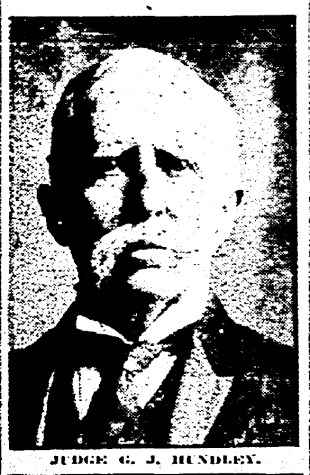
“Wooldridge Trial Near End”
Once again The Famous Forbes Case was featured on the front page of Richmond’s The Times-Dispatch. The article noted that the case was rife with contradictory evidence, all presented by reputable witnesses.
On January 10th, more witnesses were introduced for the defense. Captain J. D. Gilliam, a police officer in Farmville, testified that the ground was frozen on the night of March 3, 1904; no tracks could have been made. Mr. P. A. Grigg, a member of the Buckingham Board of Supervisors, supported Gilliam’s testimony.
For the prosecution, Miss Bessie O’Brien, repeated the “damaging” testimony she gave against Dan Wooldridge in the preliminary hearing, stating that he said that Charlie Forbes could have saved two buggies from the fire, if he had had any sense. Miss Georgia O’Brien supported her sister. P.A. Forbes impeached the previous testimony of Policemen Fogus. Arthur Forbes, son of P.A. Forbes and a bank clerk in Farmville, corroborated his father’s testimony. Mrs. Dick Forbes was brought to the stand again and contradicted Maud Wooldridge’s testimony.
The trial dragged on to a ridiculous extreme. How could the jury possibly sort through this maze of contradictory testimony?
A high point came when Mrs. Van Anderson supported her husband’s earlier testimony, adding, “I told my husband that I suppose he (Wooldridge) thought he was monarch of all he surveyed.” The Farmville Herald noted: “A ripple of laughter went over the courtroom at this, the judge himself having to smile profusely.”
Finally, it was time to instruct the jury to consider the evidence.
Judge Hundley’s Instructions
The reminders to the jury were stern. Under the law, every person charged with a crime was presumed to be innocent until proven guilty, beyond a reasonable doubt. The Times-Dispatch elaborated:
(1) . . . this presumption of innocence goes with the accused throughout the entire case and applies at every stage thereof until removed by the evidence beyond a reasonable doubt; therefore, if the jury, upon the whole case, or upon any material fact essential to the establishment of the guilt of the accused, entertains a reasonable doubt of his guilt, it is their duty to find the prisoner not guilty.
(2) The Court instructs the jury that the guilt of the accused is not to be inferred because the facts proven are consistent with his guilt, but that they must be inconsistent with his innocence.
(3) The Court instructs the jury. . . . That in the application of circumstantial evidence to the determination of a case, the utmost caution and vigilance should be used.
The newspaper continued to list Judge Hundley’s instructions point by point, including that no matter how strong one hypothesis might seem, other hypotheses could be true. He reminded them not to be swayed by “a merciful disposition or kindly feeling towards him (Wooldridge), or from sympathy for him or his family.” He warned against apparent confessions or admissions of guilt and impressed upon the jury that the prisoner must have confessed to the precise crime as charged. He defined the charges as: “a number of houses, including the smokehouse on the farm of John S. Forbes, were set on fire and burned at or about the same hour on the night of the third day of March, 1904; and, that the prisoner, Wooldridge made admissions or confessions which connect him with such burning, either alone or as a guilty participant with others in the crime.”
The judge concluded, saying:
The court has endeavored to exclude all near expressions of opinion as to the guilt or innocence of the prisoner; but if any expressions of that character escaped the attention of the court, then the court now instructs the jury that no expressions of opinion detrimental to the character of the accused about this or other matters can be considered by them.
Coming Next: The Jury’s Decision
Need to catch up? Click here for The Famous Forbes Case of Buckingham County: Part I


 slate river ramblings . . . .