

“The Disgrace in Buckingham”
On October 3, 1908 a shocking editorial ran in Newport News’ Daily Press.
Entitled “The Disgrace in Buckingham” it asked, “What is the matter in Buckingham County, anyway?”
The lengthy editorial was unsigned and raised many interesting questions, as well as offering some stinging criticism. Taking a stab at the news coverage concerning the lack of law and order in Arvonia, the author claimed that the “press reports are wordy enough, but contain little but conjecture and more or less plausible guessing.” He noted that many correspondents left the “scene of action” on October 1st in response to the “tip” that they would be shot on sight.
In addition to unprofessional reporting, the author stated that Buckingham was “afflicted with two ailments — a plethora of politics and a shortage of official backbone.”
The editorial recapped the story of N. M. Gregory, who had been shot, presumably by a member of the outlaw gang. Tired of these “illicit sellers of whisky, petty thieves, night-workers and small marauders,” Gregory had been responsible for the capture of the four ringleaders. They were jailed, and, according to this account, Sheriff Williams became the bondsman for William Thomas. The men broke jail and Gregory was shot in the back. Then came the hard criticism directed against Sheriff Williams.
Up to Thursday last, it is declared, Sheriff Williams, in spite of urgent appeals from many law-abiding citizens and violent denunciation from a still greater number, had made no definite move to find and capture the outlaws. The correspondent of a Washington newspaper states that the sheriff arrived in Arvonia on Wednesday night and promised to lead the posse of citizens against the criminals. But on Thursday morning it was discovered that the sheriff had mysteriously disappeared, remarking before he left that he would “get busy when he got ready.”
A week after N. M. Gregory was shot, Commonwealth’s Attorney Edmund Hubard, executing orders from Governor Swanson, finally pushed Williams to form a posse. The editorial continued somewhat sarcastically:
Rather deliberate, round-about and long range action some people will think. If they believed their safety depended upon it and means were available, the pursued (?) might have reached London, England, from Buckingham county in eight days.
The author went on to say that despite their general undesirableness, the outlaws had many followers and those followers represented many ballots.
Furthermore, it has been asseverated that they know how to shoot. . . .
If the sheriff is afraid that he will be shot in the back if he tries to bring criminals to justice, then he should resign or be suspended from office.
If this officer is restrained from doing his duty by the apprehension that there are not enough law abiding voters in Buckingham to return him to office at the next county election, and is catering to the other contingent, lest he lose his support at the polls, he should be deprived of his office with all possible dispatch and held up to the scorn and contempt that is due to the sworn officer who cravenly shirks his obligation to the people.
Physical cowardice is an affliction which may be pitied wherever found, but never tolerated in a guardian of the public peace. But moral pusillanimity, begotten by self-interest, is a vice for which there is no extenuation.
All things considered, the reported state of affairs in Buckingham county appears to call more urgently for the presence of a bold and fearless commander-in-chief than did the conditions in Accomac county upon the occasion of the so-called race riot.
The next day, the Daily Press quipped: “So long as Buckingham’s populace – including the sheriff – keeps under the bed, the casualty list is not expected to form a feature of news from the front.”
There is at least one other possible explanation for the lack of pursuit of these criminals, one that will grow during America’s national prohibition of alcohol. Was the gang paying protection to one or more Buckingham official who looked the other way and allowed them to continue their operations?
Coming Next: Quiet Reigns Again
Need to catch up? Click here: The Buckingham Outlaws: Part I

“Zimmerman Home and Headquarters of the Gang”
Wilkes-Barre Times (Wilkes-Barre, Pennsylvania)
Unrest in Buckingham
On October 2, 1908, The Farmville Herald printed a plaintive article, summarizing the desperate state of affairs in Buckingham County, Farmville’s neighbor to the north.
UNREST IN BUCKINGHAM
The citizens in and about Arvonia, Buckingham county, have been laboring under intense excitement for the past week, which began with the shooting from ambush of one of the prominent citizens of the community, Mr. N. M. Gregory. Since the “black hand” letters have been received, one of them by Rev. Plummer Jones, who was persuaded not to go to a regular preaching appointment on last Sunday, as the road leading to the church would have taken him through what is known as “enemy’s territory.” Two desperate white men seem to be leaders of the gang and have associated with them several negroes of bad reputation. Many or few they should be hunted down and promptly and properly dealt with.
We, as a people, are too busy to be wasting time on the lawless, the people who love and pursue peace should not be made targets for desperadoes. The wonder is that the citizens of our counties don’t realize the necessity of an organized military company at the most important business center in each county. The young men can be found to take pride in such an organization, and if properly encouraged will keep it in high state of efficiency. Such a body of men well armed and equipped, would one day relieve the situation in our sister county, restore peace, a sense of security and maintain them. To make such organizations as effective as they should be they should be generously and gratefully sustained by popular contributions.
We look upon the Farmville Guard as the strong arm upon which we lean, our best shield and surest protection.
Unquestionably, Buckingham County’s image as a peaceful, healthful place to live was beginning to tarnish.
Coming Next: “The Disgrace in Buckingham”
Need to catch up? Click here: The Buckingham Outlaws: Part I
Charles Newton Shot
Concurrent with the building excitement in Arvonia, on the evening of September 30th, reports circulated that a man named Charles Newton had been shot at Payne’s Station, Buckingham County.
According to Newport News’ Daily Press, Newton was shot by Benjamin Heinerman. The newspaper stated that there was a warrant out charging Newton with an attempted assault on Heinerman’s wife. No arrest was made and the conclusion was that Heinerman took matters into his own hands.
To readers who had been following the story of the Buckingham outlaws, however, it was clear that the gunman was probably Benjamin Zimmerman not Benjamin Heinerman and, in fact, it was Zimmerman who was guilty of assault on Newton’s wife. Charles Newton was the brother of one of Zimmerman’s wives. Which wife is currently unknown.
The Alexandria Gazette and other papers reported that Benjamin Zimmerman had shot his brother-in-law, Charles Newton, at Payne’s Station. Unconfirmed rumors spread that Charles Newton was dead and that the shooting was the result of an old grudge. Newspapers nationwide printed the news from Richmond:
Some time ago Zimmerman is alleged to have attempted criminal assault on Newton’s wife, and after the warrant was sworn out for his arrest to have threatened his brother-in-law. In consequence of the threats, Newton and his wife removed from the home of the band to a place called Payne’s Station, near where the alleged shooting took place.
By October 2nd, the governor had received confirmation that Charles Newton was dead. According to The Mathews Journal, “The information was furnished by a man who attended Newton’s funeral.”
Was another man now dead as a result of Sheriff Williams’ apathetic approach to apprehending Benjamin Zimmerman? Years ago a warrant was issued to arrest Zimmerman for assault. Why had the sheriff never pressed for his capture?
Coming Next: Unrest in Buckingham
Need to catch up? Click here: The Buckingham Outlaws: Part I
An Eyewitness
On October 1, 1908, the Baltimore American printed news from an anonymous eyewitness concerning conditions in Arvonia:
There was in this city [Richmond] today a man fresh from the scene of the trouble who talked interestingly of the conditions in Buckingham, but begged that his identity be concealed through fear that harm might come to his relatives who are still there. He said that the conditions there have not been exaggerated. He declared there is a warrant of three years standing against one of the gang for criminal assault and that he has never been arrested. This man furthermore claimed that these men deal in illicit whiskey, which for years they have openly sold in Arvonia, there being no attempt made to arrest them.
Other reports stated that the outlaws had strongly fortified their position in their territory “as wild as any jungle.” A man could hide, unseen, just ten feet from the county road.
Responding to orders from Governor Swanson, Commonwealth’s Attorney Edmund Hubard and Sheriff Lewis Williams, who was being strongly criticized for his negligence towards the criminals, returned to Arvonia on the evening of the 30th, deputized the vigilantes, and prepared them to move at sunrise on October 1st. One report said that eighty men divided into four posses. Fewer may actually have gone out.
At last, a warrant was issued for the arrest of William Thomas, charging him with the shooting of N. M. Gregory.
It was rumored that newspaper correspondents were ordered out of Arvonia and that they would be shot on sight if they remained. Supposedly, they were silenced for printing plans of both the officials and of the outlaws, interfering with county business. The Alexandria Gazette also noted that “the temerity of the reporters in plunging into the fastnesses of the outlaws” was dangerous business. On October 2nd, however, it was reported that the editor-in-chief of the Richmond News Leader traveled to Buckingham County and sent word back to Richmond that correspondents had not been ordered out of Arvonia.
So much for excuses from timid reporters!
Coming Next: Charles Newton Shot
Need to catch up? Click here: The Buckingham Outlaws: Part I

Bank of Crozet, Courtesy Phil James Historical Images Collection and The Crozet Gazette
On September 23, 1908, Richmond’s The Times-Dispatch reported a robbery at the Bank of Crozet. Was it the work of the Zimmerman-Thomas Gang? The newspaper described the crime:
The Bank of Crozet was dynamited about 2:30 o’clock this morning and about $800 taken from the demolished safe, the door of which was blown off. The work was done by men who used sledges, crowbars and other tools procured from the Crozet blacksmith shop and the section house of the Chesapeake and Ohio Railway. There were a great many tools of this kind found on the premises….
Located about forty yards from the railway station, the bank was planning to move to a new headquarters in about ten days.
On September 30th, the newspaper continued the story saying that several suspects were being watched but no positive evidence had been produced to justify an arrest. The loss was now estimated at $1,000. Covered by the Maryland Casualty Company of Baltimore, the insurance for the robbery was settled immediately. A $100 reward was offered for “the arrest and conviction of each and every one connected with the burglary.”
If the Zimmerman-Thomas Gang was behind the robbery, indications are they were never officially charged.
Learn more about the Bank of Crozet in Phil James’ article: “Secrets of the Blue Ridge: Breaking the Bank, but not the Spirit, of Crozet”
Coming Next: An Eyewitness
Tension Mounts
On October 1, 1908, news of a potential “showdown” between the Buckingham outlaws and the citizens of Arvonia spread across the nation. Articles reported that, on the evening of September 30th, the men of Arvonia announced that they would march at sunrise if the county authorities did not act, form a posse, and begin to search for the criminals. According to the Baltimore American:
The plans for tomorrow morning provide for a general movement on the stronghold of the outlaws at an early hour. The men are to move at a preconcerted signal and to shoot to kill. Men with Winchester rifles are to be stationed in tall trees overlooking the hiding place of the outlaws, and pick them off as fast as they appear. The outlaws themselves are said to be well prepared for any attempt to dislodge them. They are alleged to have cut the hearts from large trees commanding all approaches to their hiding place, from the interior of which positions they are keeping a sharp lookout day and night for attack through small port holes.
Instructions from Governor Swanson are momentarily expected, authorizing Sheriff Williams to proceed at once into the wild country where the clans are in hiding and bring the ringleaders to justice.
N.W. Gregory (sic), who was shot by the outlaws on Saturday night, is still alive. His physicians, however, give out little hope for his ultimate recovery.
. . . There is a belief here [Richmond] that the Zimmermans are the men who recently cracked the safe at the bank of Crozet. The men are said to be in possession of a quantity of dynamite secured from the slate quarries at Arvonia. It is known that members of the gang displayed considerable money for several days following the wrecking of the bank. It is certain to be a battle when an attempt is made to break up the gang.
Coming Next: EXTRA: Bank Robbery at Crozet
Need to catch up? Click here: The Buckingham Outlaws: Part I
The Black Hand Gang
In the September 30th reports concerning the situation in and around Arvonia, the Buckingham outlaws were referred to as “The Black Hand Gang.” An explanation for this new nickname appeared in The Times-Dispatch:
Letter That Caused Alarm
An anonymous letter, received here some days ago, and to which little attention was paid until the shooting of Gregory, is now considered in the light of a “Black Hand” epistle, and has greatly added to the alarm. The letter was addressed to one person, but on the inside were the names of several citizens. The letter was mailed at Penlan, five miles from here. The writer said:
“I am a minister of the gospel, and I thought it my duty to notify and give you a chance to save your life. These men are surely going to lynch you men, I think.
“You people at Arvonia have been meddling so much for the last few years that if you all don’t attend to your own business and use your manners and quit meddling with other people’s business, they are going to lynch you and everything at Arvonia.
“They say they got seventy-five and they don’t want but twenty-five more and they know where they can get them. I heard a man at Buckingham Courthouse say he was at Arvonia and said you Arvonia people didn’t have any more manners than dogs when you all were where ladies were. My advice is, you all better leave at once.”
On the topmost edge of the letter was inserted: “I saw them have six boxes of shells of buckshot, and said they were going to use their guns altogether. Those are reliable parties I heard talking. Look out any night, Arvonia is on fire now, but you can’t see the blaze.”
A. R. W. M.
Typically a Black Hand letter includes extortion, demanding money as well as threatening bodily harm, arson, or murder. Thus far, the Zimmerman-Thomas Gang had made no demands except to be left alone to ply their illegal trade and continue to terrorize the countryside. Later, in October of 1908, one Pennsylvania newspaper printed that the gang “even went to the extent of levying tribute upon the country people.” To date, no other reference to extortion has been found.
This letter, however, proved effective and the citizens of Arvonia believed the men would make good their threats.
Coming Next: Tension Mounts
Need to catch up? Click here: The Buckingham Outlaws: Part I
Jeff Johnson (colored)
The outlaws, via their “anonymous” letters, had threatened the lynching of all citizens of Arvonia – White and Black.
African-American Jeff Johnson admitted he was frightened but came forward to help the posse. The Times-Dispatch identified Johnson as colored and quoted him saying, “I am scared to speak [?] among my own color. I ain’t afraid to talk to you, gentlemen; but they will shoot me on sight if they knew I was talking to you to-night, and I am willing to lead you to their headquarters.”
According to The Times-Dispatch, Johnson was accompanied by another African American, Robert Banks. Both men were armed with shotguns. Johnson was a known victim of the outlaws’ violence. His tobacco fields had been destroyed, his barn and stable burned, and other property damaged.
In 1900, Jeff Johnson (b. March 1857) was enumerated in Slate River District, living with his wife, Josephine, and their granddaughter, Hannah. Jeff and Josephine had been married for twenty-five years. They owned their farm; however, neither could read or write. Why had the outlaws previously singled out Jeff Johnson for violent attacks? Whatever their motives, he certainly was at a higher risk than other men to once again become a target.
In 1900, Robert Banks (b. February 1847) was enumerated in Marshall District, where he lived with his wife of twenty-seven years. A day laborer, he, too, owned his place and was illiterate. Responsible for a wife, six children, and two grandchildren, what made Robert Banks willing to risk his life to fight against the Zimmerman-Thomas Gang?
Coming Next: The Black Hand Gang
Need to catch up? Click here: The Buckingham Outlaws: Part I
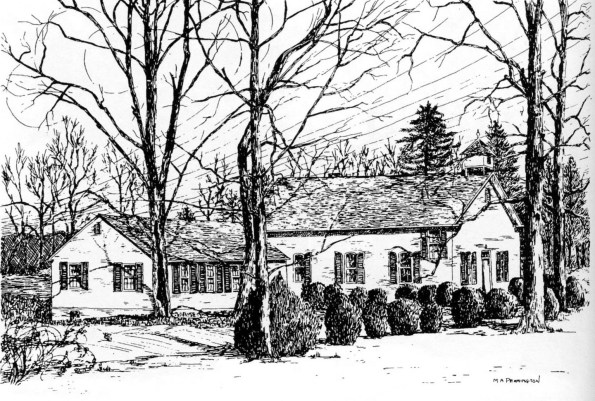 Arvon Presbyterian Church, Courtesy Historic Buckingham
Threats of Lynching
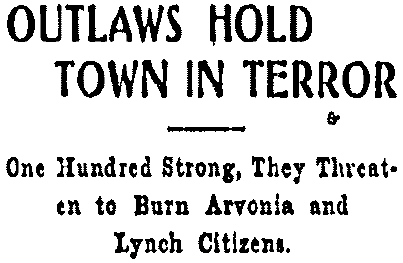
Anonymous letters, as well as some signed by the Buckingham outlaws, threatened to lynch the citizens of Arvonia and burn the town to the ground, resulting in panic. The Daily Press called one letter “vengeful” and “cheaply melodramatic.”
Governor Swanson was unable to respond immediately to the appeal for protection from the citizens of Arvonia, who lacked confidence in the local officials to act quickly and decisively. Women and children were removed to a safe place and, on September 29, 1908, a cordon of citizens surrounded the town. Only newspaper correspondents dared to enter Arvonia.
Town leaders took matters into their own hands, held a meeting, and planned a raid on the outlaws. Rev. Plummer F. Jones, the minister at Arvon Presbyterian Church, was an instigator and willing member of the self-designated posse. “I could kill any one of them without a pang of conscience,” he told the press. Following the jail break, Jones received direct threats of lynching. He remained in Arvonia, canceling an engagement in New Kent County, which would have required traveling through the area peppered with outlaw sympathizers. The country roads were practically deserted.
According to Richmond’s The Times-Dispatch, fifty citizens secretly joined Rev. Jones, including D. L. Peirce, magistrate and chairman of the vigilante committee, W. G. Edwards, L. A. Bersche, A. L. Pitts, owner of the Pitts slate quarry, William Anderson, O. A. Jeffries, W. L. Evans, and Jeff Johnson (colored) who came forward with the “movements and whereabouts of the outlaws.”
Some in the group, mostly the young and the fearless, wanted to divide into small bands of four or five and impulsively begin the man hunt; however, the “shanties” of the outlaws were scattered in a densely wooded area, covered with fallen pines, dead chestnut trees, and undergrowth. The ivy cliffs provided many hiding places. Some thought, it might take a militia force to oust them. Cooler heads decided to wait and reconvene when Sheriff Williams returned to Arvonia from his home at Diana Mills. The Times-Dispatch painted him as a gallant figure, “ready to take up the gauntlet and lead a posse against the outlaws.”
Coming Next: Jeff Johnson (colored)
Need to catch up? Click here: The Buckingham Outlaws: Part I
Coast-to-Coast News
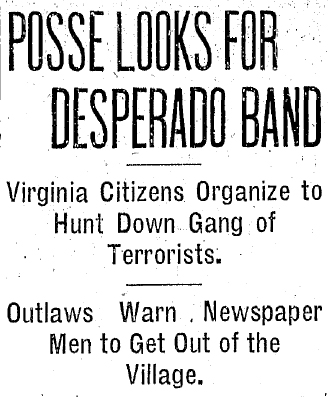
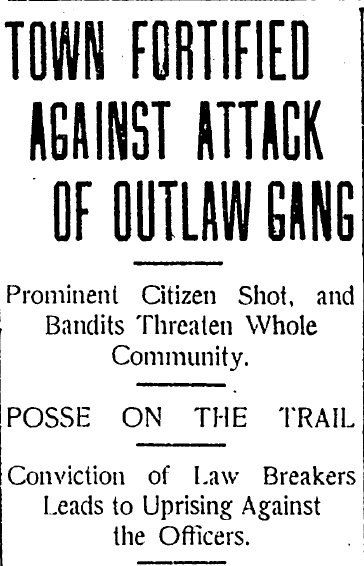
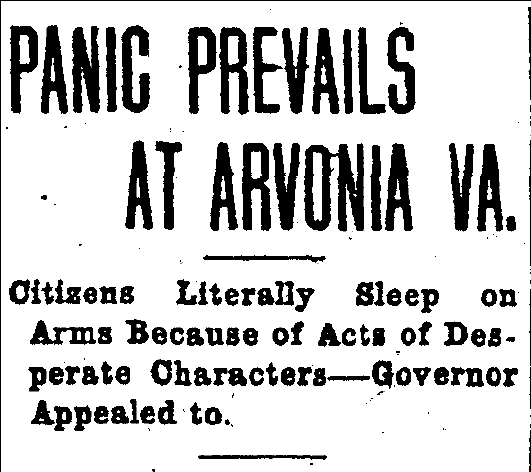
By September 30, 1908, the story of the Buckingham outlaws was coast-to-coast news. Newspapers in Pennsylvania, Boston, Baltimore, Washington, D.C., Georgia, South Carolina, Alabama, Arkansas, Ohio, Illinois, California, and across Virginia carried the story. Dramatic headlines, like the one below, filled front pages:
PANIC PERVAILS AT ARVONIA VA.
Citizens Literally Sleep on Arms Because of Acts of Desperate Characters —
Governor Appealed to.
The reports varied in detail, mostly in terms of emphasis. What follows is a composite of the story.
Commonwealth’s Attorney Edmund W. Hubard and Sheriff Lewis W. Williams spent two days conferring in Arvonia. The sheriff was expected to resume his search for the men on October 1st. “Spies” for the outlaws were hiding everywhere, “ready to warn the desperadoes.” As many as 100 relatives and connections were prepared to defend the gang, including wives and “other women folk.” The core gang was said to now have seven members. According to The Denver Post, Samuel and William Zimmerman of Albemarle County had joined the outlaws. William went to Buckingham County by way of Payne’s Station, dispatching provisions sufficient for a long siege. Allegedly, “Sam” and “Will” also brought “pockets full of guns.”
Mrs. Arthur Zimmerman and a Miss Burton were arrested as accessories to the shooting of N. M. Gregory. They were tried before Justice D. L. Peirce who dismissed the women for lack of evidence against them.
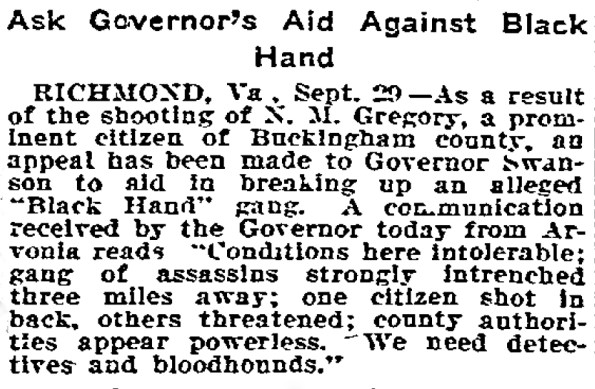
The citizens of Arvonia appealed to Governor Swanson stating:
Conditions here intolerable. Gang of assassins strongly entrenched three miles away. One citizen shot in the back; others threatened; county authorities appear powerless. We need detectives and bloodhounds. Can you come up?
The Governor wired back:
Will correspond with authorities if within my power to correct conditions in Buckingham, and will answer all demands within power.
The language used in Richmond’s The News Leader was a bit more melodramatic than The Times-Dispatch:
This veritable reign of terror which was brought to a startling climax Saturday with the sensational shooting of Gregory increased in its agonies each day and unless some decided step is taken it seems more than probable that the people will leave their homes and seek safety in other sections.
Coming Next: Threats of Lynching
Need to catch up? Click here: The Buckingham Outlaws: Part I


 slate river ramblings . . . .