

Diana Mills, Courtesy The Daily Progress
As the result of a Buckingham County chancery case, Diana Mills was put up for auction in 1867. Part-owner, Elbridge G. Jefferson, grandson of Randolph Jefferson, had died intestate on September 10, 1865, leaving his estate in the hands of the court. The following advertisement appeared in the Scottsville Register on November 2, 1867.
Commissioner’s Sale of Valuable Mills, Dwellings, Store-houses, and 175 Acres land attached.
As Commissioner, appointed by a decree of the Circuit Court of Buckingham, entered at the September (1867) term, in the case of Jones & Dunkam, vs Jefferson and others, I shall proceed to sell at Public Auction, on the premises, on THURSDAY, the 14th day of November, 1867 that very desirable property known as “DIANA MILLS,” situated on Slate River, in the county of Buckingham, together with the dwellings, store-houses and land thereto attached, or belonging.
The MILL is in good order, having been recently refitted for manufacturing flour – has two pairs of burrs, a never-failing supply of water, and is located in a fine wheat and corn section, being one of the best and most profitable mills in the country. This is also a good location for a country store – formerly sustained two – both of which store-houses are in good repair.
There are also two neat and comfortable dwellings on the premises. This property will be sold all together, or in such parcels as may be deemed most judicious.
TERMS:
A credit of six, twelve, and eighteen months, of equal instalments of the purchase money. Bonds, with good security, will be required of the purchaser, and the title retained until all the purchase money is paid, and a conveyance ordered by the Court.
Address me at Diana Mills, Buckingham county, Virginia.
GEO. CHAMBERS, Comm’r.
October 16th, ’67
~
Click here for more about Diana Mills. 
Want to learn more about Randolph Jefferson and his family? Explore: The Jefferson Brothers.

The attempt to sell the Buckingham Iron Manufacturing Company in December of 1840 apparently failed to take place or an acceptable bid was not offered. In January of 1841, another advertisement appeared in the Richmond newspapers. This time, George H. Matthews, Trustee proposed the sale for February 4th at Bear Garden Furnace and itemized some of the additional property associated with the operation: “36 mules and horses, 6 waggons, and several carts, all the implements of every description, a large quantity of mould boards and other castings. Also about 100 Tons Pig Metal, and a large number of Patterns, &c.”
Something or somebody again stopped the sale. In July of 1841, Edward W. Sims, President of Buckingham Iron Manufacturing Company, ran this notice in the Richmond newspapers:
TO THE SOCKHOLDERS OF THE BUCKINGHAM IRON MANUFACTURING COMPANY.
A MEETING of the above Company will take place at the Office of the Company, on THURSDAY, the 22nd July instant. The peculiar state of affairs of this Company makes it very important that there should be a full meeting.
Eventually, the Buckingham County Chancery Case, Robert O. Dueson [?] and others vs The Buckingham Iron Manufacturing Company and others, kept the sale of this valuable property in limbo for years. The Court judged that the company’s many debts be met and demanded an accounting from George H. Mathews, Trustee. The Court also inquired as to whether or not the property should be sold altogether or in parcels. Indeed, during the 1840s, two parcels were sold.
Sixteen years later, in December of 1857, the Buckingham Iron Manufacturing Company was once again on the auction block. By then, Edward W. Sims had removed to Ca Ira, Cumberland County, where he operated a store.
In 1860, Samuel Williams bought 3,504 acres once owned by Sims and the Buckingham Iron Manufacturing Company. It was described as being on Phelps Creek, at Bear Garden Furnace, 25 miles northeast of the courthouse.
By 1870, Edward Sims and his family were living in Missouri, far from the financial mess he had helped create in Buckingham County.
What was the “peculiar state of affairs” which surrounded the sale of the company?
How did Samuel Williams use the land?
If a Slate River Ramblings reader knows more about these complications concerning the Buckingham Iron Manufacturing Company, please comment.

1840 Census, Buckingham County Northern District (click to enlarge)
During the 19th century, while most of Buckingham County was occupied with agriculture, there were also slate and gold mines, as well as the manufacturing of iron in the northeastern corner of the county. One of the Buckingham’s busiest industrial developers was Edward W. Sims. The formation of the Buckingham Iron Manufacturing Company was likely Sims’ largest undertaking. Additionally, during 1828-1830, Sims and Thomas B. Crenshaw purchased Virginia Mills from Walter L. Fontaine. Ultimately, Sims settled in Buckingham County on a farm with the unusual name of Hornblende.

Washington Iron Works in Franklin County Virginia, c.1770–1850. Courtesy Marmaduke Percy, Wikipedia
The 1840 census enumerates the “Buckingham Iron Company” among the heads of households, locating it four households from the home of Edward Sims. The company included 1 male under 5-years-old; 1 male 15-20; 4 males 20-30; 1 male 30-40; 1 male 50-60; 1 female 20-30; and 3 men, free persons of color, aged 24-35-years-old. All of the slaves enumerated with the company were male. There were 32 men age 24-under 36 and another 6 were 36-under 55. This was a large operation!
~
Eventually, Sims became financially overextended and, by the end of 1840, the Buckingham Iron Manufacturing Company was up for sale to cover debts.
The Richmond Enquirer reported:
SALE OF VALUABLE IRON PROPERTY IN BUCKINGHAM.
By virtue of a Deed of Trust executed to the undersigned by the Buckingham Iron Manufacturing Company, bearing the date on the 24th day of November, 1840, and duly recorded in the Clerk’s Office of Buckingham County, for the purpose of securing sundry debts to Edward W. Sims, &c. I will proceed to sell to the highest bidder, for ready money, at the Furnace of said Company, in the County of Buckingham, on Friday, the 18th day of December next, if fair, if not the next fair day thereafter, Sunday’s excepted, the whole of the Lands owned by the Company, containing, as supposed 3500 acres, with all its appurtenances thereto belong. This property lies in the lower end of Buckingham, and within a mile of the James River & Kanawha Canal. About one half of the land has been chopped over – the remainder is well wooded. — The fund of Ore is believed to be inexhaustible and near to the Furnace. Every necessary building has been erected for the prosecution of a large business. The Stock and Casting house is believed to be the best in the State. Considering its proximity to market – the abundance of Ore and fuel – the superior roads leading to the Furnace, and other advantages, it is believed that no other property in the State offers such inducements to capitalists to invest their money. Such title as is vested in me will be conveyed to the purchaser.
GEO. H. MATHEWS, Trustee.
Coming Next: Buckingham Iron Manufacturing Company

The holidays will be here before we know it. Give the gift of local history.
Here’s where you can purchase these books (and many others) about Buckingham County and Virginia:
~
In Virginia
Buckingham: Housewright Museum (U.S. Route 60, in the village of Buckingham)
Buckingham: Nancy’s Gift Shop (U.S. Route 60, in the village of Buckingham)
Scottsville: Baine’s Books and Coffee (485 Valley Street)
Monticello: Monticello’s Gift Shop [The Jefferson Brothers]
Charlottesville: Michie Tavern General Store [The Jefferson Brothers]
Charlottesville: Albemarle Charlottesville Historical Society (200 Second Street, NE)
Appomattox: Baine’s Books and Coffee (205 Main Street)
Richmond: The Library of Virginia: The Virginia Shop (800 East Broad Street)
Not in Virginia? Shop online at:
Albemarle Charlottesville Historical Society
Library of Virginia: The Virginia Shop

During the summer of 1903, while Buckingham County’s Marshall District fought to settle the saloon question, other Buckingham citizens were busy making fruit brandies.
On August 19, 1903, The Times-Dispatch reported:
Mr. Charles Gee, an officer of the United States Government, passed through this section visiting the brandy distilleries last week. He found one man who was not ready for him; was not looking for him, in fact, didn’t want to see him, as he had no license to distill, although, it is said, he had about 100 gallons of “low wines” and a great many apples he had bought at 23 cents per bushel. The officer made the distiller take the cap off the still and forbid him to proceed any further, and it is said the man will be proceeded against as an illicit distiller. There are three distilleries within a radius of five miles, and if the revenue officers do not bother them too much they will make a big lot of brandy.
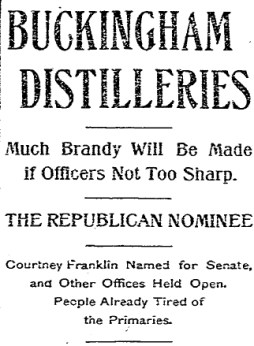
It takes four bushels of summer apples to make a gallon of brandy and these cost 92 cents, the tax on a gallon of brandy is $1, and by wholesale it does not sell for more than $1.50 per gallon, so it may be readily seen that no one can pay a tax on all they make, and as a usual thing the revenue officers have been very lenient with the brandy men here.
Do the math.
With or without saloons, legal or illegal, there was plenty of alcohol to be had in Buckingham County!

Buckingham Courthouse, Courtesy Historic Buckingham
Court Days, 1903
On August 11, 1903, Aubrey E. Strode and Judge Alexander Hall (for the drys) faced Commonwealth’s Attorney Edmund W. Hubard (for “the whiskey men”) at Buckingham Courthouse.
According to The Times-Dispatch: “The case did not come up on its merits, the court reserving his decision until next time, whether or not he had jurisdiction.”
This continuance did not bode well for the temperance movement.
On October 15, 1903, a comparatively quiet headline ran in The Times-Dispatch: “Decided for Wets.” The article noted that Judge John R. Moss heard the case in Buckingham County.
The appellees principal point in the contest was the excluding of some non-resident voters, but they so clearly established their eligibility that the case was decided in favor of the wets.
The court decided that the contested votes had been legal, though the voters were not currently residing in Marshall District.
Thus the anti-saloon fight in Arvonia and New Canton ended with a whimper.
The victory for the wets, however, was short lived. In April of 1904, Judge Hundley declined a liquor license for Marshall District, leaving only saloon In Buckingham County at Warren Ferry. This decision would set the stage for the increased sale of illegal alcohol and the rise of crime associated with it.
Meanwhile, another Buckingham County liquor story was brewing.
Coming next: Buckingham County Distillery
Need to catch up? Click here: The Whiskey Wars, Part I
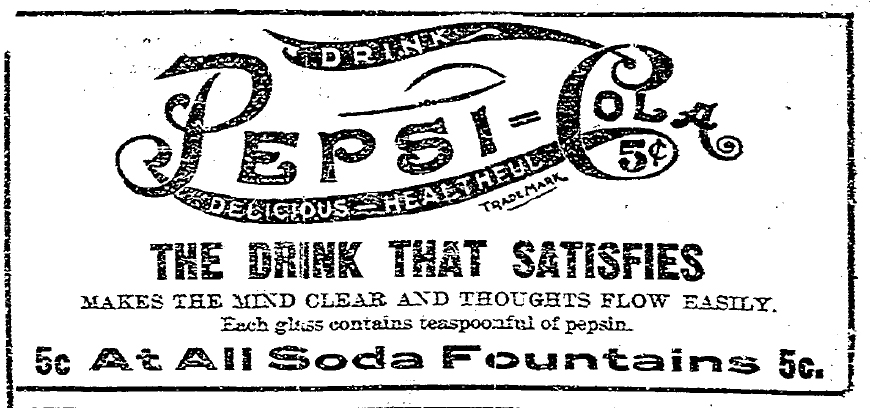

Illegal Ballots!
On July 21, 1903, The Times-Dispatch reported on post-election excitement in Buckingham County:
. . . The election, instead of allaying, only intensified the excitement in the district, and especially in the towns of Arvon and New Canton. The fight against liquor is the sole topic of conversation upon the streets, the highways and the farms, and it is certain that on August 10th, when the case comes before the County Court, there will be present one of the largest crowds that ever went from this section of the county.
Both sides have employed able counsel and both sides are strengthening their lines.

The drys claim that there were many illegal votes cast for the wets, and that there was much irregularity and the fact that all of the judges at the New Canton Precinct were “wet” men seems to strengthen their cause.
The church people and the leading business people – such as the quarry operators, merchants and physicians – are will nigh unanimously working for local option. On election day the town of Arvon cast only 6 or 8 wet votes, the quarry people being almost unanimous against the sale of liquor here. The negro vote was cast, with a few sporadic exceptions, in favor of liquor.
Last week, when the question of contest was being agitated, the excitement became intense and Saturday at New Canton two or three dangerous rows were narrowly averted. At present the result of the fight cannot be seen, but the advocates of local option insist that the fight will never be given up until every bar in the county is closed.
There never was anything “peaceful” about the temperance movement!
Coming next: Court Days, 1903
Need to catch up? Click here: The Whiskey Wars, Part I

Marshall District Votes
The wets won in Marshall District by three votes and it was front page news in the July 12th issue of Richmond’s Times-Dispatch:
WHISKEY WINS IN BUCKINGHAM
The Wets Carry Marshall District by Three Majority.
A Great Surprise.
The short, but dramatic, notice reminded readers that there were two precincts in the district – New Canton and Gold Hill.
Buckingham County citizens were indeed surprised and on July 17th the newspaper updated the story: “The whiskey men carried the election in New Canton District, but the election is being contested on the grounds that some voted who had not right to do so.”
Littleberry Lesueur was celebrating. Would there be an investigation of the new registration process based on the revised Virginia Constitution?
Coming next: Illegal Ballots!
Need to catch up? Click here: The Whiskey Wars, Part I

Arvon Presbyterian Church, Courtesy Historic Buckingham
From the Pulpit
It is not surprising that the ministers of Buckingham County took a stand on the saloon issue.
The July 3, 1903 issue of The Times-Dispatch reported:
Mr. West (Anti-Saloon League of Virginia) made his last speech at Mt. Zion Baptist Church, near New Canton, last night to a large audience. He left this morning for Richmond.
Rev. James E. Cook, of Richmond, will preach each night during next week in the Arvon Presbyterian Church, of which Mr. Plummer F. Jones is [away] for the summer. Mr. Jones will preach Sunday, July 5th, in the Howardsville Presbyterian Church in Albemarle county. He also has charge of the Scottsville Presbyterian Church and of old Trinity Church in New Canton, formerly one of the strongest church organizations in the county.

How inconvenient that the popular and influential Rev. Plummer F. Jones was not in Buckingham County immediately preceding the vote in Marshal District.
In 1908, Jones published Shamrock-Land, A Ramble Through Ireland, which was well-received in the Union Seminary Magazine. Reviewer Thomas C. Johnson called it “a highly interesting and fascinating book.” In the 1910s, Rev. Jones and his wife lived at the Arvonia Inn, owned by temperance supporter A.L. Pitts.
Coming next: Marshall District Votes
Need to catch up?
Click here: The Whiskey Wars, Part I
Remember the Ladies!
Interest was growing in Buckingham County’s fight against saloons.
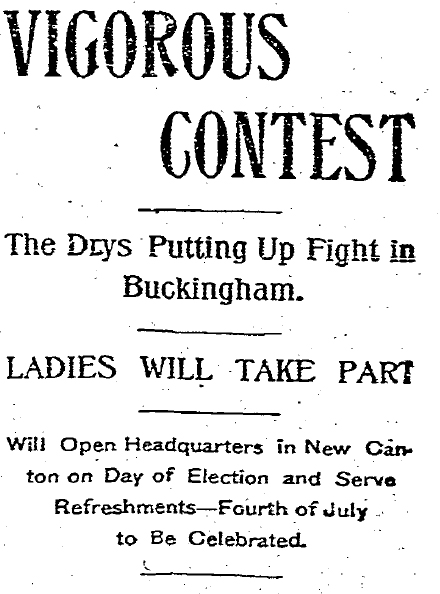
In mid-June of 1903, Professor S. C. Mitchell, the president of Virginia’s Anti-Saloon League, delivered “a fine address to an enthusiastic audience” in Arvonia’s Williams’ Hall. Mitchell was introduced by Rev. Plummer Jones of Arvon Presbyterian Church. This address launched a series. The Buckingham County anti-salooners were bringing in the big guns and the headlines in Richmond’s Times-Dispatch were getting larger. On July 3, 1903, the newspaper announced:
VIGOROUS CONTEST
The Drys Putting Up Fight in Buckingham.
Ladies Will Take Part
Open Headquarters in New Canton on Day of Election and Serve Refreshments –
Fourth of July to Be Celebrated.
. . . Mr. J.W. West, field secretary of the Anti-Saloon League of Virginia, has been in the district a week, speaking in churches, halls and on roadsides to large audiences of people, and has so enthused the temperance element that they claim certain victory on July 11th, when the election takes place.
On election day the young ladies of Arvonia, belonging principally to the Presbyterian and Baptist churches, will go to New Canton, the voting precinct, in a body, floating a banner and wearing streamer anti-saloon badges. They have secured a house and ground on the principal street in New Canton, and will there serve refreshments, such as ice cream, fruits, coffee, etc. to the friends of the temperance movement. It is understood that the ladies at Gold Hill, the other voting precinct, will proceed along similar lines.
The ladies of Buckingham County may not have secured the vote; however, they knew they were not without influence. Especially the pretty young ladies of Arvonia!
Coming next: From the Pulpit
Need to catch up? Click here: The Whiskey Wars, Part I


 slate river ramblings . . . .