
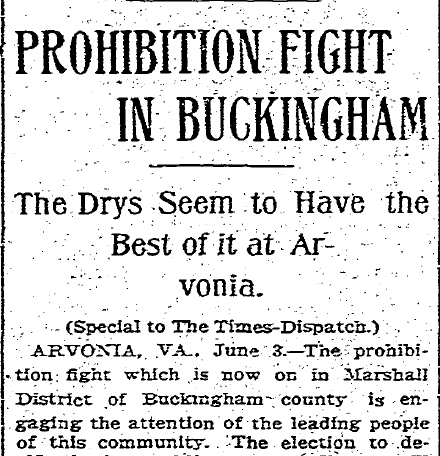
Marshall District Votes
By June of 1903, Marshall District, which included the towns of Arvonia and New Canton, was bracing for the election which was to determine whether or not licenses to sell liquor in the district would be renewed. On June 5, 1903, Richmond’s The Times-Dispatch reported:
There are two flourishing bars in the district, one in this town (Arvonia) and the other in New Canton, three miles north of here. Before the passage of the Mann (liquor) bill there were four saloons in the district.
Most of the business men and quarry operators of this town are active in behalf of prohibition on the grounds that the bars are detrimental to their business interests. So far, the issue is in doubt, both sides claiming that they will win. If the district goes dry there will remain only one wet district in Buckingham county and that one has only one small saloon.

It is not hard to imagine that quarry workers in the northeastern corner of Buckingham enjoyed a drink, or two, after a hard day’s work, especially on pay day. Was public drunkenness an ongoing problem?
Maysville was now dry, preceded by the James River, Francisco, and Curdsville Districts. Slate River District remained “wet.”
Buckingham County was not alone in its concern about the public consumption of liquor. During 1903, wets vs. drys in Lynchburg, Roanoke, Danville, and Blackstone were also in the news. Headlines like “Saloon Keepers in Newport News Raise a Protest,” kept the argument lively.
Coming next: Remember the Ladies!
Need to catch up? Click here: The Whiskey Wars, Part I

Slate Quarry Workers in Arvonia, Buckingham County. Courtesy Robert Jeffery
A Majority of One
On April 29, 1903, The Times-Dispatch printed a rather cryptic report under the headline “License in Buckingham.”
The previous Friday, the Marshall District drys and wets had descended on Buckingham Courthouse, bringing several petitions in front of Judge Moss. Mr. A. L. Pitts, accompanied by Mr. Wiley Wooton and their counsel, Judge Alexander S. Hall, who represented the drys.

The wets were there in force, as well. Mr. Littleberry Lesueur, liquor dealer, “with nine of his patrons as witnesses, fought for the wets.” According to the 1900 census, Littleberry Lesueur, Sr. ran a general store and his son, Littleberry, Jr., was a liquor dealer. Littleberry, Sr. appeared to be a stable family man. That year he had been married to his wife, Henrietta, for thirty-two years. Five of their children, including Littleberry, Jr., still lived at home.
The article went on to state that the wets won by a majority of one vote.
It seems likely that this court appearance was at least in part a response to the “Mann Bill” which was being debated that month in the General Assembly and, once adopted, would require applicants for liquor licenses in Virginia’s rural areas to secure signatures of a majority of voters in their district. Its ultimate adoption resulted in the closing of saloons in 70 of Virginia’s 100 counties. Temperance was on the rise!
Judge Moss, who apparently anticipated considerable celebrating in Arvonia, appointed Mr. Lesueur a “special policeman” over his own barroom.
It would not be long before the saloon issue would be taken to the polls in Marshall District.
Coming Next: Marshall District Votes
Need to catch up? Click here: The Whiskey Wars, Part I

On April 21, 1903, this enthusiastic, four-column-wide advertisement for Budweiser beer ran on the same page as the very small mention of Buckingham County’s “fierce” war on temperance. The Times-Dispatch knew what lined its pockets – ads for alcohol.
Marshall District: Wet or Dry?
Following the vote in Maysville District and the triumph of the “drys,” the men (and women) of Marshall District prepared for a serious contest. On April 21, 1903, Richmond’s The Times-Dispatch, announced the coming conflict:
Drys and Wets in Arvonia.
ARVONIA, VA. April 20 – A fierce war is raging in Arvonia between the drys and the wets. The former, under the direction of Mr. A. L. Pitts, are busy with their petition seeking the signatures of the voters of Marshall District to enable them to fight for the cause of temperance, while the latter, under the leadership of Messrs. L. B. Lesueur, White and Trent, saloon-keepers in this section, are busy canvassing in opposition to the drys’ petition.
The several petitions will be presented to Judge Moss at Buckingham Courthouse Friday for his decision. The anti-saloonists have secured the services of Mr. Aubrey Strode, and a great legal battle is predicated.
Mr. A. L. Pitts was the proprietor of The Arvonia Inn. Was he a teetotaler? Or did he just want the saloons closed?
In a few years, Aubrey S. Strode would be one of the defense attorneys in the cases concerning the murders of the Stewart brothers.
Click here if you missed last summer’s true-crime story: “The 1909 Buckingham Murders”
Coming Next: A Majority of One
Need to catch up? Click here: The Whiskey Wars, Part I
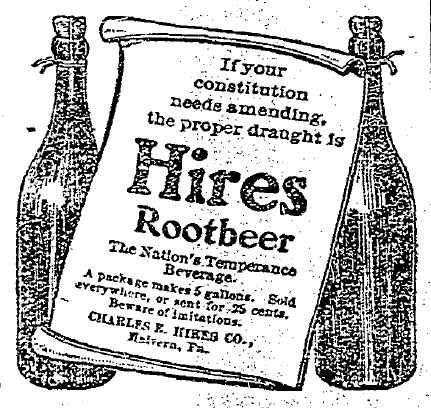
Coincidentally, this advertisement for Hires Rootbeer ran under the news article.
The Votes Are In
On April 14, 1903, buried on page four, The Times-Dispatch ran the following:
Drys Win in Buckingham.
Mount Vinco, VA, April 12 – There was an election on last Saturday in the Courthouse District between the wets and the drys. One hundred and seventy votes were cast, and the drys won by a vote of two to one. Every registered voter in the district answered to his name except ten. Before the present suffrage law was adopted the usual number of votes was over 300.
This lower turnout was primarily due to the new requirements for voting which made it difficult for Blacks and working class Whites to register to vote. The doctors, lawyers, and ministers in the Maysville district would have had much less trouble providing the new poll tax of $1.50 and meeting the literacy requirements.
For more about Virginia’s suffrage law in 1903: “Virginia Constitutional Convention (1901–1902),” Encyclopedia Virginia.
Despite the low turnout, this was a decisive vote, to be sure.
Marshall District was up next in the fight to close saloons in Buckingham County.
Coming Next: Marshall District: Wet or Dry?
Need to catch up? Click here: The Whiskey Wars, Part I
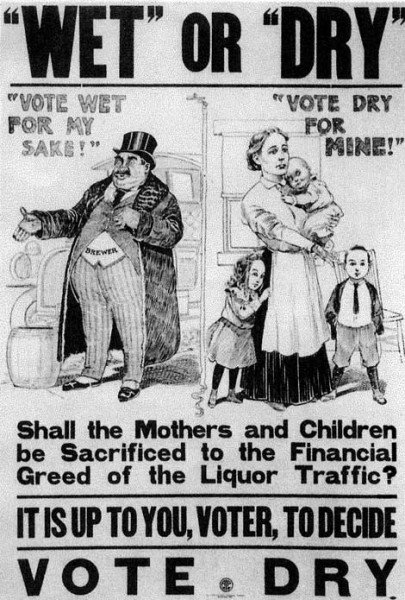
In 1920, the Volstead Act prohibited the production and sale of alcohol across the United States. Many years earlier, however, a significant number of citizens of Buckingham County were in favor of going “dry”—following a national trend towards temperance.
On March 19, 1903, Richmond’s The Times-Dispatch mentioned that on April 11th, Maysville District in Buckingham County, which included Buckingham’s courthouse and the town of Maysville, would hold an election to “decide whether or not liquor will be sold here after the expiration of the licenses now held by the saloon-keepers here, and the whiskey men say they will make a fight if the temperance people do.”
The newspaper punctuated the notice, commenting: “More clear money has been made in the business here than most any other, and they are loath to give it up.”
One of the whiskey men in Maysville was Nathaniel M. Saunders. In 1900, he was about thirty-three years old, single, and living alone. His occupation, as stated on the census, was “Barkeeper.” His immediate neighbors included a doctor, a lawyer, a hotelkeeper, a deputy sheriff, and a minister. How would they vote in the upcoming election? At the very least the doctor, deputy sheriff, and minister had professional reasons for controlling the abuse of alcohol.
Coming next: “The Votes Are In”
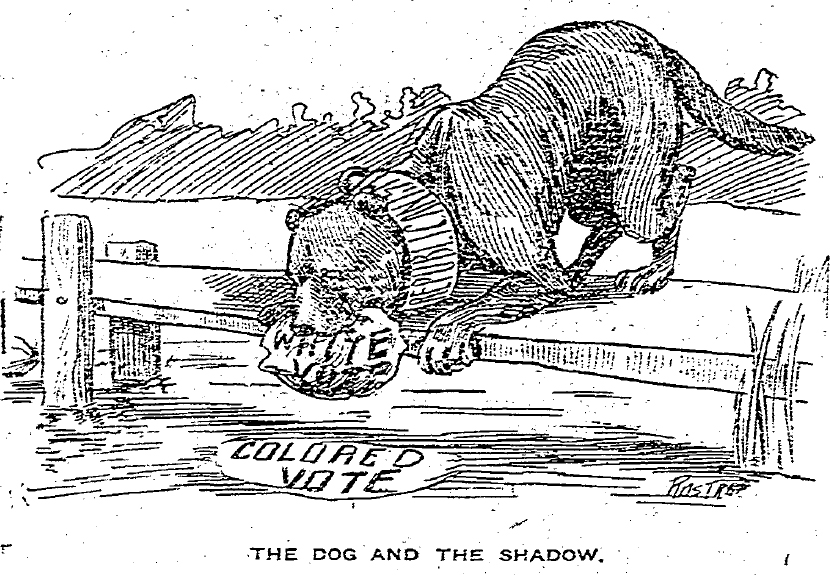
Political Cartoon (1904), Courtesy The Times-Dispatch
In March of 1903, Senator Frank C. Moon, of Lynchburg and Snowden in Buckingham County, was mentioned in the Richmond newspapers in connection with the heavily disputed suffrage law which was to become part of the new Virginia Constitution. The Times-Dispatch covered the story:
WANT SUFFRAGE CLAUSE AMENDED
Senator Moon to Offer Bill Making Temporary Clause Permanent.
Senator Frank C. Moon, of Buckingham, will offer in the Senate to-day an amendment to the Constitution, making material changes in the suffrage ordinance, and the outcome of the battle over its adoption is looked forward to with great interest, as it will bring up in the General Assembly the very questions which kept the Suffrage Committee of the convention divided for many months.
The amendment, which is understood to be the result of a conference here between Congressman Flood and a number of legislators, will propose to abolish the permanent understanding clause and make the temporary one permanent.
This does not interfere in any way with the poll tax feature, but will make the qualifications for registration for all time as follows:
Soldier, son of a soldier, property ownership or educational qualifications.
The proposed amendment will no doubt cause a great fight in the Legislature.
Congressman Flood, who had just come from a conference on the subject made the announcement to a representative of The Times-Dispatch. He said he was glad the question would be brought up and that the amendment set forth the views of himself and the majority of the Suffrage Committee, who struggled so hard for the principle in the convention last year.
The amendment, if adopted, will place broad powers in the hands of the registrars, and leave them in the position they now occupy with reference to the voters.
The poll tax and “understanding clause” not only succeeded in disenfranchising many African-Americans but also excluded illiterate and poor Whites from voting. According to Encyclopedia Virginia:
In the end, the constitution that emerged from these debates placed severe new restrictions on voter eligibility. It required payment of a $1.50 poll tax, to be paid six months in advance of any election. Not only that, but the law stipulated that payment be up-to-date for the previous three years. The double-vote plan was rejected, but the convention did adopt the understanding clause, making it a temporary measure for the years 1903 and 1904. In order to avoid the appearance of discrimination against poor whites, the convention also elected to choose the registrars who would enforce voter laws during the first two years following the implementation of the constitution. An additional law that took effect after 1903 required a written application for registration, completed without assistance. Finally, all Civil War veterans, North and South, and their sons were exempted from all of the above requirements.
These changes in Virginia suffrage laws would have a long and lasting impact not only on individual voters but also on the results of local initiatives, including the subject of the next serial to be featured at Slate River Ramblings.
Coming next: The Buckingham Whiskey Wars
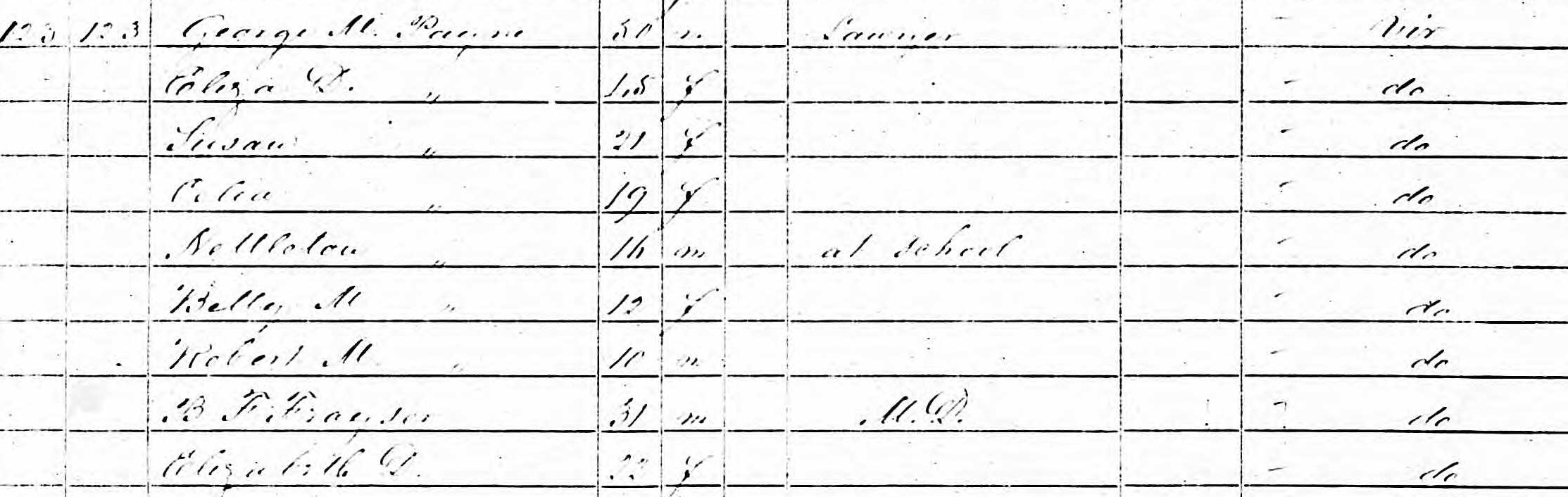
1850 Census, Marion County, Florida
Click Image to Enlarge
George M. Payne, upon leaving Buckingham County for the South, responded to his friends of the Buckingham bar:
Buckingham Ct. House, Oct. 11, 1847.
Gentlemen – I have this moment received your favor communicating to me a copy of the proceedings of a meeting of the members of the Court and Bar of this county, held this day.
My will prompts not the coming separation to which your letter and the accompanying resolutions refer. In leaving friends endeared by an intercourse frank and unreserved, through a long term of years, I sever ties at the bidding of stern necessity; and no matter what may be the fortunes that await me, the testimony that I carry with me the sympathy and good wishes of the members of the Court of Buckingham, of my professional brethren, and of all worthy men who know me, will fill with brighter ray even the sunny land to which I go; or if storms visit me there, give me increased strength to bear them….
Your friend,
Geo. M. Payne
What necessity took George M. Payne south to Florida? Health? Relations? Other business?
If a Slate River Ramblings reader knows what became of George M. Payne, Esq., please comment.
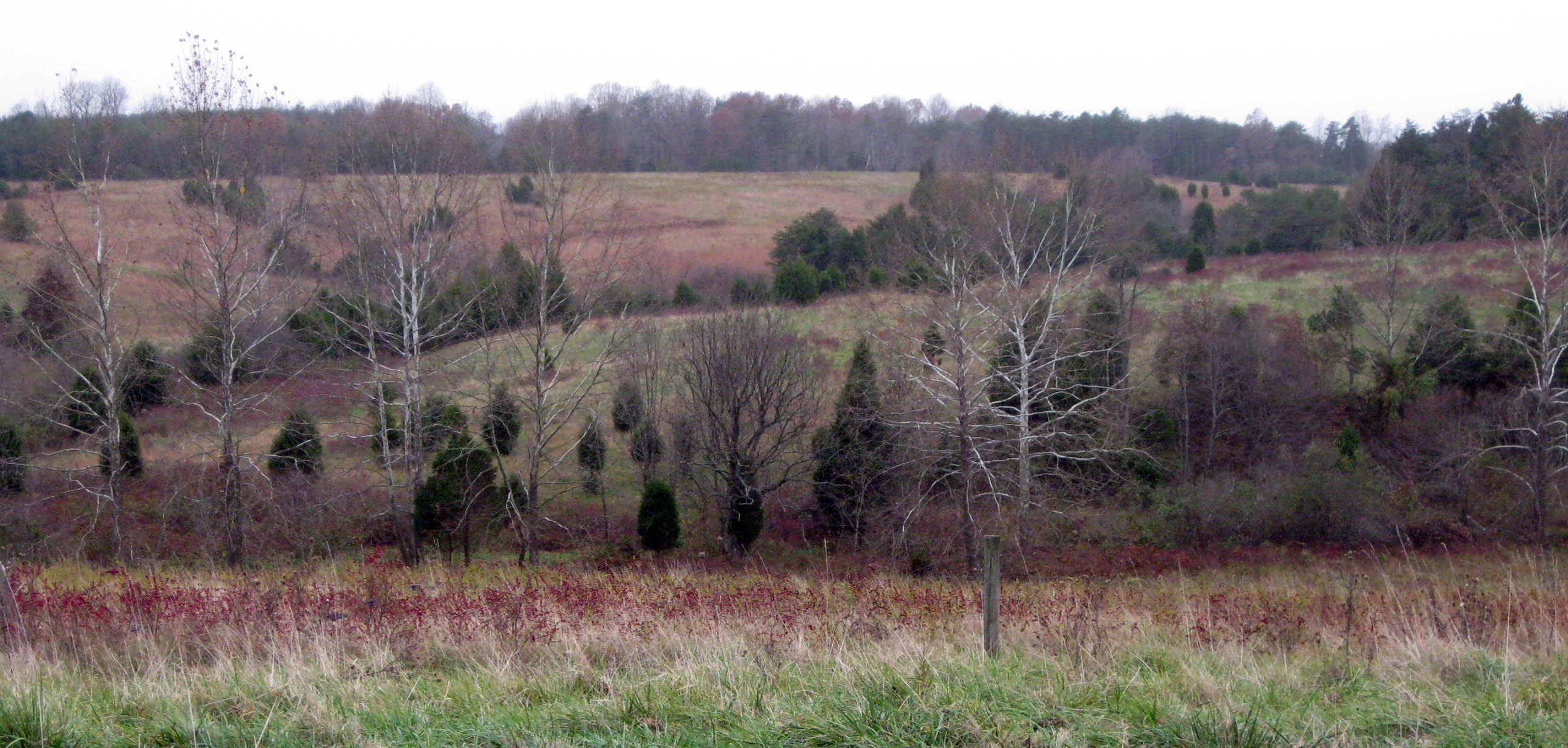
Ridge Above Marrs Creek, Photo by Joanne Yeck
In 1847, my ancestor, John M. Harris, and his brother, James Harris, purchased Ridge Farm on Marrs Creek from George M. Payne, who removed to Marion County, Florida, where he appears on the 1850 census.
There, John M. Harris established East Farm Female Seminary.
On October 11, 1847, at a meeting of attorneys of the Buckingham bar, practicing in the Superior and Inferior Courts of Buckingham County, the men made the following resolution:
WHEREAS, The members of this meeting have learned with deep regret, that their brother lawyer, GEORGE M. PAYNE, Esq. of this county, is about to remove from Virginia to seek a new home in the South; and being unwilling that the ties that have bound them together for so many years in peace and brotherly love shall be dissolved without some manifestation, on their part, of the regret they individually feel on the occasion of separating from one whose worth of character has ever commanded their confidence and esteem, or without tendering to him their hearty good wishes for his prosperity, distinction and happiness on the new theatre which he is about to enter:
Therefore, Resolved, That the members of this meeting will part with George M. Payne, Esq. with deep regret and sorrow.
Their statement went on at length listing complimentary comments from the members of the Buckingham bar and was signed by Payne’s “sincere friends” – Francis N. Watkins, Jno. W. Haskins, and Thos. S. Bocock.
Click here for more about Thomas S. Bocock.
Coming Next: George M. Payne Responds

Buckingham Female Collegiate Institute
Following the Civil War, Buckingham Female Collegiate Institute struggled to maintain enrollment and meet its debt. In 1873, the property was advertised for sale in the Richmond newspapers:
BUCKINGHAM FEMALE COLLEGIATE INSTITUE FOR SALE – As commissioners of the Circuit Court of Buckingham, we are directed to sell the valuable property known as FEMALE COLLEGIATE INSTITUE. We will offer the same for sale APRIL 23d, 1873, at public auction on the premises at 12 M.
TERMS: So much cash as may be necessary to pay expenses of sale and costs of suit, the residue of the purchase money on a credit of one, two and three years, in equal instalments, with interest on each from day of sale. Bonds with good security for deferred payments, and title retained as additional security till further order of the court.
G. B. Hanes & F. D. Irving, Commissioners
Apparently, there was no need to describe the well-known property to prospective buyers.
For more about the first women’s college in Virginia consult, “A Noble Idea,” in “At a Place Called Buckingham.”
Also, enter Buckingham Female Collegiate Institute in the search box at Slate River Ramblings and enjoy the results!

Virginia Mills Ruins, Photo by Joanne Yeck
Grist mills are among the most popular posts at Slate River Ramblings. Readers often regret that so few mills remain standing in Buckingham County. Time and flood waters have washed the majority of mills away, including this one reported in Richmond’s The Times-Dispatch on August 8, 1903:
CENTURY-OLD MILL
DAMAGED BY FLOOD
ARVONIA, VA., August 7. – The heavy rains cause one side of the valuable mill property of Mr. Hampden Nicholas to fall thereby causing great loss of property and time.
This mill is over one hundred years old and was regarded as the strongest building in the county. It is seven stories high, the first three being solid rock, while the remaining portion is brick and frame. During the progress of its erection, its height and situation, being on the edge of Slate River, caused the workmen to become dizzy, and thus negro women on the plantation were forced to supply mortar and thus relieve those unable to work.
A force of hands has been secured and the debris is being removed, preparatory to the necessary repair.
This is Virginia Mills built by the Nicholas family. Situated near where the Slate River empties into the James River in northern Buckingham County, it served the neighborhood for generations.
According to Richard Nicholas, the story about the dizzy workmen is likely folklore. By 1903, Hampton Bigelow Nicholas had deeded the property to his wife, Willie Sue Nicholas. Hampden Nicholas died in 1909; however, the mills remained in the family until 1914 when Willie Sue deeded the property to E.W. Hubard in trust to secure debts.
Edmund W. Hubard was the Commonweath’s Attorney for Buckingham County.
Click here to learn more about Thomas Jefferson’s visit to Virginia Mills.


 slate river ramblings . . . .