

There are no doubt several Buckingham County plantations, farms, and houses for which the spelling of the name has drifted over the years.
The Library of Congress, for example, holds material about the Bolling family property “Rosney” but locals in Buckingham prefer the spelling Rosny.
Peter Jefferson’s plantation on the James River at the Horseshoe Bend was originally called “Snowdon.” According to Thomas Jefferson, his father named it after their ancestor’s homeland in Wales near Mt. Snowdon. In 1776, when Randolph Jefferson took over the plantation, he and others spelled it “Snowden” and it was known as such throughout the 19th century when it was owned by various members of the Harris and Moon families. In the 20th century, new owners reverted to Peter Jefferson’s spelling, Snowdon. For more about Snowden’s history, see The Jefferson Brothers.
Bellmont, featured in “At a Place Called Buckingham” – Volume Two, was established by David and Judith (Cary) Bell in the mid-18th century. It makes sense that the original spelling reflected the Bell surname. Over the decades, however, one “l” was dropped and it became known as Belmont.
Can Slate River Ramblings readers offer other examples? If so, please comment.

I’m delighted to announce that the current issue of Broadside, The Library of Virginia’s quarterly bulletin, includes my article, “Treasure Trove: Virginia Chronicle newspaper database holds key to hidden Buckingham County history.”
Click here to download a PDF: Broadside (Winter 2015)
Click here for more about The Virginia Newspaper Project, Virginia Chronicle, and the blog, Fit to Print.

Rose Hill, circa late 1940s
Photo by Kenneth Madison McDonald, Courtesy Rosemary Holdredge
In the 19th century, it was rare for the Richmond newspapers to run a lengthy obituary for a citizen of Buckingham County. James Malone, though he was not a native of the county, was one of those exceptions. The following ran in the Richmond Whig on April 8, 1864:
Died, at his residence, Rose Hill, Buckingham county, Va., on the 25th ult., JAMES MALONE, in the 90th year of his age. A native of the County of Caroline, from whence he removed to Henrico County, A.D. 1816, where he continued to reside until last fall (?) at which time he purchased and removed to his late residence.
He was a man of extraordinary natural capacities, quick and penetrating in his discernment, faithful and just in his transactions of unbounded energy and industry, and during his long and active life accumulated a comfortable competence.
He was for many years a consistent and useful member of “the body of Christ,” untiring in his study of the Scriptures of which he had attained an extraordinary comprehension, and, as a consequence, longed for “the appearing of the Lord Jesus the Christ,” and devoutly wished, as he earnestly prayed, to be permitted to remain awake until his long expected Master and Lord should appear to assume His rightful government over the world. But at last he quietly fell asleep, in hope of a resurrection to immortality and eternal life at the appearing of Him he had so ardently longed to see.
He was highly respected for his many virtues, and will be deeply lamented by his numerous circle of friends in this vicinity.
G.B.S., Richmond, Va.
Petersburg papers please copy.
Thanks to Bibb Edwards for sharing this obituary.
Click for more about Rose Hill and the Malone School.
In 1850, a small group of Free Blacks were living in northern Buckingham County, including Isham Stanton, blacksmith, born about 1783.

Click on the image to enlarge.
Following a recent post at Slate River Ramblings concerning the Stanton Family Cemetery, Bob Vernon shared more information, indicating that members of the Stanton family were living in Albemarle and Buckingham counties long before Daniel and Nancy Stanton purchased 46.5 acres of land from H. C. Hill in 1853.
A mulatto woman, Stande/Handle [?] Stanton, is mentioned in the Albemarle County inventory of the Estate of Thomas Phelps (14 November 1751). She was his property.
Buckingham County Personal Property Tax Records reveal the following free Stantons, responsible for their own taxes:
1787: Stanton, Mathew (Mulatto) 1 tithe, 1 horse, 3 cattle
1793: Stanton, Matthew, 1 tithe, 2 horses
1795: Stanton, Matt (Mulatto), 1 tithe, 1 horse
1797: Stanton, Matt (M), Josias Cousins, 2 tithes, 2 horses
1799: Stanton, Matt (M), B. Cousins, 2 tithes, 2 horses
In 1804, a Sonnet [?] Stanton appears on the tax list.
In 1809, Isham Stanton pays tax on himself for the first time.
In 1822, an Isham Stanton is identified as a blacksmith.
In 1825, a Matt Stanton is a “Waterman” and a Jim Stanton appears in the record.
For more information about Free Black families in Buckingham County visit Free African Americans.

Photo by Joanne L. Yeck
If you are in Charlottesville, don’t miss the opportunity to see the current exhibit at the Albemarle Charlottesville Historical Society: Historical Farms of Albemarle County.
While you’re there, check out the selection of books for sale, including the newly released “At a Place Called Buckingham” ~ Volume Two.
Not in Virginia? You can support the Society by shopping online: Society Store
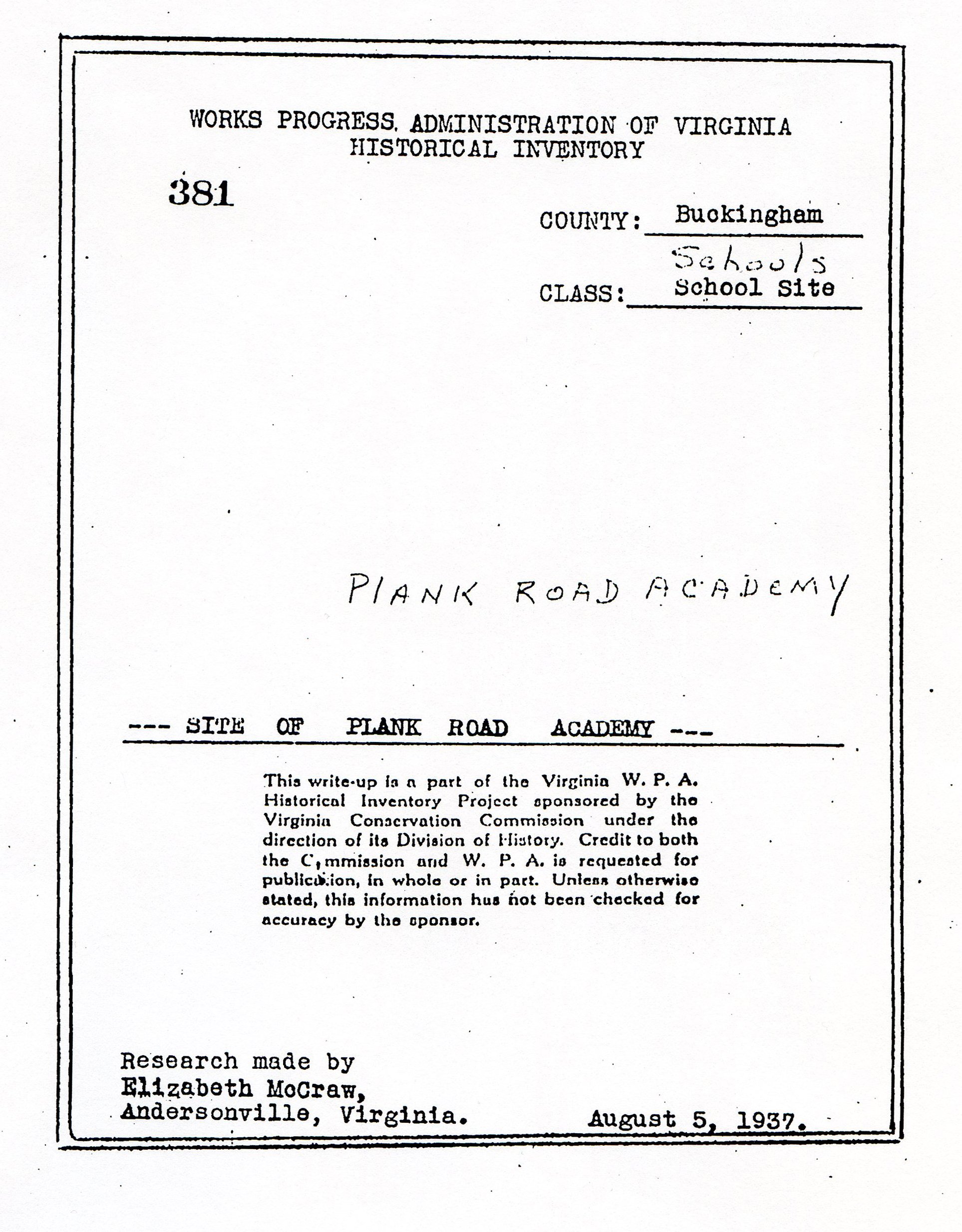
In 1937, Elizabeth McCraw surveyed the site of Plank Road Academy for the Virginia Historical Inventory. Located about a mile north of Andersonville, the one-room building was no longer standing, so Mrs. McCraw interviewed former pupils of Plank Road Academy.
Founded by Mr. Branch Gilliam and operated from about 1850–1865, the schoolroom had benches of slab plank, a few “crude” tables, and a platform which held the teacher’s chair and table. On Fridays, the pupils “proclaimed” from the platform and competed in spelling matches. “There was an ‘Arbor’ where Mr. Gilliam taught the boys,” wrote McCraw. “This arbor, as described by one of the former pupils, now eighty-seven years of age, was built of forked poles and the top covered over with brush. The pupils played in the arbor on rainy days, during recess.”
Mr. Branch Gilliam was known as an excellent teacher and disciplinarian of his day. He always had an assistant teacher, usually a woman for the girls. One former pupil recalled that Grammar, Arithmetic, Dictionary, and Philosophy were taught. Pupils were expected to learn a dictionary page per day, and on Friday, “spell over” the week’s assignment.
“The school had the reputation of being quite a ‘Courting School,’” McCraw charmingly concluded. There were several intermarriages among the students: Inez Anderson and Richard Morgan, Mary Lou Holman and Wiley Jones, as well as Betty Gilliam and Emmett McCraw. Principal Gilliam also fell under the “courting spell,” marrying Miss Nannie Steger, his assistant teacher.

Left to right: Joseph Hill Winfrey Sr., James Benson Tindall, Jr., and Mathias Bolling Winfrey. Courtesy Jeremy Winfrey
When “At a Place Called Buckingham” ~ Volume Two went to press, the man in the middle in this photo was unidentified.
No longer unknown, Tom Schilder and Carolyn Winfrey Keller, daughter of Matt Winfrey, identified him as James Benson Tindall, Jr. (17 October 1915 – 2 July 2009).
For more about ferries in Buckingham County, see “Ferrying across the James River,” in “At a Place Called Buckingham” ~ Volume Two.

The Lomax Family, Courtesy Renée Ingram and Charles W. White Sr.
The Lomax family contributed significantly to the education of African Americans in Buckingham County. In “At a Place Called Buckingham” ~ Volume Two, I wondered about the literacy of both the Lomax and the Palmer family who settled at or near Alexander Hill in the late 1860s. Edward S. Lomax’s obituary offers a partial answer.
DEATH OF E. S. LOMAX
Interesting Narrative of the Career of a Colored Teacher.
Buckingham, Va. Jan 16 – Edward S. Lomax was buried here on Sunday. Lomax was a prominent Negro in this county. He taught for [25?] years in the public schools and up to the time of his death was drawing a pension from the State Teacher’s pension fund. This man was educated in the days of slavery his master having prepared him to act as an amanuensis for him as he was a blind man. The wife of Lomax was also a teacher. Many of his children have taught school, and it is probable this family has earned more money from the public school funds than any negro family in the State. There were ten children, two of whom are doctors, one practicing in Lynchburg.
The Daily Progress, 19 January 1917
Did many slaves assume the role of amanuensis? Did Edward Lomax take dictation for a business man? Was his owner a writer? Did he simply handle the man’s correspondence?
If a Slate River Ramblings reader knows more about the Lomax family, please comment.
Many thanks to Phil James for sharing this important obituary.

If you live in or near Buckingham County, commemorate Gen. Robert E. Lee’s last camp at The Historic Village on April 11, 2015 from 11:00 AM – 4:00 PM.
For more about the fateful ride 150 years ago, see these Slate River Ramblings posts:
Buckingham Tales: Gen. Robert E. Lee
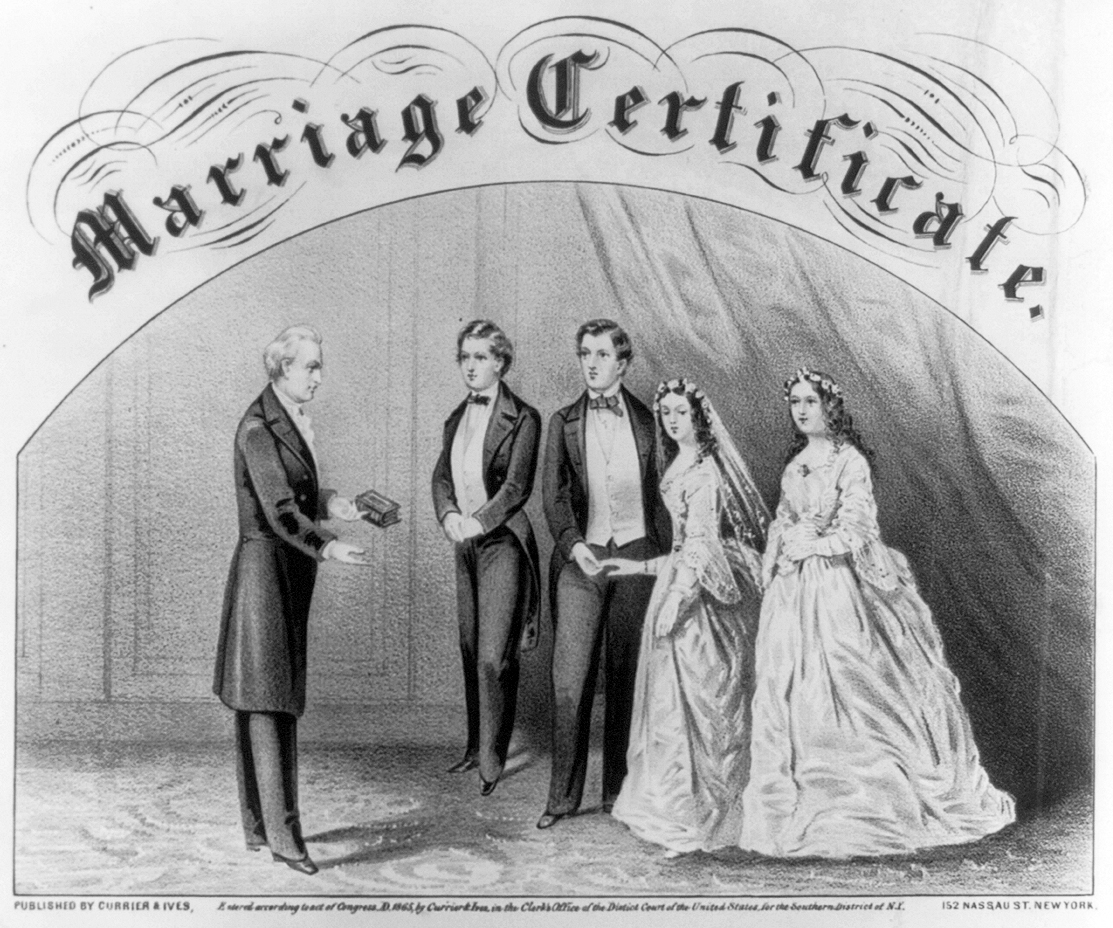
Due to the burning of Buckingham County’s courthouse in 1869, many of the county’s marriage records were lost. Beginning in 1853, duplicates of marriage records were sent to Richmond. These copies survive and are available on microfilm at the Library of Virginia.
Other sources for earlier marriages include the private records of ministers and historic newspapers. Here is a sampling of marriages performed by the popular Methodist minister, Rev. John Ayers. They are included in the Henley Marriage/Obituary Index to Virginia Newspapers at the Library of Virginia.
Married- At Travellers Rest, in Buckingham County, on March 20 (1839), by Rev. Ayres, Josiah Hatcher, of Cartersville, Cumberland County, to Miss Virginia C. Holman, second dau. of William Holeman, dec’d.
Married- On May 20 (1836), by Rev. Ayres, Samuel Hobart, to Miss Margaret Jane Nixon, all of Buckingham County.
Married- On May 19 (1836), at Crab Orchard, Buckingham County, by Rev. John Ayres, Robert H. Ayres, of Highland County, Ohio, to Miss Elizabeth H. Ayres, dau. of Col. John B. Ayres, of Buckingham County.
Married- On Wednesday, Dec. 22 (1830), by Rev. John Ayres, Shelton Roberts, of Nelson County, to Miss Jane M. Moon, of Buckingham County.
Married- On May 26 (1830), by Rev. John Ayres, William Shepherd, to Miss Martha G. Booker, dau. of Bernard Booker, all of Buckingham County.
Married- On Tuesday, August 18 (1829), by Rev. John Ayres, Mr. Robert Patteson, to Miss Margaret Hocker, eldest daughter of Adar Hocker, all of Buckingham county.
Married- On Thursday, December 11 (1828), by Rev. John Ayres, Miles Gipson, to Miss Nancy Saunders, daughter of Edward Saunders, all of Buckingham county.
Married- On Thursday February 13 (1822), by Rev. John Ayres, Schuyler Thomas, to Sabrina Scruggs, only daughter of George Scruggs, all of Buckingham County.
Married- At Cherry Hill, on Tuesday, April 13 (1819), by Rev. John Ayres, Rev. Livingston Walker, to Mrs. Lucy Davis, of Buckingham County.


 slate river ramblings . . . .